My recent wikiwiki
trip to Hawaii reminded me how generational interdependence acknowledges our
common humanity, shared vulnerabilities, and sacrifices to age in place. Hawaii is the most racially/ethnically
diverse state in the nation, perhaps the most affected as an island-state by
risks from climate change (rising sea levels/coastal erosion, coral reef
bleaching, extreme weather) and wisely looking to indigenous kupuna
for solutions.
“Indigenous
communities are key sources of knowledge and understanding on climate change
impacts, responses and adaptation. Their traditional knowledge allows them to
forecast weather patterns, improve agricultural practices and sustainably
manage natural resources. But many of them have been fighting complicated
climate battles – putting their lives and access to ancestral lands at risk.”— “On the frontlines of climate change,” United Nations Sustainable Development Goals
Goal of the Month (July 24, 2019)
Airfares to
Honolulu dropped after the 235th meeting of American Astronomical
Society at Hawaii Convention Center ended, and I arrived afterwards in time for
a two-day Climate Change Conference at University of Hawaii (UH) and Hawaii
Rising at State Capitol’s Opening of the Legislature, both marked by the
resurgence of Native Hawaiian activism based on aloha ‘aina (love of
land).
“The
Hawaiian sovereignty movement has also been about challenging our assumptions
regarding the ways we live with one another by continually asserting a culture
of sharing and interdependency with all of the life around us.” –Jonathan
Osorio, The Value of Hawaii

Ha O Ke Kai 2020 Hawaii Climate Change Conference at UH’s East-West
Conference Center (building designed by late I.M. Pei), opened with Oli
& Mele (chant) by Jon Osorio, UH Dean of Hawaiinuiākea School of Hawaiian Knowledge.
After
graduating from Kamehameha Schools in 1969, he enjoyed an award-winning musical
career (including 1981 Nā Hōkū Hanohano’s song of the year for “Hawaiian
Eyes”), and then reinvented himself as an academic earning his PhD in 1996 (at age
45). Last year, he received a Lifetime Achievement Award by Hawaii Academy of
Recording Arts.
Jon Osorio,
Big Island native who grew up in the presence of Mauna Kea, and his daughter Jamaica (indigenous
politics professor at UH) have been outspoken in their opposition to construction of Thirty Meter Telescope (TMT) on sacred Mauna Kea
(considered kupuna, the first-born, in Hawaiian creation), the highest island-mountain in the
world.
Construction
of the $1.4 billion TMT project has been stalled since last July when
protestors, including many Native Hawaiian kupuna, blocked access to
preserve Mauna Kea, and to oppose the ongoing
oppression of indigenous people’s rights (continuing illegal seizure of sacred
native lands). After the shameful arrests of 38 kupuna protestors, UH students staged a 117-day sit-in
at Bachman Hall administration building to demonstrate solidarity with TMT
protestors and to physically remind UH administrators of its kuleana
(personal responsibility). Though UH aspires to be a Hawaiian
place of learning, UH continues to condone controversial TMT project and institutional racism (notably lack of Hawaiian names on
campus, including buildings and streets).
 Hawaii
Governor David Ige read his welcome speech, referring to the program explaining
Ha O Ke Kai means “we are at one with the ocean, and go where it takes
us.” Hawaii is one of 25 states who
joined U.S. Climate Alliance, including California, North Carolina and Delaware,
which flew in representatives to conference…no apologies for contributing to
greenhouse gas emissions! Governor said nothing about the standoff on Mauna Kea
over construction of TMT.
Hawaii
Governor David Ige read his welcome speech, referring to the program explaining
Ha O Ke Kai means “we are at one with the ocean, and go where it takes
us.” Hawaii is one of 25 states who
joined U.S. Climate Alliance, including California, North Carolina and Delaware,
which flew in representatives to conference…no apologies for contributing to
greenhouse gas emissions! Governor said nothing about the standoff on Mauna Kea
over construction of TMT.


Pardon the digression, but if only Americans listened
over 40 years ago to a scolding President Jimmy Carter, who called for
government actions and individual sacrifice for the collective good:
“Point six: I'm proposing a bold conservation
program to involve every State, county, and city and every average American …into
your homes and your lives at a cost you can afford.
I ask Congress to give me authority for mandatory conservation…strengthen our public transportation systems. And I'm asking you for your good and for your Nation's security to take no unnecessary trips, to use carpools or public transportation whenever you can, to park your car one extra day per week, to obey the speed limit, and to set your thermostats to save fuel. Every act of energy conservation like this is more than just common sense—I tell you it is an act of patriotism.
Our Nation must be fair to the poorest among us, so we will increase aid to needy Americans to cope with rising energy prices. We often think of conservation only in terms of sacrifice. In fact, it is the most painless and immediate way of rebuilding our Nation's strength…It gives us more freedom, more confidence, that much more control over our own lives.”—President Jimmy Carter, “Crisis of Confidence” speech, July 15, 1979
I ask Congress to give me authority for mandatory conservation…strengthen our public transportation systems. And I'm asking you for your good and for your Nation's security to take no unnecessary trips, to use carpools or public transportation whenever you can, to park your car one extra day per week, to obey the speed limit, and to set your thermostats to save fuel. Every act of energy conservation like this is more than just common sense—I tell you it is an act of patriotism.
Our Nation must be fair to the poorest among us, so we will increase aid to needy Americans to cope with rising energy prices. We often think of conservation only in terms of sacrifice. In fact, it is the most painless and immediate way of rebuilding our Nation's strength…It gives us more freedom, more confidence, that much more control over our own lives.”—President Jimmy Carter, “Crisis of Confidence” speech, July 15, 1979
Instead,
majority of Americans chose self-indulgence, consumption, and an actor for
President who removed solar panels that Carter installed in the White House.

Telling
Stories: Hawaii’s Scientists, Artists and Activists Respond to Keynote moderated by Beth-Ann Kozlovich,
former Hawaii Public Radio host. Last
year’s conference theme of equity influenced this year’s theme of climate
change communication. Panelists criticized
capitalism for perpetuating the extraction of natural resources contributing to
climate change, but what’s the role of individual, community and government
actions?
·
Noelani
Puniwai, UH School of Hawaiian Knowledge, recommended talking about climate
change in local ways of understanding like less rain in Hilo and less snow on
Mauna Kea to feed rivers; interdependence strengthens community resilience;
talk about where food comes from to bring community together; indigenous
government not by consensus, but ali’i (chiefs) decided how to benefit
community.
·
Solomon
Enos, Native Hawaiian artist (wearing “Indigenous Tourist” T-shirt), sounded
like a permaculturist when he said, “we are the problem, we are the solution.”
·
Kawika
Pegram, Climate Strike Hawaii activist and Waipahu High School senior raised
the sharpest critiques: too much emphasis on idea of personal responsibility
contributing to climate change; why does government continue to subsidize
fossil fuel companies that perpetuate further dependence to maintain quality of
life; input by local communities most affected needed for renewal energy
projects like Kahuku windmills.

Climate
Ready Hawaii: Adapting to Rising Seas
panel moderated by Brad Romine of UH Sea Grant.
Hawaii residents can check out if they can continue to age in their
homes if sea levels rise at http://www.hawaiisealevelriseviewer.org/, an interactive map of projected
exposure and vulnerability to coastal hazards, including erosion and flooding.

Climate
Ready Hawaii: Achieving Zero Carbon Mobility panel moderated by Richard Wallsgrove of UH Law School,
and three of four scheduled panelists were replaced. Transportation sector generates the most
greenhouse gases in Hawaii: about half from ground transportation, and 1/3 of
urban lands are locked up in parking!

Chris Yunker said
new Hawaii State Energy Office purpose includes clean transportation: walking
and biking!

CJ Johnson
said solution is not just to electrify cars (Hawaii has 10,000 electric cars
out of 1 million vehicles on the road), but policy incentives like charging
users per mile, congestion pricing, removing parking subsidies—pointing to how
California transformed equitable congestion pricing to reinvent public transit
because improved public transit options needed before implementing congestion
pricing.

CJ also reminded
need to prioritize Vision Zero safety policies for vulnerable seniors, people
with disabilities and the homeless, instead of storing (parking) cars and
widening highways for speed and convenience of able-bodied.

Q&A with
mini-keynote presenters Jamie Stroble of King County Climate Action Team (left
Hawaii for college) and filmmaker Roger Sorkin of The American Resiliency Project. Jamie’s
communication tips included: show how climate change impacts people &
places around the world, especially images of people from places that audience
connects with; provide more information to aid understanding; reduce technical
language, condense and refine information.

Research
Lightning Talks highlight
was hearing from Kalisi Malusio talk about Growing Global Potential of the
Indigenous Crop, Breadfruit, under Climate Change: this protein-rich staple in Hawaii is a
fast-growing perennial tree that grows in sand, resilient to climate change
impacts (drought, storms), and produces annual yield of 450 pounds that can
feed generations.

UH
Communications Professor Scott Schimmel moderated Mini Film Festival featuring
student filmmakers.

Jamie Stroble
and Lala Nuss facilitated workshop, Stories of Strength and Vulnerability:
Communicating Climate Change & Equity.
Jamie discussed finding frontlines of climate change, or human impacts
of extreme weather (storms, floods, hurricanes, fires): young children and older adults harder to
regulate body temperature, migration due to war/conflict related to climate
change, breathing difficulties from wildfires polluting air, inability to
sleep/concentrate due to extreme heat, etc. Honolulu Climate Resilience and Equity Manager Lala discussed Oahu Resilience Strategy, based on four pillars:
remaining rooted in place-based culture to address affordability,
bouncing forward from disasters, climate security by transitioning from
Hawaii’s status as nation’s most fuel dependent state to achieve 100% clean energy by 2045, and community cohesion as one island ohana
that cares for all.
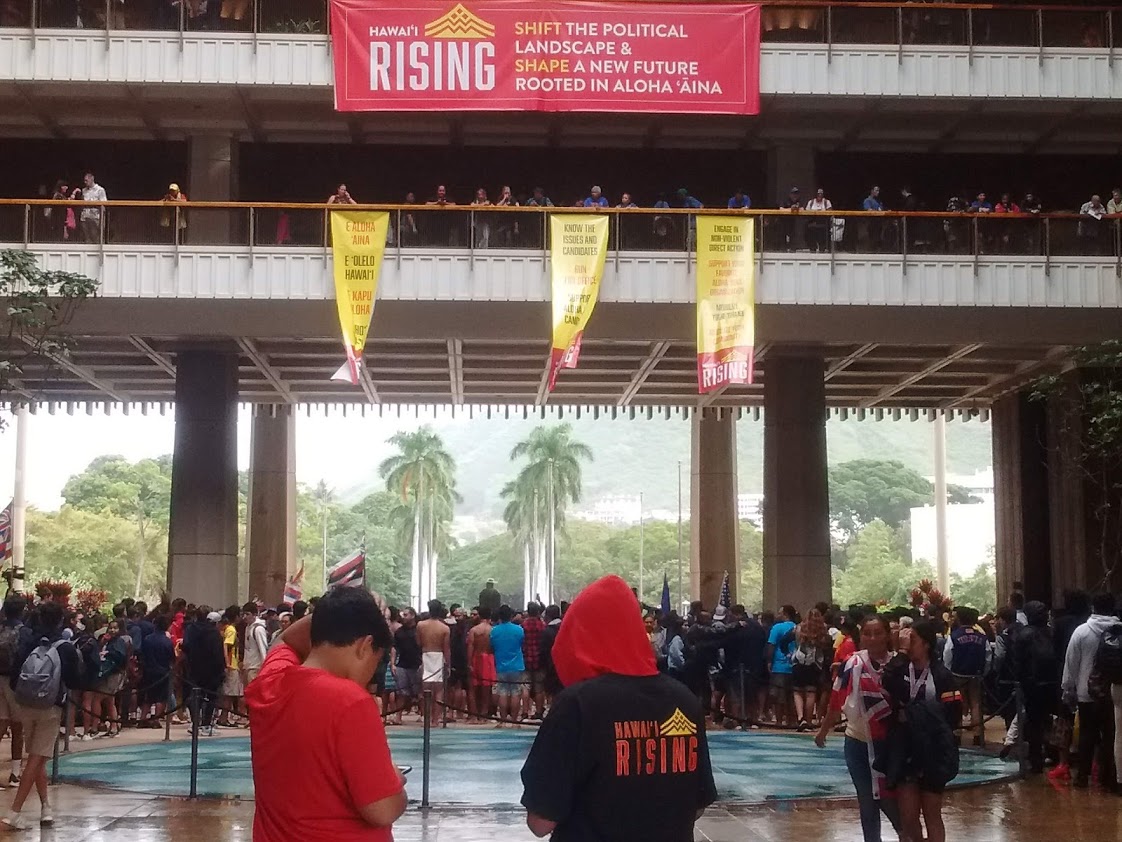

Hawaiʻi Rising at State Capitol was a massive show of intergenerational,
multicultural People Power, supported by a coalition of Native Hawaiian organizations
and grassroots individuals to demand justice for all people and ʻāina.

At Pu’uhuluhulu University
near entrance to State Capitol, Waipahu High School senior Kawika
facilitated discussion, “Mauka to Makai: Protecting Natural
Resources in Hawaii” with Halau Ku Manu Public Charter School student.

For last 10
years, Ku’i at the Capitol has promoted aloha ʻaina, including eating from the land as
a political lifestyle for all of Hawaiiʻs people: pounding kalo
(taro) and ‘ulu (breadfruit).
 House Representative Cedric Gates, Hawaii's youngest twenty-something state legislator, gave away Waianae-grown produce outside his office.

Honolulu Star-Advertiser article, “’Big ideas’ finished at Legislature,” suggested that gone are the “good ol’ days” in
the 1970s when Hawaii passed progressive legislation like Prepaid Health Care
Act via employer mandate, first state to legalize abortion, first state to pass
Equal Rights Amendment, etc. After 21
years, Hawaii became the first state to pass legislation to support working
caregivers with Kupuna Care Act of 2017.
Nowadays the Star-Advertiser
noted that Hawaii lawmakers lack a sense of urgency and appear “stuck” in
trying to address issues like homelessness, affordable housing and increasing
cost of living that may be responsible for 3 straight years of declining
population as residents continue outmigration in search of more opportunities. Since 2016, about 12,000 residents left Hawaii. And this exodus has implications for older
adults who wish to age in place, as traditionally family members nearby could
intervene to avoid nursing home placement.
Two
recent reports, Financial Health Pulse (2020) and Aloha United Way’s ALICE
(2017), described the financial struggles of the majority of Hawaii residents,
including older adults:
·
Almost
two-thirds of people working past retirement age report working more than one job
·
15%
of Hawaii residents aged 50-64 and 4% of those 65 and older said they lived with extended family.

Day before Opening of Legislature, Governor and Legislature
announced an agreed-upon package of bills to improve Hawaii’s affordability
with minimum wage increase, tax breaks for the working class, affordable
housing developments and access to childcare and pre-school. They proposed slightly increasing hourly
minimum wage from $10.10 to $13 by 2024, but Living Wage Hawaii is seeking $17 (again).

De-occupy Hawaii and Hawai’i SEED (“In Soil We Trust”)


T-shirts
reading “Keep Hawaiian Lands in Hawaiian Hands” and “We are the Change
#AlohaAina2020.”

58-year-old State
Senator Laura Thielen (Democrat) and her 86-year-old mother, State
Representative Cynthia Thielen (Republican) will retire at end of this
legislative session.

At Kupuna
Forum, longtime Molokai activist Walter Ritte talked about kupuna’s 187 days
of nonviolent direct resistance at Mauna Kea, reminding kuleana to
protect aloha ‘aina. He pointed
to State Capitol as “building based on compromise” that shuts out the voice of
Hawaiians. “Uncle Walter” and his
generation raised their voices in opposition to U.S. Navy bomb testing of Kaho’olawe,
which they also occupied during the 1970s Hawaiian Renaissance movement,
and opposed overdevelopment and GMOs to defend traditional subsistence
fishing/farming/hunting lifestyle. Now
he called on Native Hawaiians to participate in political system by registering
to vote and voting to protect Native Hawaiian interests.

“Auntie
Maxine” Kahaulelio was one of 38 mostly Hawaiian kupuna arrested at TMT
protest last summer and facing trial this month. Along with Walter Ritte’s wife
Loretta, Auntie Max was featured as one of four courageous women in the book, Nā WāhineKoa: Hawaiian Women for Sovereignty and Demilitarization (2018) by UH Political Science Department
Chair Noelani Goodyear-Kaʻōpua. Auntie Max has been an aloha aina advocate since 1970s,
organizing for welfare rights, supporting communities
against evictions in Chinatown and Waiāhole, fighting against military bombings (Kaho‘olawe, Pōhakuloa) and for preservation of sacred lands (Mauna Kea, Kahuku, Waimanalo). At one point, she urged “get angry,” then
quickly said, “kapu aloha, love each other, be together … if married,
listen to the wife.”
Wondered where was Haunani-Kay Trask, radical UH professor (retired) who received Angela Davis Prize last year?

Decarcerate
Hawaii: Pu’uhonua not Prisons facilitated by Shayna Lonoaea-Alexander,
field organizer with ACLU’s Smart Justice, which aims to reduce the U.S. jail
and prison population by 50% and to combat racial disparities in the criminal
justice system. Shayna shared her experience growing up with a father in prison, in an
effort to end the stigma of incarceration that affects over 5,000 Hawaii
families, and called for a return to the traditional Hawaiian model based on
healing as an alternative to prison.
Based in
Hilo, Ohana Ho’opakale is a community-based organization
that seeks to build Pu’uhonua, or places of refuge (similar to Biblical
times in Jordan and Canaan, Numbers 35:15) where people who committed crimes
could be healed and eventually returned to the community. The focus is restorative justice to rehabilitate non-violent offenders
in a therapeutic environment focused on holistic wellness, learning job skills,
entering drug rehabilitation, and doing ho’oponopono (Hawaiian practice
of “making right” relationships by reconciliation and forgiveness). With 60% of Hawaii’s prisoners classified as
nonviolent offenders, they could be diverted to community-based program,
eliminate need for prison, save taxpayer money, reduce recidivism by treating (not
punishing) people with substance use disorders.
According to
OHA Final Report of the HCR 85 Task Force on Prison Reform, Native Hawaiians continue to be
disproportionately incarcerated, representing 21% of the general population but
37% of the prison population, with devastating impacts of cultural trauma and
intergenerational incarceration. Native
Hawaiians also make up 41% of those incarcerated in corporate prisons in the
Mainland, where they are isolated from ‘aina, and cut off from their
culture and families.
(San
Francisco’s new District Attorney Chesa Boudin, who was traumatized as a child visiting his parents in
prison, is offering caregiver diversion program as alternative to incarcerating
parents of minor children.)

Signs
encourage Native Hawaiians and Samoans to complete 2020 Census. Last census in 2010 counted 527,077 Native
Hawaiians in the U.S., with nearly half living in the Mainland. Are Native Hawaiians being priced out of their own home-islands?

At UH School
of Medicine, Scott Denny, MSPA, PA-C, discussed unique healthcare
dilemmas in LGBT Health Care: coming out (lifelong minority stress), internalized homophobia (onset
early age—shame, stigma; drug/alcohol use, self-destructive behaviors), dating
and sex ed, body dysmorphia (eating disorders, testosterone abuse—bulking
culture in gay men), bi-invisibility/bi-erasure (exclusion in gay/straight
worlds = poor health outcomes), and aging (queer civil rights activists are now
vulnerable in old age).
 Pau hana Friday Tour of Leahi Adult Day Health Center (ADHC), on ground floor of Young Building on campus of Leahi
Hospital, located across from Diamond Head Health Center. Leahi ADHC is open weekdays 7 am to 5:30 pm, private pay $95 daily rate/Medicaid accepted, provides valuable
respite to working family caregivers who drop off frail parents to receive health monitoring, nursing care, social services, recreational therapies (walls decorated with many collaborative art works), nutritious lunch and snacks for regular or modified diets, etc.
Pau hana Friday Tour of Leahi Adult Day Health Center (ADHC), on ground floor of Young Building on campus of Leahi
Hospital, located across from Diamond Head Health Center. Leahi ADHC is open weekdays 7 am to 5:30 pm, private pay $95 daily rate/Medicaid accepted, provides valuable
respite to working family caregivers who drop off frail parents to receive health monitoring, nursing care, social services, recreational therapies (walls decorated with many collaborative art works), nutritious lunch and snacks for regular or modified diets, etc.


Leahi ADHC’s
reception area with table covered with cloth reading “Honoring Our Centenarians”
or upcoming celebration of four centenarians age 100 to 110.

Comfy chairs,
but no physical/occupational therapy. Instead, ADHC recreational therapist is responsible for leading physical exercises, including aides who guide walks on campus grounds. PT/OT available at Rehab Center, next door but separate from ADHC.

Gardening
table outside with view of Diamond Head and sunny
skies sweeping clouds away. Photo taken two
days before elder-to-elder abuse led to tragic fire at nearby Hibiscus Drive in
Diamond Head, burning seven homes and causing clouds of smoke. On Sunday
morning, recently evicted 69-year-old handyman set his 77-year-old landlady’s
home on fire, killing both in murder-suicide after he shot to death two police
officers responding to assault call.

Dementia
in the Family: Care Options and Resources conference on Saturday at Chaminade University campus, with view of
Diamond Head and confusing to find conference space because way too many buildings named Clarence T.C. Ching. Attendees received a gift
bag from Larry’s Bakery, a family business which Yafuso children closed after
50 years of operation so they could provide home care for their mother who was
diagnosed with Alzheimer’s. It took just
one visit to a nursing home (unnamed) for them to decide they would do what was
needed so she could remain in family home. See "Matt Levi Investigates: Family First” video.

Poki’i Balaz earned
her doctorate and worked as geriatric NP in the Mainland, then returned to Hawaii
as millennial caregiver after her father was diagnosed with
younger-onset Alzheimer’s disease. She presented on Dementia Basics and Caregiving.

Kim Ong, RN
is Hawaii’s only Certified Elder Care Coordinator, helping older adults navigate
long-term care.
Honorable
mention to “Aging Well” with Diane Ako, a caregiver to her mother who had
Alzheimer’s, for her informative series each Friday that can be viewed online.
 At CityLights
bookstore for David Talbot’s reading of his latest book, Between Heaven and Hell: The Story of My Stroke (2020). With humor, he said “different strokes for different folks” as he faced
surviving his stroke in November 2017 (at age 66) with “stoic exuberance,” recalling
his mother had several strokes and his biggest worry was being a burden. He recounted how he lay dying, rushed to St. Luke’s, which provided “awful care”
with an “incompetent doctor” who diagnosed him with flu. Fortunately, his sister who is a physician in
Portland, intervened by phone, and he was rushed to CPMC Davies for improved care. While
surrounded by family, he was “ready to go and say goodbye,” but his
wife and son told him "you can’t die"; he would survive to support his son Joe,
who had dropped out of high school and anxiously directing film, Last Black
Man in San Francisco.
At CityLights
bookstore for David Talbot’s reading of his latest book, Between Heaven and Hell: The Story of My Stroke (2020). With humor, he said “different strokes for different folks” as he faced
surviving his stroke in November 2017 (at age 66) with “stoic exuberance,” recalling
his mother had several strokes and his biggest worry was being a burden. He recounted how he lay dying, rushed to St. Luke’s, which provided “awful care”
with an “incompetent doctor” who diagnosed him with flu. Fortunately, his sister who is a physician in
Portland, intervened by phone, and he was rushed to CPMC Davies for improved care. While
surrounded by family, he was “ready to go and say goodbye,” but his
wife and son told him "you can’t die"; he would survive to support his son Joe,
who had dropped out of high school and anxiously directing film, Last Black
Man in San Francisco.
 At The
California Endowment, Family Caregiver Alliance hosted Caregiver Conversations: A
Day of Learning, Support, and Information Exchange, starting with
breakfast prepared by Mamacitas Café.
At The
California Endowment, Family Caregiver Alliance hosted Caregiver Conversations: A
Day of Learning, Support, and Information Exchange, starting with
breakfast prepared by Mamacitas Café.


Back to San Francisco

With assistance from
CPMC “family of 5 providers,” he rebuilt his life. After his stroke, he could not be his “same
self” as he was slower,
more fragile, walking with cane and could be last to finish crossing the street; now, he
said he lived with “death as companion,” appreciated life more, reduced risk
factor by losing weight. He recalled his son feared he would change into
Trump supporter, but stroke was “not as catastrophic”! Mostly he’s had to
acknowledge his limits, feeling chronically dizzy like being on drugs, which
protects him from chaos of life. He said
he can’t stand pity, so he understands why people don’t disclose their medical condition. He gives love back, so burden is not
severe. He also wants to bring back the lifeblood of SF, and remain an activist
to get out of depression; for example, he supported Jane Kim in mayoral race
against “Ed Lee clone, London Breed.” He
said stroke opened him up, so he’s more personal.


Nate Miley,
Alameda County Supervisor and Social Services Committee Chair, talked about
being a long-distance caregiver to his 89-year-old mother who is determined to
live independently in her 3-level Maryland home. He has advocated for “age-friendly council” because “if it’s good for seniors, it’s good for
everyone.” In 1986, he helped organize United
Seniors of Oakland and Alameda County (USOAC), where his daughter now works.

Leah
Eskenazi, MSW, FCA Director of Operations & Planning, introduced
keynote speaker Rita Choula, Director of Caregiving Projects at AARP Public
Policy Institute. Rita compared family
caregiving in the past (multi-generational household, stay-at-home mom, care
done collectively because everyone together) v. present (working mothers, no
close proximity, increasing diversity, and rattled off statistics: 41 million family caregivers, 24%
millennials, 40% men, 40% multicultural communities, and 17% of employees
provide care for a family/friend. She
reminded us that almost everyone will give or receive care at some point in
their lives.

Family
caregivers juggle many tasks … positive effects on quality of life, such as
feeling about making an important contribution (greatest for Hispanic/Latino
and Black/African American caregivers), feeling closer to care recipient, and
gives new skills to caregiver (particularly Hispanic/Latino,
Black/African-American, Chinese, Gen X and Millennial).

FCA Executive
Director Kathy Kelley talked about Supporting Caregivers in her 40-year career
with FCA, which has been caregiver centric v. disease-specific.

Resource
Fair: Christina Irving shared that FCA is partnering with Senior & Disability Action to
offer two-week Caregiver Survival School! FCA, in collaboration with Benjamin Rose Institute on Aging, also
launched Best Practice Caregiving, a new web-based database of more than 40
programs evidence-based programs for dementia-caregiving.

Caregiver
Panel: Addressing Day-to-Day Caregiver Concerns and Challenges shared resources: Self-care; respite via in-home care, adult day
programs, out-of-home respite (ALF, SNF).

Alameda
County Supervisor Wilma Chan advocated to preserve adult day health care (ADHC)
programs in 2011, so now two remain (outside of PACE).

Lunch Table
Discussions: Caregiver Action & Advocacy. At my table, I
volunteered as scribe to document barriers to receiving caregiver support:
disparities in service delivery that focus on race/ethnicity, but ignore
broader differences such as autism and severe behaviors; FCA focus on adults,
excluding children with developmental disabilities/behavioral health; need to
leave county for better care (e.g., speaker talked about move to Napa); finding
trustworthy and culturally sensitive caregiver to hire (e.g., risks of theft in
home, sleeping on job, abusing care recipient, language, etc.); not knowing
where to find support, not knowing how to communicate needs; financial incentive
for middle-income working caregivers.

Margaret
Cullen on Compassion and Caregiving.
There is no compassion fatigue, but empathic distress. She discussed need to exercise
self-compassion in 3 steps:
1. mindfulness of suffering: tendency to
be self-centered in pain, so recognize not alone to counter tendency to feel
singled out
2. common humanity: suffering connects us
to one another
3. self-kindness/self-mentoring: tell yourself “it’s okay”

Call to
Action by Susan
DeMarois, Public Policy Director at Alzheimer’s Association.
 Mostly car-free Market Street took effect January 29th, intended to reduce pedestrian injuries/deaths (seniors at high risk) and speed up public transit times in SF's busiest street, which sees half a million daily walkers and 200 buses hourly. It's a beautiful day in the neighborhood!


