Showing posts with label Summer of Love. Show all posts

Thursday, August 31, 2017

Peace, love and understanding

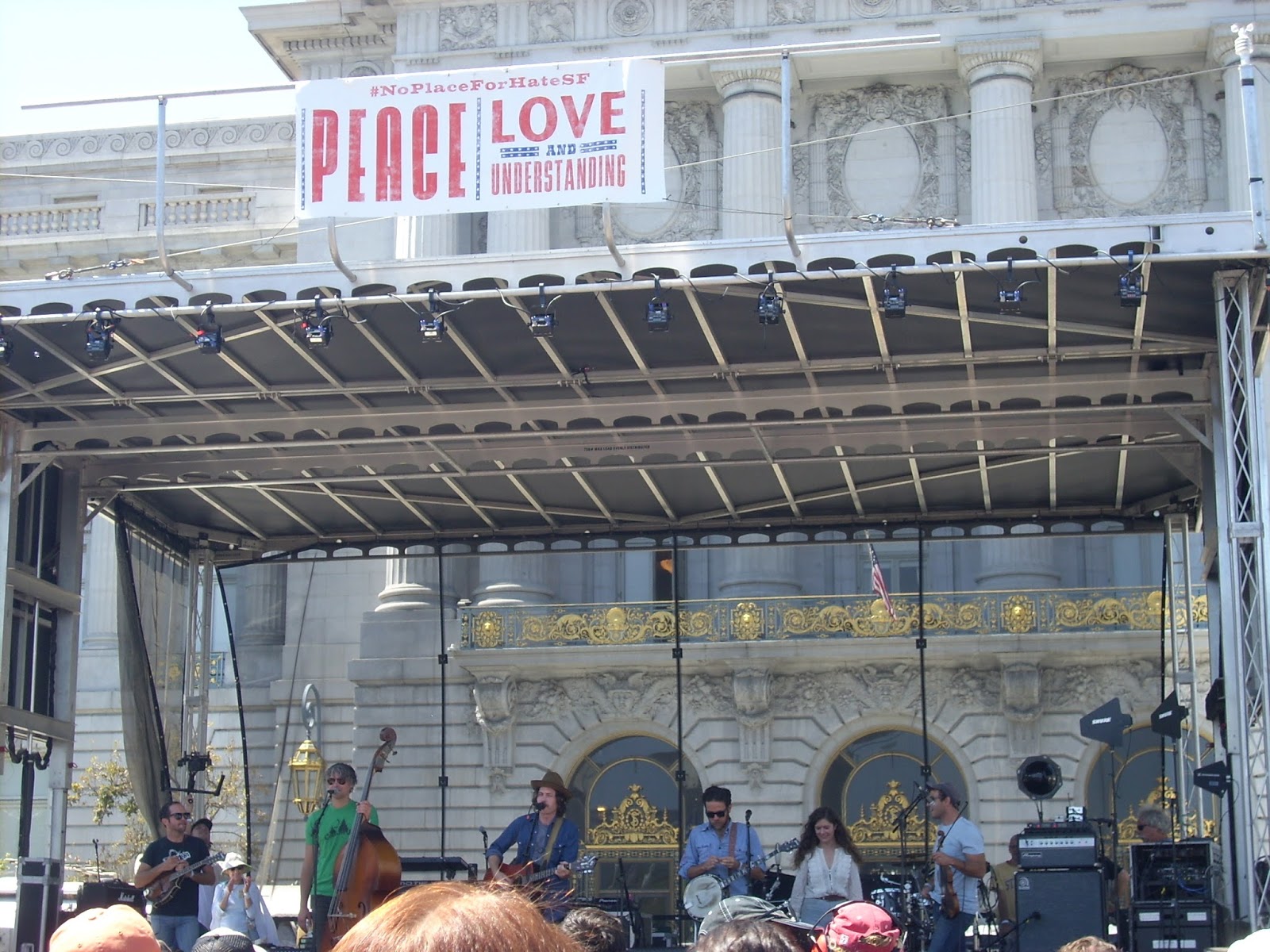
Last Saturday, thousands rallied at the “Peace, Love and Understanding” event in San Francisco’s Civic Center -- very much in the spirit of San Francisco’s Summer of Love 50 years ago!

“Still, here we are, 50 years later, marveling at the hippies, who came and went as mysteriously as the Druids, and wondering: What was that? They left behind a vague but definite cultural imprint, a kind of peculiar residue that shows up at places like yoga studios in strip malls or organic vegetable stands at the farmer’s market. That flash on the horizon that lit up the world from the ground zero of Haight-Ashbury a half-century back has never been fully extinguished. No matter how commercialized, corrupted, disintegrated, defiled or reviled the hippies have been, they refuse to disappear. Part of the reason was that Boomers have always remembered their youth. At the same time, the inaccurate mythology of the Summer of Love was such that younger generations have tried to replicate it.”—Joel Selvin, “Summer of Love: Paradise that never was lives on in legend,” San Francisco Chronicle (March 10, 2017) 

Progressive San Francisco launched the long-awaited Support @ Home (S@H), a new home care voucher program funded by San Francisco Department of Aging and Adult Services and administered by Institute on Aging (IOA).  IOA held an information meeting with Community Living Fund Director Laura Liesem and S@H Director Jeanne Caruso who explained the program guidelines. S@H is designed to serve San Francisco residents age 18+ who require assistance with at least two activities of daily living or instrumental activities of daily living, yet are not eligible for other subsidized home care such as Medi-Cal In-Home Supportive Services (IHSS), due to income/resource limits.  For those who demonstrate the program’s financial need requirements, S@H provides up to 15 hours of subsidized home care per week from contracted agencies, so residents can continue living safely in their homes.  During this two-year pilot program, S@H’s two-person staff intends to serve 250 clients.

To better understand those good ol’ days and legacy for today’s older Americans (post-World War II Baby Boom generation), I attended more events commemorating the 50th anniversary of the Summer of Love.

Revisiting the Summer of Love

Northwestern University’s Center for Civic Engagement and The California Historical Society presented an academic conference, “Revisiting the Summer of Love, Rethinking Counterculture.” 
Northwestern University’s Michael J. Kramer presented the opening lecture, Hot Fun in the Summertime: Microcosmic and Macrocosmic Views of the Summer of Love. Summer of Love participants attempted to develop a social structure for living in the Now.   
Haight Ashbury Survival School: predecessor to Senior & Disability Action’s Senior Survival School 
Moonalice Trio performed 1960s psychedelic rock music. 
Stanford University historian Fred Turner presented his lecture, From Counterculture to Cyberculture: The Dream of a World Beyond Politics, based on his award-winning book, From Counterculture to Cyberculture: Stewart Brand, the Whole EarthNetwork, and the Rise of Digital Utopianism (2006) and The Democratic Surround: Multimedia and American Liberalism from World War II to the Psychedelic Sixties (2013).  He provided an overview of how the counterculture's values of back-to-the-land, small-scale technologies, peer collaboration and communication shaped the era's communes and today's social media.
According to Fred Turner, the counterculture was represented by the New Left and New Communalists: both movements were anti-bureaucracy, anti-big technology and anti-mass culture … the dream of a world beyond politics.  Buckminster Fuller's artist-scientists would remake the world through design, not politics.  Communes disabled discussion by "rule of cool," so most communes collapsed unless they were authoritarian or religious.
Stewart Brand's The Whole Earth Catalog (1968) introduced new tools for the New Communalists.

Rural Communes panel:
  • Ramon Sender Barayon on Open Land Sixties Communes in Sonoma County talked about Morning Star and Wheeler Ranches, two hippie rural communes in western Sonoma
  • Timothy Miller from University of Kansas on Revisiting the 60s Communes, noted hundreds of communes remain today outside the mainstream
  • Benjamin Klein of CSU East Bay on A Mobile Hallucination: Celebrating the 4th of July with the Hog Farm, shared photos of the great hippie migration between Taos and Santa Fe, taken by his uncle Irwin between 1967 and 1971.
In "Peace, Love, and Social Security: Baby Boomers Retire to the Commune," The Atlantic reporter Anna Spinner found former hippies and growing numbers of Baby Boomers choosing to retire in intentional communities that are multi-generational for support and care--different from the youthful experiment of communes.
Robyn Spencer of Lehman College on The Black Power Revolution and the Summer of Love.  She talked about the role of the Vietnam War protest and failed War on Poverty on the rise of the Black Panther Party. She also observed that the conference's predominantly white male audience was similar to Summer of Love participants.  
From Punishment to Protection: Human Service Innovation in the Summer of Love panel talked about the beginnings of their agencies as welcoming support of the thousands of young people who came to San Francisco during the Summer of Love:
  • Hospitality House Executive Director Joe Wilson on Building Community in the Central City for homeless, mostly LGBT youth who arrived in the Tenderloin
  • Huckleberry Youth Programs Executive Director Douglas Styles on Tension Between Experiment and Establishment: Sustained Innovation for teenage runaways
  • Haight Ashbury Free Medical Clinic Founder David E. Smith on Haight Ashbury Free Medical Clinic: Health Care is a Right treated people addicted to drugs when it was a crime for physicians to treat addicts.

Identity and Transformation of the Self panel:
  • Blake Slonecker of Heritage University on “It’s Not Unmanly”: Sexual Politics and Collective Work at the Eugene Augur, 1969-1974
  • Sherry L. Smith of Southern Methodist University on Revisiting the Hippies and Native Americans
  • Jeremy Varon of The New School on Identity, Performance, Solidarity: Self and Community in the 1960s Counterculture                     
Northwestern University’s Stephen F. Eisenman on William Blake and the Age of Aquarius 
Intellectual Origins of the Counterculture: How Theory Shaped Practice panel:
  • James Block of DePaul University on New Individuals in New Communities: The Counterculture Vision of Post-Liberal America
  • Michael J. Kramer of Northwestern University on “A Tiny Banner Against the Inhumanities of the Technocracy”: Unfurling Theodore Roszak’s Countercultural Social Criticism 

  • Dan A. Lewis of Northwestern University on The Psyche and Polis in Social Theory: A Geography of Influence in the Bay Area 
David Farber of University of Kansas on From Innocence to Experience: LSD, the Counterculture and Sustainable Lives, described the many countercultural practices that have gone mainstream.  
The Media and the Summer of Love: From Street to Straight panel:
  • Joel Selvin, author of The Summer of Love: The Inside Story of LSD, Rock & Roll, Free Love and High Time in the Wild West (1999)
  • Rosie McGee, photographer and author of Dancing with the Dead (2013)
  • Charles Perry, author of The Haight-Ashbury: A History Overground and Underground Press
  • Abe Peck, author of Uncovering the Sixties: The Life and Times of the Underground Press (1985) 
Commemorative poster

Diggerly-Do’s 

In Diggerly-Do’s, Kent Minaut recalled the first six months of the Diggers: free food in the park, encounters with police, free store, meeting Black Panther Huey Newton, etc.
Chris Carlsson of Shaping SF facilitated Q & A after Kent’s performance. 
Appearing incognito in the audience was Digger Peter Coyote (at left in photo), author of Sleeping Where I Fall, his immensely readable memoir of the 1960s. 
Digger Judy Goldhaft at literature table

“The Hippie Revolution”

After screening of Jack O’Connell’s documentary, “The Hippie Revolution” (1968; a version updated in 1986 can be viewed online at Jack O’Connell’s website) at San Francisco Main Library, Ben Fong-Torres interviewed Louise “Today” Malone.  Now age 60 and a grandmother, Today calls herself “Yesterday” – continues to believe and practice peace, love and understanding, but has re-evaluated her prior drug use, preferring meditation and yoga.


Flower Power at Asian Art Museum


 Peace at de Young Museum

Wednesday, May 31, 2017

Older Americans Month: Age Out Loud

When I heard that this year’s Older Americans Month theme was “Age Out Loud,” I thought about the relatively loud Baby Boomer Generation (born 1946-1964), which followed the Quiet Generation (born 1925-1945) and came of age during the Free Speech Movement (student leader Jack Weinberg, at age 24 in 1964, infamously advised, “Don’t trust anybody over 30”), Gathering of Tribes for a Human Be-In (its press release announced “a new nation has grown inside the robot flesh of the old”) and Summer of Love.    
Some of my Older American shut-in clients came to San Francisco as flower children during the Summer of Love 50 years ago.  While they view the Summer of Love as a memory and nostalgia for youthful idealism (“imagining a world in which we wanted to live and making it real by acting it out,” according to Peter Coyote), I view it as history for learning about its enduring influence: rise of youth culture (questioning authority in transition from gerontocracy to gerontophobia), women’s liberation, do-it-yourself, back-to-nature, communal living, open source collaboration, higher consciousness (via Eastern spirituality, psychedelic drugs like LSD and cannabis), personal authenticity, ecological awareness, etc.  This month I had a blast attending several groovy Summer of Love commemoration events. 
San Francisco Arts Commission’s Art on Market Street commemorated Summer of Love with poster drawing of Digger Emmett Grogan on bus shelter.  In San Francisco, low- to moderate-income seniors age 65+ ride Muni bus free!
  
Hippie Modernism: The Struggle for Utopia  
“It is possible that it is possible … Take the no out of now then…”  Berkeley Arts Museum and Pacific Film Archive’s Hippie Modernism: The Struggle for Utopia exhibit explored the youth-driven counterculture’s possibilities for utopia in design and technology.       
The Diggers came out of San Francisco Mime Troupe (anarchist guerrilla street theater group) based in Haight-Ashbury. Their 1% Free (1967) poster, designed by Digger Peter Berg and showing two Chinese tong men waiting beneath the Chinese character for “revolution,” suggested that Free people were a minority.  Hippies from the 1960s were predominantly white, middle-class youth.
The Diggers’ agenda was to create a Free City, by putting free before any word: food, store, shelter, healthcare, entertainment, etc.—viewed as human rights instead of commodities.  This challenged “business as usual” because doing things for free (and anonymously) could not be co-opted, and transformed the audience to participants who could be free themselves! Why wait for retirement to drop role-playing “employee” and become “life-actor”? As Digger Peter Coyote explained in his memoir, Sleeping Where I Fall (1998), “If you wanted to live in a world with free food, then create it and participate in it.  Feeding people was not an act of charity but an act of responsibility to a personal vision.” 
Starting Fall 2017, Free City College Program is a 2-year pilot program offering free tuition to San Francisco residents!
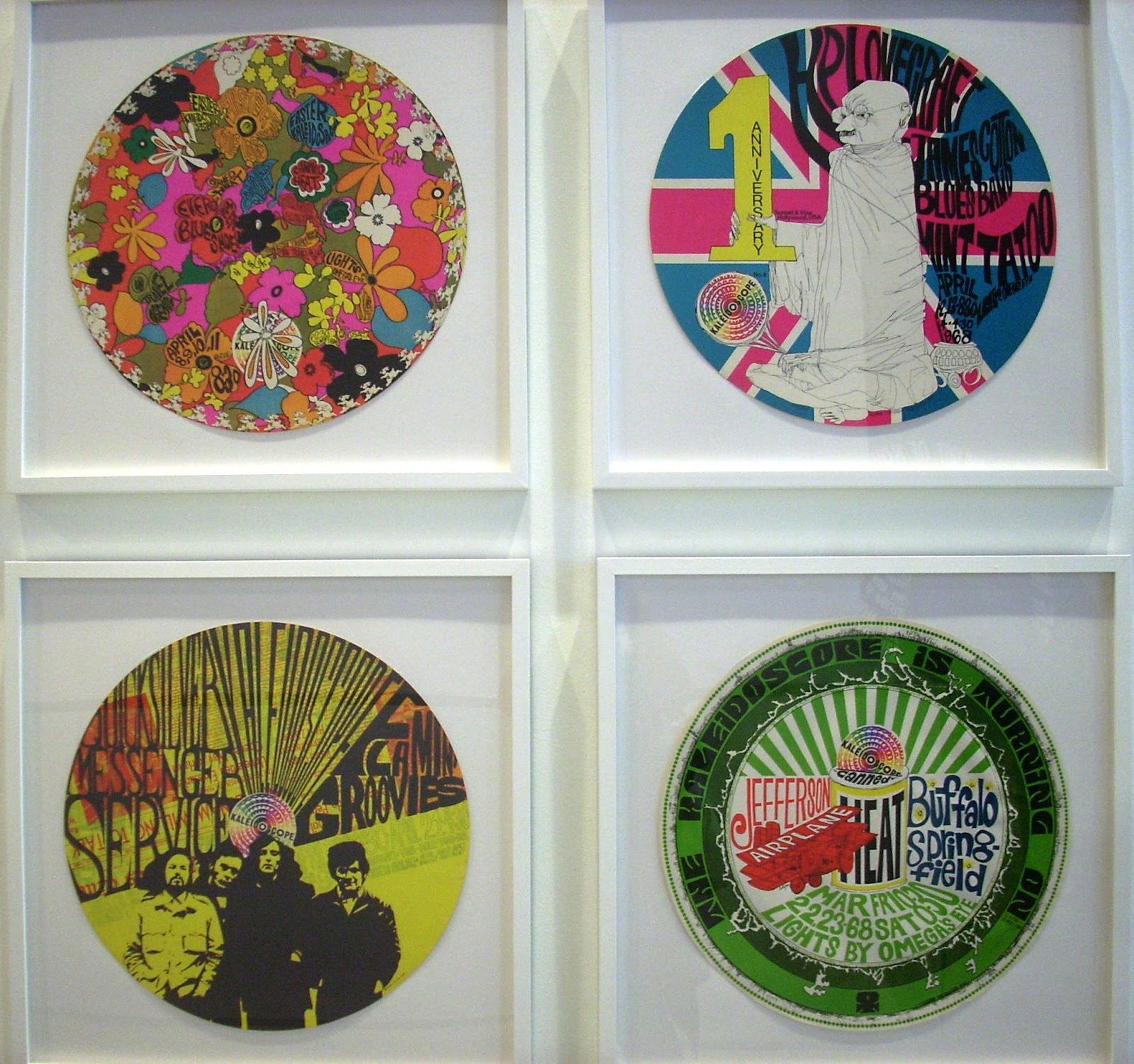
Psychedelic posters break all the print design rules for seniors
  • use simple, easy-to-read typefaces
  • avoid long blocks of text
  • incorporate lots of white space to reduce eye fatigue
  • keep use of italics to minimum
  • maintain high contrast
“We are all handicapped … what the people really NEED” from Work Chart for Designers by Victor Papanek 
This 1973 Community Memory terminal, set-up at Leopold’s Records in Berkeley, functioned as an electronic bulletin board to democratize information sharing and considered to be the world’s first digital social network. 

de Young Museum hosted a panel discussion, Reflecting the Love Generation with curators Jill D'Alessandro (textile arts) and Colleen Terry (graphic arts) in conversation with music historian Dennis McNally and music journalist Joel Selvin, contributing authors to the catalogue for The Summer of Love Experience: Art, Fashion, and Rock & RollThey discussed free spirits drawn to San Francisco during the Summer of Love after reading Jack Keroauc’s On the Road, and the draft during Vietnam War as impetus for the Summer of Love’s philosophy of peace and love 
de Young's exhibit website includes digital stories that provide historical and cultural context: The Beginnings of the San Francisco Sound; Trips Festival; Awakening in the Park; Music and Dance Venues; Posters; Idealism on Haight; Levi’s: Practicality and Ideology; Politics; and Legacy. 
“Don’t trust anyone over 30” and gentle reminder "Be nice to each other." 
The Summer of Love Experience attracted all ages, from Hippies to Hipsters.

On the Road to the Summer of Love 
On the 50th anniversary (May 13) release of “San Francisco (Be Sure to Wear Some Flowers in Your Hair),” Summer of Love anthem sung by Scott McKenzie, California Historical Society (CHS) offered free admission to visitors wearing flowers in their hair.  
On the Road to the Summer of Love exhibit was curated by Dennis McNally, former publicist of the Grateful Dead.  
Human Be-in was organized in response to a new law in California banning the use of LSD, effective October 1966.

Summer of Love in Tenderloin 
Executive Director Katie Conry welcomed guests to Tenderloin Museum’s 2ndAnniversary Community Day.  
The Diggers' "Invisible Circus" Remembered as a 72-hour “environmental community happening” at Glide Church in February 1967, a month after the Human Be-In event.  Based on the idea that “love is communication,” The Communications Company (Com/Co) printed flash bulletins, notifying everyone what was going on, how to get there, and the news right after it happened--prototype for World Wide Web. 
Participants were invited to “do your thing, be what you are … Anyone who wants to can shape history … Those who do not create the future are required to endure the future of those who do." 
“Do you feel more like you do now than before when you came in?”
Shaping San Francisco co-director LisaRuth Elliott interviewed Judy Goldhaft, original participant in the Diggers, co-founder of Planet Drum Foundation and now exercise instructor at The Granada Hotel.  Judy recalled that Diggers used humor and improvisation to coalesce society, like the Death of Money parade.  She thought the Diggers treated women as equals, and her daughter Ocean (in the audience) said she felt empowered by female Diggers.  
David Talbot discussed Summer of Love, Season of the Witch, and the Tenderloin. In Season of the Witch (2012), David wrote that the Diggers’ women did the “grunt work that kept it all going.”  While the Diggers’ act of giving away free was performance, lasting institutions resulted from “do it ourselves” ideas like Huckleberry House for teenage runaways when it was against the law and Haight-Ashbury Free Clinic stood for healthcare as a right, not privilege.  The Diggers’ "feed-in" actions at City Hall were meant to “affirm responsibility”–to do what City government should.  As hard drugs took over, hippies left for communes or intentional communities; today, San Francisco has become so expensive, even in the Tenderloin, it is not as welcoming to creative types who cannot afford it.

Women of the ‘60s Counterculture: Planting the Seeds of Liberation 

At the San Francisco Public Library, CHS Public Programs Manager Patricia Pforte introduced Women of the ‘60s Counterculture: Judy Goldhaft, Salli Rasberry, Delia Moon, Denise Kaufman, Alexandra Jacopetti Hart, and Gretchen Lemke-Santangelo (moderator).  They shared personal stories of how growing up in dominant 1950s culture (Father Knows Best, misogyny, repression) created path to counterculture’s values (self-expression, living simply, everything free), the role of psychedelics in shaping values (“lies of older generation” that smoking pot was dangerous, LSD opened to multiple realities/possibilities/creativity/feelings of nature, etc. yet made illegal).

 
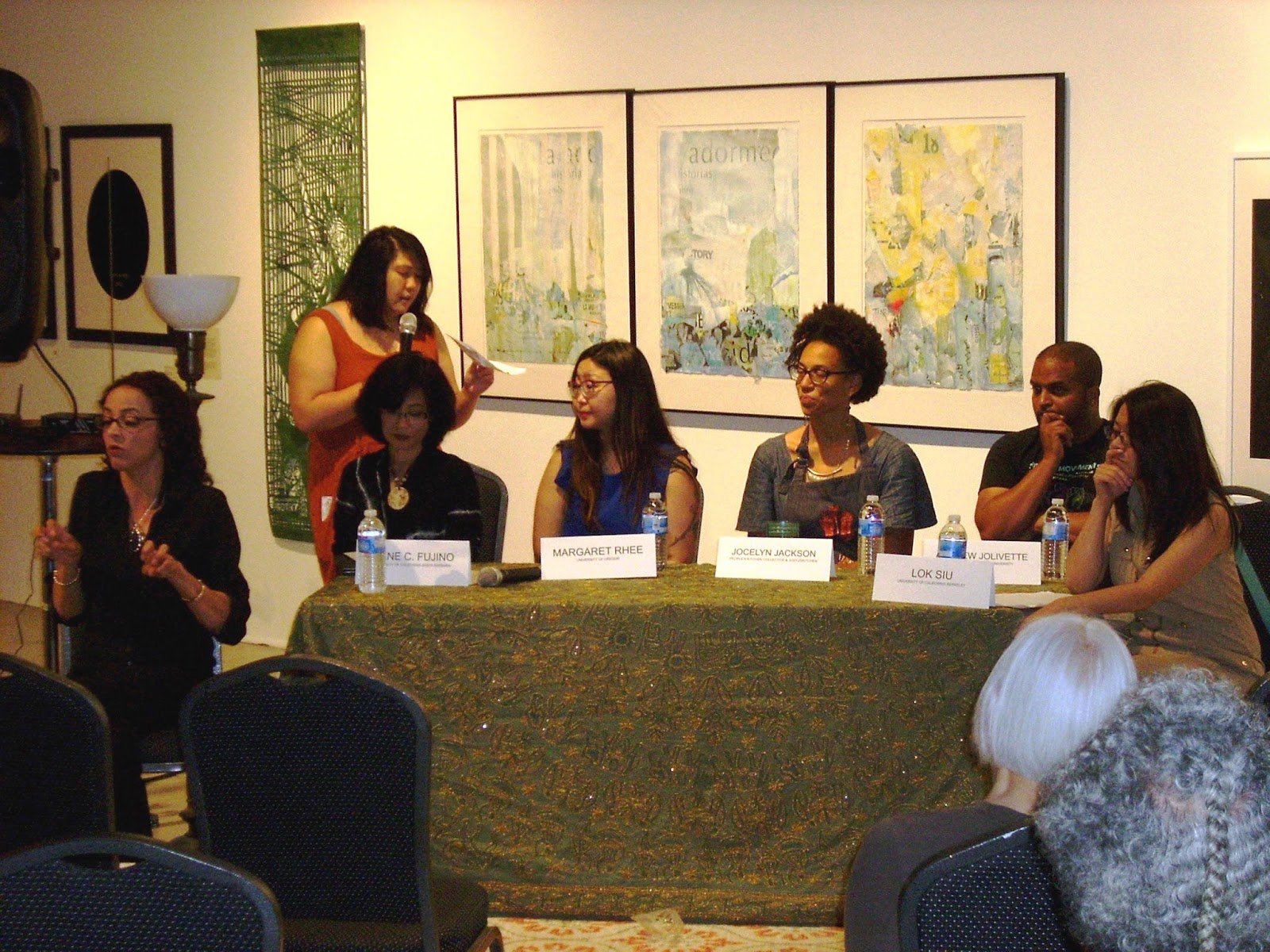
SOMArts hosted this month’s exhibition, Shifting Movements: Art Inspired by the Life & Activism of Yuri Kochiyama (1921-2014) with Passing It On: Other Feminist Futures Panel.   
With refreshments provided by People’s Kitchen Collective, the discussion reflected on Yuri’s legacy:  radical hospitality, leadership as relationship building, solidarity between communities (Asian and Black), intergenerational knowledge sharing, womanism, etc.
Meghdoot (The Cloud Messenger) by Pallavi Sharma in collaboration with other artists; each rain cloud depicts inner turmoil on present state of the world and acts as prayer.
Consciousness = power.  Individual clouds are separate but create formations and communities together, pushed together and apart by winds of social change that cannot always control.
Consciousness-raising identity in response to "othering" 
Yuri cradled Malcolm X after his assassination in 1965
Yuri’s advice through her ages on T-shirts: "decolonize your mind" and "ultimate objective in learning anything is to try to create and develop a more just society."
Resistance & Compassion (2017) mandala by Nancy Hom 


Building Community
San Francisco Main Library hosted Digital Inclusion Week, May 8-13, 2017, which included Tech ExpoLife Got Wider: Meanings Associated with the Computer Use of Older Adults exhibit, and Cyber-Seniors documentary screening.
 
May 16, 2017 Senior & Disability Rally at City Hall called for funding more home and community services, such as rental subsidies, IHSS retention pilot, internet access, transportation to and from Adult Day Programs, food through home-delivered and congregate meals, etc. 

Aging With Community: Building Connections that Last a Lifetime was the topic of the May 17, 2017 hearing before the U.S. Senate Special Committee on Aging.  Senator Bob Casey said, “Older Americans want to be out and about, ‘aging out loud,’ in their cities and towns.”  Some ideas to connect seniors with communities:
Aging and Disability Friendly San Francisco joined both WHO Global Network of Age-Friendly Cities and Communities (2014) and AARP Livable Communities (2015).