Wednesday, January 31, 2018

Power to Change

Power to Change: Creative Aging Symposium was a one-day virtual event hosted by Senior Center Without Walls (SCWW) and Creative Aging San Francisco: 
“Elders are looking for ways to have their voices heard, to create change in their lives, and the lives of others…
Whether you think of yourself as creative or not, we will give tools to unlock the creative promise we all carry… creativity is beyond art-making – it is about using your imagination to forge new paths. This symposium will share inspiring stories and creative tools to ignite changes from the very personal level of communicating one’s story all the way to addressing policy-makers.”

This online Symposium, accessible via computer or phone, included 15-minute breaks for reflection between presentations and a 75-minute lunch break.  
Fred Mandell, Ph.D., co-author of Becoming a Life Change Artist: 7 Creative Skills to Reinvent Yourself at Any Stage in Life (2010), talked about risk-taking in his creative transition.  Leaving the familiarity of a 21-year career in financial services, Fred explored the unknown when he enrolled in a sculpture class as he had not taken an art class since 7th grade.  Three years into studying sculpture, he had a one-man show to sell his art and then took up painting; his artworks are sold online. His reflections: “Do and learn at the same time …Build skills through failure in workshops …Find a community of support …develop a new network (tribe) that will be a source of encouragement and resilience … passion will sustain growth and discovery.”  He recommended journaling that helps reflect on our state of mind and heart, opportunities and disappointments.  

In 2014, Fred founded Global Institute for Arts and Leadership, a nonprofit that uses arts-based learning for innovative leadership and social impact. Fred explained art’s value in problem-solving by providing divergent, expansive ways of looking/thinking and a communal experience to make and share art that will elicit a response and dialogue that is less threatening than politics—a fixed mindset can be challenged with art that connects what’s deep inside us and to the world. 

According to Fred’s book, here are the 7 creative skills to reinvent yourself:
  1. Preparation: Deliberately engaging in activities that help break us from our usual patterns of thought and feeling, and prepare us for creative insight.
  2. Seeing: Discerning new connections, fresh perspectives and possibilities.
  3. Using context: Understanding how varied environments in which we live and work influence our thoughts and behaviors, and then using this knowledge to make changes in our lives.
  4. Embracing uncertainty: Acting on opportunities, sometimes hidden, presented by change and uncertainty.
  5. Risk taking: Acting without certainty of outcome.
  6. Discipline: Acting consistently, regardless of motivation.
  7. Collaboration: Engaging with others to help one make desired changes.
Its essence was similar to AARP’s Life Reimagined. Power to Change honors the creative possibilities available to us as lifelong learners who can make meaningful contributions.
Next up was Stagebridge performing arts company founded 1978 in Oakland, celebrating its 40th anniversary this year! Stagebridge members talked about Telling Your Story:
  •  Time Slips creative storytelling project (Anne Basting's “forget memory, try imagination”) with people with dementia, using photo image, facilitator, echoer, and scribe. This experience enabled member Emily to be more comfortable with memory loss, after realizing that memory goes, but lots left—creativity, imagination and fun remain.
  • Playback Theater with Ed Bernstein and Sarah Strong, learning that improv is about trusting inner guidance; using roles of conductor (like to add anything?), teller (new perspective on life story), and actor.
After lunch break, enjoyed 15 minutes of Poetry Reading by Gregory Pond, who has published two books of poetry, Blackened Blue and after moon.  We were nostalgic or looking forward to our next meal as he read home cookin’:
back burner glows
slow slimmer on
crock pot watch
heated up then
turned down low
to slightly bubbling
babbling brook…
rich thick steam rising
and mixing above
with
the good home aroma
of spices
and love.

David “Lucky” Goff, Ph.D., author of The Evolving Elder: Applying What Really Matters to Life (2017) and community organizer, talked about surviving a hemorrhagic stroke in 2003 and experiencing a “traumatic blessing.”  After his stroke left him permanently disabled, he lost his marriage, home, and career in psychotherapy.  He started writing a journal, Reports from the Slow Lane (now blog), to exorcise his regrets, re-learned to speak so he has been on Growing an Elder Culture radio show for past 6 years now, and co-founded Elders Salon in Sebastopol.  Lucky said he has been living creatively as a social artist because of his hardships, and his experience with disability has meant moving to a slower pace so he can notice what’s going on, rather than miss a lot while speeding through life. 
Postcards with a Punch workshop demonstrated how writing your legislators does make a difference and provided tips on how to make our letters stand out.
  •  Shirley Krohn of California Senior Legislature discussed Meals on Wheels’ “Don’t Empty My Plate” campaign that involved seniors writing their personal stories (“If it wasn’t for Meals on Wheels, I would starve”) on paper plates for visual impact and sent to Congress.
  • Jessica McCracken of Ruth’s Table suggested ways to get informed on policy issues (American Society on Aging, Leading Age, Americans for the Arts), and then showed how to create a collage from magazine clippings, using glue stick, on a 3”x5” postcard with message—"AGING massive power JUST BEAUTIFUL" or song lyrics/poems that touch the soul.
After the polarizing 2016 election, Cindy Weil left her wallpaper business to follow her impulse to be part of something bigger and found Enactivist.  She launched the Immigrant Yarn Project, involving seniors and Girls Scouts in piecing together a yarn-based creation (knit squares, pom-poms) representing our common immigrant roots for a massive public art, open-air installation at Fort Point this fall.  
SCWW Program Manager Katie Wade (pictured above at left) concluded the symposium, noting the mosaic Power to Change logo of the butterfly symbolizing transformation, reflection and exploration of our creativity as a tool for change within ourselves and our community. 

Art-making
Rhoda Goldman Plaza (RGP) Assisted Living residents learned step-by-step Portrait Painting taught by Mike Ritch of Jean Henry School of Art (pictured with model Amy Hittner, Board member of Legacy Film Festival on Aging and former Chair of SFSU Counseling Department).
RGP’s Annual Resident Art Show + Reception with strolling violinist Seth Byrd, featured origami by Hedy, paintings by Roberta, and mixed collage/painting by Shelly. 
Metal sculptures by Barry
Upcycled art by Freda


Power of Resilience
This month’s Martin Luther King, Jr. Day Celebration at Yerba Buena Center for the Arts featured a screening of the documentary, “Resilience:The Biology of Stress and the Science of Hope”, followed by journalist Belva Davis moderating a discussion with panelists: James Redford (filmmaker), Claire Willhite (Center for Youth Wellness), Lyslynn Lacoste (Bayview-Hunters Point Mobilization for Adolescent Growth in our Communities) and Lauran Cherry (Alameda Department of Education).
The documentary explored the impact of Adverse Childhood Experiences (ACE, such as abuse, neglect, household dysfunction) on adult health and behaviors, and adopting a resilience-oriented approach to trauma-informed care. According to the ACE study, chronic inflammation due to toxic stress in childhood can lead to changes in brain development and body systems. Resilience is built over time, so universal screening and interventions (presence of a stable, caring adult; therapy; mindfulness; nutrition; exercise) are key. 
FDR Democratic Club hosted a community conversation on Disaster Preparedness for Seniors and People with Disabilities (PWD) at Lighthouse for the Blind and Visually Impaired.  We viewed Rooted in Rights’ “Right to be Rescued,” a short documentary that tells the stories of PWD affected by Hurricane Katrina.  In times of disaster (hurricanes, wildfires, severe weather, etc.), older adults and PWD are vulnerable due to special needs and tend to be overlooked.  In “The Right to be Rescued: Disability Justice in an Age of Disaster," Adrien Weibgen argued for the right of PWD to receive emergency services, including their input in emergency planning.

“…the systemic exclusion of PWDs from disaster plans, coupled with arguments that it may be impossible to meet the needs of all people during times of disaster, suggests a widespread, if tacit, endorsement of the notion that it is fine to value lives differently when push comes to shove…Rather than accept as inevitable that some people will be left behind, we must significantly increase our overall level of commitment to managing emergency events.”

We heard from local and state officials on disaster preparedness:

Daniel Homsey, Director of Neighborhood Resilience, visited New Orleans 10 years ago in aftermath of Hurricane Katrina, which he called a “social justice disaster." Each of us can asset map, prepare Recology disaster kit, get Neighborhood Emergency Response Team (NERT) training by SF Fire Department, and know our community (get connected to AlertSF to receive real-time emergency alerts by texting your zip code to 888-777).  After noting that 70% of the City’s first responders do not live in the City, Daniel talked about building community resilience through grassroots Neighborhood Empowerment Network (NEN)’s Empowered Communities Program (ECP).  He encouraged us to build “who’s in kit” (social capital) through relationships in the community to kick-off a social contract of caring and problem-solving; for example, Resilient Miraloma Park neighbors staged an off-the-grid block party to practice their safety responses using emergency radios for communications and solar generators for cooking.  Daniel explained that the City promotes Neighborfests as community building tools through incentives by removing fees, providing free barricades and training for organizing block parties for neighbors:  how to form teams, implement a plan and feed one another – frequent practice uses muscle memory to respond in a real emergency.

Vance Taylor, Chief of the Office of Access and Functional Needs at the Governor's Office of Emergency Services, joined the meeting via Skype.  Vance is responsible for ensuring the needs of individuals with disabilities and persons with access and functional needs are identified before, during and after a disaster. 
Event included resource tables by nonprofit and government organizations:
  •  Joanna Fraguli, Deputy Director of Programmatic Access at Mayor’s Office on Disability: Disability Disaster Preparedness Committee (DDPC) meets every other month to identify policy needs and propose concrete recommendations. 

Sunday, December 31, 2017

Safe Streets for Seniors


“Streets will always serve as transport routes, allowing citizens to move around the city – yet the forms of transport that dominate those routes will determine if streets can fulfil their other key role, as centres of communities. Streets that prioritise pedestrians, bikes, buses and other types of mass transit are far more likely to be places where people want to meet, socialise, shop and live.” – Mark Watts, “Streets can kill cities: on the Fossil-Fuel-Streets Declaration,” City Metric, December 18, 2017 

San Francisco’s dense population of 874,000 residents in 49 square miles and ride-hails (45,000 Uber and Lyft drivers account for 15% of all vehicle trips inside San Francisco) put pressure on streets.  Uber and Lyft account for two-thirds of congestion-related traffic violations in Downtown SF. 

Over 800 pedestrians are struck in traffic collisions each year in San Francisco, which has the highest level of pedestrian collisions in the state, and over 50% of all traffic fatalities are pedestrians, the second highest rate in the country.  Each year, over 200 people are seriously injured and another 30 are killed while traveling the streets of San Francisco.  
In 2014, San Francisco adopted Vision Zero to prioritize street safety and eliminate traffic deaths within a decade, or by 2024.   
To accomplish this goal, Vision Zero SF (VZSF) is implementing its Two-Year Action Strategy 2017-2018, and focusing on a 3-prong effort of E’s: 
  • Engineering: SF Municipal Transportation Authority (SFMTA) implemented reduced speed limits earlier this year, and identified safer street designs. Based on data obtained from SF General Hospital (about 50% of its trauma patients are people injured in traffic crashes) and SF Police Department (SFPD)’s Collision Report, SF Department of Public Health (SFDPH) released a High Injury Network map showing red lines on high injury streets, where traffic safety improvements are most needed.  According to SFMTA, 70% of San Francisco’s severe and fatal traffic injuries are focused on just 12% of the City’s streets.
  • Enforcement: SFPD implemented Focus on Five mandate of 50% of all tickets issued for the most dangerous traffic violations (speeding, running red lights, failing to yield to pedestrians at crosswalks, failing to yield while making left or U-turn, failing to fully stop at stop signs) that contribute to traffic injuries and death.  However, because annual tickets issued by SFPD have dropped since 2016 (by 23,000), making it easier to meet its mandate, street safety advocates favor a bill (AB 342) to legalize Automated Speed Enforcement cameras. 
  • Education: SFMTA, SFPD, SFDPH and Walk SF collaborated on Safe Streets SF  education campaign to promote safer habits (take pledge to slow down and look around, know the rules of the road, be alert, etc.) to reduce the number of pedestrian collisions, injuries and deaths.  
Just last month before his sudden death, 65-year-old SF Mayor Ed Lee created a Vision Zero “rapid response team” directing better collaboration among city agencies to speed up transportation and street improvement projects at sites of traffic-related fatalities.

Seniors and people with disabilities top the list of vulnerable populations at risk of injury inequities.  Seniors make up only 15% of San Francisco’s population, but accounted for 44% of all traffic deaths in 2016.  If one counts only pedestrian deaths (not motorists or cyclists), seniors make up 88% of people killed in San Francisco’s traffic collisions. Seniors are four times more likely than people under 65 to be killed by a traffic collision. To ensure that Vision Zero does not exacerbate existing inequities, community engagement is essential with targeted outreach for Safe Streets for Seniors to obtain input to identify and request engineering and enforcement improvements.

Walk SF Walk Audit

Community Organizer Natasha Opfell and Executive Director Jodie Medeiros of Walk SF  and Transportation Planner Shayda Haghgoo of SFMTA (dressed in orange vest) facilitated walk audit with residents from Rhoda Goldman Plaza (RGP) Assisted Living in the Western Addition.  Walk SF provided yellow Vision Zero safety vests for participants.
  • Curb ramps: present (one side or both sides of street)? lead straight across the road—not into center of street or aligned across the street? street curb landing level is appropriate (e.g., smooth/blended to avoid tripping)?
  • Crosswalks: marked (continental or standard striping)? paint is clean/bright and uninterrupted?
  • Street conditions: good (no cracks, potholes, or other uneven surfaces)
  • Signals: pedestrian countdown on each side of crossing (if yes, auditory or non-auditory? if auditory, can hear clearly or not clear/loud enough?), crossing time is sufficient to make it all the way across to the other side of the street?
  • Drivers, speed and turns: most drivers seem to be obeying speed limit? most drivers yield to pedestrians when turning? cars allowed to turn right on red?
For consideration prior to the walk audit, Natasha provided an overview of engineering improvement solutions (“person might fail, but road should not”) for reduction in crashes:
RGP residents voiced concerns about cars speeding along Scott Street, increased car traffic by drivers seeking to avoid Divisadero and Geary corridors (one block away from Post and Scott Streets) during rush hours, lack of pedestrian countdown so they don’t know how much time left to cross before signal turns red, need for mid-block crossing as short-cut from RGP front entrance to park or Western Addition Branch Library across the street, fixing uneven pavement at corner of Post and Scott. 
Shayda presented an overview of Western Addition Community-Based Transportation Plan for near-term intersection improvements to include: advance limit lines (more separation between cars and pedestrians), daylighting, leading pedestrian intervals (let pedestrians walk before giving green signal to drivers to turn vehicles), and painting continental crosswalks.  She explained that a pedestrian countdown might take longer to happen due to high cost (new signal is $300,000); however, she encouraged residents to continue advocacy efforts with Walk SF.

SDA Crosswalk Timing Campaign


Beginning in the 1990s, Senior Action Network (predecessor of SDA) has advocated for senior pedestrian safety in San Francisco with demands for banning use of cell phones while driving, banning right turns on red light, increase timing of crosswalk signals.  


Since April 2017, SDA’s Transit Justice Group (TJG) has held 4 press conferences to emphasize to City officials that seniors and people with disabilities—even without canes and walkers--don’t have enough time to cross the streets of San Francisco safely.  In late October, SDA received a DPH grant for Safe Streets for Seniors to fund pedestrian safety activities.  Last month, SDA held a bilingual Spanish-English Pedestrian Safety Leadership class at Centro Latino de San Francisco Senior Center in the Mission District.

According to 2009 Manual on Uniform Traffic Control Devices (MUTCD), walking design speed is 3.5 feet per second.  Previously MUTCD suggested 4 feet per second as a normal walking speed.  Yet, in one study of people age 70 or older, the normal walking speed for 90% of the group was less than 4 feet per second.  Other research estimated pedestrian speeds at 2.5 to 3.25 feet per second for older people.  Researchers also found:
·       older pedestrians cross more slowly than younger pedestrians;
·       within both age groups, women walk more slowly than men;
·       those who comply with traffic or pedestrian signals cross more slowly than noncompliers 

SDA Health Care Organizer Ligia Montano and TJG Organizer Pi Ra, who holds up sign in Spanish that reads in English translation: “CAUTION! Many pedestrians have been hit at this intersection. QUESTION: At this intersection, DO YOU NEED MORE TIME TO CROSS SAFELY? Contact 415.546.1333 or srira@sdaction.org.”


Pi explained that the 4 feet per second formula (i.e., 10 seconds to cross 40 feet crosswalk) was based on 1970s test of college students walking in Boston, and he met one former participant who is now 75 years old and cannot cross so quickly.  Pi said the City favors 3.5 feet per second, though the federal standard is 3 feet per second in areas with a lot of senior pedestrians.  SDA is advocating for the City to adopt 3 feet per second standard.  

Starting January 2018, TJG will conduct observation studies (walking speeds and crossing capabilities of seniors and people with disabilities at 10-12 high injury intersections) and opinion surveys (asking which intersections they routinely walk that are difficult to cross safely), and present data analysis by early Spring 2018.

Pi also proposed a solution from Singapore, which has the world’s fastest walkers:  Green Man Plus provides that Singaporeans who are age 60+ or with disabilities can apply for special transit cards, which can be swiped at sensors in intersections for an extra 3 to 13 seconds to cross streets.  

(Effective January 1, 2018, in California, pedestrians can legally enter a crosswalk during a countdown signal if there is enough time to reasonably complete the crossing safely.) 

Thursday, November 30, 2017

Good Life to Good Death

After a relatively good life of more than 12.5 years, my notebook’s motherboard burned out.  I responded in Kubler-Ross model: denial, anger, bargaining, depression and then acceptance.  Since a new motherboard was no longer available, I ordered a new laptop during a Cyber Monday sale. Then I researched how to properly dispose of my old notebook, which is considered hazardous waste. 

I also considered how to dispose of my body (after death) in an environmentally responsible way.  According to TED Fellow and artist Jae Rhim Lee, our bodies accumulate a lot of toxins that can be released into the environment during burial or cremation, so she has proposed an Infinity mushroom burial suit to remediate toxins in the soil during decomposition of our dead bodies and transfer nutrients back to the environment.
Last month, I joined a standing-room only crowd of deathlings to meet Ask a Mortician’s Caitlin Doughty, who was promoting her latest book, From Here to Eternity: Traveling the World to Find the Good Death, at Green Apple Books. Growing up in sunny Hawaii, Caitlin became obsessed with death after the trauma of witnessing a girl fall (presumably to death) from a height in a shopping mall.  After college, Caitlin worked in an Oakland crematory, completed training to become a licensed mortician, founded The Order of the Good Death (to promote real talk about death and dying) and Undertaking LA (alternative funeral service that empowers people to have a closer relationship with death and the funeral process).

In California, the legal options and costs for disposing our bodies are:
In the U.S., the cremation rate recently surpassed the burial rate. According to Caitlin, cremation is not eco-friendly: embalming with toxic formaldehyde-based chemicals is often done even when a body is going to be cremated, and each cremation uses natural gas equivalent of a 500-mile car trip, requiring 28 gallons of fuel and effectively turning a body into air pollution! Dead bodies donated to UCSF and Stanford are ultimately cremated.
In her TED Talk, “A burial practice that nourishes the planet,” Caitlin advocated for access to more eco-friendly burial options:
  • Recomposting:  based on livestock composting, architect Katrina Spade of Urban Death has proposed adding wood chips (carbon) to dead bodies (nitrogen) for decomposition by bacteria within 4 to 6 weeks, to create nutrient-rich humus to nourish our planet.
  • Conservation burial: natural burial, aka green burial, using biodegradable materials (linen shroud, cardboard box) for return to nature.
Green burials are not new, but really a return to practices prior to the mid-19th century (during the Civil War, embalming came into practice for shipping bodies over long distances) and customary for Jewish and Muslim burials.

Green burials are consistent with Zero Waste, adopted by California in 2002, and San Francisco has adopted to go Zero Waste by 2020, yet the nearest green burial option for its deceased residents is Fernwood Cemetery in Mill Valley (14 miles north of San Francisco).  [Since 1900, burials within San Francisco (land thought to be too valuable for the dead) have been prohibited, so most deceased residents are interred in Colma, located about 10 miles south of San Francisco and incorporated for housing the dead.]

“California has a particular significance in the modern history of death. In 1963, Golden State resident Jessica Mitford published her seminal exposé of the funeral industry, The American Way of Death. That same year, the Catholic Church approved cremation as an acceptable form of body disposal, and Southern California quickly became the capital of what Doughty describes as "the direct cremation revolution". Today, Northern California is at the heart of the "alternative death industry", which advocates eco-friendly, coffin-free home burials.”—Tim Walker, “Death becomes her: Meet the very modern mortician who champions ‘cool’ burials,” Independent (May 24, 2013) 

Jewish Community Center of San Francisco’s 3rd Annual Embracing the Journey: End of Life Resource Fair was an opportunity to indulge in advance planning research.
Fair attendees were welcomed with Before I die, a community art project that invited people to reflect on their lives and share their personal aspirations in public.  It was originally created by artist Candy Chang on an abandoned house in New Orleans after she lost someone she loved.  Today there are over 2,000 walls around the world.  

At JCCSF’s Before I die, I want to … “go to Antarctica” was mentioned several times.  Most people sought experiences in travel (hike in Italy, return to Romania, gaze upon the Northern Lights, live on another planet), physical activity (skateboard, dance on a table again, skydive), and creativity (write a book, sing my songs).  There were few explicit altruistic experiences (be kinder to more people, make the world a little better as a first responder) that might be more common with people who have survived near-death experiences.  NYU’s Sam Parnia, MD, who has conducted research on consciousness after clinical death of people who survived cardiac arrest, made this observation to LiveScience: "What tends to happen is that people who've had these very profound experiences may come back positively transformed — they become more altruistic, more engaged with helping others. They find a new meaning to life having had an encounter with death." 
EOL Resource Fair offered a wealth of information, especially colorful informational brochures from Bay Area Funeral Consumers Association (BA-FCA), a local affiliate of Funeral Consumers Alliance, a national non-profit dedicated to protecting the right to choose meaningful, dignified, affordable death care.  Its Fall 2017 In Touch newsletter featured an interesting article about Alkaline Hydrolysis (AH), aka “water cremation” that will go into effect July 1, 2020, in California. AH is a process using a high pH (alkaline) solution to dissolve soft parts of the body, leaving only bones to be crushed and returned in the same way as cremation ashes, while the liquid is sent to a water treatment plant or facility where it can be used to generate energy.  While less polluting than conventional burial and cremation, AH uses about 285 gallons of water per cycle.
Hello to Nate Hinerman, co-Chair of San Francisco End-of-Life Network and my former SFSU Gerontology Professor who taught Death and Dying course!
Final Footprint, founded by Jane Hillhouse, offers biodegradable caskets made of wicker, bamboo, willow, etc.   

I attempted to attend overlapping afternoon sessions:
Stopped by to pick-up publications from Rebecca Sudore, MD, who presented Advance Care Planning Seminar & PREPARE Workshop (1-3 pm) covering 5 steps:
  1. Choose a medical decision maker – who will ask doctors questions & respect your wishes
  2. Decide what matters most in life – what brings you quality of life?
  3. Choose flexibility for your decision maker – if something else is better for you at that time
  4. Tell others about your medical wishes – document on advance directive form
  5. Ask doctors the right questions – benefits, risks, options, what your life will be like after treatment; and make sure you understand
Stopped by to say hello to Deb Fox, Esq., former Board member of Legal Assistance to the Elderly, who presented, Getting Your Ducks in a Row Before You Go (1:30-2:30 pm).  Ask yourself this "ducklist":
  • Do you have a trusted person(s) or organization to help?
  • Durable financial power of attorney?
  • Advance health care directive?
  • Last will & testament?
  • Revocable trust? Fully funded?
  • Beneficiary designations for retirement accounts, annuities, life insurance policies, pensions?
  • Passwords for online accounts?
  • Plan for companion animals?
Attended talk (1:30-2:30 pm) based on new book, Life After the Diagnosis: Expert Advice for Living Well with Serious Illness for Patients and Caregivers, by Steven Z. Pantilat, MD of UCSF Palliative Care Service.  He noted that we live longer with serious illness, and death rate remains 100%.  He considered 3 myths v. truths:
  1. You have to choose between quality and quantity of life v. You can have both with palliative care; 15% of people who receive hospice “graduate” (get better or stabilize).
  2. Talk about what is really going on will destroy hope v. Talking about hope encourages it; ask golden questions (When you think about the future, what do you hope for? When you think about what lies ahead, what worries you the most?).
  3. Goal is to have good death v. goal is to live a good life.  Remember people who made a difference in your life by caring, teaching something worthwhile and making you feel appreciated. 
Most important issues at EOL, according to California Healthcare Foundation (2011):
Making sure family not burdened financially by my care – 67%
Being comfortable and without pain – 66%
Being at peace spiritually – 61%
Making sure family not burdened by tough decisions about my care – 60%
Living as long as possible – 36%

Deathbed in Intensive Care Unit (ICU):  According to Dr. Pantilat, get better care at lower cost in home v. ICU. 

Cambridge University researchers found the chances of a good (comfortable) death are four times higher for the oldest old (aged 85+) in their own house or a care home, than those in a hospital ward. 

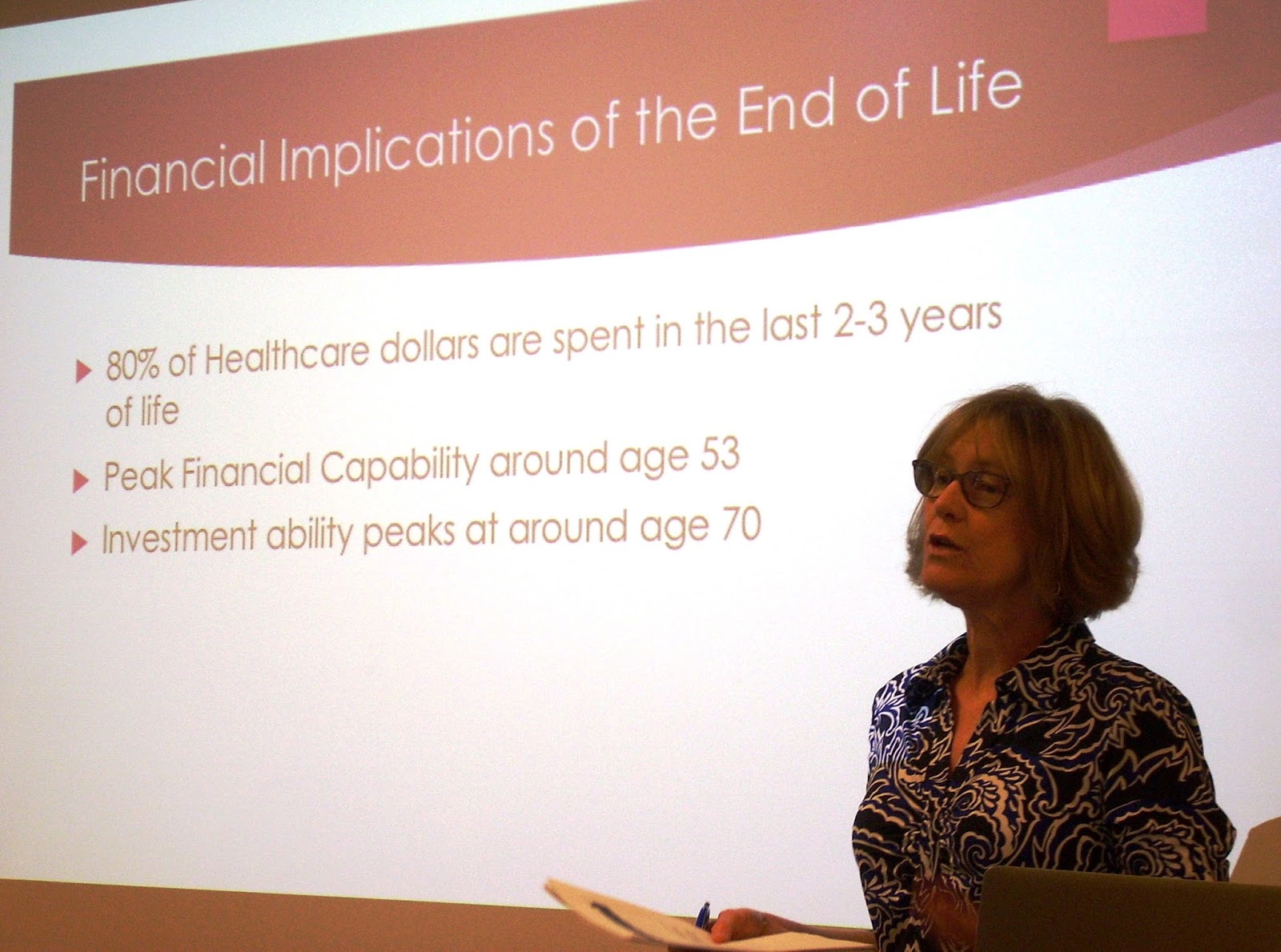
Chris Remedios, CFP, presented Preparing Financially for EOL
When I saw slide reading, “Peak financial capability around age 53,” I immediately thought yikes, should I continue working at a nonprofit? But then thought … Before I die, I want to do more advocacy to protect our safety net (Medicaid for long-term care, Medicare for hospice)! 


Opioid crisis update

Last month, President Trump declared the opioid crisis a public health emergency, with 140 Americans dying every day from opioid overdose.  Almost a third of Medicare patients—nearly 12 million people—were prescribed opioid painkillers by their physicians in 2016. Older adults are vulnerable when kidney and liver functions slow with age, increasing the time that drugs remain in their system and increasing the risk for overdose or addiction. 

This month, JAMA published research by Dr. Andrew Chang of Albany Medical Center, finding that opioids were no more effective in pain reduction than over-the-counter medications (ibuprofen-acetaminophen), after two hours in cases of arm or leg pain due to sprain, strain or fracture. 
The Opioid Epidemic in SF panel featured Paula Lum, MD, HIV PCP at UCSF; Terry Morris, Program Director at SF AIDS Foundation; Barry Zevin, MD, director of Street Medicine at SF DPH; Laura Thomas from Drug Policy Alliance; and Beth Stokes, Executive Director of Episcopal Community Services.  Take-aways:
  • Opioid addiction is a brain disease; it’s biological, and partly genetics. Stop placing blame on people with substance use disorders, and address the issue as an illness.  
  • Some people use drugs to feel good, but many people use drugs to feel less bad (as a coping mechanism).
  • Rather than calling someone an addict, use the term “opioid use disorder.” Language matters to reduce stigma so people are more willing to help and seek help. 
  • Buprenorphine and Methadone reduce drug use, but are tightly restricted in medical practice.
  • SF DPH’s harm reduction approach to reduce overdoses seeks to create safe, supervised spaces for people who use drugs.
  • Ask your pharmacist for Naloxone, the drug that reverses opioid use.
  • Defend the Affordable Care Act, which has increased treatment access for people with substance use disorders.