Sunday, April 27, 2014

Out and about

According to Traditional Chinese Medicine and permaculture principles, one should live in harmony with the natural cycles of the environment.  Spring is the time for growth, renewal and regeneration.  Following winter’s hibernation stage, it’s now time to get out of bed, stretch and move!
Afia Walking Tree and soul line dancing at Black Health & Healing Summit at SFSU

Transit Justice

One challenge of aging is the loss of mobility due to chronic conditions, loss of a driver’s license, safety or cost of transportation.  Older adults and persons with disabilities may feel stuck in their homes unless they have access to safe and affordable transportation options.  This month I joined Senior & Disability University for Transit Justice (Transito Justo) advocacy training at Valencia Gardens, which was attended mostly by seniors from nearby Centro Latino de San Francisco Community Center so information presented was bilingual English-Spanish, thanks to Flor who provided Spanish translation. 
Senior & Disability Action's Pi Ra (aka PiRaTransit when he worked for Paratransit Services) noted that San Francisco is changing, especially who the City is taking care of in the areas of transportation and housing.  These issues are related because private commuter shuttles that take tech workers living in the City to work in Silicon Valley clog Muni stops and drive up the price of nearby housing.  Long-time residents, mostly seniors, have experienced a high rate of evictions and rent increases, with the majority taking place within two blocks of the Apple/Google/Yahoo shuttle stops.  San Francisco is becoming expensive.  Pi asked, “If you can’t afford to ride the bus, you walk and get hit by a car—where’s the justice?”  Free Muni for seniors and adults with disabilities campaign would be modeled after Free Muni for Youth program providing bus passes for low- to moderate-income students. 
Community organizer from POWER inspired us with 5 strategies that worked for Free Muni for Youth campaign: 1) build base by organizing at and on bus and schools, 2) build coalition, 3) develop champion (Supervisor David Campos dedicated staff person), 4) build strong case with fact sheets, personal stories about problem, and 5) build pressure against the target at public events to get media attention.  He explained strategy to start small and gain something, so they started with youth who have no money of their own.  Free Muni for Youth pilot program that began last year will be permanent.
Oops, I arrived too late for April 15 SF MTA (Municipal Transportation Agency) HEARING ON FREE MUNI FOR SENIORS AND PEOPLE WITH DISABILITIES at City Hall, and ended up drawn to SEIU Local 1021 demonstration outside City Hall over economic inequality.  Nurses, caregivers and 911 dispatchers protested unsafe staffing levels.  Without enough nursing staff, dementia patients risk being tied in restraints to prevent falls or wandering. 
City workers seek fair pay to live in the communities they serve, and enough staffing to keep San Franciscans safe and healthy.  They say ending the tax break for Twitter and other tech companies in the mid-Market area would reduce the City’s deficit and free up funds for staffing and pay.

Though I missed the MTA hearing, I learned that the hearing room was packed and the MTA Board decided to revisit funding Free Muni for Seniors and Disabled in January.
Walk SF Executive Director Nicole Schneider and District 6 legislative aide Sunny Angula provided an overview of City and community responsibilities (SF MTA, SF County Transportation Authority, SF Police Department, SF Board of Supervisors, Walk SF, California Walks, Pedestrian Safety Advisory Committee, etc.); engineering, enforcement and education for pedestrian safety; Vision Zero plan to eliminate traffic deaths within a decade, which includes Walk First initiative to improve safety at 170 high-collision corridors in the City.  Top causes of collisions are speeding, red light running, not yielding to pedestrians in crosswalk, unsafe turning, and not coming to a complete stop at stop signs.  As of this month, 7 pedestrians have been killed in vehicle collisions in San Francisco; last year’s record was 21 pedestrians killed.  To add insult to injury, Bay Area drivers who kill pedestrians rarely face punishment.

Pi talked about lobbying strategies: letter writing, phone calling, public speaking (at hearings, rallies/demonstrations, community meetings), media (press conference, press release), petition, events, and visiting public official (do prep work—know issue, elected official, role-play presentation; and follow-up after presentation).

Buck Institute: Science of Aging

Aging is a complex process influenced by biological and psychosocial factors.  I advocate for behavioral justice, or empowering individuals with access to resources in their environment to support healthy behaviors and reduce health disparities.  This month, the Brookings Institute released its study showing that life expectancy gap between the rich and poor is growing in America, with life expectancy gaining most among the rich who live longer.  Millions of dollars have gone to San Francisco Bay Area institutions for research to “stop the aging process” and potentially increase healthspan, but I wonder if everyone will benefit or just the well-to-do who can afford cutting edge treatment?   
Gerontologist Hope Levy and I carpooled with my SFSU classmate Gabriela to visit Buck Institute for Research on Aging, which offers free, docent-led tours to the public on Thursday mornings.  Established in 1999 in Novato (30 miles north of San Francisco), Buck Institute’s mission is to extend healthspan through interdisciplinary research and education, focusing on age-related diseases like Alzheimer’s and Parkinson’s.  Its reception wall reads: 
I want to extend help towards the problems of the aged.--Beryl Hamilton Buck

 
We viewed Scientist as Artist exhibit in semi-circle shaped atrium with fruitless olive trees in planters.  Hope (at left) examines Chubby Angry Fat Cells, by Regina Brunauer, PhD, who researches the regenerative potential of adult stem cells from mice by staining fat tissue in red dye and cell nuclei in purple dye.  Gabriela (at right) stands in front of Astronomy of a Cell, by Shona Mookerjee, PhD, who studies insulin-secreting cells. 
The atrium skylight resembles I.M. Pei’s steel and glass pyramid at the Louvre. 
Architect I.M. Pei designed 5 structures, but only 3 have been built to date for 550 capacity.  Buck campus sits atop a rock foundation sturdy for scientific instruments, and surrounding land in deer-friendly natural state. 
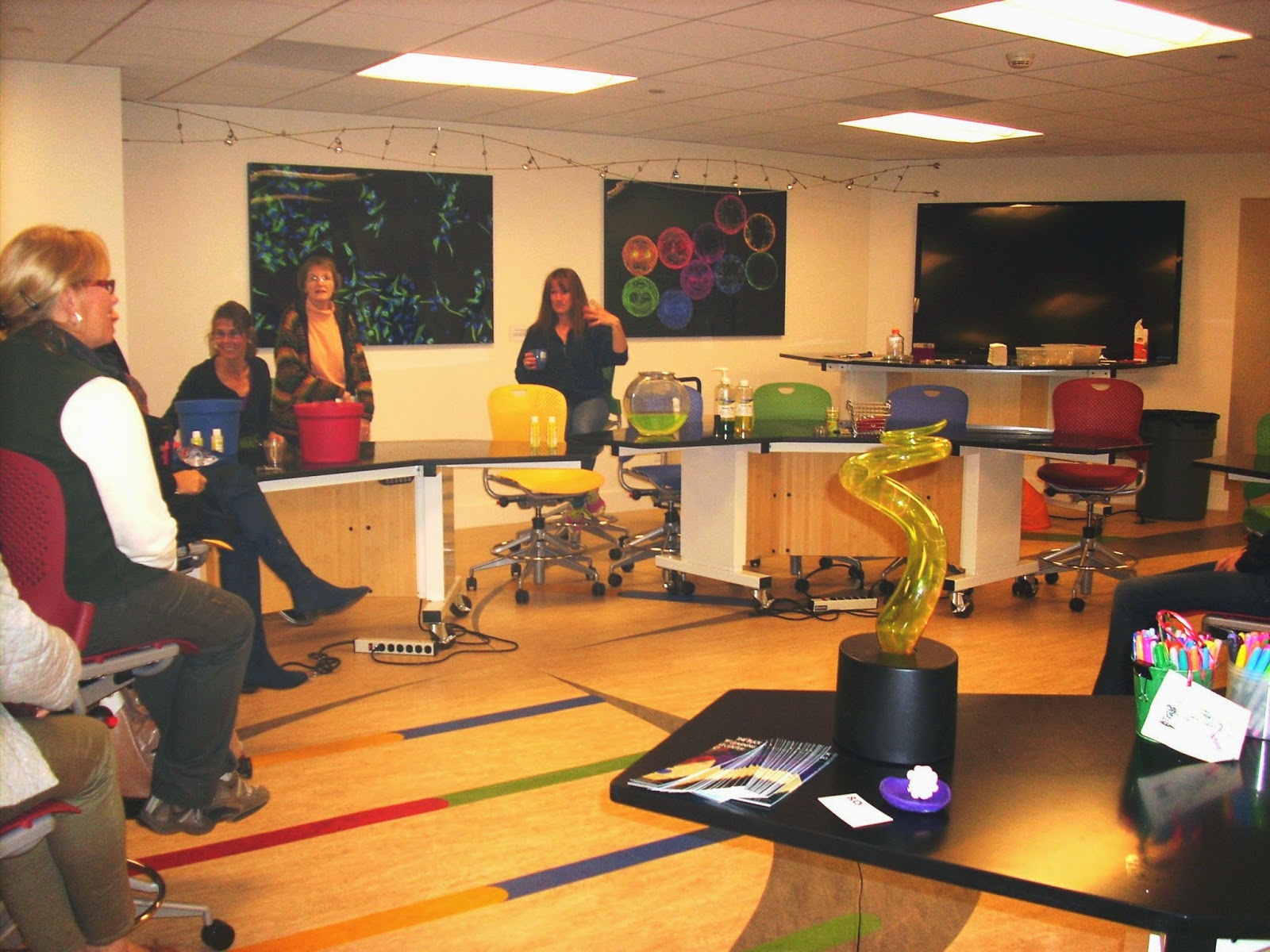
At Buck Learning Center, stem cell researcher Julie Mangada, PhD, talked about how models like fruit flies, yeast, worm, mice and water bears have genes similar to humans.  She mainly works with school kids, who are often surprised to meet a female scientist who’s also “darn cute” versus the stereotypical nerd.  
Buck staff kept referring to our gerontology group as the “UCSF group” so we had to repeatedly correct them that we’re from SFSU Gerontology Program! 
When adults ask Julie about the latest scientific cures for diseases, she explains that science is more about making connections and building information as illustrated in this poster, Systems Biology of Human Aging, from http://legendarypharma.com/chartbg.html.

Art of Aging Gracefully:  Heart Advice

This month’s JCCSF’s Art of Aging Gracefully featured speakers who were all women with topics on Sexual Health and Aging Woman, How to NOT Have a Heart Attack, Sleep in a Society that Never Sleeps, and Evidence-Based Look at Popular Dietary Supplements.  
Anne Thorson, MD from UCSF Center for Prevention of Heart and Vascular Disease, pointed to chart showing prevalence of high blood pressure in adults increases with age:  more than half of adults age 55 and older have high blood pressure.  Ideal cardiovascular health factors are:
  • Total cholesterol < 200 mg/dL
  • Blood pressure < 120/<80 mm Hg, untreated
  • Fasting blood sugar < 100 mg/dL, untreated
  • Body mass index < 25 kg/m2
  • Abstinence from smoking (never or quit > 12 months)
  • Physical activity at goal
  • DASH (Dietary Approach to Stop Hypertension)-like diet (or Mediterranean diet)
Dr. Thorson noted that ideal patients are rare—less than 5%--in most clinical practices.  I am the 5%!

On Lok:  Experience Matters in Senior Care
 
Joined Hope Levy’s Encore Adventures for field trip to On Lok Lifeways Rose Center, with On Lok shuttle service arranged by Daniel Frias-Vidal so we could experience what it’s like to be an adult day healthcare client for a day. 
Our group participated in Fit & Fun exercise led by a recreational therapist.  We also toured the physical therapy room, medical clinic (on-site optometrist, doctor, dentist, podiatrist, etc.), swimming pool with jet massage, laundry room, kitchen (“largest woks outside of Chinatown”), SRO housing and garden.  To respect client privacy, I was not allowed to take photos showing client faces, which was challenging so not many photos taken.  
We enjoyed Asian lunch of almond jelly, white rice, baked chicken, bok choy, tea and cranberry juice.  Though federal nutrition standards provide for at least half whole grains, older adults may have a harder time digesting brown rice (chewed by the mouthful 200 times by Macrobiotic practitioners) and heavy metals (arsenic, cadmium, mercury) tend to accumulate in bran and husk, which are polished off in processing white rice. After lunch, there was a slide presentation on Italy, which I missed because I had to leave for another appointment.

LGBT Aging

Sigma Phi Omega, our gerontology honor society, hosted LGBT Aging talks by graduate Loren Meissner and Professor Brian de Vries. 
Loren presented his study on HIV and Aging 
Professor Brian presented on LGBT Aging Challenges and Strengths, discussing stigma and discrimination, minority stress, strength and resilience (positive marginality). When Professor Brian talked about LGBT seniors asking “who will care for me?” in the absence of a spouse or children, I thought this was universal to never-married, childless seniors —a growing demographic, especially since personal finances (including maintaining rent-controlled housing) may be a factor in the decision to remain singleAs an introvert, I know I don’t want care in an institution so I looked at John Lam, On Lok Enrollment and Outreach Specialist, and said out loud, “On Lok will care for me!”  if I can afford its private pay rate of $5,400 per month, or impoverish myself by remaining in school while working part-time at a non-profit to qualify for Medi-Cal?

SFSU Graduate Showcase 
As part of our culminating experience, 25 classmates and I participated in SFSU Graduate Showcase presenting posters summarizing our research papers.  My subject, Chronic Disease Self-Management Program (CDSMP) and Behavioral Justice, was based on applying a systems approach to my work organizing CDSMP workshops. My 123-word abstract:
As an intervention to provide older adults with the tools to remain independent and “age in place,” the U.S. Administration on Aging funded the nationwide delivery of the evidence-based Chronic Disease Self-Management Program (CDSMP).  CDSMP is based on self-efficacy theory, which assumes people have individual responsibility and control over how they manage their health.  Behavior and the environment have a greater impact on health than genetics and medical care, yet low-income persons may not have access to resources in their environment to engage in health-promoting behaviors.  This paper explores the need to connect low-income participants in CDSMP with access to community resources to support their weekly action plans, based on a behavioral justice model for health promotion, aimed at potentially reducing health disparities.

My text-rich poster and I stood at the edge next to Gerontology, Engineering and Public Health so I could easily slip away to visit other posters.  I believe the permaculture principle, “Use edges and value the marginal: The interface between things is where the most interesting events take place.  These are often the most valuable, diverse and productive elements in the system.” I was commonly asked, “What is gerontology?” and I thought how the gerontology poster topics made aging seem like a host of problems: chronic disease self-management & behavioral justice (from yours truly), dementia, crisis of type 2 diabetes, elder abuse, problem gambling, medication adherence with major depressive disorder, reducing antipsychotic drugs in nursing home residents, sex in long-term care, etc.  Then I remembered the philosophy of permaculture: “The problem is the solution.”  I love systems thinking J!
 
Smiling classmates Maryann and Brittany stand beside Professor Anabel Pelham, who served as second reader for 9 classmates, generously volunteering her time this spring semester when she’s on sabbatical as part of her 5-year phased retirement under Faculty Early Retirement Plan.  Professor Brian took a break from grading our posters when he saw Edna James, SFSU gerontology alumna and Commission on Aging President.

In my paper, I acknowledge Edna who first told me about adapting CDSMP for cultural relevancy; Kay Strawder and Sheila James of San Francisco Office on Women’s Health for hosting Women’s Health Leadership Institute training last summer that led to my partnering with Aging & Disability Resource Center (Lolita Kintanar) for my Community Action Project; San Francisco Department of Aging & Adult Services and Administration for Community Living (ACL) for funding this invaluable work. I was happy that Edna and my ACL internship mentors came to Showcase!  
ACL Aging Services Program Specialist Anna Cwirko-Godycki and Legacy Film Festival on Aging Executive Director Sheila Malkind. 
SFSU Professor Darlene Yee chats with my ACL internship preceptor Darrick Lam. 

Gerontology dining table: note two men in our graduating class of 2014! 
Professor Brian is a raffle winner!

Careers in Aging 

Careers in Aging Week (CIAW) is an annual event that takes place the first full week in April on college campuses to promote careers in aging.  Though I missed this month’s event at SFSU due to my internship, I happily returned to University of San Francisco’s event which took place in the late afternoon so I could attend after work.  Two years ago after I attended USF’s CIAW event, which featured SFSU gerontology alumna Edie Yau, Director of Diversity and Inclusion at Alzheimer’s Association in Northern California, I applied to SFSU gerontology program and the rest is history.  This month I brought our SFSU gerontology program brochures to USF for interested attendees.  Wow, the room was packed, much credit to USF Professor Chris Thompson who offered extra credit to his kinesiology students for attending! 

Monday, March 31, 2014

This is what 60 looks like: ASA's Aging in America conference


At 60 years, American Society on Aging (ASA) is finally an older American under the Older Americans Act (OAA)!  More than 2,500 registrants, including yours truly, convened in sunny San Diego to celebrate ASA’s 60th anniversary and learn, network, eat and drink together.  It was a real challenge to select from more than 600 sessions, workshops, roundtables, peer groups, constituent groups, summits and other conference events.  
Throughout this year’s ASA conference, I wore these “HAVE A HJPPY DEATH” buttons, which I picked up from Dr. Aviva Boxer while I was volunteering as room monitor during her presentation Bonding Your Life Legacy.  Aviva said that aging baby boomers mean there will be more deaths, so we need to prepare for our legacy and think about getting our core life message in one line.  An online authority on end-of-life, she mentioned websites like deadsocial (schedule social media posts into the future) and liveson to manage digital legacies. 

Earlier this month, I attended a celebration of life to honor my 94-year-old landlord.  It was a lovely memorial service which included remembrances from family and friends that were heartfelt, funny and lengthy.  Now I wondered how to capture the essence of his 94 years of living in a single line message—though my clueless neighbors recalled “he didn’t allow pets.”  When I learned about his death, I called his landline telephone number only to reach his recorded message, “This is the Hallford residence,” and later suggested that his widow keep the recording because it’s like part of his legacy.  Sadly, Mr. Hallford did not have a HJPPY death but a pLinful one from an infection caused by botched surgery.  (Note: The 5th annual Dying Matters Awareness Week: You Only Die Once takes place May 12-18, 2014.)
Aviva bonding with her daughter Chelsea. 

Chronic Disease Self-Management Program (CDSMP)

Over two years ago, I became interested in adapting CDSMP to make it more relevant to different groups ever since our San Francisco Commission on Aging President Edna James told me this could be done while maintaining fidelity to Stanford’s evidence-based model, citing work done by Philadelphia’s Harvest Health: Translation of CDSMP for Older African Americans in a Senior Setting.  I work part-time organizing CDSMP workshops under a San Francisco Department of Aging and Adult Services (DAAS) grant that provides for targeting groups that have been identified as demonstrating the greatest economic and social need:  low-income, non- or limited-English speaking, minority, frail and Lesbian-Gay-Bisexual-Transgender (LGBT).  For my graduate culminating experience, I am researching and writing about adapting CDSMP to target low-income groups, based on a behavioral justice model (or providing universal access to resources needed to engage in health-promoting behaviors) to potentially reduce health disparities.  With this focus, I decided to attend sessions relating to CDSMP, health promotion, and senior poverty. 

CDSMP sustainability
 
National Council on Aging (NCOA)’s Howard Bedlin and Emily Dessen joined Administration for Community Living (ACL)’s Michele Boutaugh for Evaluation of Two National Initiatives Implementing and Sustaining Self-Management followed by Moving Toward a Sustainable Infrastructure for Delivery of Evidence-Based Programs.  Michele discussed ACL’s initiatives focused on scaling (marketing and partnerships) and sustaining (diversify funding and referrals) self-management and other evidence-based health promotion programs.  San Francisco’s CDSMP workshops are funded by a grant that runs through June 30, 2016, so it was helpful to learn about Medicare reimbursement for both CDSMP (health and behavior assessment) and Diabetes SMP (diabetes education). 
Monte Cimino, Programs Director at Curry Senior Center, which is a partner with San Francisco Healthier Living Coalition, mentioned that his Center’s clinic is a Medicare provider which will help to obtain Medicare reimbursement for its CDSMP workshops.  

Also in the audience was Oklahoma Department of Human Services Research Manager Zohre Salehezedeh, who presented Diabetes Self-Management Program Effectiveness in Preventive Care Practices in the previous afternoon (which I missed due to my volunteer duty).  It was great to finally meet and thank her in person because I had e-mailed her last year to obtain a copy of her study, The Impact of CDSMP on Nursing Home Residents, which was instrumental in convincing Jewish Home of San Francisco to host our CDSMP-Healthier Living workshop series for their residents, which included a couple of centenarians!

Tim explained that Medicare reimbursement requires additional infrastructure (including review and sign-off by RN, RD or pharmacist) to Stanford’s Diabetes SMP; and current reimbursement rates are up to $550 for 13 hours including medical nutrition therapy (MNT), and $340 without MNT.

CDSMP adaptations & translations
 
Diabetes Self-Management Programs: Best Practice Models of State Implementation for Diverse Populations was an interesting panel discussion on the challenges of reaching diverse groups with Stanford’s highly structured Diabetes SMP.  Tammi Pollum reported that Detroit Area Agency on Aging dropped Stanford’s Diabetes SMP due to cost, length and inflexibility, in favor of Merck's Conversation Map, another evidence-based program reimburseable under Medicare. Kristen Smith said San Diego's Aging and Independence Services offers CDSMP in English, Spanish, Somali, Tagalog, Vietnamese and Arabic.  Robin McConney of Chicago's Rush University Medical Center adapted Stanford Diabetes SMP to target African-American women in Health Legacy Program that features Diabetes SMP health education along with cardiovascular exercise, support group/counseling and hands-on meal planning/nutrition counseling; clinical measures are included to monitor progress.  Finally, Merlyn Puente's Health Foundation of South Florida partnered with organizations serving primary target populations to serve 35,000 older adults in 5 years: 50% Hispanic, 17% Black, 25% White, 4% Haitian and 4% Other; the completion rate was 76% for English language, and 88% for Spanish language.

I attended a couple of sessions presented by the award-winning Hawaii Healthy Aging Partnership (HHAP), which has successfully adapted its evidence-based programs for Asian and Pacific Islanders:  CDSMP and Diabetes SMP. 
Kokua Kalihi Valley Elder Services Program Director Merlita Compton and University of Hawaii at Manoa Public Health Researcher Michiyo Tomioka presented How Multicultural Elements Within Health Promotion Programs Facilitate Improved Health and QOL.  Merlita discussed the importance of hiring multi-lingual staff with ethnic backgrounds similar to clients; conducting focus groups; acknowledging all cultures; providing transportation to increase access; offering culturally appropriate food, music and dance.  She also works with Michiyo to collect data annually because testimonials are not enough for program evaluation. 
Kauai County Aging Executive Ludvina Takahashi, Maui County Aging and Disability Program Specialist Jo Reyes, and Michiyo presented Best Practices in Sustaining a Statewide Health Promotion Initiative to share strategies to sustain their evidence-based health promotion programs, despite shrinking grant opportunities.  HHAP charges for CDSMP lay leader training and requests participant donation of $10 per CDSMP session (though scholarships available for low-income), which seem to inspire greater commitment with an active leader pool and 82% completion rate! They involve participants in annual HAP Advocacy Day to visit legislators, asking them if they’ve had to care for an elderly relative, and then stating their support for evidence-based programs to improve health of older adults by sharing their own experience and providing data sheet showing cost savings.

Senior poverty: do something
 
National Senior Citizens Law Center’s Special Counsel Paul Nathanson and Executive Director Kevin Prindiville presented Let's Talk Senior Poverty: What Are We Doing About It?  The official poverty rate for seniors is 9%, but the supplemental poverty measure after factoring health costs is 15%; the supplemental poverty measure is higher in DC (26%) and California (20%).  Senior poverty is rising due to growing number of seniors, impact of long-term changes in the economy (stagnant wages, decline in defined benefit plans, growing income inequality) and recent economic downturn (unemployment among older adults, loss of housing equity, loss of savings). 
Yet public programs designed to blunt the impact of elder poverty rate haven’t been updated much.  Supplemental Security Income (SSI) supports two million of the poorest seniors (majority are women), lifting monthly income to maximum $721 (or 74% Federal Poverty Level), but a senior cannot have more than $2,000 in resources to be eligible, as the benefit rate and resource limit have been updated only modestly since 1972 when Nixon envisioned SSI as providing “a step out of poverty and toward a life of dignity and independence.”  (California provides $156 monthly supplement, but does not allow SSI recipients to receive CalFresh food stamps.)  NSLC is advocating for SSI Restoration Act of 2014 to increase eligibility by raising amounts (for resource limit, general income disregard, earned income disregard) and providing for annual adjustments to reflect inflation. 
DOMA Repeal Nine Months Later: Did It Work? U.S. Assistant Secretary for Aging Kathy Greenlee with Carroll Estes and Max Richtman, both from National Committee to Preserve Social Security and Medicare, discussed how implementation of Supreme Court’s decision repealing In Defense of Marriage Act (DOMA) affected LGBT families’ access to Social Security benefits compared to previous situation described in Living Outside the Safety Net: LGBT Families and Social Security.

San Francisco State University (SFSU) presence
SFSU gerontology classmates Lois, Mary, Diane and Tony seated at opening general session 
SFSU gerontology graduate student Tony Maglio and SFSU gerontology Professor Brian de Vries at their poster session on Motivational Interviewing to Improve Diabetes and Ambivalence Towards Treatment 
SFSU interior design graduate Merijane Lee presented her poster on Home Modifications: BabyBoomer Intentions for Aging in Place  
SFSU gerontology classmate Brittany: ASK ME! VOLUNTEER
 
SFSU Professor Brian and graduate Loren Meissner join ACRIA’s Mark Brennan-Ing and SAGE’s Aaron Tax in presentation on The Intersection of Research, Policy and Advocacy Issues Among Older LGBT and HIV+ Adults.  Professor Brian and Loren presented preliminary research findings in last year’s ASA poster session.

This SFSU presence reminds me that I have to get back to work on my culminating experience and brevity . . .so few more conference highlights:

Past & future 
MLK, Jr. Community Choir performed before opening general session 
19 years ago, ASA’s The Future of Aging session featured Ken Dychtwald, Betty Friedan, Bob Butler and Fernando Torres-Gil (then the first U.S. Assistant Secretary for Aging).
General Session—The Future of Aging:  Ken (pop gerontologist) and Fernando (UCLA Social Work Professor) return, but Joseph Coughlin of MIT’s Age Lab and Jo Ann Jenkins of AARP take the place of Friedan and Butler 
General Session—Veterans and Their Families included recognition to World War II veterans, including an original “Rosie the Riveter” who continues working for Boeing at age 94 because she has to “get out of the house”
 
Port of San Diego's Greatest Generation Walk  
The man, who claimed he was the sailor kissing a nurse in Times Square after World War II ended in famous Life magazine photo, recently died at age 86.
  
James and Jo of Maui County Office on Aging with palm trees behind

San Francisco-based Community Living rocks! Marie Jobling of Community Living Campaign and Darrick Lam of Administration for Community Living
Surprise! Jenn Chan, founder of San Francisco-based Senior Shower Project: A Novel Approach to Celebrating and Educating New Family Caregivers 

Technology 


Outliers: Who's Doing the Cool Stuff and What Difference Will It Make? featured The Patterson Foundation-funded Institute for the Ages, a non-profit based in Sarasota (oldest county in America, with 32% of its residents age 65+) that offers the market research services of its seniors to companies developing products and services to the growing senior consumer market.
General Session—Technology and the Quality of Older Life in the 21st Century 
SCAN Health Plan’s Delena Penner (also member of San Francisco Healthier Living Coalition) and Karen Richards presented on Gerotechnology: Using Interactive Technologies to Boost Intergenerational Communication

Diversity

Joined roundtable discussion on Fear of the Other: Managing Diverse Clients in a Segregated Culture to brainstorm strategies for developing greater acceptance of differences in a safe environment that respects everyone: communicating what’s appropriate ahead of time, posting reminders (table tents, posters) about acceptable behavior, correcting without shaming to protect everyone, organizing activities to move from fearing differences to understanding commonalities, showing films to start conversations versus lecturing, etc. 
American Geriatrics Society CEO (and former On Lok CEO) Jennie Chin Hansen speaks at Asian-American and Pacific Islander Best Practices and Networking 
APIs want their own Summit next year because conference presentations tend to focus on Whites, Blacks and Latinos.  My Hawaii colleagues and I felt so fortunate to have grown up in API/multi-ethnic-dominant place, and with enough beach time that we actually attended conference instead of going to San Diego beach! 
Diversity Summit:  Investing in the Future of Professionals in Aging—A Call to Action  Fernando Torres-Gil talked about how aging boomers might respond to the changing demographics of increasing non-white population, asking who are having the babies? Who will take care of us when we can’t? noting that Latinas are having the babies.  (This reminds me of Do it for Denmark campaign:  “There are not enough children being born to support an aging population . . .Can sex save Denmark’s future?”)  Fernando emphasized acculturation to be more effective participants in mainstream society, to learn English to navigate the country, yet retain own culture, as opposed to assimilation when one gives up ethnic heritage to join the melting pot because more assimilation is associated with being less healthy.
ACL Deputy Assistant Secretary of Aging Edwin L. Walker’s take-away message was that OAA funding is not keeping up with projected demand for services so need to change mindset that OAA provides "free services"; instead, Aging Network needs to be more entrepreneurial by partnering with health care providers and sell services.  In addition, he mentioned that plans for 2015 White House Conference on Aging (WHCoA) will maximize social media and technology to reach a more broad-based community, instead of sending the usual delegates chosen by Congress and Governors. (This month ACL's 2015 budget request to Congress included $3 million for WHCoA.)
Diversity Summit presenters discussed Affordable Care Act (ACA) enrollment challenges especially among Latinos and Pacific Islanders, engaging communities in interventions to reduce health disparities, providing culturally sensitive care, being vigilant against –isms and microagressions, etc.

One self-described “white, gay man” expressed his frustration at Diversity Summit, which focused on racial-ethnic diversity until one of the last presenters mentioned gay marriage.  Services and Advocacy for GLBT Elders (SAGE) Executive Director Michael Davis discussed the need for LGBT training for different care settings because LGBT elders faced official discrimination when being LGBT was considered a mental illness and crime, and "don’t ask, don’t tell, live and let live," creates obstacles to person-centered long-term care.  For example, the mentality not to appropriately ask if a client is LGBT means missing out on learning about a piece of one’s identity.  (This month San Francisco’s LGBT Aging Policy Task Force issued a report, LGBT Aging at the Golden Gate, which addresses these concerns with proposed solutions relating to data collection on gender identity/sexual orientation, cultural competency, access to health/social services/housing/legal services, etc.; page 13 of report acknowledges contribution of SFSU Professor Brian de Vries!)
Tai Chi for Arthritis creator Dr. Paul Lam got our Chi flowing at 7 am 
2013 Rosalinde Gilbert Reception for Innovations in Alzheimer's Disease honored San Francisco's The Genius of Marian documentary film by WeOwnTV.
 
ASA's popular webinar voice. . . er, host Steve Moore organized poster session: now we can match his smile to his voice :-)
What aging naturally looks like:  Feminine Transitions: A Photographic Celebration of Natural Beauty, by Alyscia Cunningham, shows the portraits of females from 7 weeks to 103 years of age, without make-up.


Brain Food: Bringing an Evidence-Based Nutrition Program to Assisted Living and Adult Day Health was a joint presentation by Amazing Place Executive Director Tracy Brown who worked to implement a brain-healthy meals plan at her senior facility with Nancy Emerson Lombardo, founder of Brain Health and Wellness CenterNancy developed Memory Preservation Nutrition Program (MNP)’s 6 guiding principles to reduce the risk, delay the onset and slow the progression of Alzheimer’s disease:
  1. increase amount & variety of anti-oxidants from plant foods (spices, leafy greens, nuts & seeds, whole grains, berries)
  2. increase omega-3s (fish, fish oil, flax seed); decrease omega-6s (corn oil)
  3. reduce inflammation (increase omega-3s, berries, greens, green tea)
  4. reduce insulin resistance (reduce sugar, eat complex carbs like whole grains)
  5. reduce LDL cholesterol & saturated fats; avoid trans fats
  6. assure adequate B, D, & E vitamins
Nancy believes drugs are not the answer and because the pathology of Alzheimer’s starts decades before symptoms appear, she promotes a healthy lifestyle program with nutrition at the centerpiece.  This can be a challenge due to lifestyle changes as we are more sedentary, have more work so less time to cook and grow our own foods, more stress so less sleep.  Her 11 brain healthy lifestyles are: nutrition & hydration; physical exercise; mental & cognitive stimulation; management of stress & depression; social engagement & support; sleep; balanced chi (energy); music & other creative arts; spiritual practices—pray, meditate, forgive, let go, be kind & loving, practice gratitude, be positive; humor, fun, laughter & joy; and sense of meaning & purpose in life.  She encouraged us to put nutrition into practice by offering us brain food samples like almonds and Trader Joe’s Oh my! omega trek mix.  Much thanks to ASA Project Coordinator Nancy Decia, for accommodating my request to volunteer as room monitor for this session (foodie that I am)!

Sam Beattie discusses how nutrition is a clinically proven intervention in many common chronic conditions in Nutrition Reconciliation: Critical for Chronic Condition Improvement and Successful Transitional Care   
Beth Burrough says home-delivered meal is the most requested service for patients in their homes, according to Aging & Disability Resource Center (ADRC) Care Transitions 
Aging's Not for Sissies: Guiding Seniors to Live Life to the Fullest presentation by vegetarian Seventh-day Adventists Rhonda Whitney and Marilyn Renk who discussed whole-person health CREATION (acronym for Choice, Rest, Environment, Activity, Trust, Interpersonal relationships, Outlook, Nutrition)

Never too late

After ASA conference ended, I returned to San Francisco for Meat Out
What senior vegetarians look like:  San Francisco Vegetarian Society President Dixie Mahy (80 years), Ann Wheat (almost 80), Patti Breitman (60), Mad Cowboy Howard Lyman (75), and Larry Wheat (80+).  Ann and Larry are owners of San Francisco’s premier vegan restaurant Millennium, which is their encore career following Larry’s retirement from managing a public accounting firm in Hawaii. 
Patti Breitman introduces her new book, Never Too Late to Go Vegan: The Over 50 Guide to Adopting and Thriving On a Plant Based Diet.   
Former President Bill Clinton went vegan at age 64, and reportedly his heart is “younger than it was 10 years ago.”  
Meat Out lunch prepared by Chef Patricia Allen Koot: plum and hazelnut kale salad, herbed polenta squares with vegetable ragu, Field Roast, and (not pictured) carob coconut cake 
Genius Albert Einstein was vegetarian