Showing posts with label diabetes. Show all posts

Sunday, October 30, 2016

Aging = living

San Francisco State University (SFSU)’s Gerontology Program has moved from the School of Social Work to the School of Public Affairs & Civic Engagement (PACE), which includes Criminal Justice Studies, Environmental Studies, Public Administration, and Urban Studies & Planning.  Earlier this month, I volunteered to participate in a focus group for PACE alumni, and I was the sole gerontology alum who showed up to explain, “What is gerontology?” Since gerontology is interdisciplinary, it could probably fit in anywhere in the College of Health & Social Sciences.  In fact, I tend to see the world through a gerontologist’s lens such that everything is related to aging; after all, aging=living!

Films 
Last month’s 6th Annual Legacy Film Festival on Aging at New People Cinema (which should have been renamed Old People Cinema J) featured diverse themes centered around The Art of Living (including The Presence Project), Who Cares? (A Letter From Fred), Deep Learning (The Family Dog), Generations; Memory; Life, Death and Love; and Gotta Dance! (Hip Hop-eration; check out TEDx talk by this dance troupe’s manager Billie Jordan). 
Legacy Film Festival Director Sheila Malkind, with Board Member Arlene Reiff, announced that Bradford (England), the world’s first UNESCO City of Film, will host its inaugural 3-day Golden Years Film Festival – Celebrate Life through Film, October 3-5, 2016, a free event featuring films from Sheila’s Legacy Film Series! 
Panel discussion with Snow Day: Life, Death, and Skiing documentary filmmakers and director Erica Milsom’s parents, and Wayne filmmaker Mario Galaretta, MD.  During Q&A, it was interesting to learn about Dr. Galaretta’s career change from neuroscience researcher to filmmaker! (So awesome to have filmmakers who are trained physicians, like Voices documentary filmmaker Gary Tsai, MD, because there is greater authenticity in their work featuring people experiencing disability/disease/death.)

For the past year, I have joined my friend Jane at free Hollywood movie screenings hosted by AARP’s Movies for Grownups, which have included Hello My Name Is Doris, Miles Ahead, My Big Fat Greek Wedding 2, Florence Foster Jenkins, and The Hollars.  As I prefer documentaries for greater authenticity, these Hollywood films featuring older adults seem to target audiences who want to escape reality.

Time 

Whenever my employer stresses doing more assessments and data entry (like bringing out my iPad to type during home visits with clients, which can be more challenging to maintain eye contact—done more easily when using pen to paper), I feel like a factory worker in a widget production line.  But then my clients appreciatively remind me that I actually spend more time with them than the average 15 minutes that doctors spend with patients.  Administrative work can take more time than being present for clients/patients.  This is a scary thought since the complexity of my clients’ lives (especially clients with dual diagnoses) demand more time.  For example, shorter doctor visits increase the likelihood that patients leave with a prescription for medication, rather than for more sustainable behavioral change — like eating more healthy and exercising.  In my work, I help fill the gaps by referring clients to health promotion resources like tips for home safety, fall prevention, smoking cessation, etc.  And I am always eager to learn to be a more effective advocate for my clients.

Food & Addiction

I was mesmerized by many presenters who were as engaging as the topic of UCSF’s conference, Food & Addiction: Environment, Policy & Individual Factors.  Fortunately, the busy doctors gave more than 15 minutes of their time J. None of the presenting doctors were geriatricians, but what they had to say applies throughout one’s life course and most of my clients continue to see their internists. 
Elissa Epel, PhD, noted for her research on the role of chronic stress on cellular aging and incorporating behavioral science into UCSF medical school curriculum, introduced renowned addiction medicine expert Mark S. Gold, MD.  
In his presentation, Food Addiction: How did we get here and where are we going? Dr. Gold, a self-described “itinerant food addict,” took a life review perspective of his academic pursuits based on food, “I like French fries, pizza and frozen custard” – attending Yale School of Medicine in New Haven for Pepe Pizzeria, and Washington University in St. Louis for Ted Drewe’s frozen custard! Dr. Gold’s 30+ years of addiction research has demonstrated similarities in the effects of drugs (tobacco, cocaine, opiates) and certain foods (fast food, sugar) on the brain and behavior.  Based on successful treatment of addictions to drugs, Dr. Gold is researching treatments for food addictions and hyperphagia.  
Drs. Dean Schillinger and Robert Lustig, sample paleo-friendly, gluten-free muffins from Muffin Revolution.  
Laura Schmidt, PhD, chaired session on Preventing Food Addiction in Vulnerable Populations, with George W. Albee’s prevention is better (than treatment) quote on screen: “No epidemic has ever been resolved by paying attention to the treatment of the affected individual.”  Schmidt’s view is that addictive substances, like sugar, should be regulated through taxation and limits on marketing and access. 
Dr. Schillinger, founder of UCSF Center for Vulnerable Populations, talked about his work with Youth Speaks through The Bigger Picture to combat the rising epidemic of type 2 diabetes (formerly known as adult-onset diabetes, but increasing in younger people). He showed spoken word video, Death Recipe, by San Francisco resident Erica McMath-Sheppard at age 16:

We eat like we still slaves
Cause back in the days we got what whites didn’t want
And now we got something called freedom of eat
But granny still chooses salt covered pigs feet
And mama still chooses KFC
And I still choose whatever is given to me …

(I thought about the 64-year-old grandmother who filed $20 million suit against KFC for false advertising because she paid $20 expecting bucket overflowing with chicken to feed the whole family, but only got ½ bucket; and KFC “helping” to fight breast cancer with pink buckets.) 
Nancy Adler, PhD, founder of UCSF’s Center for Health and Community, and Robert Lustig, MD, UCSF Professor of Pediatrics and President of the Institute for Responsible Nutrition, with power point summary of his What’s the real addiction? presentation on screen: “The only items in 'junk' food that are addictive are sugar and caffeine; but they are really food additives.”

[In Sugar: The Bitter Truth (2009), Dr. Lustig talked about turning around 40 years of mainstream nutrition belief that blamed fat v. sugar for dis-ease.  He declared sugar is toxic like alcohol and tobacco, urging us to reduce sugar consumption for public health.]

Last month, UCSF researchers Stanton Glantz, Cristin Kearns and Schmidt published an article in JAMA Internal Medicine about the sugar industry paying Harvard scientists to blame fat and cholesterol as dietary causes of coronary heart disease, while downplaying evidence that sugar consumption was a risk factor, about 50 years ago. This resulted in misleading a generation of baby boomers who counted calories (though all calories aren’t equal, according to Dr. Lustig), gave up eating saturated fats like butter (in favor of trans fat margarine or low-fat) and cholesterol-rich egg yolks (in favor of whites only).  Just as there should be more geriatric training among doctors, reliable and accurate nutrition science training is needed to promote healthy aging!

Communication 
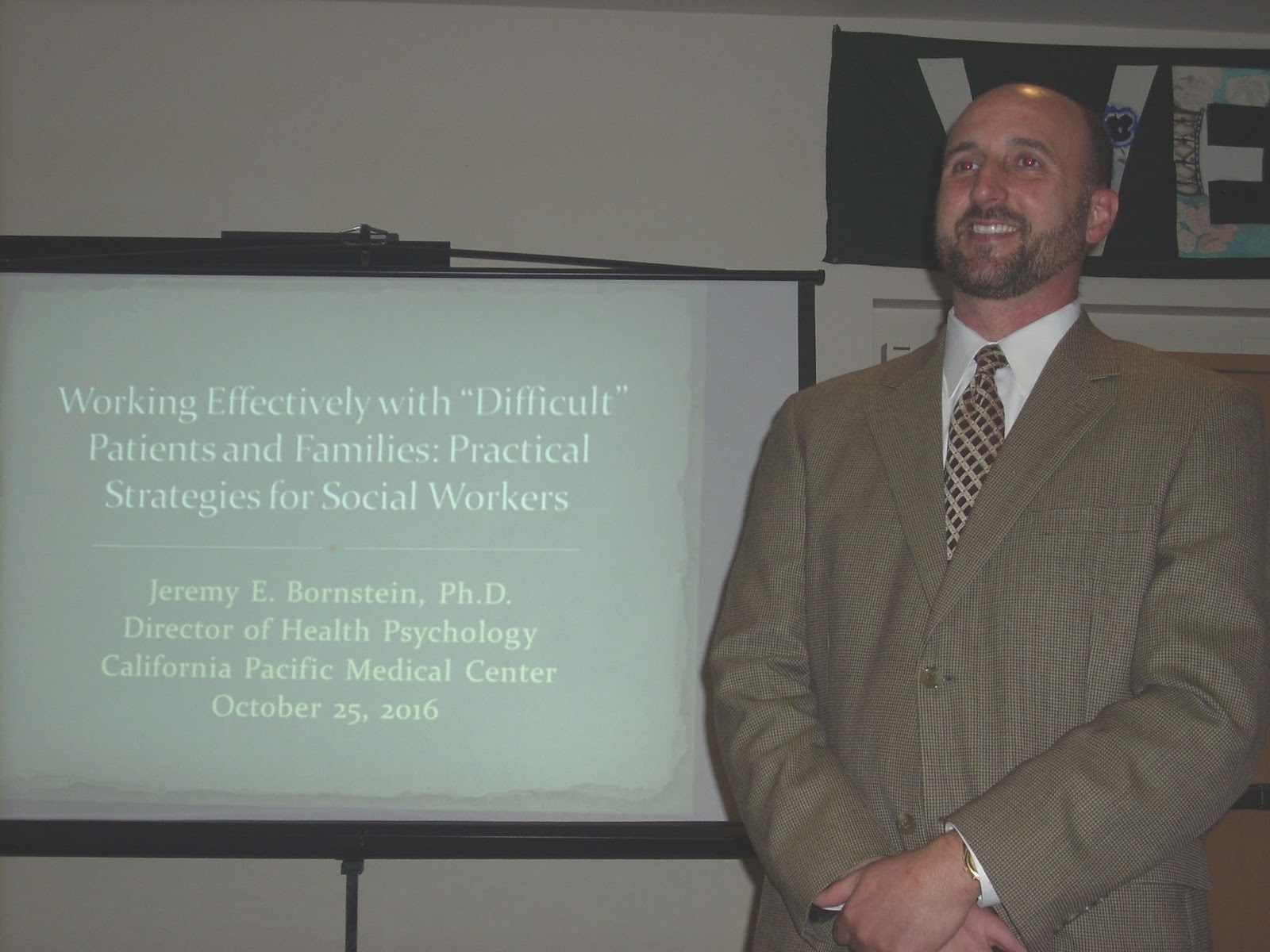
At Jewish Home, CPMC psychologist Jeremy Bornstein presented Effective Healthcare Communication with Difficult Patients and Families.  Key points:
  • “Difficult” is subjective assessment when one’s perceived skill is not up to challenge
  • “Difficult” is manageable by acknowledging level of challenge and looking for ways to increase skill
  • Get behind “difficult” behavior (e.g., aggressive, depressed, anxious) and address emotional needs with support, education and mental health resources
  • Develop rapport to understand underlying values, beliefs, goals and expectations
He reminded us of the Talmudic quote, “We don't see things as they are, we see them as we are.”

Eating for Health 
UCSF rheumatologist Cristina Lanata, MD, presented Update in Lupus Research at Lupus of Northern California’s Fall Conference.  Almost 2 million Americans suffer from lupus—more prevalent than AIDS, cerebral palsy, multiple sclerosis, sickle-cell anemia and cystic fibrosis combined.  Lupus mostly affects women, and is more common among women of African-American descent. (However, late-onset lupus after age 55 is more common among Caucasians.)  While 40% of lupus is transmitted genetically, the actual expression of genes is based on epigenetics or life-course exposures to external and internal stimuli. Exposures to smoking, asbestos and nail polish were associated with higher risk for lupus. Having a diagnosis of lupus is an opportunity for self-care. 
After Jessica Goldman Foung was diagnosed with lupus-related kidney failure 12 years ago, her doctors prescribed a low-sodium diet.  As she let go of sodium, she began focusing on all the healthier alternatives (replacing high sodium processed foods) and taking control – motivating her to learn cooking, inspiring her to share her adventures in her Sodium Girl blog, and rebranding low-sodium in her new book, Low-So Good: A Guide to Real Food, Big Flavor, and Less Sodium with 70 Amazing Recipes (May 2016).  Her zest for healthy living was apparent in her schedule of back-to-back health events: she had attended National Kidney Foundation’s Annual San Francisco Authors Luncheon prior to speaking at Lupus Conference!

At World Veg Festival, Shanta Nimbark Sacharoff introduced her new book, Other Avenues Are Possible: Legacy of the People’s Food System of the San Francisco Bay Area (September 2016). Shanta, an original member of Other Avenues Grocery, a worker-owned food co-op started in 1974, documented the rise of the “Food for People, Not Profit” movement that challenged agribusiness and supermarkets, and promoted healthy foods to local communities.  Long live SLOW (Seasonal, Local, Organic, Whole) food movement!
Speaking before an intergenerational audience at University of San Francisco, Filipino Food Movement Board Chairman PJ Quesada said that Filipinos need to get over tyranny of "authentic" food like "no one cooks better than grandma," particularly since Filipino cuisine is “fusion” with influences from Spanish and Chinese.
SFSU History Professor Dawn Mabalon noted difference between fusion and whitewashing food, criticizing Bon Appetit’s “Ode to Halo Halo” made with gummi bears and popcorn.  This was a very timely topic as I have been working with a client, first generation Filipino-American who may outlive her retirement savings if she continues paying $250 per month for her daily dish of authentically prepared Filipino food (which supplements her 2 home-delivered Western meals)--so we are exploring options like persuading her IHSS worker to cook authentic Filipino meals since my client can no longer cook for herself.
  

Pork tocino buns & arroz caldo from F.O.B. Kitchen Chef Janice Dulce


Senior Prom 
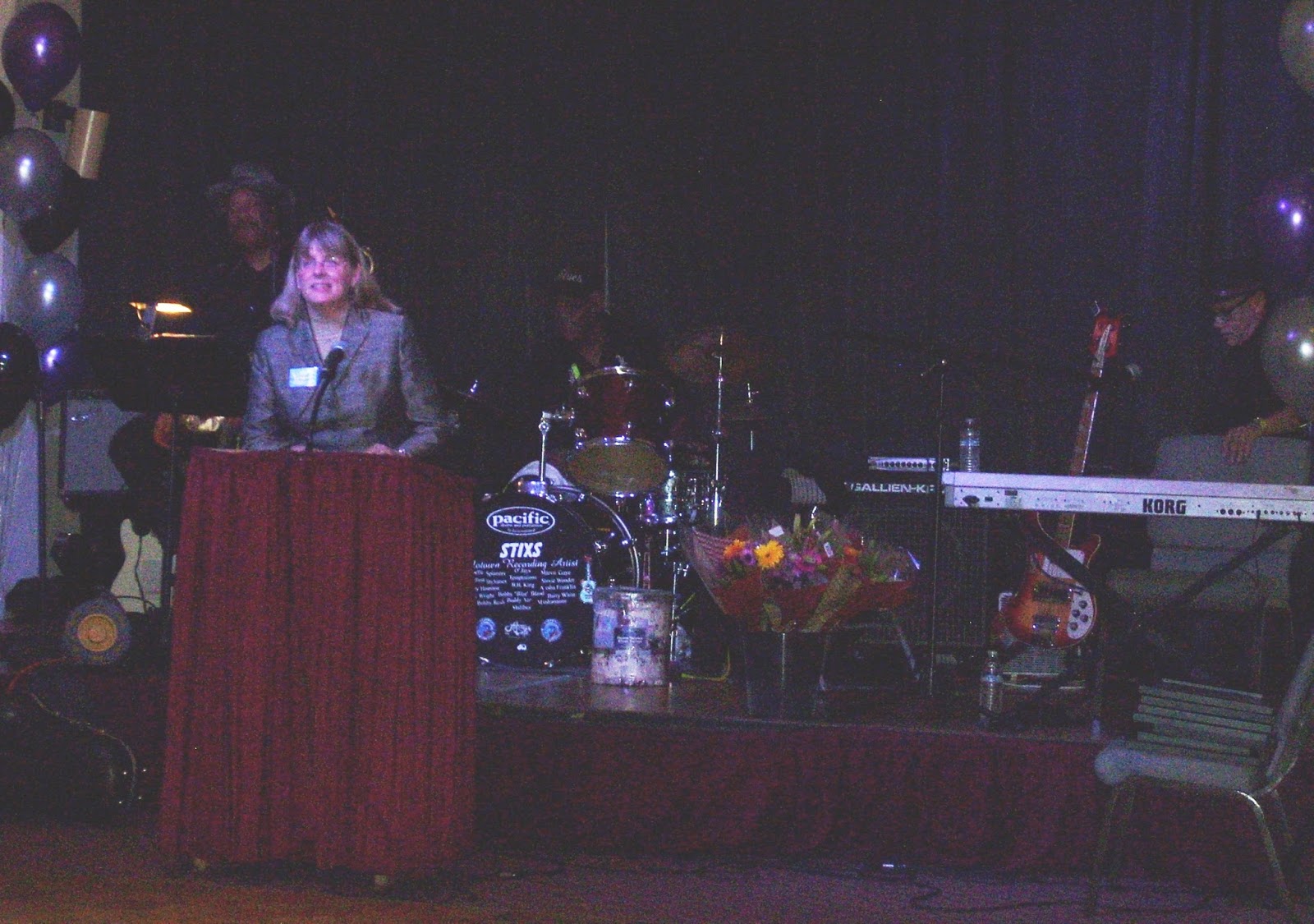
The Village Project’s A Senior Moment: Senior Prom for the 50+ featured entertainment by West Coast Blues Society and awards presentation by Bayview Senior Services Executive Director Cathy Davis. 
Senior Prom honorees with Supervisor London Breed, who said she preferred oldies but goodies music over her generation’s music with “swear words”! 
Aging Commission President Edna James got into the picture! 
Healthy plate of mostly plant foods.

Monday, March 31, 2014

This is what 60 looks like: ASA's Aging in America conference


At 60 years, American Society on Aging (ASA) is finally an older American under the Older Americans Act (OAA)!  More than 2,500 registrants, including yours truly, convened in sunny San Diego to celebrate ASA’s 60th anniversary and learn, network, eat and drink together.  It was a real challenge to select from more than 600 sessions, workshops, roundtables, peer groups, constituent groups, summits and other conference events.  
Throughout this year’s ASA conference, I wore these “HAVE A HJPPY DEATH” buttons, which I picked up from Dr. Aviva Boxer while I was volunteering as room monitor during her presentation Bonding Your Life Legacy.  Aviva said that aging baby boomers mean there will be more deaths, so we need to prepare for our legacy and think about getting our core life message in one line.  An online authority on end-of-life, she mentioned websites like deadsocial (schedule social media posts into the future) and liveson to manage digital legacies. 

Earlier this month, I attended a celebration of life to honor my 94-year-old landlord.  It was a lovely memorial service which included remembrances from family and friends that were heartfelt, funny and lengthy.  Now I wondered how to capture the essence of his 94 years of living in a single line message—though my clueless neighbors recalled “he didn’t allow pets.”  When I learned about his death, I called his landline telephone number only to reach his recorded message, “This is the Hallford residence,” and later suggested that his widow keep the recording because it’s like part of his legacy.  Sadly, Mr. Hallford did not have a HJPPY death but a pLinful one from an infection caused by botched surgery.  (Note: The 5th annual Dying Matters Awareness Week: You Only Die Once takes place May 12-18, 2014.)
Aviva bonding with her daughter Chelsea. 

Chronic Disease Self-Management Program (CDSMP)

Over two years ago, I became interested in adapting CDSMP to make it more relevant to different groups ever since our San Francisco Commission on Aging President Edna James told me this could be done while maintaining fidelity to Stanford’s evidence-based model, citing work done by Philadelphia’s Harvest Health: Translation of CDSMP for Older African Americans in a Senior Setting.  I work part-time organizing CDSMP workshops under a San Francisco Department of Aging and Adult Services (DAAS) grant that provides for targeting groups that have been identified as demonstrating the greatest economic and social need:  low-income, non- or limited-English speaking, minority, frail and Lesbian-Gay-Bisexual-Transgender (LGBT).  For my graduate culminating experience, I am researching and writing about adapting CDSMP to target low-income groups, based on a behavioral justice model (or providing universal access to resources needed to engage in health-promoting behaviors) to potentially reduce health disparities.  With this focus, I decided to attend sessions relating to CDSMP, health promotion, and senior poverty. 

CDSMP sustainability
 
National Council on Aging (NCOA)’s Howard Bedlin and Emily Dessen joined Administration for Community Living (ACL)’s Michele Boutaugh for Evaluation of Two National Initiatives Implementing and Sustaining Self-Management followed by Moving Toward a Sustainable Infrastructure for Delivery of Evidence-Based Programs.  Michele discussed ACL’s initiatives focused on scaling (marketing and partnerships) and sustaining (diversify funding and referrals) self-management and other evidence-based health promotion programs.  San Francisco’s CDSMP workshops are funded by a grant that runs through June 30, 2016, so it was helpful to learn about Medicare reimbursement for both CDSMP (health and behavior assessment) and Diabetes SMP (diabetes education). 
Monte Cimino, Programs Director at Curry Senior Center, which is a partner with San Francisco Healthier Living Coalition, mentioned that his Center’s clinic is a Medicare provider which will help to obtain Medicare reimbursement for its CDSMP workshops.  

Also in the audience was Oklahoma Department of Human Services Research Manager Zohre Salehezedeh, who presented Diabetes Self-Management Program Effectiveness in Preventive Care Practices in the previous afternoon (which I missed due to my volunteer duty).  It was great to finally meet and thank her in person because I had e-mailed her last year to obtain a copy of her study, The Impact of CDSMP on Nursing Home Residents, which was instrumental in convincing Jewish Home of San Francisco to host our CDSMP-Healthier Living workshop series for their residents, which included a couple of centenarians!

Tim explained that Medicare reimbursement requires additional infrastructure (including review and sign-off by RN, RD or pharmacist) to Stanford’s Diabetes SMP; and current reimbursement rates are up to $550 for 13 hours including medical nutrition therapy (MNT), and $340 without MNT.

CDSMP adaptations & translations
 
Diabetes Self-Management Programs: Best Practice Models of State Implementation for Diverse Populations was an interesting panel discussion on the challenges of reaching diverse groups with Stanford’s highly structured Diabetes SMP.  Tammi Pollum reported that Detroit Area Agency on Aging dropped Stanford’s Diabetes SMP due to cost, length and inflexibility, in favor of Merck's Conversation Map, another evidence-based program reimburseable under Medicare. Kristen Smith said San Diego's Aging and Independence Services offers CDSMP in English, Spanish, Somali, Tagalog, Vietnamese and Arabic.  Robin McConney of Chicago's Rush University Medical Center adapted Stanford Diabetes SMP to target African-American women in Health Legacy Program that features Diabetes SMP health education along with cardiovascular exercise, support group/counseling and hands-on meal planning/nutrition counseling; clinical measures are included to monitor progress.  Finally, Merlyn Puente's Health Foundation of South Florida partnered with organizations serving primary target populations to serve 35,000 older adults in 5 years: 50% Hispanic, 17% Black, 25% White, 4% Haitian and 4% Other; the completion rate was 76% for English language, and 88% for Spanish language.

I attended a couple of sessions presented by the award-winning Hawaii Healthy Aging Partnership (HHAP), which has successfully adapted its evidence-based programs for Asian and Pacific Islanders:  CDSMP and Diabetes SMP. 
Kokua Kalihi Valley Elder Services Program Director Merlita Compton and University of Hawaii at Manoa Public Health Researcher Michiyo Tomioka presented How Multicultural Elements Within Health Promotion Programs Facilitate Improved Health and QOL.  Merlita discussed the importance of hiring multi-lingual staff with ethnic backgrounds similar to clients; conducting focus groups; acknowledging all cultures; providing transportation to increase access; offering culturally appropriate food, music and dance.  She also works with Michiyo to collect data annually because testimonials are not enough for program evaluation. 
Kauai County Aging Executive Ludvina Takahashi, Maui County Aging and Disability Program Specialist Jo Reyes, and Michiyo presented Best Practices in Sustaining a Statewide Health Promotion Initiative to share strategies to sustain their evidence-based health promotion programs, despite shrinking grant opportunities.  HHAP charges for CDSMP lay leader training and requests participant donation of $10 per CDSMP session (though scholarships available for low-income), which seem to inspire greater commitment with an active leader pool and 82% completion rate! They involve participants in annual HAP Advocacy Day to visit legislators, asking them if they’ve had to care for an elderly relative, and then stating their support for evidence-based programs to improve health of older adults by sharing their own experience and providing data sheet showing cost savings.

Senior poverty: do something
 
National Senior Citizens Law Center’s Special Counsel Paul Nathanson and Executive Director Kevin Prindiville presented Let's Talk Senior Poverty: What Are We Doing About It?  The official poverty rate for seniors is 9%, but the supplemental poverty measure after factoring health costs is 15%; the supplemental poverty measure is higher in DC (26%) and California (20%).  Senior poverty is rising due to growing number of seniors, impact of long-term changes in the economy (stagnant wages, decline in defined benefit plans, growing income inequality) and recent economic downturn (unemployment among older adults, loss of housing equity, loss of savings). 
Yet public programs designed to blunt the impact of elder poverty rate haven’t been updated much.  Supplemental Security Income (SSI) supports two million of the poorest seniors (majority are women), lifting monthly income to maximum $721 (or 74% Federal Poverty Level), but a senior cannot have more than $2,000 in resources to be eligible, as the benefit rate and resource limit have been updated only modestly since 1972 when Nixon envisioned SSI as providing “a step out of poverty and toward a life of dignity and independence.”  (California provides $156 monthly supplement, but does not allow SSI recipients to receive CalFresh food stamps.)  NSLC is advocating for SSI Restoration Act of 2014 to increase eligibility by raising amounts (for resource limit, general income disregard, earned income disregard) and providing for annual adjustments to reflect inflation. 
DOMA Repeal Nine Months Later: Did It Work? U.S. Assistant Secretary for Aging Kathy Greenlee with Carroll Estes and Max Richtman, both from National Committee to Preserve Social Security and Medicare, discussed how implementation of Supreme Court’s decision repealing In Defense of Marriage Act (DOMA) affected LGBT families’ access to Social Security benefits compared to previous situation described in Living Outside the Safety Net: LGBT Families and Social Security.

San Francisco State University (SFSU) presence
SFSU gerontology classmates Lois, Mary, Diane and Tony seated at opening general session 
SFSU gerontology graduate student Tony Maglio and SFSU gerontology Professor Brian de Vries at their poster session on Motivational Interviewing to Improve Diabetes and Ambivalence Towards Treatment 
SFSU interior design graduate Merijane Lee presented her poster on Home Modifications: BabyBoomer Intentions for Aging in Place  
SFSU gerontology classmate Brittany: ASK ME! VOLUNTEER
 
SFSU Professor Brian and graduate Loren Meissner join ACRIA’s Mark Brennan-Ing and SAGE’s Aaron Tax in presentation on The Intersection of Research, Policy and Advocacy Issues Among Older LGBT and HIV+ Adults.  Professor Brian and Loren presented preliminary research findings in last year’s ASA poster session.

This SFSU presence reminds me that I have to get back to work on my culminating experience and brevity . . .so few more conference highlights:

Past & future 
MLK, Jr. Community Choir performed before opening general session 
19 years ago, ASA’s The Future of Aging session featured Ken Dychtwald, Betty Friedan, Bob Butler and Fernando Torres-Gil (then the first U.S. Assistant Secretary for Aging).
General Session—The Future of Aging:  Ken (pop gerontologist) and Fernando (UCLA Social Work Professor) return, but Joseph Coughlin of MIT’s Age Lab and Jo Ann Jenkins of AARP take the place of Friedan and Butler.  
General Session—Veterans and Their Families included recognition to World War II veterans, including an original “Rosie the Riveter” who continues working for Boeing at age 94 because she has to “get out of the house”
 
Port of San Diego's Greatest Generation Walk  
The man, who claimed he was the sailor kissing a nurse in Times Square after World War II ended in famous Life magazine photo, recently died at age 86.
  
James and Jo of Maui County Office on Aging with palm trees behind

San Francisco-based Community Living rocks! Marie Jobling of Community Living Campaign and Darrick Lam of Administration for Community Living
Surprise! Jenn Chan, founder of San Francisco-based Senior Shower Project: A Novel Approach to Celebrating and Educating New Family Caregivers 

Technology 


Outliers: Who's Doing the Cool Stuff and What Difference Will It Make? featured The Patterson Foundation-funded Institute for the Ages, a non-profit based in Sarasota (oldest county in America, with 32% of its residents age 65+) that offers the market research services of its seniors to companies developing products and services to the growing senior consumer market.
General Session—Technology and the Quality of Older Life in the 21st Century 
SCAN Health Plan’s Delena Penner (also member of San Francisco Healthier Living Coalition) and Karen Richards presented on Gerotechnology: Using Interactive Technologies to Boost Intergenerational Communication

Diversity

Joined roundtable discussion on Fear of the Other: Managing Diverse Clients in a Segregated Culture to brainstorm strategies for developing greater acceptance of differences in a safe environment that respects everyone: communicating what’s appropriate ahead of time, posting reminders (table tents, posters) about acceptable behavior, correcting without shaming to protect everyone, organizing activities to move from fearing differences to understanding commonalities, showing films to start conversations versus lecturing, etc. 
American Geriatrics Society CEO (and former On Lok CEO) Jennie Chin Hansen speaks at Asian-American and Pacific Islander Best Practices and Networking 
APIs want their own Summit next year because conference presentations tend to focus on Whites, Blacks and Latinos.  My Hawaii colleagues and I felt so fortunate to have grown up in API/multi-ethnic-dominant place, and with enough beach time that we actually attended conference instead of going to San Diego beach! 
Diversity Summit:  Investing in the Future of Professionals in Aging—A Call to Action  Fernando Torres-Gil talked about how aging boomers might respond to the changing demographics of increasing non-white population, asking who are having the babies? Who will take care of us when we can’t? noting that Latinas are having the babies.  (This reminds me of Do it for Denmark campaign:  “There are not enough children being born to support an aging population . . .Can sex save Denmark’s future?”)  Fernando emphasized acculturation to be more effective participants in mainstream society, to learn English to navigate the country, yet retain own culture, as opposed to assimilation when one gives up ethnic heritage to join the melting pot because more assimilation is associated with being less healthy.
ACL Deputy Assistant Secretary of Aging Edwin L. Walker’s take-away message was that OAA funding is not keeping up with projected demand for services so need to change mindset that OAA provides "free services"; instead, Aging Network needs to be more entrepreneurial by partnering with health care providers and sell services.  In addition, he mentioned that plans for 2015 White House Conference on Aging (WHCoA) will maximize social media and technology to reach a more broad-based community, instead of sending the usual delegates chosen by Congress and Governors. (This month ACL's 2015 budget request to Congress included $3 million for WHCoA.)
Diversity Summit presenters discussed Affordable Care Act (ACA) enrollment challenges especially among Latinos and Pacific Islanders, engaging communities in interventions to reduce health disparities, providing culturally sensitive care, being vigilant against –isms and microagressions, etc.

One self-described “white, gay man” expressed his frustration at Diversity Summit, which focused on racial-ethnic diversity until one of the last presenters mentioned gay marriage.  Services and Advocacy for GLBT Elders (SAGE) Executive Director Michael Davis discussed the need for LGBT training for different care settings because LGBT elders faced official discrimination when being LGBT was considered a mental illness and crime, and "don’t ask, don’t tell, live and let live," creates obstacles to person-centered long-term care.  For example, the mentality not to appropriately ask if a client is LGBT means missing out on learning about a piece of one’s identity.  (This month San Francisco’s LGBT Aging Policy Task Force issued a report, LGBT Aging at the Golden Gate, which addresses these concerns with proposed solutions relating to data collection on gender identity/sexual orientation, cultural competency, access to health/social services/housing/legal services, etc.; page 13 of report acknowledges contribution of SFSU Professor Brian de Vries!)
Tai Chi for Arthritis creator Dr. Paul Lam got our Chi flowing at 7 am 
2013 Rosalinde Gilbert Reception for Innovations in Alzheimer's Disease honored San Francisco's The Genius of Marian documentary film by WeOwnTV.
 
ASA's popular webinar voice. . . er, host Steve Moore organized poster session: now we can match his smile to his voice :-)
What aging naturally looks like:  Feminine Transitions: A Photographic Celebration of Natural Beauty, by Alyscia Cunningham, shows the portraits of females from 7 weeks to 103 years of age, without make-up.


Brain Food: Bringing an Evidence-Based Nutrition Program to Assisted Living and Adult Day Health was a joint presentation by Amazing Place Executive Director Tracy Brown who worked to implement a brain-healthy meals plan at her senior facility with Nancy Emerson Lombardo, founder of Brain Health and Wellness Center.  Nancy developed Memory Preservation Nutrition Program (MNP)’s 6 guiding principles to reduce the risk, delay the onset and slow the progression of Alzheimer’s disease:
  1. increase amount & variety of anti-oxidants from plant foods (spices, leafy greens, nuts & seeds, whole grains, berries)
  2. increase omega-3s (fish, fish oil, flax seed); decrease omega-6s (corn oil)
  3. reduce inflammation (increase omega-3s, berries, greens, green tea)
  4. reduce insulin resistance (reduce sugar, eat complex carbs like whole grains)
  5. reduce LDL cholesterol & saturated fats; avoid trans fats
  6. assure adequate B, D, & E vitamins
Nancy believes drugs are not the answer and because the pathology of Alzheimer’s starts decades before symptoms appear, she promotes a healthy lifestyle program with nutrition at the centerpiece.  This can be a challenge due to lifestyle changes as we are more sedentary, have more work so less time to cook and grow our own foods, more stress so less sleep.  Her 11 brain healthy lifestyles are: nutrition & hydration; physical exercise; mental & cognitive stimulation; management of stress & depression; social engagement & support; sleep; balanced chi (energy); music & other creative arts; spiritual practices—pray, meditate, forgive, let go, be kind & loving, practice gratitude, be positive; humor, fun, laughter & joy; and sense of meaning & purpose in life.  She encouraged us to put nutrition into practice by offering us brain food samples like almonds and Trader Joe’s Oh my! omega trek mix.  Much thanks to ASA Project Coordinator Nancy Decia, for accommodating my request to volunteer as room monitor for this session (foodie that I am)!

Sam Beattie discusses how nutrition is a clinically proven intervention in many common chronic conditions in Nutrition Reconciliation: Critical for Chronic Condition Improvement and Successful Transitional Care   
Beth Burrough says home-delivered meal is the most requested service for patients in their homes, according to Aging & Disability Resource Center (ADRC) Care Transitions 
Aging's Not for Sissies: Guiding Seniors to Live Life to the Fullest presentation by vegetarian Seventh-day Adventists Rhonda Whitney and Marilyn Renk who discussed whole-person health CREATION (acronym for Choice, Rest, Environment, Activity, Trust, Interpersonal relationships, Outlook, Nutrition)

Never too late

After ASA conference ended, I returned to San Francisco for Meat Out. 
What senior vegetarians look like:  San Francisco Vegetarian Society President Dixie Mahy (80 years), Ann Wheat (almost 80), Patti Breitman (60), Mad Cowboy Howard Lyman (75), and Larry Wheat (80+).  Ann and Larry are owners of San Francisco’s premier vegan restaurant Millennium, which is their encore career following Larry’s retirement from managing a public accounting firm in Hawaii. 
Patti Breitman introduces her new book, Never Too Late to Go Vegan: The Over 50 Guide to Adopting and Thriving On a Plant Based Diet.   
Former President Bill Clinton went vegan at age 64, and reportedly his heart is “younger than it was 10 years ago.”  
Meat Out lunch prepared by Chef Patricia Allen Koot: plum and hazelnut kale salad, herbed polenta squares with vegetable ragu, Field Roast, and (not pictured) carob coconut cake 
Genius Albert Einstein was vegetarian.