Hawaii has its own time zone, Hawaiian Standard Time,
which lags two and five hours behind Pacific Standard Time (west coast) and
Eastern Standard Time (east coast) in the continental U.S. In my small kid time in Hawaii,
this lag made me want to move ahead by joining the brain drain in
the mainland.
Fast forward, decades
later after working time-pressured billable hours and traveling around the
world’s time zones, I now cherish time to slow down. Last year, I was amused to learn if you want time to slow down, become a student again because greater cognitive demands of a task slow our
perception of time.

I registered for Hawaii
Pacific Gerontological Society’s 18th Biennial Conference, Imagine 2030: Mobilizing our Communities Across Generations, at Waikiki Beach and Resort. This two-day Conference schedule featured local
and national speakers; three concurrent sessions with no more than three
choices (not including Falls Prevention Track offered throughout Day 1);
roundtable and brainstorming in small groups; all-you-can-eat breakfast and
lunch; EnhanceFitness exercise activities; and several breaks for informal
networking (including three designated for visiting Exhibitors on Day 2) or
beach time J!
Waikiki Beach time with bronze surfer dude Duke Paoa Kahinu Mokoe Hulikohola Kahanamoku (1890-1968), a high school drop-out (to help support family) and five-time
Olympic medalist in swimming. There is a
webcam watching this statue,
so visitors can shaka sign (hang loose), as popularized by Uncle Barry J!
Mon.
9/29
7:30am
Registration Opens
8:30am
Welcome & Opening Remarks
8:45am
Keynote Address
Sacramento-based AARP
President Jeannine English delivered the Conference keynote address, Age-Friendly Cities: Livable Communities
For All Generations. She noted that urban Honolulu
has the highest percentage of population age 85+ and among the highest
percentage of population age 65+ in the nation (3.5% and 17.8%, respectively, according to 2010 U.S. Census). She talked about supporting older adults’
independence, choice and control through initiatives like the Age-Friendly City Partnership with the
City and County
of Honolulu and AARP, and
caregiving assistance.
English noted that Hawaii has the nation’s worst older pedestrian death rate, and AARP Hawaii was involved in
advocating for Complete Streets policies to design streets safer for all users.
In addition, AARP Public Policy Institute has developed a Livability Index incorporating features like transportation, housing and land use.
AARP’s recent Livable Communities Survey in Honolulu, Hawaii of Adults Age 45+ ranked affordable home healthcare as
the top concern. Hawaii has 247,000 unpaid caregivers who provide
162 million hours of care valued at $2 billion a year. Hawaii’s
average caregiver is age 62, female, married with at least a two-year college degree,
and juggles work and caregiving. AARP
has done education, research and advocacy around workplace policies like
flexible schedules and family leave to enable caregivers to do all jobs; this
has resulted in enhanced productivity, lowered absenteeism and increased
recruitment. In Hawaii,
the cost of care for a private nursing home room is $135K per year, or greater
than the cost of four years at University
of Hawaii (tuition &
fees, room & board, books/supplies & expenses). Hawaii
also ranks last in number of nursing beds.
Two-thirds of Hawaii
residents are not confident paying cost of one year at a nursing home.

English presented $5,000
check, a donation of her conference speaking fee, payable to Age-Friendly
Honolulu, which was accepted by Honolulu Mayor Kirk Caldwell with AARP Hawaii
Executive Director Barbara Kim Stanton included in this photo-op. Nice segue to
next speaker.
9:45am
Special Guest Speaker
Mayor Caldwell said Hawaii’s one million residents are the
healthiest and live longest, but the State is also the most expensive and
regulated. In 2030, Hawaii’s
population will be 25% age 65 or older.
At the time of statehood, Hawaii
had among the youngest population who have grown to be the oldest in the nation.
Caldwell talked about the need to do better with Age-Friendly
initiative, which includes 100 volunteer citizens on its advisory committee;
proposed Rail Transit Project (mass transit is about social equality); greater accessibility to
health or market needs within one-fourth mile of transit stop; private sector
building affordable senior housing; ohana zoning (in-law units); arts and
culture corridor; park beautification (more shade); Complete Streets (median
strips, parklets, remove car lanes, etc.); and fast track permitting process for retrofitting/remodeling (e.g., ramp for wheelchair).
10:30am
Exercise Activity
Paula Keele of Maui County
led EnhanceFitness,
an award-winning, evidence-based multi-sensory exercise program that aims to
improve cardiovascular fitness, strength, flexibility, balance and cognition--all while having fun!
Michiyo, Merlita and volunteer in HPGS
T-shirt helped register about 300 Conference attendees, mostly locals.
10:45am
Break
11:00am Concurrent Session A (45 minutes)
In The Future
of Caregiving: Writing and Poetry to Preserve our Humanity, retired Hawaii teacher Frances Kakugawa read excerpts from
her book, Mosaic Moon: Caregiving Through
Poetry, about caring for her mother who had Alzheimer’s disease. Through the reflective process of writing that
gave meaning, she learned that caregiving teaches humanity and compassion: how
to listen and dignify the person. She
cautioned against saying “it’s the disease, not the person,” because this
viewpoint “vaporizes” the person; instead, she needed to go beyond the behavior
and focus on everything toward her mother’s benefit, which became her own
benefit. She asked, “if today is the
last day of life, how can I make it the best?” because the only way caregiving ends
is death, so she would not spend unnecessary energy on things she didn’t need
to care about like regrets because she did the best she could and then grieving
could take its natural course.
11:45am
Break
12:00pm Awards Ceremony & Business Lunch
All-you-can-eat lunch J
All six 2014 recipients of Na Lima Kokua Ma Waena O Makua (Helping
Hands Across the Ages) Awards were women!
It was refreshing to see Mr. James Mariano of Maui County Office on
Aging take the stage to accept award on behalf of Research and Teaching Award
Recipient Heather Greenwood for introducing Powerful Tools for Caregivers,
an evidence-based intergenerational program that assists caregivers in
recognizing and mastering self-management skills to become better caretakers of
themselves. Community Service Award
Recipient Merlita Compton (middle in photo above) was most lei’d because she’s
also member of HPGS Conference Planning Committee.
1:30pm
Mini Break
1:40pm
Concurrent Session B (75 minutes)
In Hawaii,
an estimated 25,000 adults age 65+ have Alzheimer’s disease, and this figure is
projected to increase 40% by 2025. Jody,
Coordinator of Hawaii State Plan on Alzheimer’s Disease and Related Dementias
(ADRD), provided these highlights:
- Low-hanging fruit:
aloha spirit, strong community, family values, Alzheimer’s
Association-Aloha Chapter, Hawaii State Plan on ADRD;
nursing home quality improvement; evidence-based caregiver interventions
at Honolulu Gerontology & Alzheimer’s Association;
evolution of Hawaii’s ADRCs
- Visionaries: Hawaii
County Fire Department’s free tracking equipment, Project Lifesaver;
Dr. Ritabelle Fernandes of Kokua Kalihi Valley Patient Memory Care; Dr. Kore Liow of Castle Hospital Hawaii Pacific Neuroscience; Kuakini
Pacific Islands Geriatric Education Center;
Chris Ridley, LCSW, Hawaii County Alzheimer’s Association; Age-Friendly
City Honolulu Initiative; Namaste Care at Hale Aina, Hale Kuike, Manoa Cottage Kaimuki – low light, aromatherapy
- Champions: #1
dementia caregivers who provide 70% homecare; in 2013, Hawaii had 64,000 family caregivers
delivering 73 million hours of unpaid care valued at $910 million
- Collaboration: Healthy Brain Initiative Road Map
- Opportunities Hawaii
2025: dementia-friendly communities
2:55pm
Mini Break
3:05pm Concurrent Session C (45 minutes)
Sustaining Evidence-Based Programs to Serve Current and Future
Generations with Hawaii Healthy Aging
Partnership-Embedding Evidence-based programs (HAP-EE) members Pauline Fukunaga
(Hawaii County Office on Aging), Merlita Compton
(Kokua Kalihi
Valley), Jo Reyes (Maui County Office
on Aging), Caroline Cadirao (Hawaii Executive Office on Aging), Michiyo Tomioka (University of Hawaii). Photo-op only. I didn’t attend this session since I heard
from Merlita, Jo and Michiyo on this topic at ASA conference six months ago. Instead, I attended. . .

How to Integrate Tai Chi into
your Program or Community with Tai Chi for Health Institute (TCHI)
Master Trainer Ileina Ferrier, introduced by Stan Michaels of Hawaii Department of Health’s Injury Prevention & Control, which has partnered with TCHI as
part of its fall prevention program. Two-day Tai Chi for Arthritis & Fall Prevention Instructor Workshop cost is $198. In addition to arthritis/fall prevention,
Ileina explained that tai chi’s slow
movement facilitates breathwork to invigorate power of mind. We began and ended with tai chi salute as a reminder of friendship (four fingers),
humility (thumb) and strength (fist).
3:50pm
Mini Break
4:00pm Roundtable Session (30 minutes)
University of Hawaii's Pamela Chow and Seiko Sato facilitated
roundtable discussion, Are Hawaii Communities
Age-Friendly for Older Adults? Pamela took her sabbatical at Portland State University,
which was approached by WHO to collaborate in its Global Age-Friendly Cities
Project.
Pamela then introduced Hawaii Communities For a Lifetime (HI-CFL) project, which involves
residents in making a photographic evaluation of their neighborhood based on
WHO’s age-friendly framework: physical
(housing, outdoor spaces and buildings, transportation), social (social
participation, respect and social inclusion, civic engagement and employment),
and service (community support and
health services, communications and information). HI-CFL kick-off in Liliha, McCully-Moiliili,
and Kaneohe involved
residents in MAPPS (Mapping Attributes: Participatory Photographic
Surveys) training and discussions,
community conversation and a community report.
4:30pm Adjournment
All you-can-eat pupu (appetizers) at Pau Hana
(after work) networking event in Pool Terrace
Jo and Paula join all-you-can-eat
to increase energy for Enhance Fitness!
Tue.,
9/30
7:30am
Registration Opens
8:30am
Welcome
HPGS President Shannon Miyazaki and Conference
Chair Suzie Schulberg (holding Messaging with Love notecards, with life lessons from local centenarians, made by Iolani School
student) welcome us to Day 2.
8:45am
Keynote Address
October 1 marks UN International Day of Older Persons (2014 theme, Leaving No One
Behind: Promoting a Society for All)
when HelpAge released its GlobalAgeWatch Index 2014 ranking 96 countries according to the social and economic well-being of older
people (income security, health status, capability and enabling environment): Norway
ranked #1, while U.S. ranked #8. My personal favorite, Singapore, didn’t make
the list due to lack of data.
9:45am
Exercise Break
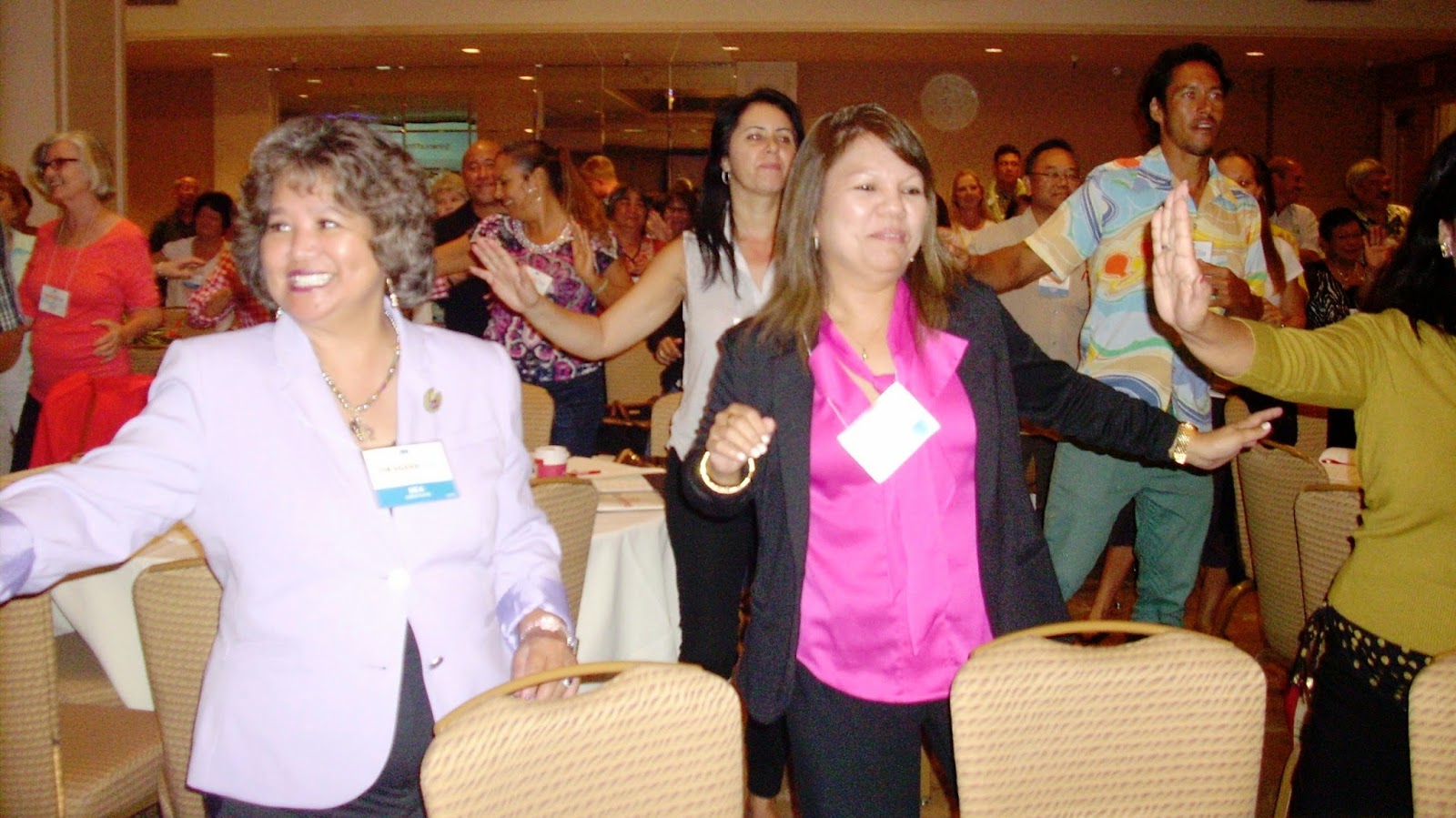
Paula led 15-minute Enhance Fitness exercise to Rose Royce’s Car Wash and
then My Bonnie Lies Over the Ocean.
10:00am
Break/Exhibits/Networking

State of Hawaii
Executive Office on Aging offered print publications. According to Aging & Disability Issues 2014: A Guide
for Hawaii’s Legislators, Organizations & Citizens, the 9th
annual publication sponsored by HPGS, Hawaii Family Caregiver Coalition (HFCC),
Hawaii Disability and Communication Access Board (HCAB) and Maui County Office
on Aging, the Aging Network’s priorities include:
- Kupuna Care,
a state program for non-Medicaid eligible kupuna to remain in their homes by offering home and
community-based services such as adult day care, assisted transportation,
attendant care, case management, chore service, home delivered meals,
homemaker service and personal care.
- Aging & Disability Resource Centers (ADRC) in each county to provide information,
assessments and options counseling for anyone needing long-term support
and services
- Long
Term Care Insurance public
awareness and education campaign to build community support for mandatory
social insurance program to help Hawaii
residents pay for long-term care

Assistive Technology Resource Center
of Hawaii (ATRC),
State of Hawaii’s
designated Assistive Technology Act agency, links individuals to technology but
does not sell any products.
Kokua Mau (Hospice & Palliative Care) Executive Director Jeannette Koijane
and former Compassionate Care of California POLST Program Director Leilani
Maxera. Hawaii’s POLST form is printed on bright
lime-green cardstock. Effective July 1, 2014, Hawaii allows Advanced Practice Registered Nurses (APRN) to sign POLST so the form was renamed Provider's (replacing Physician's) Order for Life Sustaining Treatment. This change was made to reduce barriers to effectuating such orders, especially in rural areas where primary care providers are APRNs rather than physicians, and in long-term care settings where physician visits may be several weeks apart.
Eme at
AARP, which scheduled her for two presentations at its Oahu Family Caregiver Conference on Saturday.
Sage
PLUS/SHIP (State Health Insurance assistance Program) Coordinator
Pamela Cunningham and volunteers provide free, one-on-one assistance to help
Medicare and Medicaid beneficiaries navigate the complexities of health and
long-term care systems. In FY 2014, SHIP was transferred from the Centers for Medicare &
Medicaid Services (CMS) to the Administration for Community Living
(ACL). I kept bumping into Pamela after
I first met her at CMS National Training in San
Francisco in August, and then while in Honolulu last month, I saw her at Senior Fair,
HPGS conference and AARP Caregiver conference! Her SHIP table was always crowded, and
Pamela mentioned her office was receiving 100 calls per hour due to
non-renewing Medicare plans.
Merlita
visits Cullen at Kupuna
Education Center,
which offers training for Home Care Worker, Family Caregiver, Active Aging
(Career Transitions) and Kupuna Connections online TV show.
11:00am
Featured Speaker
In Unleashing the Potential of All Generations in an
Age-Intentional World Generations United (GU) Executive Director Donna Butts noted Hawaii’s concept of ohana (family) honors all generations,
staying with "what’s true and right." (On
this 20th anniversary of the UN International Year of the Family,
GU published Intergenerational Family Connections: The Relationships that Support a Strong America.) Save date for GU’s biennial Integenerational Action on a Global Scale
Conference: July 21-24, 2015 in Honolulu, Hawaii
– first time outside of D.C.!
11:45am
Lunch, Network, Exhibits
1:00pm
Mini Break
1:15pm Featured Speaker
Dementia-Friendly Communities by Michael Splaine - Since age is the most significant risk factor
for dementia, support for WHO Age-Friendly Cities would have a positive impact
on the lives of persons living with dementia.
Splaine added that a Dementia-Friendly Community would include more
public awareness about dementia that leads to support for persons with dementia
and their caregivers to allow for independent living.
Splaine presented World Alzheimer’s Month 2014
Theme, Dementia: Can we reduce the risk? (1-look after your heart, 2-be physically active, 3-follow healthy diet, 4-challenge brain, 5-enjoy social activity) T-shirts to Shannon and Suzie.
2:00pm
Break/Exhibits
2:30pm Imagine 2030 Brainstorming Session
Groups addressed best case scenario, supporting and restraining
forces for ten topics: advocacy & policy, business innovation, caregiving, economic
security, elder-friendly community, fall prevention, healthy aging, intergenerational
exchange, workforce development, and volunteerism.
4:00pm
Closing Remarks
“Fun” in Hawaii’s
Aging Community
When one conference attendee learned that I was visiting from
the mainland, she asked me, “What are you doing for fun (outside of the
conference)?” As a Tiger Mum’s daughter and gerontology geek, I told her how
much I enjoyed reading Honolulu
Star-Advertiser’s daily local coverage of aging issues:
- 9/27
By adjusting your lifestyle, you,
too, might reach 100: HMSA’s Blue Zones Project Hawaii initiative is consistent with practice of ancient Hawaiian values like kuleana (responsibility/concern)
and ohana (family unit) to
create conditions for each member of the community to engage in healthy
living and enjoy long life
- 9/29
End-of-Life Care: A New Video
Campaign Gives Patients a Voice on Treatment Options: Hawaii has
nation’s 2nd highest
rate of hospital deaths at 33% v. U.S. 25% (though most patients
prefer to die at home), nation’s 45th
lowest use of hospice care (which focuses on making terminally ill
people as comfortable as possible, usually at home) at 36% v. U.S. 48%); Advance Care Planning Decisions videos are not available for individual viewing at home because they are intended to be part of a conversation
with a health professional, and HMSA is making these videos available
in every major hospital and hospice in Hawaii, and working to create local
versions featuring Hawaii residents and languages commonly spoken in the
islands.
- 10/1
Seniors’ Health Care: ‘Silver Wave’
about to hit shore: Editorial
suggests that State Oversight of Home and Community-Based Services Working
Group consider community support for family caregivers at all stages of
providing elder care, with easily accessible training programs; private
financing for middle-class families who don’t qualify for Medicaid to pay
for respite care; educating Hawaii residents about hospice and other
end-of-life programs.
- 10/2
Weighty Ambitions: Profile of 65-year-old Pearl City grandfather and
weightlifting champion who has battled health issues (stroke, sciatica)
yet determined to break records at quadrennial World Master Games in 2017.
My "fun" pre-conference activities included:
Hawaii Pacific Health’s Women’s Way to Health,
a free community health conference at Ala Moana Hotel, included topics that
affect older adults like incontinence
(experienced by 1 in 4 women, and which women experience twice as often as men),
osteoporosis/falls prevention (1 in
3 women over age 50 will experience osteoporotic fractures versus 1 in 5 men), aging brain (women make up two-thirds
of Americans living with Alzheimer’s) and diabetes.
Elvis lives in bronze
statue outside Blaisdell Center, site of his 1973 Aloha from Hawaii concert and
30th Anniversary Hawaii
Seniors Good Life Expo, a 3-day event with over 300 exhibit booths: mix of
government, non-profit and commercial, plus entertainment.
Merlita told me about American Samoa Territorial Administration on Aging staff's visit to Kokua Kalihi Valley Elderly Program, which serves sizeable Samoan
seniors.
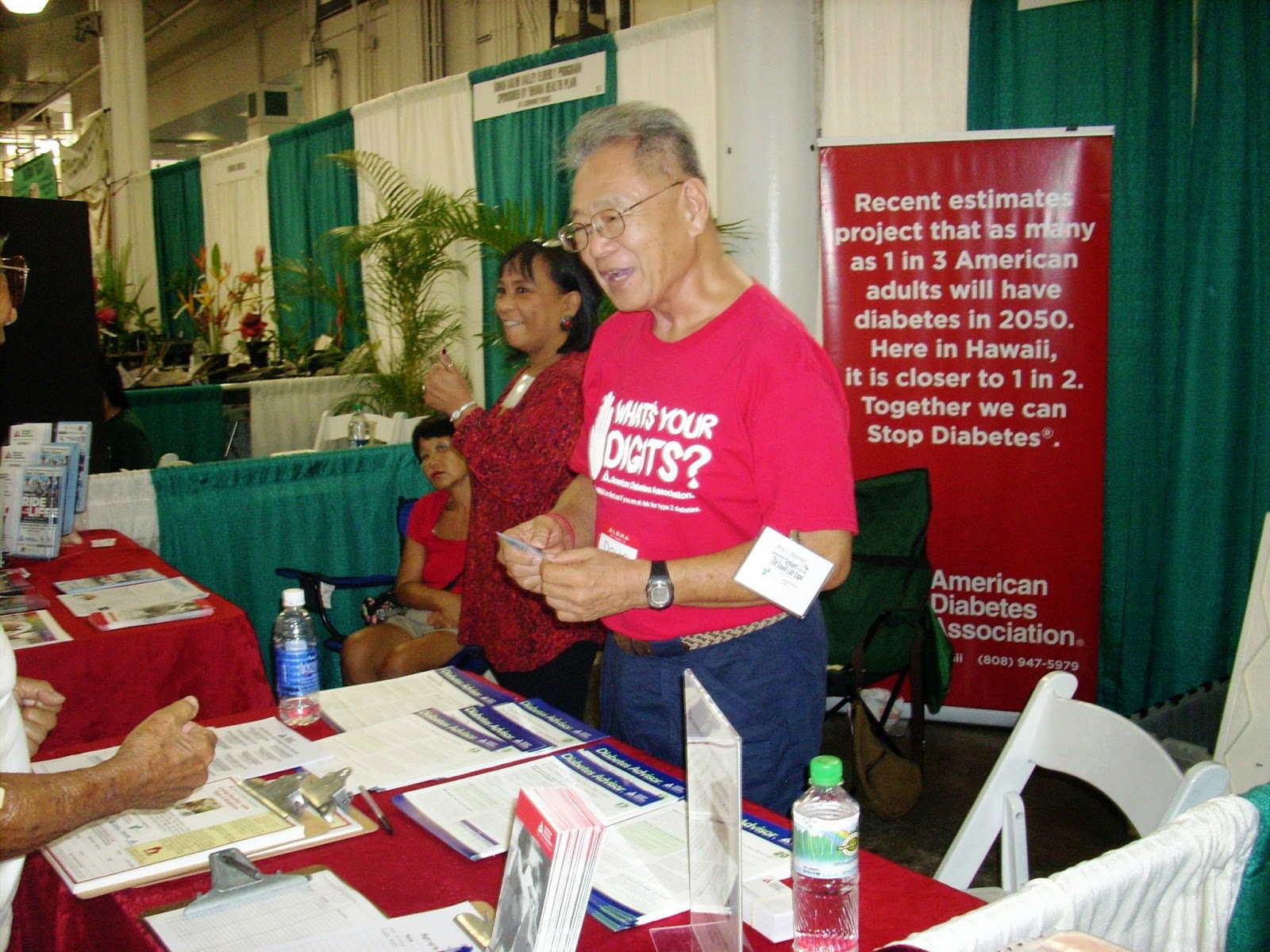
In Hawaii, estimates project that 1 in 2 will have diabetes by 2050. American Diabetes Association hosted all-day professional
education symposium, Type 2 Diabetes:Easier to Prevent or Control?,
but I chose instead to attend AARP Family Caregiving Conference and then family
dining out.
Seniors perform hula
5th Annual Rice Festival benefits Lanakila Meals on
Wheels, which provides meals to 2,300 kupuna
(seniors) and persons with disabilities to support their independent living in
the community. This community event also
set a Guinness World Record for the world’s
largest loco moco at 1,126 pounds, which took 3-1/2 hours to prepare!
Serving seniors is a great
cause, but I was distracted by potential food safety concerns. . . like 600
pounds of cooked rice, which FDA Model Food Code lists as potentially hazardous
food, sitting in open air at room temperature poses risk for foodborne disease as
bacteria reproduce every 15 to 30 minutes when maintained at temperature danger
zone (40F-140F). White rice
reminds me of local comic Frank DeLima’s advice for all ages: “Slow down. Walk
more. Drive less. The less you drive, the more you’ll see. Above
all, eat rice. If you have diabetes,
make that brown rice.”

Noticed lack of hair
restraint during preparation of ground beef patties (200 pounds), scrambled
eggs (300; more authentic over-easy eggs with runny yolks would have been cause
for salmonella poisoning so FDA advises thorough cooking until both white and yolk are firm), and gravy
(200 pounds). Food prep volunteers said
the finished product would be donated to the homeless. According to the 2014 State of Homelessness
in America report, Hawaii has the nation’s highest rate of homelessness (451 per 100,000),
and includes a growing number of
homeless seniors, so food safety is concern since seniors have a higher risk for contracting foodborne illness
because their immune system weakens with age.
Finally, I made "fun" post-conference plans to visit Manoa Cottage
(mentioned as one of the visionaries in conference’s Dementia-Friendly session)
and Neal Milner (retired University of Hawaii professor with several inspiring encore
careers), attend Medicaid Planning for Long-Term Care seminar and AARP Family
Caregiver Conference, conduct updated geriatric assessments on my parents and
help them research Medicare Advantage plans since their HMSA Akamai Advantage
plans were discontinued.
Manoa Cottage in Kaimuki is a skilled nursing facility known for Namaste
Care for persons with advanced dementia.
The Kaimuki site, opened since 2012, looks like other apartment
buildings in the neighborhood with a pair of papaya (non-GMO, I hope) trees outside the parking lot. Tiger Mum
came with me for the educational value because it’s good to know what resources
are available if you can’t do-it-yourself, especially dementia care (even Glen Campbell’s family support and financial fortune couldn’t keep him at home when his doctor advised his move to
a “memory care facility”)
but Pop refused to join us on an excursion because he wants only to age in
place. . . yet, my paternal grandparents both had dementia so I want to learn
more about dementia care, even in an institutionalized setting.


Unlike the
stereotypical hospital-like nursing home institution with drug-induced residents, Manoa
Cottage describes itself as a “small community” that enables its staff to give
personalized and holistic care with visits by therapy labradoodle and students
enrolled in nearby Iolani High School’s One Mile Project to improve the lives of older adults within a one-mile radius of their school.
Based on
social worker Joyce Simard’s book, The End-of-Life Namaste Care Program for People with Dementia, Namaste
Care takes place in a designated room, five hours a day, staffed by certified
nursing assistants trained as Namaste Carers who engage residents in “meaningful”
activities of daily living (ADL) through sensory-based activity and
interaction—using soft colors and homey décor, soft music for motion exercises,
lowering/turning up lights and soothing/livelier music to signal mealtimes,
lavender or seasonal scent, explaining activities, hugging/touching in greeting
and goodbye, etc.

Director of Social Services Allison Tabarracci provided tour though
there is wait-list for beds occupied by 27 residents. There is a registered nurse on duty 24/7, and
I tried to imagine the nurse’s station as a home office. Daily rate was $341 for private room, so do
the math: $124,465 per year. A shared
room with three residents was $300, or $109,500 per year. Ouch, it's not even certified for
Medicare/Medicaid, so it’s mainly private pay, long-term care insurance.

I attended legal seminar, How to get nursing home costs
paid by Medicaid, presented by funemployed estate planning attorney Ethan Okura. Hawaii adopted federal Deficit Reduction Act of 2005 (DRA), so the look-back period for
non-exempt asset transfers prior to Medicaid application is 60 months, and the
penalty is based on $8,850 average monthly nursing home cost. (In contrast, slowpoke California has not yet implemented full regs for DRA so its Medi-Cal look-back period is 30 months, and the penalty based on $7,628 average private pay rate.)


On Saturday morning, my sister and I joined about 450 persons for AARP Oahu Caregiver Conference, which included Resource Fair and
scones. AARP Hawaii
Conference Chair Laurie Kaneshiro drafted her husband Eugene to participate in Caregivers R Us panel. Eugene talked about his
wife giving up her job to care for her mom who had Parkinson’s and moved into
their home, and his weekend care of his blind father with colon cancer. He provided advice like communicate (be aware
of emotional meaning of words because “women have great memories,” talk about
finances to pay for care); learn to laugh, deal with mess and let it go; time
to care for oneself like eat regularly, whatever gives relief or refreshes; and
don’t expect perfection when providing care; feelings waver but continue to
give because actions are expressions of love.


Another caregiver Russell Nanod returned home to become caregiver to his mom during her three-year battle
against ovarian cancer and legally blind father with multiple chronic
conditions; since caregiving can be stressful, he made sure to play golf with
friends on weekends and had a 5 handicap after his mother died. Mediator Tracey Wiltgen moved in with her mom, diagnosed with Alzheimer’s and cared for 12 years, but risked isolation and her own
health trying to do it alone so she reached out to hire caregivers and finally
moved her mom to skilled nursing facility in last nine months of life.
Three points to remember:
- You are not alone
- Take care of yourself
- You are essential
Annual cost of paid care in Hawaii
- Adult Day Health Care $19,175
- Home Health Aide $57,772
- Assisted Living Facility $57,000
- Nursing Home (semi-private) $121,545
- Nursing Home (private) $135,050
In Improving Quality of Life for Caregivers, Michael Cheang offered these tips:
- Don’t do caregiving alone (not martyr)
- Be self-ful, or between self-less (burnout quickly) and self-ish (too busy with own situation to help)
- Be proactive (make things happen for you) versus reactive (let things happen to you)
- Have boundaries and care partner involving family, friends, neighbors, paid help to give others opportunity to show they care
- Decide with people, not for them
- Take advantage of community resources
Eme moderated Services and Transportation to Help with
Living at Home panel with Debbie of Gerontology Program at Child &
Family Services, Roger at Catholic Charities and Cindy at Project Dana. In a later session, Eme facilitated a caregiver support group.
Chris Ridley, LCSW of Hawaii County Alzheimer's Association (mentioned as one of Dementia-Friendly visionaries at HPGS conference), presented Minimizing
Challenging Behaviors in Dementia. She
reminded us that a person with dementia gradually loses memory, but their
personhood does not disappear, so caregivers need to know the person with dementia, their history, culture, values,
favorites, etc. Caregiver also needs to
give person with dementia a sense of control like offering choices (e.g., ask
coffee or tea? cream or sugar?).
Caregivers must take a
proactive stance to provide an environment that accommodates for the person’s
fluctuating levels of functioning. In
response to an episode of agitation or anxiety, utilize four-step approach:
- Validate
in action and words: accept
their world
- Assess
for basic needs: hunger,
thirst, toileting, activity, touch, comfort
- Provide
for basic needs
- Distract
to activity
Afterwards, reassess
potential causes of behavior related to:
- Physical
and emotional health:
acute/chronic illness, dehydration, medications, constipation, depression,
fatigue, etc.
- Environment: clutter, excessive stimulation, not enough
cues, unfamiliar or unstructured environment, lack of meaningful activity,
etc.
- Tasks: too
complicated, unfamiliar, etc.
- Communication: misunderstand what is being said, inability
to find right words, etc.
With dementia, Chris said we need to
shift gradually from curative, medical model to palliative, psychosocial model
so focus on quality of life and comfort—things that matter and can control.
While
riding TheBus, it was “fun” to see age-friendly banner ads on Fall Prevention Tips for Seniors and Rewarding Home Caregiver job growth
expected to increase 70% by 2020 (but no mention about salary, working
conditions, turnover, etc.)! Oahu’s TheBus Senior Annual Pass is $30 -- a real bargain compared to San Francisco’s Muni Senior Monthly Pass is $23, and seniors can get kicked off Muni bus if they’re caught without ID to prove
their age.
As much as I wanted to runaway from Hawaii,
I still return to people who know me from my small kid time. My experience in American Samoa earlier this year instilled a renewed appreciation for values like family interdependence. In Asian American and Pacific Islander (AAPI)
culture, using extended family members as unpaid or underpaid domestic workers
is common, and there is more reluctance to institutionalize elderly relatives
and to seek professional caregiver respite and supportive services. AAPI cultures endorse the filial piety tradition of caring for
elders – perhaps also out of economic necessity because of the high cost of living and
contracting out caregiving to third party providers and institutions.
My grandparents and
parents immigrated from Communist China, where they harbored a distrust of
government including welfare; family and village were the only acceptable
sources of charity. My grandparents were do-it-yourself types who never took
advantage of Older Americans Act (OAA) programs. With my parents, I tried to introduce them to
OAA programs (senior center wellness classes, congregate meals) but they told me they have no time because of their work ethic (they remain self-employed
running the family business) and discriminating palates.


If I ever retire in Hawaii, I’d return like a boomerang to live with my parents while paying rent in-kind by working the family business (based more on cheap
labor than nepotism). My parents’ home
design is already age-friendly,
and it’s also about location, location, location (near Kapiolani Community
College, where I can enjoy its Farmers’ Market and enroll in lifelong learning classes; walkability;
view of Diamond Head and Pacific Ocean).
If I get tired of urban Honolulu’s traffic and concrete blight, maybe
I’ll escape to neighbor isles like Molokai and Lanai (though 97% owner Larry
Ellison is turning former Pineapple Island into luxury tourist destination) . .
.

If I want time to slow
down, I’d be a student again so I
got together with my all-time favorite professor and Hawaii visitor attraction, Neal Milner. Though retired as professor of political
science, Neal remains storyteller,
actor, playwright and author of The Gift of Underpants, but I did not gift underpants to him J. He and his wife just returned
from visiting their Portland-based daughter (who once quit her job to work as temp so she could travel around the world!) and
back just in time for Neal to provide TV commentary (keeping candidates
accountable) on gubernatorial debate.
We dined at 220 Grille to support Kapiolani Community College’s Culinary Arts Program, feasting on
Hanalei Poi Crusted
Island Catch with Kabayaki & Wasabi Butter Sauce served with Zucchini, Corn
& Tomatoes -- I ate mine with steamed rice, while Neal ordered his
paleo-style with Waipoli Hydroponic Greens instead. But like My Dinner with Andre—one of my favorite films which is just one scene of two
friends catching up over dinner—the delicious meal was incidental to our more
meaningful conversation about living a life without regrets, which some people
wait until retirement or near death to be honest and seize opportunities.