Showing posts with label retirement. Show all posts

Sunday, October 31, 2021

Collaboration


At Contemporary Jewish Museum’s Experience Leonard Cohen (1934-2016) exhibit, 18 men in their 60s and 70s sing from tracks of I’m Your Man – each recording in their own life-size monitor (modeling physical distancing during this pandemic!), and their synchronized voices form a cappella choir. 

Well, my friends are gone and my hair is grey

I ache in the places where I used to play

And I'm crazy for love but I'm not comin' on

I'm just payin' my rent every day in the Tower of Song…

I was born like this, I had no choice

I was born with the gift of a golden voice…

--Leonard Cohen, “Tower of Song” from I’m Your Man (1988)  

Like a choir, gerontology involves collaboration of many voices for a holistic approach to optimal aging. 

Gerontology is multidisciplinary in that it combines or integrates several separate areas of study… fosters collaboration between physicians, nurses, biologists, behavioral and social scientists, psychologists, social workers, economists, policy experts, those who study the humanities and the arts, and many other scholars and researchers in aging. Geriatrics, the branch of medical science concerned with the prevention and treatment of diseases in older people, is a part of the broader field of gerontology.

Gerontologists improve the quality of life and promote the well-being of people as they age through research, education, practice, and the application of interdisciplinary knowledge of the aging process and aging populations.

--"What is gerontology?” Gerontological Society of America 

Given the dominance of the deficit-focused biomedical paradigm that views aging as a disease for allopathic treatment, collaboration with other disciplines (shout out to lawyers and occupational therapists!) allows for a more subjective approach that includes voices of older adults based on their contextualized lived experiences, strengths and what’s meaningful for them.

California Alliance for Retired Americans (CARA) hosted its 18th annual convention via Zoom. During online registration, participants selected just one of six workshop offerings (LTSS, Health Care, Affordable Housing, Climate Justice, Social Security, Nursing Home Reform), but technical difficulties with Zoom breakout rooms provided alternative opportunity to listen to all six workshop presentations with abbreviated Q&A. This workaround suited me because I wanted to learn from all six workshop presenters!

Long-Term Support & Services (LTSS)

Ramon Castellblanch, SFSU Professor Emeritus of Health Education (and a reader of my gerontology master’s thesis 😊), introduced LTSS for All! Lindsay Imai Hong, California Director of Hand in Hand Domestic Employers Network, said one in two Americans will need LTSS (broadly defined as assistance with activities of daily living, home modifications, durable medical equipment, etc.) in their lifetime. Existing public programs for financing LTSS are Medi-Cal In-Home Supportive Services (IHSS), Regional Centers for people with developmental disabilities, Veterans Affairs Aid & Attendance. Everyone else pays out of pocket, or relies on unpaid caregiving from family/friends/neighbors/charities.  

Amanda Ream, Research Director at United Domestic Workers, representing 80,000 IHSS workers in California, presented The Care Agenda solution for universal LTSS! 

Pres. Biden’s Build Back Better agenda includes “the most transformative investment in access to home care in 40 years, when these services were first authorized by Medicaid,” $150 billion (reduced from $400 billion in original proposal) to support people who need care (including 800,000 on waiting lists) and their paid caregivers. 

Nursing home reform

I am petrified to get old. This disgraceful, broken system of senior living care is something that we all need to care about. Because this is our future.—Kim Valentine, elder abuse attorney, “State health department blasted over nursing home oversight: Problems are staffing shortages, turnover, training and pandemic pressures,” CalMatters (Oct. 6, 2021)

UCSF Nursing Professor Elizabeth Halifax said California nursing homes have had a humanitarian crisis with over 60,000 cases + 10,000 deaths among residents from COVID-19. She presented Nursing Home Reform policies to address problems of inadequate/unstable staffing; poor financial transparency and lack of accountability for use of public funds; lack of enforcement of existing regulations; state failure to vet owners/require licensing; failure to empower residents; inappropriate discharges; poor access to alternative/home care; outdated/unsafe nursing home environment.

Homeless advocacy


Janny Castillo, Director of Community Outreach at St. Mary’s Center (its Geriatric Homeless Shelter was profiled in The NYTimes) and Oakland Housing Authority Commissioner, presented on Housing for All, calling social justice as wellness tool: fight to increase funding for safety net services, benefits and affordable housing; protect poor people’s basic human rights by fighting for decriminalization of those experiencing homelessness; advocate for better mental health services; participate in peer-to-peer education and advocacy.

California Master Plan for Aging (MPA) San Francisco Regional Forum: Ending Homelessness Amongst Seniors and People with Disabilities (PWD) began with recorded intro by SF Mayor London Breed: “I was raised by my grandmother and she meant everything to me. Towards the end of her life, what mattered most was that she had the care and support she needed to continue to live with dignity. Everyone should be able to live and thrive without fear of ending up alone or on the street.” (Breed’s grandmother lived out her final years at Laguna Honda nursing home, notorious for patient abuse scandal uncovered in 2019.) 

UCSF Benioff Homelessness and Housing Initiative (BHHI) Director Margot Kushel, MD delivered keynote (almost same content as her 2019 Grand Rounds), followed by all-women panel! Most importantly, this program included the voices of Del Seymour as panel moderator and Yolanda Harris as panelist, who shared their own lived experiences with homelessness.

“50 is the new 75” among homeless adults with overall poor functional status and geriatric conditions worse than those in the general population in their 70s and 80s. Dr. Kushel said the solution to homelessness is Housing First

She provided examples of collaborations between aging and homeless services for low-income population:

·       HomeSafe program involves Adult Protective Services (APS) to reduce eviction risks related to self-neglect. Some key findings from BHHI interim evaluation of HomeSafe pilot program are improved systems integration, limited usefulness of homeless risk assessment tool, and “some” clients helped to avoid homelessness.

·       PACE (Program of All-Inclusive Care for Elderly) co-located with Permanent Supportive Housing (PSH).

·       CAPABLE (Community Aging in Place—Advancing Better Living for Elders) for people located in PSH who are provided with a visiting nurse, occupational therapist, and handy person to modify home environment. 

·       Homebridge provides IHSS to PSH residents. 

·       Project Roomkey provides motel/hotel rooms to medically vulnerable homeless during COVID-19 pandemic (and prioritized older adults age 60+ with chronic conditions).   

COVID-19 vaccination rate among people experiencing homelessness was about 39% (much lower than 70% of San Franciscans) as of August, and access appeared to be a greater challenge than hesitancy. 

Del Seymour said he was a 60-year-old disabled vet when Homeless Outreach Team worker got him off streets into Navigation Center, and then next day connected to Swords to Plowshares, which gave him keys to his 1st apartment; at that time, he was his own case manager hand-carrying paperwork between agencies working in silos because Veterans Affairs (VA) did not talk to Department of Public Health (DPH), which did not talk to Human Services Agency, which did not talk to…

·       Shireen McSpadden, ED of SF Department of Homelessness & Supportive Housing (HSH), considered MPA Goal #1 as a call to action to fund housing options for older adults, also need for supports and universal design to serve PWD, focus on preventing homelessness. Of the City’s existing 22,600 affordable housing units, over 13K or 58% occupied by seniors and PWD. She emphasized need for partnerships between HSH and DAS (pilot enhanced IHSS in PSH), as well as DPH and community-based organizations, to support people to age in place in PSH.

·       Kelly Dearman, ED of SF Department of Disability & Aging Services (DAS), talked about housing-related support services (rental subsidies, housing retention support services in public housing, Home Safe-Phase 2); lowering barriers to access like pilot to tailor co-located services to streamline IHSS eligibility.

·       Yolanda Harris, SF Housing Authority Commissioner, shared her own personal housing challenges to help others navigate systems to access services.

·       Beth Stokes, ED of Episcopal Community Services (and SFSU MSW alum), which manages adult coordinated entry, said current challenge is focus on rehousing shelter-in-place (SIP) hotel guests, and need to expand referral outside SIP pool to serve more for PSH available; value of accessing services in neighborhood in which they’re from. She believes we are capable of ending homelessness because pandemic showed how quickly we can move to get people housed. She talked about PSH partnering/co-locating with health care providers onsite, providing access to wellness program, recovery and substance abuse services.

During Q&A, I re-submitted question in chat that I emailed in advance that didn’t get selected (“What metrics are used to evaluate effectiveness of contract providers? What is being done to address high turnover among staff who serve unhoused population to ensure these clients are not further traumatized when people need more stable therapeutic relationships & ensure they do not fall through the cracks?”), and surprised to receive chat comment from ol’ college classmate (“Good point…it is difficult to recruit and retain staff in SF with non-profit salaries. Staff cannot afford to live in the city”)!

Will higher salaries address root causes of staff turnover? My HR Toolkit lists these reasons for high staff turnover: overwhelming workloads, poor management, workplace bullying and toxic culture, lack of opportunities for development, and better offers elsewhere. Bullying is common in “caring” professions, and turnover makes sense for self-preservation: follow Robert I. Sutton’s No A—hole Rule, and leave toxic work environment right away! While The Atlantic’s Derek Thompson considers quitting to be a sign of optimism (“We can do better!”), still waiting to see if employers get woke to improve work culture. More power to The Revolt of the American Worker and The Great Resignation!

Day after this program, the City’s HSH decided on extension to wind down SIP hotels through September 2022, to allow more time to relocate 1,400 SIP hotel guests (majority age 50+) to PSH. Cost of running single SIP hotel room (including meals, harm reduction supplies, health services, laundry and housekeeping services) estimated at $7K per month! 

Gabor Mate’s Wisdom of Trauma (2021) documentary featured Downtown Streets Team (DST), a SF Bay Area nonprofit that claims to be “dedicated to ending homelessness” through “dignity of work” (unhoused “team members” start as “volunteers” to clean streets to “earn basic needs stipend” with potential to move up Team Lead-Manager hierarchy). Such an odd, creepy pick in light of news reports that DST executives involved in wage theft (settled), defamation, and allegations of sexual harassment and promoting drinking culture. 

Dr. Mate followed up his documentary with a series of conversations with trauma-informed providers. How Trauma Literacy Can Transform Medicine was about mind-body-spirit connection: “If you don’t know how to say no, your body will eventually say no for you…” Docs talked about high suicide rate in their profession (higher than the military, and highest rate of any profession), bullying in their medical training that resembles the military. (Recognizing the harmful effects of bullying to patient care and team dynamics, American Medical Association published Bullying in the health care workplace: A guide to prevention & mitigation.)

“the story holds the key to what’s really going on, health is social well-being…” Patient’s life story provides context and allows patient to feel heard and seen.

Narrative-based medicine (NBM) came about in response to inadequacies of the biomedical model. According to George Zaharias, NBM is “a coming together of disparate schools of thought: the medical humanities (history, philosophy, ethics, literature, literary theory, the arts, and cultural studies); primary care and patient-centred care; biopsychosocial medicine and holistic care; and psychoanalysis and the work of Michael Balint.” 

It is more important to know what sort of person has a disease than to know what sort of disease a person has.—Hippocrates, father of medicine

Chronic Pain and Trauma-Informed Healing discussion was multidisciplinary with MDs (Maté, Schubiner), life coaches (Ozanich, Rosen) and counselor (Wallin). “Wound is where the light enters the body”…reminded me of what Leonard Cohen sang in "Anthem"…

Experience Leonard Cohen included Judy Chicago’s paintings of his lyrics.

Ring the bells that still can ring

Forget your perfect offering

There is a crack, a crack in everything

That's how the light gets in

The birds they sang at the break of day

"Start again", I seem to hear them say

Don't dwell on what has passed away

Or what is yet to be…

--Leonard Cohen, “Anthem” from The Future (1992)

As gerontologist, enjoyed Experience Leonard Cohen exhibit and “10 Moments” mini-catalogue that mentioned his 2008-10 grand tour after a 15-year break as Buddhist monk. Wish it explained septuagenarian Cohen got back on tour after he experienced elder financial abuse by his long-time manager, who embezzled his retirement savings. This could have been an opportunity to raise public awareness of elder abuse and prevent such trauma from happening!

Elder Abuse Prevention                               

At bimonthly Elder Abuse Prevention (EAP) Multi-Disciplinary Team meeting, Alice Chiu, former Consumer Rights Program Director at Senior & Disability Action (SDA), was introduced as newly hired EAP Program Supervisor at Institute on Aging! At these meetings, APS workers present two cases for consultation with specific members requested: attorney, medical practitioner, ombudsman, coroner/medical examiner, law enforcement, district attorney, public guardian, psychologist, etc.

During COVID-19 pandemic, older adults have been targeted for financial scams. While perpetrators target vulnerable older adults (dependent due to cognitive/physical decline), behavioral scientists believe elder abuse prevention approaches could preemptively target populations who are cognitively vulnerable to deception and involve family caregivers in advance care planning like creating durable power of attorney. 

Medical-Legal Partnership (MLP)


HealthBegins hosted Achieving Liftoff: Building Medical-Legal Partnerships for Impact, as part of its mission to “moving upstream” by addressing structural determinants of health equity. In July 2021, HealthBegins and National Center for Medical-Legal Partnership (NCMLP) announced a new initiative to integrate MLPs into Kaiser Permanente care delivery for greater housing stability and eviction prevention. 

Bethany Hamilton, Co-Director of NCMLP at George Washington University, defined MLP as an intervention where legal and health care professionals collaborate to help patients resolve social, economic and environmental factors that contribute to health disparities and have a remedy in civil law. She said MLP is one of the only interventions that tackles individual needs and underlying policies: By detecting patterns in patients’ needs and using upstream strategies to target unhealthy policies, MLPs prevent future problems and advance health equity. 

MLPs engage in these types of Patients to Policy projects: 

1.   Use data/stories to educate decision makers about the effects of a policy

2.   Meet with agencies to propose changes to application requirements and procedures for benefits

3.   Convene community stakeholders and decision makers

4.   Challenge laws in courts!

NCMLP Toolkits:

·       A planning, implementation, and practice guide for building and sustaining a health center-based MLP 

·       VA medical-legal partnership readiness guide 

UCSF geriatrician Dr. Anne Fabiny presented on a “deeply engaged” MLP for seniors in SF VA health care system with UC Hastings School of Law. They began Transitions, Referral and Coordination (TRAC) team to care for older adults who are kept in the hospital for social, not medical, reasons because they don’t have a place to go and they end up living in the hospital more than 100 days, with the longest stay over two years!

Their strategies included implementation of standardized process for reviewing need for probate conservatorship for patients with dementia that ensures all other potential options have been explored (veterans waiting for a conservator made up some of the longest stays, now fewer patients referred for conservatorship); increased use of Geriatrics Inpatient Consultation Service for capacity assessment; forum for discussing challenging ethical issues and moral distress; and group decision making about how best to engage family members in constructive problem solving around discharge plans. (See Dr. Fabiny’s article, How an Interdisciplinary Care Team Reduces Prolonged Admissions Among Older Patients with Complex Needs.)    

Lara Eilhardt, MLP Senior Attorney with Office of General Counsel at Department of VA, talked about legal needs as a social determinant of health because civil legal issues that can affect health and housing, if left unaddressed, can increase the risk of suicide. Based on CHALENG (Community Homelessness Assessment, Local Education and Networking Groups) survey, five of the top 10 unmet needs reported by homeless veterans require legal assistance: resolve child support, prevent evictions/foreclosures, restore driver’s license, address outstanding warrants/fines, and secure discharge upgrades. VA MLP services have improved veterans’ housing stability and mental health, and decreased their PTSD symptoms and reduced their substance use spending.

Check out Free Legal Clinics with VA Facilities.

Support Veterans Medical Legal Partnerships Act of 2021

Pedestrian safety

On sunny Saturday morning, advocacy groups Walk SF + Senior & Disability Action hosted walk audit for public to provide feedback to government agencies (SF Municipal Transportation Agency, SF Recreation & Parks), on Golden Gate Park (GGP) and proposed changes to car-free routes designed to promote equal access and improve traffic safety and GGP experience for all visitors. 

Joined group with Walk SF Brian + SF Rec Brian to assess traffic along Fulton Street near 10th Avenue entrance to Golden Gate Park. Since this entrance has been closed to private cars during COVID-19 pandemic, there appears to be increased car traffic and occupied parking spaces outside entrance. But once inside refreshing GGP, less air + noise pollution from cars.

Adding more benches would make GGP more visitor friendly but alas the City has actually removed benches to discourage resting spots for unhoused people.

Here inside GGP’s car-free JFK Drive (where I paid attention to GGP shuttle for first time!), bicyclists did not observe STOP signs near pedestrian crossings. California’s Safety Stop Bill (AB 122) introduced to allow bicyclists to treat stop sign like yield sign, allowing them to proceed in intersections when clear and safe.

Before the pandemic, 75% of traffic used JFK Drive as a shortcut between places outside GGP--landing on the City's high-injury corridor with more than 100 injury collisions involving people walking/biking therein from 2015-2020. Since going car-free during the pandemic, zero collisions!

Plan for repaving this lot behind Music Concourse (which has its own 800-space underground garage that is pricey like Academy of Sciences admission tickets) to provide more parking spaces for people with disabilities. 

On busy Van Ness Ave. near SF City Hall, sign marks “someone died here”–11th pedestrian death this year, nearly half have been age 70+! Gov. Newsom vetoed Jaywalking Bill, which would have leveled playing field for pedestrians in car-centric roads. 

Healthy aging

At virtual Hawaii Book & Music Festival, Healthy Aging program offered perspectives from University of Hawaii faculty from Geriatrics, Social Work, and Microbiology! 

·       Geriatrics Professor at School of Medicine (SOM) Kamal Masaki, MD, discussed geriatric approach to care (focus on whole person, not organ systems, include physical, cognitive, psychologic, social domains; enhance independence and quality of life; preventive care; early rehab if possible; palliative care if necessary; interdisciplinary team approach). Ideally, every older adult age 65+ would see a geriatrician, except there is a shortage with only 7K geriatricians nationwide so now geriatricians mostly care for very frail elderly. Shortage of geriatricians is less in Hawaii, thanks to over 200 grads of UH geriatrics fellowship, many stay in Hawaii and serve as consultants to primary care physicians; UH SOM also requires every medical student to complete four weeks of geriatrics and palliative care training. Hawaii has nation’s highest life expectancy due to Asian ethnic groups (Chinese women live longest; Caucasians among lowest life expectancy). Women outlive men, but women age 70+ experience greater physical disability and need for assistance with activities of daily living.

·       Social Work Professor Emerita Colette Browne, DrPH, presented on older women and gender equity: advantages include longevity (nearly 70% of people age 85+ are women) and stronger social networks; disadvantages include lower income, health care and absence of LTSS. Despite improved gender parity in education, these gender inequities shape opportunities throughout their life course so women experience greater economic insecurity/risk of poverty in later life

·       Chancellor Emerita/Professor Virginia Hinshaw, PhD, presented on positive effects of aging, such as using both hemispheres of the brain (more compassion), decreased activity in amygdala (less response to fear, anger, hatred so become mellow and increasingly react to positive). She founded SOM Mini-Medical School on Healthy Aging in 2014, and now it’s available online

Col-Labor-ation => retirement?

The latest issue of Public Policy & Aging Report focuses on Retirement Structures and Processes, noting a “decoupling of retirement and full labor-force departure” associated with decreasing financial security for many older workers, particularly since Great Recession of 2008. Redefining retirement today often includes some engagement in paid work, with opportunities in the gig economy and development of encore careers. 

“My new career is doing various stuff.  What’s needed to be done today? What can I learn today? What kind of charges me up a little bit is being able to do something familiar and, at the same time, having that opportunity to learn something new.”—Chris Francis, RV worker in 400 sq. ft “house on wheels”, PBS Changing Work, Changing Workers   

According to economist Teresa Ghilarducci, the future of work is connected to future of retirement income, and many older adults are working longer to supplement eroding pensions or declining Social Security benefits, while facing discrimination; she has called for creating Older Workers’ Bureau within U.S. Department of Labor! 

Lawrence R. Samuel, author of Aging in America: A Cultural History (2018), views Boomers working as long as they can and aging in place (instead of fading into a life of leisure in a sunny retirement community) as a "wonderful development" to reintegrate older people back into the mainstream and possibly lessen ageism.

Musician-turned-social scientist Arthur C. Brooks noted that “having any job at all makes people happier” but “money as a career goal does not”; instead, he found job satisfaction comes from a good fit with your employer’s values and culture, and a sense of accomplishment. 

…all over the world job satisfaction depends on a sense of accomplishment, recognition for a job well done, and work-life balance. Teamwork, too, has a strong influence in collectivist cultures, but less so in individualist ones. The late Harvard psychologist Richard Hackman found that job satisfaction was strongly, inversely tied to leader-centricity: In one of his studies, musicians who worked in symphony orchestras, where many conductors rule with an iron fist, were 21 percent less satisfied with their growth opportunities than players in leaderless string quartets.—Arthur C. Brooks, “The Secret to Happiness at Work,” The Atlantic (Sep. 2, 2021)  

Very subjective! Brooks advises for real job satisfaction, we should pursue intrinsic goals like earned success (which employers can facilitate by giving “clear guidance and feedback, reward merit, and encourage their employers to develop new skills”) and service to others (sense of making the world a better place). For example, Brooks describes how his former student derived job satisfaction serving customers as waiter in Barcelona. (In contrast, Princeton grad Lillian Li did not derive job satisfaction from serving rude customers when she worked as waitress, but likely derived greater job satisfaction from writing about that experience in her novel, Number One Chinese Restaurant.) 

Did Danish artist Jens Haaning derive job satisfaction from his “Take the Money and Run” delivery of blank canvases to Kunsten Museum of Modern Art as part of its Work It Out exhibit, in exchange for $84K? 

Haaning insisted, “The work is that I have taken their money.”

Kunsten CEO said, “This new work reminds us that we work for money.” 


“Work” is any job I do, paid or unpaid, that’s important to me. It’s anything I work incredibly hard at, pour my heart and soul intoand anything that sits at the very core of who I am and have always been.

I’m a Mother, a Writer, a Musician, a Caregiver, an Athlete, and a Student.

And work doesn’t define me — I define it.

I’m a Caregiver for Seniors by day.

Although I often feel like the clean version of a professional escort service for the elderly — I love every minute of it…

Whatever daily living activities my clients need help with, I always make sure my eyes (and smile) are bright, my hair is pinned back, my scrubs are clean and crisp, and I’m ready to show up for who and what they need me to be that day.

I love helping people. I love my Caregiving job because it doesn’t feel like work to me.

--Divina Grey, “Choose a Job You Love and You’ll Never Have to Work a Day in Your Life.” —Confucius. I know what I’m doing, even if you don’t think so. Medium (Aug. 14, 2021)  

“Caregiver for Seniors” baffled me with her seemingly contradictory statements: concluding “I love my Caregiving job because it doesn’t feel like work to me” after previously defining “work is any job I do, paid or unpaid, that’s important to me.” And hope she is getting paid for job=work, for sake of funding her retirement! According to IRS, she is a “household employee” (employer controls work she does and how she does it) if she is paid more than $2,300 wages (2021), and both employer and employee obligated to pay Social Security + Medicare taxes. 

National Retirement Security Month  

Retirement security is a subject near and dear to me, as my pre-encore career was spent working in ERISA-covered retirement plans (investment management, trust administration, plan design and compliance, etc.). And I continue to live and breathe ERISA...

This month’s Women’s Institute for a Secure Retirement (WISER) conference looked at 25 Years of Improving Women’s Financial Security - Where We Stand: Possibilities & Progress

Among the ways women can improve their long-term financial security are safeguarding one’s health and employability (keeping job skills up to date, networking, scoping out opportunities, etc.).   

While other countries have social safety net programs, women in USA have borne the brunt of job losses and caregiving burden during the pandemic. Since the beginning of 2020, 4 in 10 working women age 40-65 (and especially those providing care to others) experienced job loss, reduced hours, furlough, temporary layoff, or reduced wages --this translates to lower lifetime income, less savings, and reduced Social Security benefits that undermine women’s retirement security.

In USA, retirement security is “earned” during employment through payroll taxes (Social Security + Medicare) and employer-sponsored tax-qualified plans (traditional defined benefit pensions, defined contribution plans often with 401(k) salary deferral feature).

Social Security Administration (SSA) announced that its annual cost-of-living adjustment (COLA) will increase to 5.9%, effective January 2022! 

According to Social Security and Medicare Board of Trustees’ 2021 annual reports:

·       Social Security Trust Funds are projected to become depleted in 2034, one year earlier than projected last year, with 78% of benefits payable at that time. 

·       Medicare Part A (Hospital Insurance) trust fund is projected to run out of funds in 2026 (no change from last year’s report), and pay 91% of total scheduled benefits. 

Data and projections were based on estimated effects of 2020 Recession (high unemployment) and COVID-19 pandemic on demographics (increases in deaths, decreases in births, and lower immigration rate): fewer people contributing to the funds, greater financial pressures. Call to action: Congress do something to address projected funding shortfall (e.g., increase amount of covered earnings subject to payroll tax)! To fix retirement income crisis, consider All Generations Plan (with caregivers’ credit for those who take time out of paid workforce to care for family members)! 

2021-25 OAA State Plan on Aging, went into effect Oct. 1, 2021 (aka International Day of Older Persons!) —serving as a blueprint for CA’s #OAA network to build equitable, age-friendly communities through programs, partnerships, services, outreach efforts, and advocacy! Must read!

Wednesday, September 30, 2020

Dissent

“Fight for the things that you care about, but do it in a way that will lead others to join you.”— Justice Ruth Bader Ginsburg’s advice upon receiving 2015 Radcliffe Medal, and after former Justice David Souter introduced her as “tiger justice”; dissent jabot from RBG’s 2012 Glamour Woman of the Year Award   

My she-ro, Ruth Bader Ginsburg, died on Erev Rosh Hashanah, which makes her Tzadik (person of righteous deeds), according to Jewish tradition.  May her memory be a blessing. 

Like many RBG followers and her neighbors, who posted sidewalk sign “If you won’t wear a mask to protect your friends and family, do it to protect RBG,” I worried that she might get COVID-19.  Earlier this month, reports circulated about 87-year-old RBG officiating a wedding – outdoors, but no masks worn and no distancing for harm reduction—just two weeks after her latest hospitalization for cancer, a co-morbidity that raised her risk for severe COVID-19 if infected. Very disappointed: The bride’s careless tweet, “don’t worry, we tested negative!” sounded like President Trump’s testing only strategy, providing absolutely no reassurance, as false-negatives occur.  RBG’s death was reported as due to “complications from pancreatic cancer.”

I mourn the loss of RBG, who modeled how to fight for causes: Her pragmatic, incremental approach enabled laws to catch up with social movements over time, leading former opposers to join her.  RBG’s monumental Olmstead decision (1999) makes possible my encore career advocating for community living/aging in place, and her fight for gender equality has my eternal gratitude.  RBG brilliantly applied Americans with Disabilities Act (ADA) and Equal Protection Clause for inclusion of people with mental disabilities and both genders, previously denied rights and opportunities due to discrimination. 

I paid tribute to RBG, along with Mister Rogers, when their documentary films were released two years ago.  They are so inimitable that I have not seen actors imitating them in Hollywood films, On the Basis of Sex and A Beautiful Day in the Neighborhood.  However, I plan to listen to Derrick Wang’s Scalia/Ginsburg comic opera via WNED Classical radio on Nov. 7 @ 1 pm EST. 

https://www.nydailynews.com/news/politics/ruth-bader-ginsburg-funny-t-shirt-brooklyn-court-article-1.2151495

You can’t have TRuth without Ruth!

“When you write a dissent, you’re writing for a future court that will see the error into which your colleagues have fallen.”—RBG, “In Her Own Words,” Elle (Oct. 2014) 

I will miss RBG’s reasoned voice of dissent (for liberal minority), especially in these times when shouting and interrupting pass as debate.  RBG’s style was subtle like dropping “respectfully” before “I dissent.”   

Retirement

After RBG’s death, I was appalled at the meanness of people blaming RBG for not retiring 7 years ago during Obama’s 2nd term so he could nominate a younger replacement to prolong “liberal” legacy. Why the fixation on life expectancy, based on risk factors like age and disease? To address partisan battles, consider judicial term limits instead of pressuring octogenarian justices to retire? 

At the funeral of Justice John Paul Stevens (JPS), who died from a stroke at age 99 last year, RBG shared her exchange with JPS in the last week of his life when they attended a conference in Lisbon: 

         RBG to JPS: My dream is to remain on the Court as long as you did.

         JPS to RBG: Stay longer!

JPS retired at age 90, after serving 35 years in the U.S. Supreme Court, and then went on to author 3 books, including 560-page memoir!

Thankfully for RBG’s retirement dissent, she became Notorious RBG at age 80.  RBG epitomized the Power of Oldness

With a lifetime appointment to the U.S. Supreme Court in 1993 (at age 60), why would RBG retire from a meaningful job that she loved after only 20 years? Sure, she had health issues, including 5 bouts of cancer, heart surgery, fractured ribs, etc. but nevertheless, she persisted with “full steam.”  Nothing affected RBG’s brain or ability for legal reasoning.  Grateful for her fierce work ethic and commitment fighting to protect our rights to the very end! Working Longer Solves (Almost) Everything: The Correlation between Employment, Social Engagement and Longevity. 

American Society on Aging (ASA) CEO Peter Kaldes hosted The Four Pillars of the New Retirement: Dramatic Changes for Aging and Aging Services, based on study prepared by Ken Dychtwald of Age Wave (pictured with his Medicare statement, which he said needs to be more user-friendly), and Ken Cella of Edward Jones, finding that people of all ages are reimagining the pillars of retirement: health, family, purpose, and finances. 

This was a more holistic approach than traditional retirement planning, based on 3-legged stool of employer-sponsored retirement plans + personal savings + social security (safety net). Yet, since study was sponsored by financial services company, lots of messaging how people are not financially prepared to retire and need to start saving/retirement planning while younger...and send $$$$ to professional investment managers to collect fees! Same old, same old messaging when I worked in financial services/retirement plans until Great Recession.

No surprise older generations (Silent Gen, Boomers) have remained more emotionally/psychologically resilient than younger generations (Gen Z, Millennials, Gen X) during COVID-19 pandemic.  Ken D mentioned safety net helps mental health. Yes, thank compassionate ageism for facilitating old-age welfare state

Almost 70% of Americans who plan to retire in the next 10 years say they have no idea what their healthcare and long-term care (LTC) costs will be in retirement.  This graph might help: expect 10 years in poor health for Americans who live to age 78.5. 

Thought about this chart after learning about two singer-songwriters who died yesterday at age 78.5+:  Helen Reddy of “I am Woman” (1971), my empowerment theme song forever (relate to “wisdom born of pain,” but not so much “I am invincible”), died in MPTF nursing home, no cause of death reported but she had dementia during last 5 years; and Mac Davis of “In the Ghetto” (1969), social justice song about vicious cycle of poverty, died after heart surgery. 

This month, 89-year-old Chuck Feeney, described to be “in poor health” and living with his wife in rented SF apartment, set aside $2 million for their retirement after donating more than $8 billion to various charities (including UCSF Global Brain Health Institute) via Atlantic Philanthropies.  Way to go, Giving while Living, Chuck! 

Family and community are important to living well with purpose.  Research found definition of family broadened, mostly driven by younger generation, to include "families of affinity” (66%) and related by blood/marriage/legal adoption (34%).  Majority (67%) of Americans say pandemic brought family closer together. 72% of retirees say one of their biggest fears is becoming burden on families; 71% of retirees willing to offer financial support to family, even if this could jeopardize their own financial future.  Wonder if this is reciprocal: Would adult offspring be willing to offer financial support to their retired parents, even if this could jeopardize their own financial future?

U.S. Government Accountability Office published Older Women Report Facing a Financially Uncertain Future (Sept. 24, 2020), based on focus groups with older women mostly age 70+.  Highlights: concerns about future of safety net (Social Security, Medicare), costs of health care and housing, lack of personal finance education negatively affected ability to plan for retirement, etc.  

Cost of retirement living highest in Hawaii, New York and California. 

Things to care about (lead others to join): Long-term care

At ASA Public Policy Town Hall, journalist Jay Newton-Small moderated audience poll and panel discussion with Charlene Frizzera, consultant (retired after 30 years at Centers for Medicare and Medicaid); Kathy Greenlee, JD, consultant (and former U.S. Assistant Secretary for Aging, 2009-16); and Kevin Prindiville, JD, Executive Director of Justice in Aging.  ASA Public Policy Committee asked U.S. Presidential candidates about policy initiatives to meet needs of older adults: Trump has not responded yet, Biden’s response posted on ASA advocacy site

In LTC reform, 79% of audience supported nursing homes that are “reimagined” as smaller, more home-like settings. Kathy added systemic changes needed for nursing home staff to be paid more; private rooms for residents; Medicaid paying for LTC impact on state budgets; disability community needs more options; more attention to health equity/intersectionality.

Nearly 62% of audience polled preferred to receive information electronically, followed by 26% talking with someone.  Charlene said COVID has been opportunity to force older adults to use digital tech; Kevin viewed information access as equity issue; Kathy added access needs to consider cognitive impairment, non-English, ADA, facilitation for telehealth. 

When it comes to monitoring and/or analyzing legislation, Kathy recommended looking to trusted experts who can do this for a living (yes, subscribe + donate to Justice in Aging!), at federal level sometimes it’s not about legislation but (agency) regulation, focus on budget driving programs so need “people on the ground” locally talking to legislators back home to advance budget items.

Whether candidates for elected office fully understand issues faced by older adults and are offering coherent policy recommendations, 94% of poll think candidates “need improvement.”

After mentioning that her father hid his Alzheimer’s diagnosis for 10 years due to stigma fears, Jay noted how Presidential candidates seemed to weaponize age and mental acuity, and asked is it appropriate to ask whether someone is sharp enough to be President at a certain age? Kevin replied this was inappropriate as ageist and ableist. 

(University of Illinois longevity researcher Jay Olshansky found that 77-year-old Biden and 74-year-old Trump are likely “super-agers,” who maintain their mental and physical functioning and tend to live longer than the average person.) 

Jay read my question (submitted anonymously) on whether candidate with narcissistic personality disorder (NPD) can properly hold public office? Long silence, then finally Kevin responded in politically correct manner, “is there such a candidate? All kinds of people with all different kinds of abilities can represent our country.”  I dissent, submitting that people with NPD lack empathy needed for leadership and NPD might explain failure to model COVID-19 public health orders like mask wearing! 

When Jay asked about cancel culture, Kathy mentioned she turned age 60 (making her eligible for Older Americans Act programs 😊), recognized term political correctness renamed cancel culture can be taken to extreme to shut down people, which she believes is a symptom, not cause, of distrust and lack of conversation.  For example, when she created Administration for Community Living to combine disability with aging, she worked hard to earn trust from disability field, asked “am I saying this correctly?” to learn her way, doing more listening than talking. (According to POLITICO survey, Gen Z and Millennials favor cancel culture more than Gen X and Boomers.) 

Ken Stern of Longevity Project, in collaboration with Stanford Center on Longevity, hosted Longevity and the Pandemic: A Look Back, A Look Aheadvirtual panel discussion with Laura Carstensen, Stanford Center's founding director (pandemic accelerating changes underway like addressing equity); Andrew Scott, London Business School economist/author of self-help book, The 100 Year Life: Living and Working in an Age of Longevity (2016) (pandemic as “viral attack on aging” and reveals which countries equipped to deal with aging society); Jack Rowe, Columbia Professor and Successful Aging co-author (need “complete redesign” of LTC, more intergenerational spaces via tax breaks and incentives, telemedicine paid by Medicare and insurance here to stay per stock market). Perhaps in response to my question about diversifying panel in July, this program included pre-recording from John Eu-Li of National University of Singapore (discussed Singapore’s success with infection control, Seniors Go Digital program). 

Gray Panthers SF convener Art Persyko moderated meeting on Nursing Home Crisis and Struggle for Aging in Place:

·       Marilyn Albert, Registered Nurse (retired) and advocate with Healthy California Now, explained problem out in open with 76,270 COVID-19 deaths in LTC facilities: private equity consolidation of for-profit hospital system invaded nursing home system to the detriment of health care quality. 

·       Pat McGinnis, Executive Director of California Advocates for Nursing Home Reform (CANHR), recommended lawsuits for nursing home deaths, take profit out of nursing homes; prioritize keeping people out of nursing homes by creating more affordable models to stay at home; get more legislators to care about issue than wait until their own family member needs LTC; non-profit Front Porch + Covia senior living communities.

·       Jodi Reid, Executive Director of California Alliance for Retired Americans (CARA), discussed successful fight against state cuts to Home and Community Based Services (HCBS) and advocacy for HCBS Long-Term Services and Supports (LTSS) in Master Plan on Aging (MPA). 

Coronavirus Commission on Safety and Quality in Nursing Homes released its final report, with lone dissent by Justice in Aging Directing Attorney Eric Carlson due to its imbalance: recommendations for federal government, but not enough to make nursing homes responsible for resident safety and quality of life. 

National Academy of Social Insurance (NASI) hosted virtual forum on Strengthening California’s Care Infrastructure: Poverty, Inequality, and Universal Long-Term Care. Kim Alvarenga of the California Domestic Workers Coalition moderated lively discussion with Fernando Torres-Gil, PhD, of UCLA's Center for Policy Research on Aging; California State Senator Richard Pan, MD, MPH (pediatrician); and Christina Mills of California Foundation for Independent Living Centers. 

Christina and Fernando shared their lived experiences that inform their commitment to strengthening formal safety net to fill gap in absence of informal supports.  As chair of both Senate Committee on Health and Budget and Fiscal Review Subcommittee on Health & Human Services, Richard recognized underinvestment in aging and sponsored SB 512 for actuarial study to create LTSS social insurance program, which was folded into Governor’s MPA. He talked about building political will and framing issue: how much will it cost if we don’t do social insurance program for LTSS? This will make people understand this is better choice for tax dollars.

In response to question about Billionaire’s Tax to help finance LTC insurance (similar to state’s Proposition 63 Millionaire’s Tax that funds expanded public mental health services), Richard cautioned about need for stable financing system as being dependent on state income tax is subject to swings like last year’s $20 billion surplus to this year’s $50 billion deficit.

(Likelihood of achieving universal health care not good where there’s too much income inequality.) 

Advancing Action, 2020: A State Scorecard on LTSS for Older Adults, People with Physical Disabilities, and Family Caregivers is based on these performance indicators: Affordability and Access; Choice of Setting and Provider; Quality of Life and Quality of Care; Support for Family Caregivers; Effective Transitions.  Top 10 LTSS states are: Minnesota, Washington, Wisconsin, Oregon, Vermont, Connecticut, Hawaii, Colorado, California, and Massachusetts.  Interesting to note that Florida, which has 2nd largest population of older adults (after California), took last place at #51! 

Dishing with Debbie Toth, President of Choice in Aging and member of MPA Stakeholder Advisory Committee, featured Louise Aronson, UCSF geriatrician and author of Elderhood: Redefining Aging, Transforming Medicine, Reimagining Life (2019), on discussion of ageism’s impact on health. Dr. Aronson mentioned insufficient medical school training in geriatrics, yet older adults are disproportionately patients; need health care system focus on continuum of care, body function, prevention v. medical system care for organs/disease that incentivizes serious illness in ICU/hospital and fails to view LTC as part of system.

Debbie talked about planning Choice in Aging’s Aging in Place campus: relocation of existing adult day health care and preschool, construction of 81-unit affordable senior housing, addition of case management.  She obtained 14 streams of funding for housing but no funding for services, though LTSS in HCBS cost is less than nursing home.

Brave space: race + age

Attended Critical Race Theory (CRT) as Tool to Dismantle Anti-Blackness in API Community, hosted by Asian Pacific Islander (API) Social Work Council, to get my dues worth as member of National Association of Social Workers (NASW).  In contrast to safe space, prefer brave space community guidelines: confidentiality; embrace discomfort; “I” statements; controversy with civility; own your intentions and your impact.  This Zoom session had mixed race audience with optional (voice by choice) interaction via video or chat: important to have conversations to understand where people are coming from, maybe find common ground, and keep Socratic dialogue going.

When and how should cultural identity (gender, race, age) differences matter? Try to figure out without constitutional law framework (i.e., discrimination based on race is suspect class subject to strict judicial scrutiny, gender is quasi-suspect subject to intermediate scrutiny, age/disability is subject to rational basis).  For example, why wasn’t old age included in diversity and inclusion criteria by Academy of Motion Picture Arts and Sciences, which announced eligibility reforms to best picture category, effective in 2024, addressing women, LGBTQ, underrepresented race/ethnicity, and disability? This could encourage inauthenticity of Hamilton musical, or re-make The Good Earth with real Chinese actors?! Older people “treated” better in documentaries, like RBG, Ralph Nader (An Unreasonable Man), and 7-Up adults (Up series).

Colorblindness reminds me of MLK’s aspirational “I Have a Dream” about not being judged by skin color but by character.  According to CRT, colorblindness can be a problem that perpetuates fallacy of meritocracy, like Asian model minority myth.  Reality is people have faced discrimination based on appearances like race, gender and age, so critical theory is helpful to question power/privilege and oppression in historical and cultural contexts, engage in consciousness-raising to see need for social change (“dismantle structural oppression”), and work toward emancipation of those who are oppressed. 

Oops, here’s where CRT can provoke/upset dominant groups, like President Trump’s Executive Order banning federal agencies from using tax dollars on CRT training, criticized for how it “engenders divisive, anti-American propaganda.”  Instead of coddling minds via cancel culture/censorship of different viewpoints, learning is about hearing other perspectives (beyond white-washed history), questioning for understanding, engaging in thoughtful silence, always reserving the right to dissent if you care; and if there’s thoughtless noise/profanity, best tune out

I embrace my discomfort with identity politics that lead to us v. them tribalism.  Colorblindness and age-lessness not enough, because sad reality is people from the same tribe oppress each other, too…since Biblical times, “man has dominated man to his injury” (Ecclesiastes 8:9).  And experiences of privilege and oppression are fluid in the context of time and place.  

Racism and ageism are hurtful.  Gerontologist Erdman Palmore's research on ageism had its roots in his research on racism: while studying at the University of Chicago in the 1950s, Palmore noticed similarity between stereotypes of Blacks and Old people.  

Colorblindness also calls to mind what RBG accomplished for gender equality, based on gender blindness, when (impressively in her first U.S. Supreme Court brief, Reed v. Reed, in 1971!) she successfully argued against different treatment of women based on a supposed pedestal that was often a cage for women, that so-called protections for women were limiting their opportunities.  And systems such as divisive laws permitting gender discrimination also oppressed men, whom she also represented so that they could receive government benefits (tax deduction, survivor benefits) enabling them to be caregivers to parents and children. Instead of bashing all men who represented patriarchy, fair-minded RBG recognized equal partner in her hubby (who was more extroverted with connections to help advance RBG’s legal career to the Supremes) and found common humanity with her ideological opposite buddy Justice Antonin Scalia (“some very good people have some very bad ideas”).

In her first U.S. Supreme Court oral argument in 1973 case, RBG citing powerful quote from abolitionist Sarah Grimké "I ask for no favor for my sex. All I ask of our brethren is that they take their feet off our necks,” triggers image of white police officer kneeling into neck of Black man lying face-down?

What to think about compassionate ageism, which places older people in “deserving” pedestal, based on risks associated with old age, such as poverty, frailty, dependency, discrimination, etc., enabling old age welfare system, mandatory elder abuse reporting, reserving seats for “seniors” near front of bus, etc.? While Social Security Act (1935) facilitated de-institutionalized ("aging in place") solutions for old-age poverty, Medicaid (1965) continued traditional indoor relief (poor house/nursing home) for people with chronic disease/disability conditions.

Compassionate ageism also has “othered” older people as passive and “deserving” of retirement.  Retirement might be anathema for people with a strong work ethic.  Gray Panthers founder Maggie Kuhn protested her forced retirement at age 65, especially the prospect of old age segregation at senior centers passing time with bingo games, sing-a-longs, no-strain-the-brain activities.  Homer Gere, father of actor Richard, delivered “meals and human interaction” as octogenarian volunteer for Meals on Wheels, featured in folksy public service announcement videos. (Now the elder Gere is 97 years old, unknown if he’s still delivering meals.) 

Pizza delivery man, 89, receives $12K tip after going viral on TikTok” article included comments like “Somebody at that age should not be working that much” because he was working 30 hours a week during pandemic.  Was this compassionate ageism? Reportedly, he started delivering pizza because he couldn’t “afford his bills on Social Security alone.”  Unlike Chuck Feeney, he didn’t have $2 million in retirement savings, and safety net has become more precarious.  Social Security was amended in 1972 to provide for Supplemental Security Income, which is means-tested, so often refused as “lacking dignity”/stigmatized by Silent Gen (born 1928-1945) cohorts with strong work ethic.

Racialization discussion here got dicey, with example of questioning neutrality of laws in guise of benevolence like mandatory child abuse reporting due to concerns that welfare systems contribute to racialization, or respond in ways to reinforce stereotypes of certain minorities as criminals in need of social control.  Is there a similar argument for compassionate ageism’s mandated elder abuse reporting laws intended to protect older adults, who are viewed as a group that is vulnerable to certain age-related diseases that impair functional abilities including decision-making capacity (that is fluid) and potentially placing older people under conservatorship?  

NASW-CA supports Proposition 16 amending California’s Constitution to restore affirmative action based on race/ethnicity and sex, which was repealed in 1996’s Proposition 209.  Anything less of meritocracy is contrary to values of Tiger Mom Amy Chua, who identified “character traits” of superiority complex, insecurity, and impulse control to "rise" in socio-economic mobility among diverse cultural/ethnic groups like Chinese, Jewish, Mormons, Cuban exiles, Nigerian, Lebanese, South Indian, etc. in The Triple Package: How Three Unlikely Traits Explain the Rise and Fall of Cultural Groups in America (2014, co-authored with her Jewish hubby, recently suspended from Yale for his sexual misconduct).  Add social capital, which helped pull “forgotten poor white American” like Hillbilly Elegy's J.D. Vance (mentored by his Yale Law Prof. Chua) out of poverty.

Before Proposition 209, in Regents of UC v. Bakke (1978), U.S. Supreme Court upheld affirmative action by allowing consideration of race, but not racial quotas used by UC Davis Medical School, in admissions decisions…so white applicant Alan Bakke was admitted to UC.  But what really struck me was this: Bakke was denied admissions by at least two other med schools because he was considered “too old”—when he was in his early 30s during early 1970s—which is prohibited under Age Discrimination Act of 1975!  Race gets more attention than age...

Among Spirit of 1848 listserv members, there was lively debate about COVID-19 dashboards reporting on decedents’ underlying conditions and race, which began with a post of Vanderbilt History Professor Arleen Tuchman’s opinion piece, “Stop blaming COVID-19 deaths on diabetes: Once again, health disparities are being blamed on specific and allegedly racial traits while ignoring the role of structural racism.” Discussion got controversial as some members felt identification of race promoted racism, and thus argued unnecessary to report data on race. So déjà vu like initial reluctance to report race data during early days of COVID-19 pandemic due to xenophobia, fear and stigma associating Chinese with COVID-19.  

I prefer disclosure of data that can inform interventions.  Race is not a problem, but racism is a problem! In contrast, older age presents greater vulnerability to COVID-19 due to less functional immune system, plus ageism is a problem!  Yet confusion reigns because race is socially constructed.  Race might be useful in interpreting impact of racism on chronic diseases—as Professor Tuchman points out how racism exacerbates diabetes by raising stress and glucose levels.  Her book, Diabetes: History of Race and Disease (Aug. 2020) opens with chapter, “Judenkrankheit, a Jewish Malady,” finding that diabetes was considered a Jewish disease due to high prevalence and blaming racial stereotypes of neuroticism or gluttony (rather than poverty and stress of Jewish immigrants fleeing pogroms) in late 19th and early 20th centuries.  This was during a time when racial constructs in the U.S. were influenced by immigration policy, so there was debate about the degree of whiteness among Jews after immigration increased among East European Ashkenazi Jews, who many argued should be classified as Oriental (“purebred Asiatics") and thereby denied entry under Chinese Exclusion Act.  According to Professor Tuchman, history of racism and blaming "lifestyle choices" continue with diabetes associated with Native Peoples and African Americans.

Virtual Hawaii

Decided to postpone trip to Hawaii, which has 14-day quarantine for visitors and seemed less safe during this COVID-19 pandemic due to science-defying policies that place people at greater risk of harm, like closing access to free public outdoors spaces but allowing for-profit indoor bars, gyms and strip clubs to remain open? Why, in light of science community’s greater understanding of risks for airborne transmission of coronavirus in closed spaces? I dissent, and stuck to safer virtual visits to Hawaii…

Indulged in more Chinese-Jewish (called Pake-Jew in Hawaii) connection and listening to Silent Gen by joining PBS Hawaii screening + discussion of Harbor from Holocaust documentary about 20,000 European Jews who escaped Holocaust by immigrating to Shanghai, which already had a Jewish community and did not require visas for entry at a time when U.S. and Canada closed its doors to refugees.  Vienna-based Chinese diplomat Ho Feng-Shan issued about 2,000 visas to allow Jews to leave Austria for Shanghai. (Humble Dr. Ho lived in my SF neighborhood until his death, and I studied at Fudan University in Shanghai via American University program with mostly Jewish socialists.) 

PBS Hawaii Director Leslie Wilcox (leaving next year to mainland for family caregiving) hosted discussion with this woman-majority production team: Shanghai-born director Violet Du Feng, producer Darryl Ford Williams, and 86-year-old Shanghailander Doris Fogel.  Doris related living in cramped quarters during violent Japanese occupation, making friends with Chinese who were equally vulnerable (“together, we didn't have much but we took care of each other”) and learning street smarts during her 9 years in China, then left for Illinois after WWII ended.  

Documentary also featured 79-year-old Laurence Tribe, recently retired Harvard Constitutional Law Professor, who was born in Shanghai to Russian Jewish immigrant parents, and then left for SF. Wish he was included in PBS Hawaii discussion as he successfully represented the state before U.S. Supreme Court in Hawaii Housing Authority v. Midkiff (1984), upholding state’s use of eminent domain to force transfer of leased land to fee simple in land redistribution scheme. (Arguably, this landmark case facilitates aging in place because ownership is more secure than leasehold.)  

Got more of my dues worth attending NASW Hawaii’s Webinar Wednesday on Grief, Loss, and End of Life Transition During a Pandemic with Leilani Maxera, MSW, MPH (and Mills sista!), sharing survival guide tips like Go outside (or look outside)!

COVID-19 update

According to SF Department of Public Health (DPH) COVID-19 data tracker based on 506,677 test results reported to date: 11,275 positive cases and 104 deaths (68% male; 52% age 81+, 19% age 71-80, 15% age 61-70, or 86% of deaths age 60+; 39% Asian, 28% Latinx, 17% White, 8% Black; 1% homeless).  Total COVID-19 deaths: 205,859 in U.S., over 1 million worldwide. Yale researchers believe COVID-19 deaths in U.S. could be undercounted by as much as 28%. 

UCSF infectious disease specialist Peter Chin-Hong, MD, who has presented many COVID-19 townhalls (with Diana Lau, RN, interpreting in Cantonese) since COVID-19 pandemic declared in March, moderated (monolingual English) Asian Health Institute (AHI) COVID-19 Roundtable with UCSF faculty representing internal medicine, infectious disease, cardiology, oncology, psychiatry, endocrinology, and women’s health.  Despite COVID-19’s disproportionate impact on older people, geriatrics missing from panel!  Janet Chu, MD, MPH, discussed challenges due to inconsistent reporting of data for Asians, who might be aggregated with Pacific Islanders or “other.” (Filipinos can claim to be Asian, Hispanic/Latinx, or Pacific Islander.)

According to APM Research Lab’s The Color of Coronavirus findings from COVID-19 data as of Sept. 15, 2020: 1 in 1,400 Pacific Islander Americans has died (or 71.5 deaths per 100,000), 1 in 2,470 Asian Americans has died (or 40.4 deaths per 100,000). 

In SF, Asians continue to have highest COVID-19 death rate and low COVID-19 testing rates.  Are Asians as model minority (who took to wearing protective masks early in the pandemic) being perpetuated in failure to include Asians as one of the vulnerable populations at risk of COVID-19 in SF DPH's Health Advisory: Prioritizing Populations with Structural Barriers to Health in COVID-19 Care Response (which lists Black, Latinx, Native/Indigenous, and Pacific Islander)?  

Asian COVID-19 deaths were highest in age groups 65-74 (18%), 55-64 (17%), 75-84 (15%), 45-54 (13%) and 85+ (12%) – statistically different from studies reporting increased risk of COVID-19 at older ages.  Discrepancy might be related to inaccurate reporting of Asians with COVID-19? 

UCSF infectious disease specialist Monica Fung, MD, discussed COVID-19 symptoms while noting 40-45% of infections are asymptomatic.  This upcoming flu season may be confusing as fever, chills, body aches, sore throat, nausea/vomiting/diarrhea are symptoms of both flu and COVID-19; one distinguishing symptom of COVID-19 is sudden loss of smell/taste. 

This chart presents data showing rising hospitalization and death rates with older age groups.

UCSF geriatrician Anna Chodos presented Our Crisis: Geriatrics and the Public Health Response in Nursing Homes and Residential Care Settings during COVID-19: 40% of U.S. COVID-19 deaths are linked to nursing homes. 

Quadruple aim for COVID-19 response for LTC facilities: readily available testing of staff and residents; sufficient and properly used PPE; stellar infection prevention; and emergency preparedness/incident command mode.

RCFEs aka assisted living facilities (ALFs) are non-medical facilities, less regulated than nursing homes with respect to staffing and infection control requirements. They have experienced “significant increase” in COVID-19 cases and deaths, while mostly left on their own to respond.  In SF, memory care unit in ALF reported COVID-19 outbreak affecting 17 residents and 12 staff, with at least one death. 

During my stint in SNF, there was full-time RN infection control specialist and dozen Social Services staff.  SNFs require social services – critical role, though no mandate for licensed clinical social worker (LCSW) – which seems to reinforce their lower status in medical model/nursing home relative to other mostly licensed/certified staff for nursing (RN), physical therapy, nutrition (RD), psychologist, physician assistant, geriatrician, psychiatrist, etc.

SF DPH finally updated health order to allow outdoor visits at LTC facilities, so retired geriatrician Teresa Palmer’s in-person visits with her 102-year-old mother were featured in SF Chronicle and J Weekly

Two weeks ago, Laguna Honda sent email seeking volunteers to observe outside visitation.  Wondered if this could be opportunity to resume my thesis research on Nursing Home Social Work Interventions, so called to inquire. Volunteers need to sign-up for 4-hour afternoon shift, which involves volunteer taking COVID-19 nasal swab test, reviewing rules (masks, distancing, no contraband, 1-hour limit), and reporting violations to staff for enforcement; visitation was being rolled out gradually with just one visit per day.  Need to wait for better air quality.

Yes, geriatricians rock! Dr. Chodos co-authored study of first 50 COVID-19 deaths in SF, nearly half from LTC facilities.  Nearly half of COVID-19 decedents in LTC facilities did not present with typical COVID-19 symptoms of fever, cough or shortness of breath.   Instead, COVID-19 facility residents more likely presented with altered mental status like confusion or lethargy, and more likely to have dementia. 

Older adults continue to be excluded from COVID-19 vaccine and cardiovascular clinical trials

Dr. Anthony Fauci said that even an effective COVID-19 vaccine won't replace the need for other public health measures, such as wearing a mask, distancing and washing hands. 

Yesterday, SF moved from the state’s red to orange tier, allowing reopening of restaurant dining rooms.

"We have to be on guard, unfortunately. Everyone is yearning to aspire to the life pre-COVID and this isn’t the time for that.  COVID is still simmering in the community. It’s not like the plague is over and we can all hold hands and rejoice…I think if I was older and had co-morbidities, I personally wouldn’t do the riskier things and I’d still be leery of indoor stuff, especially until this orange status has sustained for a longer time,—UCSF infectious disease expert Peter Chin-Hong, MD, “Experts urge caution as San Francisco expands reopening,” SF Gate (Sept. 30, 2020) 

Last month, he called out people’s failure to distance and wear masks at Dolores Park as “reckless” and “as scary as American Horror story, the COVID version.”  Not long after, smoke from wildfires added to plague.

More things to care about (lead others to join): Community care

In addition to dying disproportionately from COVID-19, an estimated additional 1,200 to 3,000 Californians age 65+ died between August 1 and September 10 from wildfire smoke-related health conditions, according to Stanford researchers; most had pre-existing medical conditions.  

Amid this unprecedented wildfire season, California Governor issued executive order to phase out sales of new gas-fueled vehicles by 2035 in effort to combat climate change. 94-year-old Sir David Attenborough hopes to fight climate change in a way that others will follow him on Instagram: “Don’t waste anything!”   

September 10 is World Suicide Prevention Day, so IOA hosted Older Adult Suicidal Ideation During COVID-19: Understanding & Prevention with Patrick Arbore, EdD, who founded Center for Elderly Suicide Prevention’s Friendship Line in 1973.  He discussed how COVID-19 pandemic has increased the risk of suicide for older people, especially those who live alone as physical distancing mandates strain coping strategies when the tendency is to reach out to people in physical spaces and in-person encounters that have that have been restricted during pandemic. The emotional consequences of chronic stress exacerbate feelings of anxiety, fear, depression, loneliness, and social isolation that can lead to thoughts of suicide.

Before the pandemic, suicide rates were increasing (after falling 1979-2000).  According to California DPH, suicide rates peak at multiple stages throughout lifespan: young adults ages 25-29, middle ages 50-64, and highest at age 85+ group; suicide rates are highest among American Indian/Alaskan Native & White populations; firearms (37%) are leading method of suicide death.

Interpersonal theory of suicide explains late-life suicide: as older people are more likely to experience shrinking social networks (decreased belongingness) and dependence on others due to functional decline (increased burdensomeness).  Being socially connected helps individuals maintain a sense of control and access coping resources; opposite effects with social network losses, such as experienced during late life transitions (retirement, widowhood, residential moves, etc.).

Patrick called COVID-19 pandemic “a time of collective sorrow.”  According to California DPH, as of Sept. 6, 2020: out of 13,596 COVID-19 deaths, 82% were people age 60+.  Ambiguous loss associated with COVID-19 deaths (lacking clarity/finality due to unpredictable losses, denial of being present at time of death/burial ritual) make it very hard to move forward.  Patrick quoted Weir (2020), “We’re talking about grieving a living loss—one that keeps going and going.”  He noted that mental health effects of pandemic are profound, so suicide prevention needs urgent consideration.  Patrick mentioned that most intervention and prevention programs are based upon known risk factors for Caucasians due to their higher rate of suicide in the past. 

Patrick offered these communication strategies:

·       Remember grief + loss is uniquely personal experience

·       Listen compassionately to individual’s stories about their suffering

·       Reassure individuals that you will not abandon them

·       Be aware of resources in communities that support lonely people

·       Ask directly about suicidal thoughts; discuss both sides of suicide equation: reasons for wanting to take one’s life, and one’s psychological strengths and life-affirming reasons for not doing so

·       Pay attention to “daily hassles” experienced by older adults

Linda McKay related her 64-year-old husband Eric Swenson’s suicide by shooting himself at Mission Police Station in 2011, and his suicide note explaining his depression and not wanting to be a burden.

Joined virtual meeting of All Together Now: Dr. Vivek Murthy in Conversation with Dr. Anita Friedman, who asked what’s going on during this pandemic with older adult population who are “losing their zest for life” due to isolation? Dr. Murthy, author of Together: The Healing Power of Human Connection in a Sometimes Lonely World (2020)responded: you see a peak of loneliness often after the age of 80, but many people who are in their 60s and 70s experience loneliness at lower levels than people who are adolescents and young adults. 

“It has to be wrong reinforcing as it does that to be older is to be lonely, isolated, dependent, lacking resilience, sick, in poverty, frail, voiceless and disempowered, the list is endless. Increasing profits or donations by turning me into a commodity and then marketing my ageing self or feelings and emotions in ways that I do not recognise, is dehumanizing and offensive…The notion of victimhood within the context of loneliness feeds the ageist myths… appointing a Minister of Loneliness (England) normalizes the continual exploitation of older adults and is simply a political absurdity.”—Mervyn Eastman, “Manufacturing and manipulation of loneliness in later life narrative,” Co-operative Merv Unleashed (Aug. 9, 2020) 

Merv’s dissent reminds us that “chronic loneliness is not confined to our later years, but exists across all generations” and "loneliness is an economic and societal challenge brought about by lack of meaningful human interaction, belonging and purpose.”  

nature + design

COVID-19 pandemic and wildfire smoke (including Sept. 9 when SF sky was dark orange) has reinforced importance of fresh air and sunlight, which are part of nature.  Ideally, our built environment is designed to maximize our connection to nature which is healing.

Joined Northern California Psychiatric Society (NCPS) and Psychiatric Foundation of Northern California (PFNC) for Nature’s Healing Benefits presentation by Ecotherapy Specialist Darlene DeRose, who worked in financial services before returning to JFK University to study Ecotherapy, Consciousness and Transformative Studies.  We can experience physical, mental, social and spiritual health benefits from being exposed to nature 20-30 minutes a day, based on theories of attention restoration and stress recovery.  

Yes, nature sounds—water, wind, birdsong—do not include construction noise (lots of remodeling going on in my neighborhood) and neighbor's barking dog who probably needs to be let loose outdoors (ecotherapy includes animal-assisted therapy if conducted outdoors). 

Yes, nature inspires awe, transcendence, communion with Mother Nature/Creator.

After this Zoom presentation, I was ready for ecotherapy, so inspired to take a walk outside and reconnect with nature…but remained cooped indoors because AirNow quality was very unhealthy purple (“risk of health effects is increased for everyone”).  

As an aging-in-place advocate, I enjoy learning about designing “forever” homes, incorporating universal design.  COVID-19 pandemic has inspired re-design of LTC facilities for better infection control, improved air ventilation and other resilient design features.

“During Florence Nightingale’s time as a nurse in the 19th century, she recognized the benefit of fresh air and sunlight for patients. It seems that we have come away from that, but are trying to circle back. Aesthetics are quite important including ventilation, views to nature and access to sunlight…Many people say that for architects, the concept of place matters, but I would like to suggest that for everyone, design matters.”—Diana Anderson, MD, MArch, “Remodeling healthcare through architecture,” Doctors Who Create 

Trauma Informed Design: Designing for Dignity, Healing, and Joy! introduced this framework to design built environment to help people experience resiliency. 

Questions to ask: How to tell if a building is trauma-informed?

·       How have people with lived experience had a say in design of this project?

·       How has the specific lived experiences or identities of potential residents informed the design of amenity space (indoor/outdoor), apartments?

·       How does this building assist individuals in building relationships, both with staff and fellow residents?

·       How does this building help residents experience joy? Create space for grounding? Offer dignity? Ensure residents feel and are safe?

Biophilia design features focus on nature in space (daylight, natural elevation, indoor/outdoor balance), natural analogues (elements of nature shapes/materials), and nature of space (viewpoints offer feelings of expansiveness and security, while places of refuge provide protection and comfort; circular spaces, getting outside). 

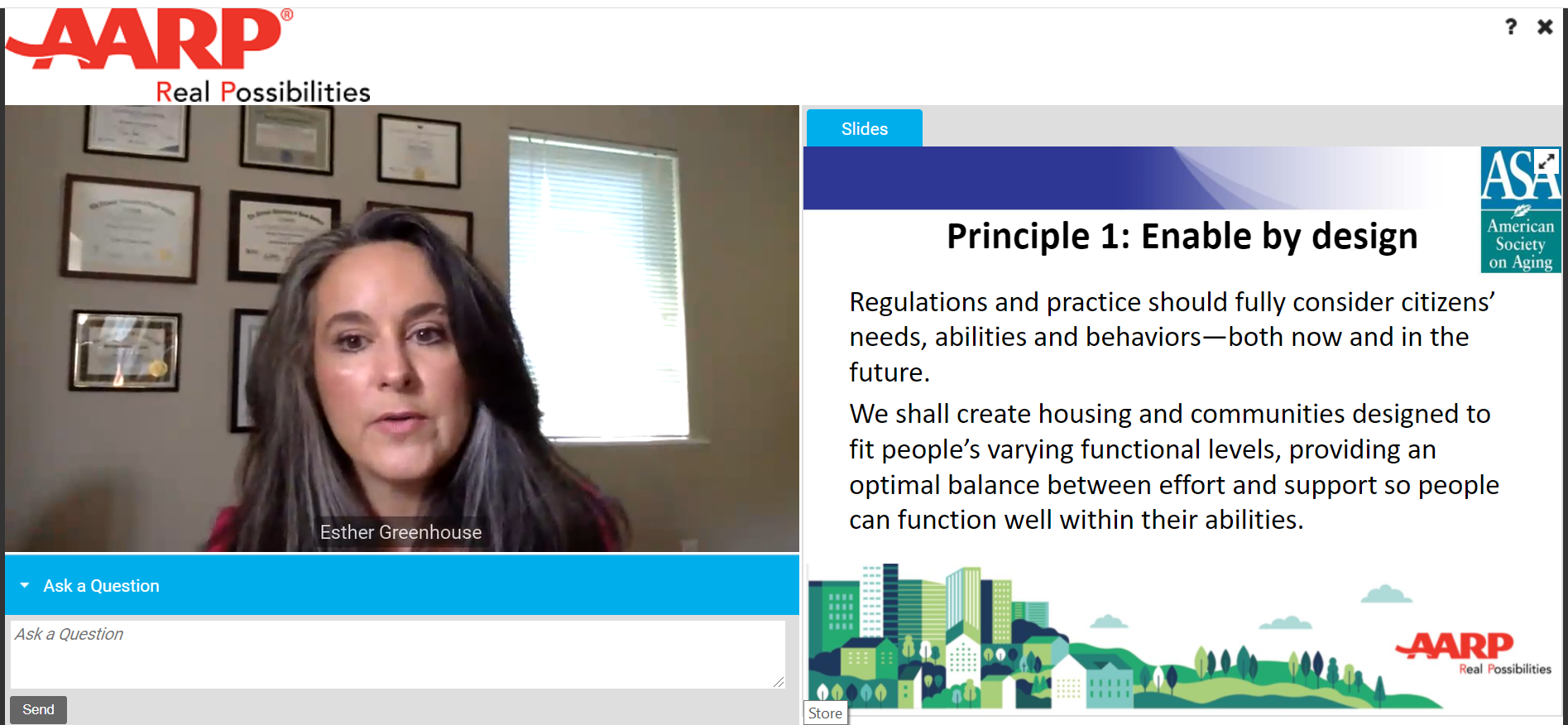
Environmental gerontologist Esther Greenhouse (who has perfect last name for the work she does) presented Equity by Design series on Creating Enabling & Equitable Housing and Multigenerational Communities, based on AARP International Statement of Built Environment Principles

Urban planner Ifeoma Ebo created Safe Places, Active Places! Community Playbook for Transforming Public Spaces in Your Neighborhood (2019) to improve safety and well-being through the built environment, programs and policies that activate ethic of care and compassion; pandemic resilience design makes use of open spaces on ground floor, housing with outdoor spaces.

Other pandemic designs: low-maintenance Freedom House with wraparound porch; World Alzheimer Report 2020’s Design, Dignity, Dementia: dementia-related design and the built environment for and with people living with dementia.   

While air quality was poor, watching The Dark Divide was like virtual forest bathing.  After fresh air returned, took “awe walk” through SF Botanical Garden, communing with plants from around the world!