Last week I attended American Society on Aging (ASA)’s Aging in America (AiA) conference, held in Chicago
for the second time in three years. I
was happy to return to Chicago,
former headquarters of Andersen (brand name was revived last fall—almost ten years after the Supreme Court overturned the firm’s 2002 criminal conviction) and where I attended annual training during my Arthur Android (“think straight, talk straight”) years...so I associate Chicago with learning, nowadays through ASA, which will be back in Chicago for 2017 AiA conference.
Kudos to ASA for making this annual conference accessible by offering free registration to student volunteers (new!) and discounted registration to other volunteers (very helpful to those of us who work in nonprofits with limited training budgets)!
Day 1
For 2015 AiA conference, I
took a red-eye flight (using frequent flyer miles), returned to stay at Hostelling International ($32 per night)...and then trekked a mile through snow, rain and sleet to the
conference site at Hyatt (avoided $219 per night) for Monday morning’s mandatory
volunteer orientation to reacquaint myself with the floor levels by
colors: silver, blue, green, bronze and
gold. New this year was scanning name badges (instead of sign-in sheets) for continuing education credit so session attendees received credit only if they entered session room within 15 minutes after start time to be scanned in, and then remained to be scanned at end of session. Also new was at least one men's restroom temporarily converted for gender-neutral use (with black curtain hiding urinal stall), which was very practical because more women attend conference.

Rock and Roll Legends Reflect on Aging, Making Music
and Living Life: With youtube
clips, Roy Earnest (Corporation for National and Community Service, Oakland) talked about intergenerational
connectedness (Adele’s cover of Bonnie Raitt’s “I Can’t Make You Love Me”;
Grateful Dead bassist Phil Lesh performing with his two sons in his San Rafael
restaurant; Carlos Santana functioning from center of his heart “so he’s never
out of style");
Janice Blanchard (Aging Better Together, Denver) discussed ageism and
female rockers (contrasting 56-year-old Madonna and 60-year-old Annie
Lennox “acting your age” at last month’s Grammy Awards, which reminded me of continuity theory of aging; 82-year-old Yoko Ono responding to critics, “Please don’t stop me being the way I am. I don’t want to be old and sick like many
others of my age”); and Pamela Braverman Schmidt (Bunker Hill Community College, Boston) explored rock musicians branching out into other creative
genres (Patti Smith’s photography, David Bowie’s acting, Neil Young’s
environmentalism, Bob Dylan’s poetry).
Shame in Aging: psychiatrist Angela Smith reviewed aging in a developmental context,
noting the most intense psychosocial drivers are avoid shame (appearing old, asking
for and receiving help, and feeling useless as a result of marginality) and
desire for connection; social worker Paula Seefeldt and volunteer support director Denyse Kapelus talked about Irene Zola’s
founding of Morningside Village (New York) enlisting volunteers to offer friendship and informal help to elderly neighbors
free of charge (unlike other village models that charge membership fees). Their Lifeforce in Late Years (LiLY) website includes a wonderful resource on How to Build an Eldercare Village.
Chicago-based Mather’s More than a Café
Chorus performed at the opening general session. ASA Chair Lynn Friss Feinberg welcomed 3,000 registrants from all 50 states plus Puerto Rico, and 15 countries.
Jennie Chin Hansen
received ASA Hall of Fame Award for
her advocacy and leadership to improve the lives of older adults—notably her
almost 25 years at On Lok in San Francisco, where she led push to enact 1997 federal law that
incorporated On Lok’s long-term care model into the Program for All-Inclusive
Care for the Elderly (PACE), a Medicare and Medicaid program now operating in
more than 30 states!
In Disruptive Aging, AARP CEO Jo Ann Jenkins said instead of aging,
focus on living—sounding much like Ilya Mechnikov, who said “We must continue
living, not age-ing.”
In Maturity Re-Imagined, Age Wave CEO Ken Dychtwald said maturity is
about more than aging, but purpose and legacy (giving back). His survey indicated that health is
the most important ingredient to achieve a happy retirement.
Day 2
My volunteer assignment as room monitor on Day 2 helped reduce overchoice dilemma and broaden my horizons to attend sessions that I had not previously considered.
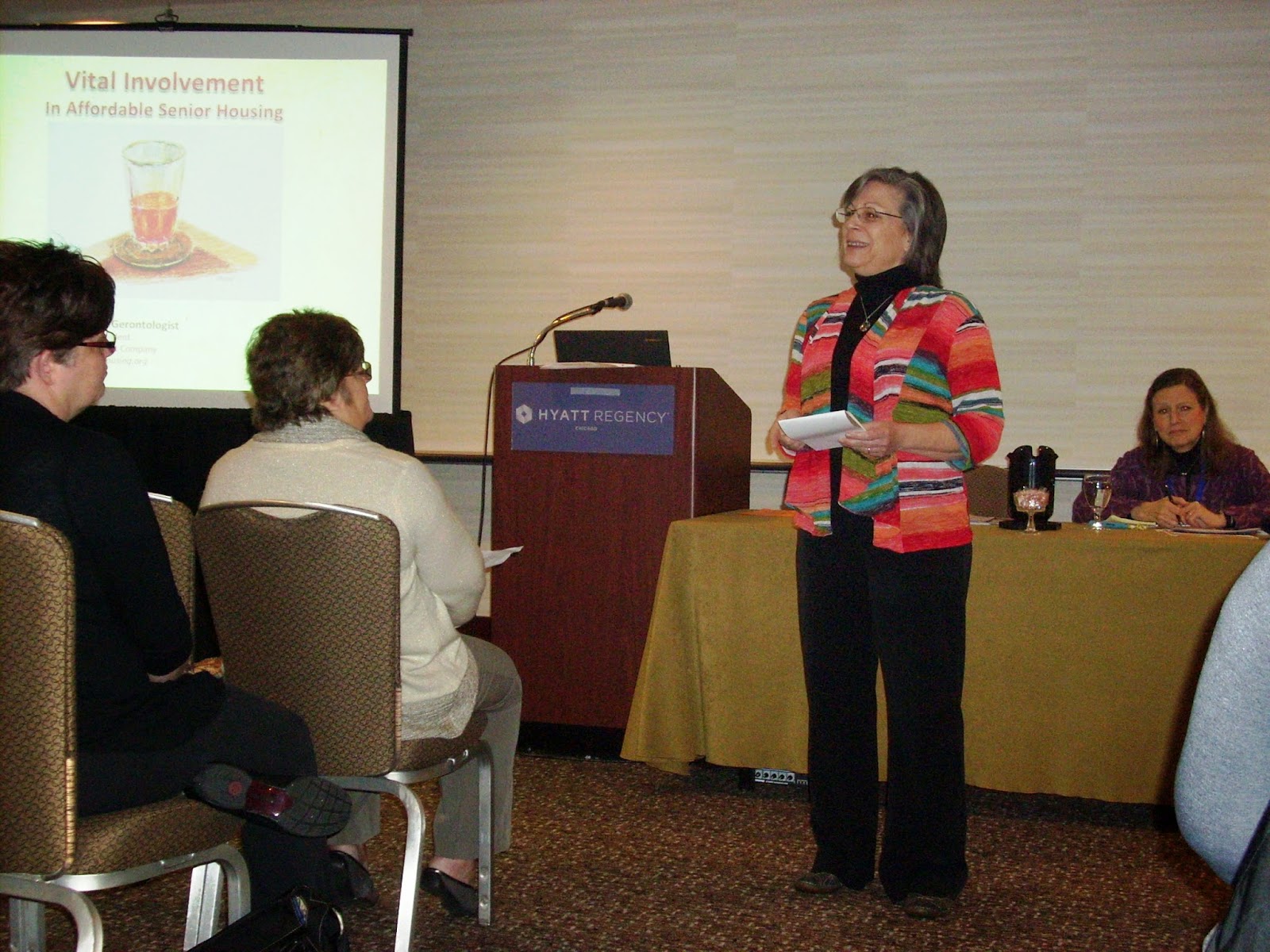
Vital Involvement in Affordable Senior Housing: The
Creative Approach: after meeting at an ASA conference, Linda Duncan
of AHEPA Management Company (Indiana) and Helen Kivnick (Minnesota), co-author of Vital Involvement in Old Age (1986), began a
collaboration to enhance creative wellness among 4700 residents of HUD 202
housing based on the minimax principle:
minimize obstacles by maximizing supports for and emphasize resident’s
strengths to focus on what the person has and can do. AHEPA Services Coordinator Betty Montgomery provided an example of this strengths-based problem-solving:
- identify personal need/problem: lack of movement among residents with arthritis and their lack of exercise that increased pain when moving
- identify gaps/obstacles in environment: misinformation about managing arthritis pain
- identify supports in environment: Service Coordinator invited arthritis pain speaker who provided solid information to dispel myth that people with arthritis should avoid exercise
- identify personal skills/interests/values: residents wanted to be more active and involved in daily life so they learned movements and exercise strategies to maximize muscle strength and to minimize pain
Use of Online Dementia Care Training in a Live
Classroom Setting based on Alzheimer's Association essentiALZ® certification through CARES online (available 24/7 on staff’s own time with compensation) and
in-classroom (not more than 30 minutes, face-to-face interactions, group
problem-solving, Q&A).

Open Windows: Older Adults Sharing Life Experiences presented by Senior Learning Network founders Ellen Ervin and Lynne Beachner incorporating Zoom video meetings with
Sheila Finkelstein,
author of Technology for Seniors Made Easy,
Melva Stein (former Peace Corps volunteer in Malawi), and Bibi (“Belgium Anne
Frank”).
Took a quick break to see Ai-jen Poo, author of The Age of Dignity: Caring for a Changing America (2015), since I missed her book tour in San Francisco last month.
How to Use Technology for a Positive Aging
Experience: Arthur (former CPA) and Bonnie Kupperman (former
journalist) demonstrated their website, My Senior Portal,
originally developed for Arthur’s 95-year-old father, to engage (create and maintain personal records and information), enjoy (participate in online games,
read jokes), and educate (learn
health information, housing and caring services).
Pinchas Cohen, a
pediatrician before he became Dean of USC Davis School of Gerontology,
discussed making personal and societal changes to improve health: smoking (stop),
sedentary lifestyles (“sitting is the new smoking”), diet (legislate labeling,
though don’t know best diet), and Alzheimer’s risk (avoid by diet, exercise and
staying engaged).
His healthy aging
advice was not “one-size-fits-all,” but personalized aging, and suggested a
longevity calculator to calculate biological age. Fernando Torres-Gil, Director of the Center
for Policy Research on Aging at UCLA, commended session’s pharmacy sponsor for
going tobacco-free last year.
Day 3
Spirit of ’45 recognized the Greatest Generation including 95-year-old Elinor Otto,
a “Rosie the Riveter,” who built the planes flown by these three Tuskegee Airmen. She said work gave her a reason to wake up,
and only recently retired when Boeing plant closed.
In Disabilities in Aging: A Future Redesigned, Fernando Torres-Gil said most of us are “temporarily abled” who may soon face the vicissitudes of the aging
experience that include impairment. Chicago-based Access Living CEO Marca Bristo talked about her own experience when she became
paralyzed at age 23 after diving into Lake Michigan,
and changing from the medical to social model so disability is a normal part of
the human condition. UC Berkeley
Visiting Scholar Wanda Lieberman presented show and tell of universal design
architecture examples.
Gerijoy’s Victor and Brittany Wang of San Francisco married after meeting at last year’s ASA conference.
Helping Lower-Income Seniors Maintain Financial Independence: Consumer bankruptcy attorney Eric Olsen founded HELPS http://www.helpsishere.org/ (Help Eliminate Legal Problems for Seniors) Nonprofit Law Firm to provide seniors who are judgment proof and with protected income (social security, disability, veterans benefits, ERISA retirement) an attorney who communicates with debt collectors to prevent collector harassment.
Using Information and Technology to Improve
Healthcare for Older Adults in the
transition from episodic care to population health, presented by Jaewon Ryu of session
sponsor Humana. General sessions were opportunities for attendees to win a free ipad or AARP RealPad.
Gray Panthers’ Intergenerational Action Model: A
Strategy for Social Movements and Change featured intergenerational panelists Jarmin Yeh (UCSF doctoral
student), Brooke Hollister (UCSF Institute for Health and Aging), Carroll Estes
(Board Chair of National Committee to Preserve Social Security and Medicare
Foundation), and Paul Nathanson (Justice in Aging Special Counsel).
In solidarity, we formed
circle for Gray Panthers’ Growl: stand and raise both arms (reach toward
peaceful world), open eyes wide (envision suffering and need), open mouths and
stick out tongue (cry out against injustice), and growl three times!!!
Martha Holstein, who attended Gray Panthers' session, provided promo code 4M15HLSTN, for 30% discount on U.S. orders of her new book, Women in Late Life: Critical Perspectives on Gender and Age (2015).
California Association for Adult Day Services received 2014 Rosalinde Gilbert Innovations in Alzheimer’s Disease Caregiving
Legacy Award for Policy and Advocacy,
based on its Success
Through a Unified Vision: the Fight to Preserve Alzheimer's Care in California, which
saved Adult Day Health Care (ADHC) from elimination as a Medi-Cal benefit in
2011 through a concentrated effort utilizing public interest litigation,
grassroots advocacy and persuasive media stories.
Day 4
In On the Rise: Prescription Drugs and Substance Abuse
Addiction Among Elders, Certified Master Addictions Counselor Steven Moore (Houston) said that baby boomers have had more exposure to alcohol, tobacco and illegal drugs in their youth; prescription drug abuse is present in 12-15% of elderly who seek medical attention; more patients age 60+ are admitted to hospitals for alcohol connected problems than for heart attacks; 85% of older adults take prescription medication.
Let’s Talk Senior Poverty: What Are We Doing About
It? same title, description and
speakers as last year’s session. Presenters Paul Nathanson (Washington, DC) and Kevin Prindiville (Oakland) from Justice in Aging use the
power of law to strengthen government safety net programs like Medicare, Social
Security, Medicaid and SSI to fight senior poverty.
In Transforming Communities for an Aging Society, Debra Whitman talked about creating "great neighborhoods for all ages," including age-friendly NYC's example of designating seniors-only swimming pool hours, in response to seniors who weren't comfortable splashing with younger ones. She and
Rodney Harrell introduced AARP Network of Age Friendly Communities and
AARP Livability Index coming April 20th!

In The Hidden Male, Friendship Senior Options Director of Lifestyles Michael McCann (Schaumburg, IL) explained
The Male Journey, based on Joseph Campbell's Hero Myth Cycle and Richard Rohr's male spiritual journey, with three outcomes: Foolish, Angry or Wise. When given freedom during retirement, men who "suck it up to be a man" seek opportunities to "explore, hunt and continue to grow." Activity programmers might get these men in the door by offering beer, steak and sports, and then engage them to get deeper in the aging process like naming highlights/celebrations and detours/disappointments in life journey, etc.

Community Gardens in
Senior Living with Kavod Senior
Life Resident Care Coordinators Elizabeth Dubinsky and Dre Dufford showed us a video of their Denver retirement community garden and later engaged us in hands-on gardening activity. Though Kavod's vision was an intergenerational horticultural therapy program, its older gardeners did not want to share with children. They primarily grow foodstuffs to use for congregate meals.
Seed ball recipe: 1¼ cup
dry terracotta clay + ¾ cup dry organic compost + ¼ cup assorted seeds + enough
water so mixture binds together but doesn’t stick to hands; roll into
penny-sized round balls & completely dry in sun, then throw seed balls into
garden, water to allow seeds to germinate. Seed balls were a traditional method of planting for many Native American tribes.

Facing the Challenges of Oral Health Care for
Seniors with Leonard Brennan, dentist and Co-Director of Harvard Geriatric Dental Fellowship Program, and his daughter Kathleen, a family practitioner (Maine), discussed age-prevalent oral conditions such as candidiasis (fungal infection) and
xerostomia (dry mouth), which are associated with medication side effects.
UCLA Public Health Professor Steven Wallace on Equity and Social Determinants of Health Among Older Adults, and Health Foundation of South Florida's Martha Pelaez on Ending Health and Social Disparities (legislate access and resources to ensure tools and culturally appropriate support to manage health).
SAGE Executive Director Michael Adams on its National Resource Center on LGBT Aging, University of Washington Social Work Dean Emeritus Nancy Hooyman on Gender Inequities in LTC (caregiving's low status perpetuates gender-based health disparities across the life course; poverty and poor quality of life in old age is the price women pay for other people's dependence on them for caregiving, which is seen as a private duty rather than a service with "public value"; take Fair Care Pledge), and UW Social Work Professor Karen Fredriksen-Goldsen on Promoting Health Equity Among LGBT (still need protection from discrimination in employment, housing and public accommodations).

University of Hawaii Social Work Professor Colette Browne on culturally competent community programs (Ha Kupuna National Resource Center for Native Hawaiian Elders received ASA's Award for Excellence in Multicultural Aging), Willy Valencia on Diabetes in Older Hispanic/Latino Americans, Tim McNeill on African-Americans, and SFSU Gerontology Professor Darlene Yee-Melichar on Perspectives from Asian-American Communities.
March is National Nutrition Month: Chicago
Meat-In
Farmer’s Fridge North Napa
Salad ($7 for jar containing napa
cabbage, mixed greens, avocado, organic red grapes, pistachios, dried tart
cherries & balsamic vinaigrette) and “Fried Rice” (not pictured, but $3.75 for cauliflower, local peas, carrot, garlic,
egg whites).
Exhibit Hall Reception
Gilbert Award Reception
Good Stuff’s Michelle Melt Free Range Turkey Burger ($6.98 included caramelized onions, swiss
cheese, ruby tomato, lettuce on wheat bun with southlawn herb garden mayo)
Garrett Mix of sweet CaramelCrisp and savory CheeseCorn (free sample): Chicago tradition since 1949
Art in Bloom
Foliage loss due to snowy weather in Chicago had me yearning for horticultural therapy, so I headed over to a department store's flower show on its 9th floor ...perhaps closest I could get to being Up on the Roof ("it's peaceful as can be, and there the world below can't bother me," as Carole King sang).
My love of gardening comes from my grandfather,
a strong, silent type who seemed to express affection through gardening
activities and eating together. Being
close to nature (plants) makes me reflective, so I reflected on conference
remarks about seniors wanting their own time and space in NYC’s swimming pool
and Kavod’s community garden. I thought
how different my grandparents were because we lived in an intergenerational
household with no age discrimination. I
vividly recall accompanying my grandmother as her underage guest to a wedding and being
told “no kids allowed” but my grandmother prevailed, and I found the wedding to
be PG-rated except for alcohol.
Five years ago, I re-lived
that “no kids allowed” experience when I set foot in a senior center for the first time:
when I walked through the entrance door with a sign stating that the facility
was for seniors age 55+, several seniors approached me at the door asking for
the purpose of my visit. After I
explained that I was visiting the nutrition class offered through City College,
they approved.
Because I chose to attend
the conference’s Health Disparities Forum, I missed the Senior Centers Summit
scheduled at the same time. However, for my gerontology class, I wrote a paper about reinventing senior centers for baby boomers,
who are more involved with their children to stay young, and less comfortable
with the age segregation of their parents’ generation. Offering different
models that include multigenerational community or wellness centers so there is
something for everyone is vital.
Landmark Chicago Theater, Beaux-Arts style building from 1921.
Thanks to Marie-Louise Ansak scholarship, I completed an independent study on horticultural therapy to share with On Lok's adult day care program participants. Earlier this month in sunny and dry San Francisco, I presented my hands-on horticultural therapy project: container garden (intended for windowsill), infusion and sachet activities using organic herbs from the mint family to promote memory (lemon balm, rosemary, sage), relaxation (lavender, lemon balm) and digestion. Aromatherapy uses essential oils from herbs that can be inhaled and absorbed into lungs and nasal passages, entering the bloodstream and activating centers in the brain that affect mood, emotions and immune function.
Selected herbs originate from Mediterranean region, which has climate similar to San Francisco Bay Area: dry summer, mild winter. Plant care is relatively low-maintenance SWAN:
- Sunlight: 5 hours per day
- Water: once a week
- Air: ventilated to avoid powdery mildew
- Nutrition: feed fertilizer once every 6 weeks