Showing posts with label deaf. Show all posts

Thursday, April 30, 2015

Homeless

Housing is a basic need, yet homelessness can happen to anyone due to factors outside of one’s personal control: increasing income inequality/poverty, cuts to government safety net programs, lack of affordable housing, discrimination, natural disasters, tragedy, serious illness or disability, loss of employment, domestic violence, evictions, etc. 


“The toughest thing about being homeless is the ageing.”--Christopher Young of homeless encampment near Airbnb’s San Francisco headquarters

"Nobody wants to be old and alone and homeless,…and their pride keeps them from asking for help.”-- Sandi Bachom, What It's Like To Be Suddenly Poor And Homeless At 70

When San Francisco’s public housing wait list, closed since 2010, opened for homeless people over a six-day period earlier this year, over 10,000 households signed up, with the average age of the head of household who applied was 66. Though older adults age 60+ make up 19% of the City’s population, they represent 34% of the City’s population that is poor—even access to SSI and Social Security benefits often fail to cover the cost of housing.

According to UCSF Professor of Medicine Margot Kushel, about half the homeless population is age 50+, and a quarter to a third of homeless seniors have significant cognitive impairment that makes it difficult to complete steps to be housed. 


Housing the Homeless
At last month’s Town Hall to End Homelessness, Arondo Washington Cox presented Camp Unity, one of a handful of self-managed, transitional tent villages in Seattle that provide a “safe and private place to live” with a strict code of conduct (sex offender and background checks, no alcohol/drugs, random drug tests) while moving every three months.  Set-up costs are $2,500 for 50 tents, plus $5,000 monthly operating cost for 50 people.  Camp amenities include shower, bathroom, electricity, washer/dryer, WiFi, communal kitchen, 24-hour security, and trash removal.  To help end homelessness, Campers have access to supportive services and 10 have graduated to permanent housing in the past year. 

How would this work in San Francisco, and for seniors and persons with disabilities? 

Estimated at around 6,400, the number of homeless on the streets of San Francisco is about the same as it was in 2005 when then Mayor Gavin Newsom launched his 10-year Plan to Abolish Chronic Homelessness, and after the 1989 Loma Prieta earthquake when homeless formed “Camp Agnos” outside City Hall.  In the past decade, more than 11,000 formerly homeless have been housed, while new homeless are added to the count. (Senator DiFi is seeking to revise HUD's definition of homeless to include persons doubled-up with friends or family, couch-surfing or living in single-room occupancy hotels.)  

San Francisco spends $165.7 million per year on homelessness, but millions more are needed to house the remaining thousands of homeless. (As reported in The Daily Show, Utah claims it is more cost-effective to invest $10-12,000 to house formerly homeless versus $20,000 for homeless to remain on the streets, including emergency services and jail time costs.) 
Journalist Gary Kamiya, who wrote “The Outsidersabout perpetual homelessness in the March 2015 issue of San Francisco magazine, moderated a community panel.  District 6 Supervisor Jane Kim, who spent one night in a homeless shelter, said she experienced intense boredom during the 12-hour lock-up, except for one-hour smoke break, with no services.  As a result, she has funded a pilot yoga program at Next Door shelter for its clients and minimum wage staff.  She also proposed a luxury condo sales tax to fund below-market rate housing.
Hospitality House’s Community Building Program Manager and formerly homeless Joe Wilson advocated for anti-poverty programs, in contrast to the hypocrisy of no more homeless by having shelter in the prison system, which is being used to address poverty and mental illness; and how the presence of homeless reminds people of suffering so they’re criminalized based on Elizabethan Poor Laws distinguishing the deserving versus undeserving poor.


Homeless Prevention
At this month’s Senior & Disability Action (SDA) meeting, affordable housing activist Calvin Welch talked about reforming short-term residential rental law, which could help prevent homelessness as landlords evict tenants to list rooms for short-term rentals that are a bigger factor than Ellis Act evictions. Share Better SF has proposed a ballot initiative that would cap vacation rentals to 75 nights per year, impose fines on hosting platform companies like Airbnb for listing rentals out of compliance, and require quarterly reporting to the City.  (Since February, unlimited short-term rentals are allowed when a host is present, 90 days per year of entire-house rentals by absentee hosts, and no fines/reporting requirements.) 5,000 units are taken off the market for short-term rentals. 

SF Anti-Displacement Coalition hosted all-day Tenant Rights Fair: Knowledge is Power – How to Stay in Your Home with information tables and workshops (offered in English, Chinese and Spanish) to empower tenants to defend against rising evictions that result in homelessness for persons who cannot afford market rate housing after being evicted.  Most vulnerable are long-term tenants in rent-controlled units, seniors on fixed income, and persons with disabilities who require reasonable accommodations like ground floor units in buildings without elevators (limited supply).
Section 8 – Know Your Rights presented by Bay Area Legal Aid housing staff attorney Monique Farris and Housing Rights Committee Executive Director Sara Shortt: half of Section 8 voucher holders are seniors and persons with disabilities; no new Section 8 vouchers except 100 for veterans; wait list has been closed; takes average 6 months to find landlord who will accept Section 8; pay only amount determined by Housing Authority because side payments are illegal that could lead to subsidy termination based on fraud.  Sometimes landlords no longer want to participate in Section 8, so no repairs made; in that case, tenant can contact Department of Building Inspection/Department of Public Health/Housing Authority to cite landlord; use repair and deduct with caution and only if attorney involved to avoid eviction on record.  Subsidy can be terminated if program rules violated, but right to request hearing within 10 business days of notice.
Navigating Buyouts presented by Eviction Defense Collaborative staff attorney Deepa Varma and Advancing Justice - Asian Law Caucus housing rights staff attorney Katherine Chu: value of buyout increases over time, so first to leave gets least money; how high can you go depends on litigation costs, rent differential, encumbrances, certainty, emotional cost, and some landlords are actually nice. 
Your building is for sale, how to stay in your home presented by Housing Rights Committee organizer Fred Sherburn-Zimmer and tenant: if you’re under rent control, nothing changes when your building is sold . . . but be prepared to organize with neighbors (power of community > power of one); estoppel form (assert any rights not specified in lease); declare protected category (senior or disabled person in Owner Move-In or Ellis Act eviction); reject new House Rules; get support (legal, friends, tenant groups, allies); pressure to drop eviction!


Homeless with Disabilities
At this month’s Mayor’s Disability Council meeting, Director of Housing Opportunities, Partnership & Engagement (HOPE) Bevan Dufty said that many homeless clients have disabilities, so his office tries to work with them to overcome problems in the shelter or services that don’t meet their needs.  Challenges include: homeless clients have to give up things because the only storage in a shelter is a drawer under the bed; married couples cannot stay together in a shelter; more clients are seniors and persons with disabilities yet shelter staff not trained to assist with activities of daily living, especially in the case of people discharged from hospital going directly to shelter.  He also mentioned last month’s launch of The Navigation Center, a one-stop shop for homeless to obtain services like case management, laundry and meals; and opening of LGBT-focused shelter (29% of City’s homeless identify as LGBT) in June.


Homeless Living
Fundraiser for St. Francis Living Room, a non-profit serving homeless and low-income older adults in the Tenderloin for over 20 years, with a weekday hot breakfast program, practical assistance and activities to promote the well-being of participants.  Hosted by Program Director Greg Moore and Board President Pedro Torres (pictured above), this full house event held at Sweet Inspiration Bakery CafĂ© had something for everyone – pasta dinner (vegetarian pesto for yours truly), meeting other supporters and Martha Boesing's wonderful Song of the Magpie performance (very cool to hear her mention St. Francis Living Room in typical day of homeless older adult)! 
Richmond Senior Center Director Linda Murley, Curry Senior Center (Tenderloin) Director David Knego, DAAS Program Analyst Maria Guillen and YMCA Central (Tenderloin) Senior Program Coordinator Gloria Garcia enjoy socializing, food and drink.
Martha’s play was based on her Faithful Fools “street retreat,” which involved living like a homeless older person in the Tenderloin for a week. She contemplated that it would be scary to live on the street, and then wondered what she would do . . . with “no house to clean”?  Her typical day was getting in and out of shelter at 7, then foraging for food, including begging people who would look right through her as if she didn’t exist.  She revealed that "seniors first" policies on lunch lines and at shelters were ways to "get us out of there ... people can't stand to look at us, it's too distressing ... it makes them think about their parents whom they've abandoned to some old people's home ... or maybe they think: 'That's where I'll end up.'" 

She talked about sleep deprivation, criticized Care Not Cash, stale food, etc.   She likened the homeless to nomads who wander, remembering a book she read that nomads were kinder and wiser than people who lived in separate square boxes.  She noted that magpies are omnivores who eat anything, moving and foraging throughout the day.
Sweet Inspiration owners Chef Michael Colter and Wendy Mogg (certified sign language interpreter) serve poppyseed cake for dessert.

Back to Nature
Ohlone tribe lived at Lands End prior to 1776 Spanish settlement in San Francisco. No one should be homeless, and I wanna sing out, "This land was made for you and me!"

Martha’s reference to nomads and foraging made me think about traditional hunter-gatherer cultures like the nomadic Ohlones, whose lifestyles were really sustainable ("kinder and wiser" except for burning belongings after a person’s death?) and starvation was unheard of so they didn’t have to practice agriculture.  It’s tragic to think that their native lands that provided such a varied diet (acorns, buckeyes, berries, nuts, seeds, mushrooms, weeds, etc.) were taken from them, replaced with government subsidies like processed wheat flour and rancid oil—recipe for Indian fry bread and diabesity. 
Coastal strawberry (Fragaria chiloensis) thrives on sandy soil: these wild berries can be eaten fresh or dried, its leaves and roots used to make tea.
Food is also medicine, like yarrow used by Ohlones to treat stomachaches and skin sores.

Nature provides an abundance of food so no one should really go hungry, especially when there are so many snails and edible plants growing wild that can be foraged. Think about perfectly edible “invasive weeds” thrown into compost bins, when they could be fed to starving people.  Even “pests” like snails in our gardens are sources of edible protein.  Eating wild brings us closer to nature.


Natives like sticky monkey flower, Indian paintbrush, seaside daisies and California poppy are drought-tolerant and natural feast for the eyes!

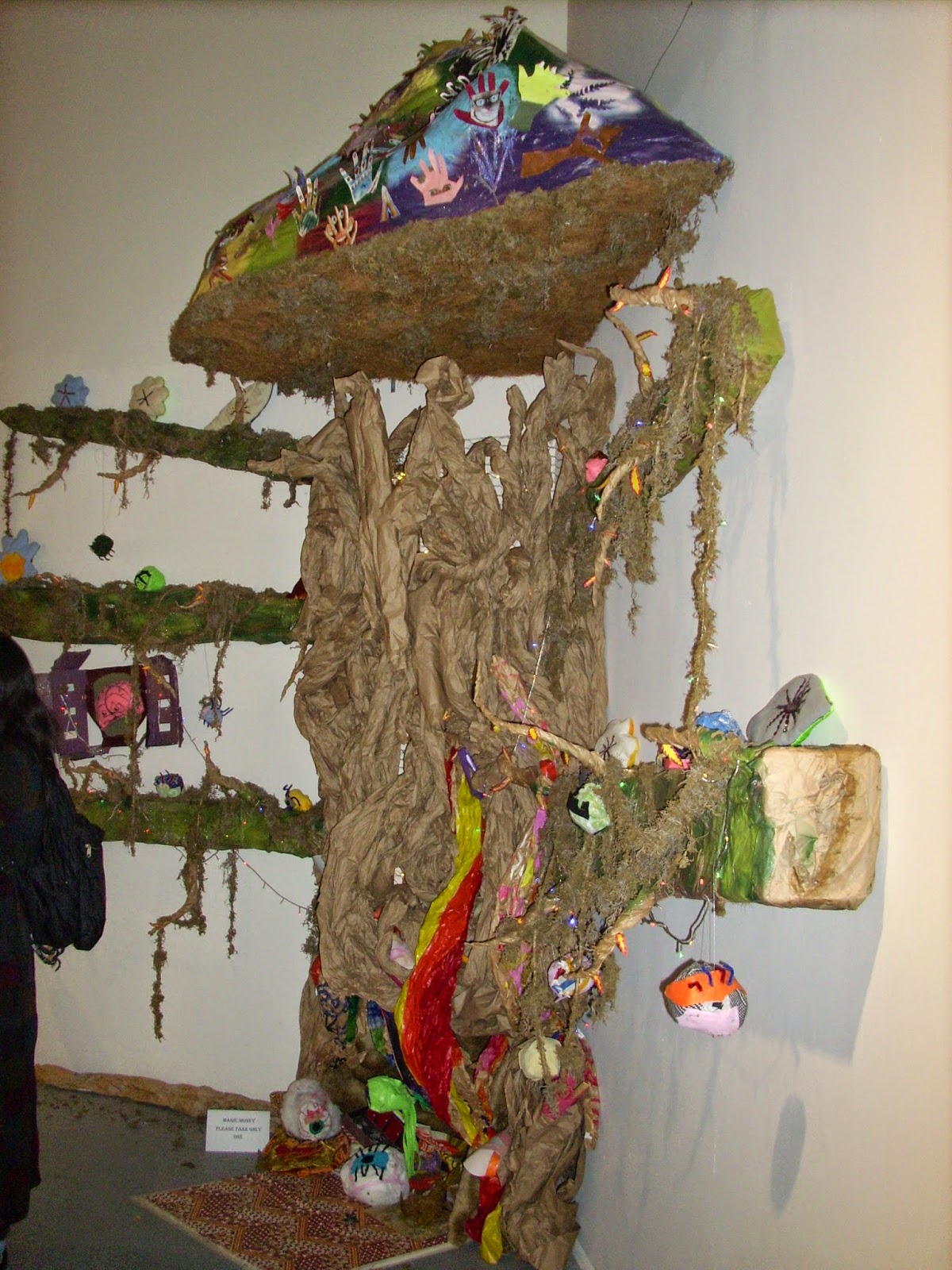
At Dis/Play exhibition at SOMArts Gallery, Arc of San Francisco’s ArtReach Studios students collaborated to create Magic Tree intended as a peaceful and spiritual place that can be entered alone, liberated from the crowd and free to play.
Safe to Touch wall displayed tactile art by the artists of Artful Steps within Stepping Stones Growth Center, embracing inclusion, accessibility and unification of diverse communities.

Check out California School for the Deaf visual artist David Call's Eye Hand Studio website for Deafhood Unleashed (2011), The Missing Jigsaw Pieces (2012), Resistance (2012), The Deaf Eye (2012), and The Power of ASL (2013) -- all featured in Dis/Play, as commentaries about Deaf people being oppressed by audists who focus on the hearing and speech approach to education, when Deaf people are visual learners who use natural hand signs.


At Dis/Play Closing Reception, deaf-owned and operated Mozzeria had mobile pizzeria with built-in oven serving awesome flatbread with braised greens, white garlic sauce, currants, shallot-brown sugar and brie.

Sunday, April 28, 2013

No senior left behind


Springtime in lovely garden at 30th Street Senior Center (http://www.onlok.org/30thStreetSeniorCenter/About30thStreet.aspx)

apple penny table

This month I began participation in UCSF’s Practicing Alternatives to Heal Depression (PATH-D) study, as I was selected to take part in the non-depressed group.  For the screening exam, I was given the Folstein Mini-Mental State Exam (MMSE), which involves repeating the words:  apple, penny, table.  Because these words have become so clichĂ© (like an apple a day keeps the doctor away, a penny saved is a penny earned, etc.), I wondered about the effectiveness of repeating these same words to screen for cognitive impairment?

I read that “major depression in older people living in the community range from less than 1 percent to about 5 percent, but rises to 13.5 percent in those who require home healthcare and to 11.5 percent in elderly hospital patients” 
(http://www.nimh.nih.gov/health/publications/older-adults-depression-and-suicide-facts-fact-sheet/index.shtml).  This confirmed my career choice to work in health promotion to support aging in community. 

“Only happy faces bloom there and there’s never any room there for worry, gloom or cares.  Seniors come here from everywhere to enjoy a day of cheer.”  By Precita Eyes Muralists in collaboration with the 30th Street Senior Center.  If communing in this garden doesn’t lift someone out of depression, I find the karaoke singing (deep, abdominal breathing) inside the senior center brings a smile to my face and an occasional chuckle.

“nothing about us, without us!”
American Deaf Culture (http://www.americandeafculture.com/) author Thomas Holcomb presented a talk, Deaf Culture: An Obsolete Concept or A Timeless Solution? at SF Main Library.  When the medical model provides cochlear implants as a cure for deafness, does this mean full assimilation so there’s no need to be deaf anymore—something passĂ©, a relic for a museum display case?  Alternatively, Holcomb offered Deaf Culture as a cultural/linguistic model to support healthy identity formation, self-determination, information-sharing and full access to communication. 

The Deaf community has opposed mainstreaming, which denies deaf children the opportunity to learn American Sign Language and isolates them among hearing classmates. When the Deaf seek opportunities for congregation, the hearing view them as segregation. 

Holcomb discussed the current fight for deaf-only retirement communities, which has raised concerns about discrimination against the hearing, but it’s really about a linguistic minority being able to live out their lives where they can enjoy the ease of freely communicating based on shared language and experience.  Holcomb explained that American Deaf Culture is characterized by information-sharing to the extent that not much is held back: access to communication is a way to understand how the world works (for example, buying a car at sticker price) because this was not picked up from their hearing parents or teachers. 

senior advocacy

SFSU Gerontology Program hosted Careers in Aging Fair, which included my invitees Department of Aging & Adult Services (http://www.sfhsa.org/DAAS.htm), Family Service Agency (http://fsasf.org/svc_senior.html), Gray Panthers (http://graypantherssf.igc.org/), Meals on Wheels (http://www.mowsf.org/) and Senior & Disability Action (http://www.sdaction.org).

Left photo:  Family Service Agency Senior Services Director Cathy Spensley with LTC Ombudsman Benson Nadell.  Right photo:  SDA Executive Director Jessica Lehman with Gray Panthers advocate Michael Lyon.

older women’s health
SFSU Gerontology Program Chair Darlene Yee-Melichar presented a talk, Women’s Health & Healthy Aging: Living Longer, Living Better.  Highlights:
  • Ethnic minorities are becoming the majority
  • If we seek to reduce death rate among women, focus on their top three causes of death: heart disease, cancers, cerebrovascular diseases (strokes)
  • Multiple Chronic Conditions among age 45+ (“MCC zone”):  impact of caregiving among mid-life women of sandwich generation is often neglecting self-care
  • Most common combination: hypertension + diabetes correlation, nutrition + physical activity factors
  • 1/3 of older women exposed to disabilities, 2/3 of older women independent; activity limitations & disabilities increase by age, setback by sedentary lifestyle—need older person to retain autonomy or lose ability so weigh consequences of being helpful v. too helpful
  • 1/3 of U.S. population has low health literacy—need accurate info. that’s easy-to-understand
home care & domestic workers’ rights
At this month's SDA meeting, we heard from domestic workers and their advocates to learn how supporting the Domestic Worker Bill of Rights (http://leginfo.legislature.ca.gov/faces/billNavClient.xhtml?bill_id=201320140AB241) can be win-win for domestic workers and older adults and persons with disabilities (PWD) who receive their services so we can age in community.

getting around
SDA’s Senior Survival School at I.T. Bookman Community Center included transportation panel:  Matthew West of SF Muni Accessible Services discussed priority seating (blue decals on windows above seats, blue-colored seats in new buses) for seniors and PWD (Muni driver may not drive bus if passenger safety at stake should someone refuse to yield front seats to seniors and PWD), and late-night stop policy allows riders to request stop near side of intersection v. designated bus stop from 8:30 pm to 6 am.  John Sanderson discussed applying for paratransit services (ADA shared-ride cost $2, ADA group ride cost paid by senior center, and non-ADA-mandated taxi service).  Roxana Lara talked about shop-a-round, a grocery shuttle service for seniors and PWD, with a special offering free rides through August 15, and then we received shop-a-round tote bags! More information in Muni Access Guide (http://www.sfmta.com/cms/raccess/mauindx.htm).

aging gracefully

Jewish Community Center of SF hosted The Art of Aging Gracefully: Stay Vital, Healthy and Fit, with presentations from UCSF MDs.  My favorites:
Dr. Bruce L. Miller of UCSF Memory and Aging Center presented Factors Associated with Cognitive Aging, which included showing “Great Works Done in Late-Life or with Neurological Disease”:  Yeats, Shaw & O’Neill had Parkinson’s; de Kooning had Alzheimer’s; and Ravel had dementia.  Modifiable (non-genetic) risk factors that affect cognitive aging are adiposity/obesity, chronic inflammation, physical exercise that regrows brain-derived neurotrophic factor (BDNF), and vascular risk factors (hypertension reduces brain volume).  What we can do:

  • Aerobic exercise is the only proven means to increase brain cells
  • Protect against vascular disease (what is good for the heart is good for your brain)
  • Participate in social networks & engage in mental activity
  • See your doctor (e.g., treat low vitamin B12, thyroid)
UCSF oncologist Dr. Donald I. Abrams (who appears separated at birth from Mister Rogers?) returned to school ten years ago to study at Dr. Andrew Weill’s Arizona Center for Integrative Medicine.  He delivered the following 12-point program for Healthy Aging:

1.     Eat an anti-inflammatory diet: plant-based foods (whole grains, fruits, cruciferous vegetables); decrease animal fats except increase marine omega-3s; decrease refined carbs; season with garlic, ginger, onions, turmeric; drink green tea
2.     use dietary supplements wisely to support body’s defenses & natural healing power (e.g., medicinal mushrooms)
3.     use preventive medicine intelligently: know risks of age-related disease; get appropriate diagnostic & screening tests; treat problems in early stages
4.     get regular physical activity throughout life:  for posture, strength, balance, flexibility, endurance; brisk walk helps weight control, mental health, heart health
5.     get adequate rest & sleep: regular bedtime; avoid alcohol; no eating immediately prior to bed; evaluate meds for sleep interference
6.     learn & practice methods of stress protection
7.     exercise your mind as well as your body
8.     maintain social & intellectual connections as you go through life
9.     be flexible in mind & body:  learn to adapt to losses & let go of behaviors no longer appropriate for your age
10.think about & try to discover for yourself the benefits of aging: gift of time, freedom, senior discounts
11.do not deny reality of aging or put energy into trying to stop it:  use experience of aging as stimulus for spiritual awakening & growth
12.keep an ongoing record of the lessons you learn, the wisdom you gain & the values you hold.  At critical points in your life, read it over, add to it, revise it, & share it with people you care about.

More on Dr. Abrams’ thoughts on getting better with age (http://www.ucsfhealth.org/doctors_and_clinics/features/abrams_donald/index.html): 

“. . . aging is totally natural and, in fact, quite beautiful. I think of aging as something that adds value. As a culture, we appreciate things that get better with age, such as wine, cheese, and redwoods . . .”

“. . . age confers a certain understanding that life itself is the most valuable thing you have and what's valuable is still being here. . . “

“You can be smart when you're young, but you need to be old to be wise.”

non-profit approaches to aging in place

As adults with young children leave San Francisco (which has the lowest proportion of children of any major city in the U.S. according to the 2010 Census), this means aging parents are left behind without the informal support of family members, which could lead to isolation among these seniors.  AARP reports that many older adults join Villages because of a desire to age in place, yet “not be dependent on family members and friends” (http://www.aarp.org/home-garden/housing/info-03-2010/fs177-new.html). 
This month’s OWL (http://www.owlsf.org/) meeting featured a panel discussion on Aging in Place with Executive Director Marie Jobling of Community Living Campaign (CLC at http://sfcommunityliving.org/), Executive Director Kate Hoepke of SF Village (http://www.sfvillage.org/), Executive Director Jacqueline Zimmer Jones of NEXT Village (http://nextvillage.org/) and moderator Glenda Hope.  A common theme was building community to reduce isolation. 

Marie explained that formal services by agencies can deliver 20% of this support, while the rest comes from family, friends, neighbors and community.  A community organizer herself, Marie founded CLC in late 2006 as an organizing project with paid and trained Community Connectors who build small support networks of friends and neighbors (not “volunteers”) to care for one another and define the issues, and this evolves into a community.  For example, OMI Community Connector Deloris McGee began a food pantry delivery program for five mobility-challenged neighbors that has grown tenfold, attracting funding from DAAS.  This OMI Food Network has expanded to home modification assistance (install grab bars, repairs), breast cancer support, Fog Walkers group, computer training, etc. 
Founded about four years ago, SF Village and NEXT (Northeast EXchange Team) Village each charge $50 monthly fee for members to access network of volunteer services,  referrals and programs.  SF Village serves all of SF with a current membership of about 250.  NEXT Village concentrates on SF’s northeast corner with a current membership of over 60.  In February, SF Board of Supervisors gave $50,000 each to expand and diversify their membership, such as subsidizing cost to low-income members.

aging film fest coming soon to SFSU!
Executive Director Sheila Malkind is presenting the Legacy Film Festival on Aging (http://legacyfilmfestivalonaging.org/) at SFSU on June 7-9.  Malkind says the festival’s mission is to present films that inspire, educate and entertain intergenerational audiences about the issues surrounding aging.

saving CCSF older adults education 


Thanks to SDA advocacy training, I’ve prepared this two-minute elevator speech in response to SB 173 (http://leginfo.legislature.ca.gov/faces/billNavClient.xhtml?bill_id=201320140SB173, as amended on April 24, 2013), which threatens to “delete the authorization for noncredit community college parenting, older adults, home economics, and health and safety education courses and classes to receive program-based funding from the state.”

I am speaking out to support continued state funding for noncredit community college older adults, home economics, and health and safety education courses. 

While exploring a career change, I spoke with May Fong, Consumer Education Department Chair at City College of San Francisco (CCSF), who referred me to a noncredit Nutrition & Health course at Golden Gate Park Senior Center (GGPSC).  Lisa Yamashiro, a registered dietitian (RD) who taught the course, really made the connection between senior health issues and eating habits.  I immediately saw the value that this course brought to my mostly senior classmates in this safe learning community (no exam/grade pressures), so students were free to reveal their personal health issues and then Lisa would kindly suggest helpful dietary changes and positive reinforcement during each week’s class. 

Inspired by Lisa’s example, I eventually enrolled in her 17-credit Nutrition Assistant Program at CCSF and returned to teach my former GGPSC classmates in one class to fulfill a Community Nutrition class assignment.  Like Lisa, I also taught container gardening to involve seniors in their own food production!

I gained a greater appreciation for CCSF’s noncredit Nutrition classes during my field experience at Department of Aging and Adult Services (DAAS), the local Area Agency on Aging for the City and County of San Francisco.  Under the supervision of my preceptor, DAAS nutritionist Linda Lau, RD, I had the opportunity to work with different congregate meal sites, where many low-income seniors obtain their only nutritious meal of the day.

CCSF’s RDs teach free, noncredit health classes in nutrition/cooking/physical activity/safety at over 30 sites in the City, delivering the bulk of required nutrition education classes at senior congregate meal sites, and provide excellent training for students in the Nutrition Assistant Program.  Particularly with low-income seniors who cannot afford prescription meds, food is their medicine, so learning from CCSF RDs about proper nutrition and how to eat healthy from food pantries empowers them to take charge of their health so they can continue to age in community instead of premature institutionalization (more costly for Medi-Cal).

As you may be aware, we are experiencing an unprecedented growth in our older population—the so-called Silver Tsunami since the oldest Baby Boomers began turning age 65 in 2011.  The average 75-year-old has three chronic conditions, and the majority of these associated health costs can be managed by dietary/lifestyle changes.   I urge you to consider the impact of SB 173, as the current version of the bill to remove funding of critical nutrition and health promotion courses would be disastrous to our most vulnerable seniors.  Please keep funding intact to support our community college Nutrition & Health courses.

Thank you in advance for your support of lifelong learning so our seniors can age in community!

preparing for a good death

We all know there are two certainties in life: taxes and death.  Most Americans remember April 15 as filing due date for their federal income tax returns, but not as many are aware that the following day (April 16) is National Health Care Decisions Day.  If you haven’t yet done your advance care planning and you’re still competent, it’s not too late to execute your health care power of attorney or living will (free forms available at http://www.nhdd.org/public-resources/).