Showing posts with label Legacy Film Festival on Aging. Show all posts

Saturday, September 30, 2017

Place matters

This month’s three-day Legacy Film Festival on Aging (LFFoA) featured “Stay, or Move” program, exploring where we’ll live as we get older and what kind of role place plays in the quality of our lives: staying put in our homes (aging in place) or moving on to communities (aging in community).

Staying inside an air-conditioned theater was respite from the heat wave in San Francisco.  At least three seniors who lived alone at home in San Francisco succumbed to death over Labor Day weekend when temperatures rose to a record-breaking 106 degrees.  San Francisco and the U.S. Senate Special Committee on Aging held hearings on emergency preparedness and the special needs of Older Americans.  
Sunny skies brought smiles to LFFoA Director Sheila Malkind with Mother, Child filmmaker Tin Pang and his mother Kitty, outside New People Cinema.  As volunteer, I had awesome opportunities to meet and greet filmmakers and audience members when they arrived to the theater. Tin and Kitty had friends and family from Australia, Toronto and Brisbane (California) attending LFFoA.                            

Stay, or Move 
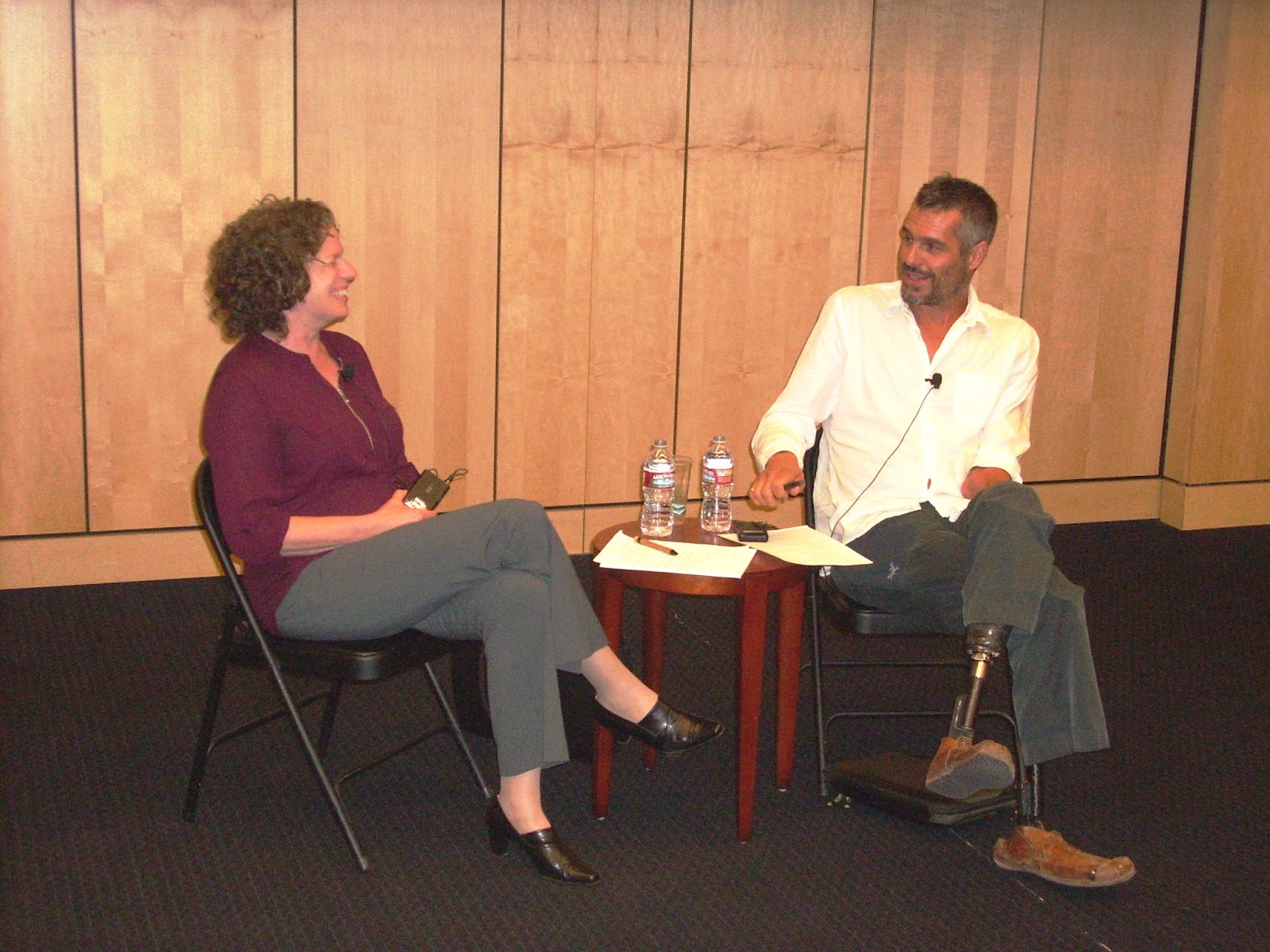
Bay Area filmmaker Kristi Denton Cohen answered questions about Stay or Move from Arlene Reiff, LFFoA Board member and Transition Network’s San Francisco Bay Area chapter co-founder.  Some films (like Stay or Move) shown at LFFoA are freely available online, but it still pays to attend LFFoA, which facilitates community dialogue with filmmakers about important issues like housing, transportation, long-term care, etc.  
Kristi and Arlene took questions from the audience. An award-winning filmmaker with over 25 years of experience, Kristi explained that she had no children and decided to make a series of short documentary films exploring housing options as we get older because she wanted to make the decision for herself before someone else did. 

LFFoA showed the following short films from Stay or Move:
·      Deciding to Stay or Move: UC Berkeley Social Work Professor Andrew Scharlach discussed warning signs when it may be time to move (fall risk, can’t get out to places where they want to go, no longer connected to community) and advised finding an “environment that you’d like to live in where people will be part of your life forever – any age, so you’re not alone in the world, people really know who you are.”
·      Staying Put:  building an Accessory Dwelling Unit (ADU) for Multigenerational Living and accessing supports from Marin Villages of the Village Movement 
·      Moving On: affordable housing with onsite resident services coordinator at Strawberry Creek Lodge in Berkeley.

Dial-A-Ride 
Dial-A-Ride (2016) was a short documentary featuring the bonding of passengers on board a UK community bus that provided weekly door-to-door transport for isolated older people living in remote and rural South Wales with no public transport nearby. The pleasant driver provided commentary, noting his interactions with passengers always provided "something interesting or a surprise."  The film’s website provided this Director’s statement:

“With government funding for a community transport cut by half in 2016, it is a tragedy that invaluable services like Brecon Dial-A-Ride are being shut down around the country.  These buses are a lifeline for many older people in the UK, particularly in remote areas where they can’t necessarily get to a bus stop or afford a taxi.  In the UK, 49% of people over 75 live alone, and over two million people are ‘persistently lonely.’  Without a means of transport, many of these older people feel trapped in their own homes.”

The Green House Project
Stay, or Move’s website includes a three-minute video, Celebrating 10 Years of the Green House Project, as a nursing home alternative under Moving On.  At LFFoA, Sheila decided to screen the 25-minute documentary The Green House Project (2004), showing the development of the first Green House in Tupelo, Mississippi. A Green House is home for a dozen residents with private rooms, a central gathering place, open kitchen, table for communal dining to promote convivium, easy access to outdoors garden/patio, and staffed by care partners (called shahbaz, Persian for royal falcons).  In 2005, Robert Wood Johnson Foundation granted $10 million to the Green House Project to replicate the model, which provides residents better, safer and more personalized care so they enjoy better outcomes (quality of life, improved health and remain independent longer) than nursing homes.  
LFFoA Board member Paul Kleyman talked about his hero, Dr. Bill Thomas, and the Pioneer Network leading culture change to revolutionize long-term care institutionalization and replace nursing homes.  He also spoke about home and community based services, like PACE (Program of All-Inclusive Care for Elderly) through IOA and On Lok Lifeways, as alternatives to nursing homes.

Last year, Dr. Thomas told The Washington Post: “We need to get people out of hospitals, we need to create a rich set of community-based alternatives… [the goal is] normalizing the entire lifespan instead of separating and stigmatizing one part as something different.”  In moving beyond nursing homes by setting up Green Houses, Dr. Thomas noted an advantage of their small size:  “Within six weeks, they had to send a truck around to pick up all the wheelchairs …You know why most people [in nursing homes] use wheelchairs? Because the buildings are so damn big…The buildings disable elders.”

In an interview with filmmaker Dale Bell (of And Thou Shalt Honor, a 2002 PBS caregiving outreach project ), Dr. Thomas discussed his Green House Project model, based on principles of The Eden Alternative:

“The nursing home takes good, good, loving, caring people and plugs them into an institutional factory-like arrangement. And it's no good… the best alternative I can think of is a garden…a place that's worthy of our elders, we make a place that enriches all of our lives, caregiver, family member and elder alike… we call it the Eden Alternative.”

Green Care Farms offers a nursing home alternative closer to a garden (as described in blog post coverage of IAGG World Congress).  More recently, Dr. Thomas introduced Minka, an affordable age-friendly, small-scale dwelling. 

Mother, Child 
Sheila facilitated Q&A with Mother, Child (2017) filmmaker Tin Pang and his mother Kitty. Mother, Child is a short film based on Tin’s own experience as carer for his mother after she suffered a stroke in 2015, just 10 days after her retirement at age 65, and then she endured a long rehabilitation to relearn how to talk and walk. Only child Tin dropped everything in Sydney and rushed to care for his single mother in the Gold Coast.  As portrayed in the film, there is inevitable tension when son, who moved out 10 years earlier, returned home to share a small apartment with his mother who became dependent on him in a role reversal with now 30-something year-old child caring for mother who continued to exert control, like reminding her son how to cook steamed fish. Kitty said the stroke caused disorientation and re-examination of her relationship to her son.  Tin said writing about his experience as carer was cathartic, preferable to talk therapy, and making the film was an opportunity to advocate for better supports for stroke victims and their carers. (One in six people will experience a stroke in their lifetime; a stroke occurs every ten minutes in Australia.) 
Tin told Sheila that he filmed “Mother, Child” in just one take! After meeting Tin and Kitty in-person and then seeing their intro trailer, I actually preferred the charming and dynamic Tin and Kitty over the actors Lawrence Leung and Gabrielle Chan who played son and mother. 
Tin reported that after 8 months in the Gold Coast, he and Kitty moved to a smaller apartment in Sydney. Kitty said she has recovered about 80% since her stroke, and Tin has resumed his film career to great success!  

Should the need arise, I would be like Tin and drop everything to care for my own parents so they can age in place.  In the meantime, I continue exploring options for aging in place and community.  

September is World Alzheimer’s Month.  According to the Alzheimer’s Association:
·      After age 85, the risk of Alzheimer’s reaches nearly 50 percent 
·      Compared to only 4 percent of the general population, 75 percent of the people with Alzheimer’s will be admitted to a nursing home by age 80. 

As a nursing home alternative for people with severe dementia, Hogeweyk Dementia Village in the Netherlands is designed like a small village with residences (each home houses 6 to 8 people with the same lifestyle), courtyards, a grocery store, restaurants and a movie theater.  Residents can move freely inside the house and outside, though they can’t venture outside of the periphery doors of the village on their own.  All staff members are trained in dementia care.

“The act of engaging in community …about developing a more personable and comprehensive way of treating disease...The countless studies reinforcing how many dementia patients feel lonely or isolated, juxtaposed with Hogewey’s considerable success with these residents, call into question how much of dementia is a result of disease, and how much is a result of how we treat it.– Josh Planos, “The Dutch Village Where Everyone Has Dementia”, The Atlantic (Nov. 14, 2014)  

https://changingaging.org/dementia/re-branding-dementia-advocacy/

In Dementia Beyond Drugs: Changing the Culture of Care (2010), geriatrician G. Allen Power, M.D., proposed doing away with segregation of people with dementia in living areas labeled after a disease (like “dementia care” or “memory care”) to rid the institutional mindset that reduces people to their deficits.  He criticized dementia-specific living environments (specialized physical design, specialized staffing, dementia-specific activity programming, lock-down exit systems, isolation of people with behavioral symptoms, complaints of others who don’t want “those people” in their living areas):
1.     physical design does not look and feel like home:  living in an unfamiliar environment creates unmet needs that trigger behavioral expressions, so it’s best to dismantle the institution (long halls, double rooms, nursing stations, alarms, call bells; lack of relationship, autonomy and meaning) and recreate a comfortable home (Green House Project).
2.      civil rights issue: treating people with disabilities as “separate, but equal, not in our neighborhood” reflects fears and misconceptions about the disease, and sells short the potential for growth and engagement that still exists in people with dementia.

Dr.  Power noted that the Green House Model followed a process similar to that used to deinstitutionalize people with developmental and psychiatric disabilities using group homes. The Green House blends people with and without dementia.  Instead of segregation, Dr. Power noted the advantages of a diverse community such as the creation of a nurturing interdependent community.  

Sunday, October 30, 2016

Aging = living

San Francisco State University (SFSU)’s Gerontology Program has moved from the School of Social Work to the School of Public Affairs & Civic Engagement (PACE), which includes Criminal Justice Studies, Environmental Studies, Public Administration, and Urban Studies & Planning.  Earlier this month, I volunteered to participate in a focus group for PACE alumni, and I was the sole gerontology alum who showed up to explain, “What is gerontology?” Since gerontology is interdisciplinary, it could probably fit in anywhere in the College of Health & Social Sciences.  In fact, I tend to see the world through a gerontologist’s lens such that everything is related to aging; after all, aging=living!

Films 
Last month’s 6th Annual Legacy Film Festival on Aging at New People Cinema (which should have been renamed Old People Cinema J) featured diverse themes centered around The Art of Living (including The Presence Project), Who Cares? (A Letter From Fred), Deep Learning (The Family Dog), Generations; Memory; Life, Death and Love; and Gotta Dance! (Hip Hop-eration; check out TEDx talk by this dance troupe’s manager Billie Jordan). 
Legacy Film Festival Director Sheila Malkind, with Board Member Arlene Reiff, announced that Bradford (England), the world’s first UNESCO City of Film, will host its inaugural 3-day Golden Years Film Festival – Celebrate Life through Film, October 3-5, 2016, a free event featuring films from Sheila’s Legacy Film Series! 
Panel discussion with Snow Day: Life, Death, and Skiing documentary filmmakers and director Erica Milsom’s parents, and Wayne filmmaker Mario Galaretta, MD.  During Q&A, it was interesting to learn about Dr. Galaretta’s career change from neuroscience researcher to filmmaker! (So awesome to have filmmakers who are trained physicians, like Voices documentary filmmaker Gary Tsai, MD, because there is greater authenticity in their work featuring people experiencing disability/disease/death.)

For the past year, I have joined my friend Jane at free Hollywood movie screenings hosted by AARP’s Movies for Grownups, which have included Hello My Name Is Doris, Miles Ahead, My Big Fat Greek Wedding 2, Florence Foster Jenkins, and The Hollars.  As I prefer documentaries for greater authenticity, these Hollywood films featuring older adults seem to target audiences who want to escape reality.

Time 

Whenever my employer stresses doing more assessments and data entry (like bringing out my iPad to type during home visits with clients, which can be more challenging to maintain eye contact—done more easily when using pen to paper), I feel like a factory worker in a widget production line.  But then my clients appreciatively remind me that I actually spend more time with them than the average 15 minutes that doctors spend with patients.  Administrative work can take more time than being present for clients/patients.  This is a scary thought since the complexity of my clients’ lives (especially clients with dual diagnoses) demand more time.  For example, shorter doctor visits increase the likelihood that patients leave with a prescription for medication, rather than for more sustainable behavioral change — like eating more healthy and exercising.  In my work, I help fill the gaps by referring clients to health promotion resources like tips for home safety, fall prevention, smoking cessation, etc.  And I am always eager to learn to be a more effective advocate for my clients.

Food & Addiction

I was mesmerized by many presenters who were as engaging as the topic of UCSF’s conference, Food & Addiction: Environment, Policy & Individual Factors.  Fortunately, the busy doctors gave more than 15 minutes of their time J. None of the presenting doctors were geriatricians, but what they had to say applies throughout one’s life course and most of my clients continue to see their internists. 
Elissa Epel, PhD, noted for her research on the role of chronic stress on cellular aging and incorporating behavioral science into UCSF medical school curriculum, introduced renowned addiction medicine expert Mark S. Gold, MD.  
In his presentation, Food Addiction: How did we get here and where are we going? Dr. Gold, a self-described “itinerant food addict,” took a life review perspective of his academic pursuits based on food, “I like French fries, pizza and frozen custard” – attending Yale School of Medicine in New Haven for Pepe Pizzeria, and Washington University in St. Louis for Ted Drewe’s frozen custard! Dr. Gold’s 30+ years of addiction research has demonstrated similarities in the effects of drugs (tobacco, cocaine, opiates) and certain foods (fast food, sugar) on the brain and behavior.  Based on successful treatment of addictions to drugs, Dr. Gold is researching treatments for food addictions and hyperphagia.  
Drs. Dean Schillinger and Robert Lustig, sample paleo-friendly, gluten-free muffins from Muffin Revolution.  
Laura Schmidt, PhD, chaired session on Preventing Food Addiction in Vulnerable Populations, with George W. Albee’s prevention is better (than treatment) quote on screen: “No epidemic has ever been resolved by paying attention to the treatment of the affected individual.”  Schmidt’s view is that addictive substances, like sugar, should be regulated through taxation and limits on marketing and access. 
Dr. Schillinger, founder of UCSF Center for Vulnerable Populations, talked about his work with Youth Speaks through The Bigger Picture to combat the rising epidemic of type 2 diabetes (formerly known as adult-onset diabetes, but increasing in younger people). He showed spoken word video, Death Recipe, by San Francisco resident Erica McMath-Sheppard at age 16:

We eat like we still slaves
Cause back in the days we got what whites didn’t want
And now we got something called freedom of eat
But granny still chooses salt covered pigs feet
And mama still chooses KFC
And I still choose whatever is given to me …

(I thought about the 64-year-old grandmother who filed $20 million suit against KFC for false advertising because she paid $20 expecting bucket overflowing with chicken to feed the whole family, but only got ½ bucket; and KFC “helping” to fight breast cancer with pink buckets.) 
Nancy Adler, PhD, founder of UCSF’s Center for Health and Community, and Robert Lustig, MD, UCSF Professor of Pediatrics and President of the Institute for Responsible Nutrition, with power point summary of his What’s the real addiction? presentation on screen: “The only items in 'junk' food that are addictive are sugar and caffeine; but they are really food additives.”

[In Sugar: The Bitter Truth (2009), Dr. Lustig talked about turning around 40 years of mainstream nutrition belief that blamed fat v. sugar for dis-ease.  He declared sugar is toxic like alcohol and tobacco, urging us to reduce sugar consumption for public health.]

Last month, UCSF researchers Stanton Glantz, Cristin Kearns and Schmidt published an article in JAMA Internal Medicine about the sugar industry paying Harvard scientists to blame fat and cholesterol as dietary causes of coronary heart disease, while downplaying evidence that sugar consumption was a risk factor, about 50 years ago. This resulted in misleading a generation of baby boomers who counted calories (though all calories aren’t equal, according to Dr. Lustig), gave up eating saturated fats like butter (in favor of trans fat margarine or low-fat) and cholesterol-rich egg yolks (in favor of whites only).  Just as there should be more geriatric training among doctors, reliable and accurate nutrition science training is needed to promote healthy aging!

Communication 
At Jewish Home, CPMC psychologist Jeremy Bornstein presented Effective Healthcare Communication with Difficult Patients and Families.  Key points:
  • “Difficult” is subjective assessment when one’s perceived skill is not up to challenge
  • “Difficult” is manageable by acknowledging level of challenge and looking for ways to increase skill
  • Get behind “difficult” behavior (e.g., aggressive, depressed, anxious) and address emotional needs with support, education and mental health resources
  • Develop rapport to understand underlying values, beliefs, goals and expectations
He reminded us of the Talmudic quote, “We don't see things as they are, we see them as we are.”

Eating for Health 
UCSF rheumatologist Cristina Lanata, MD, presented Update in Lupus Research at Lupus of Northern California’s Fall Conference.  Almost 2 million Americans suffer from lupus—more prevalent than AIDS, cerebral palsy, multiple sclerosis, sickle-cell anemia and cystic fibrosis combined.  Lupus mostly affects women, and is more common among women of African-American descent. (However, late-onset lupus after age 55 is more common among Caucasians.)  While 40% of lupus is transmitted genetically, the actual expression of genes is based on epigenetics or life-course exposures to external and internal stimuli. Exposures to smoking, asbestos and nail polish were associated with higher risk for lupus. Having a diagnosis of lupus is an opportunity for self-care. 
After Jessica Goldman Foung was diagnosed with lupus-related kidney failure 12 years ago, her doctors prescribed a low-sodium diet.  As she let go of sodium, she began focusing on all the healthier alternatives (replacing high sodium processed foods) and taking control – motivating her to learn cooking, inspiring her to share her adventures in her Sodium Girl blog, and rebranding low-sodium in her new book, Low-So Good: A Guide to Real Food, Big Flavor, and Less Sodium with 70 Amazing Recipes (May 2016).  Her zest for healthy living was apparent in her schedule of back-to-back health events: she had attended National Kidney Foundation’s Annual San Francisco Authors Luncheon prior to speaking at Lupus Conference!

At World Veg Festival, Shanta Nimbark Sacharoff introduced her new book, Other Avenues Are Possible: Legacy of the People’s Food System of the San Francisco Bay Area (September 2016). Shanta, an original member of Other Avenues Grocery, a worker-owned food co-op started in 1974, documented the rise of the “Food for People, Not Profit” movement that challenged agribusiness and supermarkets, and promoted healthy foods to local communities.  Long live SLOW (Seasonal, Local, Organic, Whole) food movement!
Speaking before an intergenerational audience at University of San Francisco, Filipino Food Movement Board Chairman PJ Quesada said that Filipinos need to get over tyranny of "authentic" food like "no one cooks better than grandma," particularly since Filipino cuisine is “fusion” with influences from Spanish and Chinese.
SFSU History Professor Dawn Mabalon noted difference between fusion and whitewashing food, criticizing Bon Appetit’s “Ode to Halo Halo” made with gummi bears and popcorn.  This was a very timely topic as I have been working with a client, first generation Filipino-American who may outlive her retirement savings if she continues paying $250 per month for her daily dish of authentically prepared Filipino food (which supplements her 2 home-delivered Western meals)--so we are exploring options like persuading her IHSS worker to cook authentic Filipino meals since my client can no longer cook for herself.
  

Pork tocino buns & arroz caldo from F.O.B. Kitchen Chef Janice Dulce


Senior Prom 
The Village Project’s A Senior Moment: Senior Prom for the 50+ featured entertainment by West Coast Blues Society and awards presentation by Bayview Senior Services Executive Director Cathy Davis. 
Senior Prom honorees with Supervisor London Breed, who said she preferred oldies but goodies music over her generation’s music with “swear words”! 
Aging Commission President Edna James got into the picture! 
Healthy plate of mostly plant foods.

Wednesday, September 30, 2015

Aging + disability: equal opportunities

Americans with Disabilities Act (ADA) and Older Americans Act (OAA) are equal opportunity laws that support full participation in community living. Americans also have equal opportunities to become Americans with disabilities and older Americans.
                                             
Aging with disability

Americans, including those with disabilities, are living longer.  As Eli Gottlieb wrote in The New York Times opinion piece, “Adult, Autistic and Ignored,” parents of dependent children with disabilities fear: What will happen to them when I’m gone?  After his mother died, Eli became guardian of his older brother Joshua who has autism and lives in an institution.  Like his mother, Eli became an advocate critical of the disability cliff when children with disabilities age-out of “special education” and the need for more attention to elderly autistic people like Joshua.  
At 5th Annual Legacy Film Festival on Aging (LFFoA), LFFoA Director Sheila Malkind facilitated Caring program discussion with Dr. Toni Miles and Mimi and Dona documentary filmmaker Sophie Sartain. 

Sophie began filming her documentary in Dallas six years ago when 92-year-old Mimi (Sophie’s maternal grandmother) was no longer able to care for her 64-year-old daughter Dona (Sophie’s aunt) who was diagnosed with “mental retardation” in the 1950s (though Sophie suspects undiagnosed autism).  When Dona was asked to leave public school after 2nd grade, Mimi sheltered Dona at home instead of the prevailing practice of sending her “retarded” child to a mental institution. 

Mimi makes the difficult decision to place Dona into Denton State-Supported Assisted Living Center, a long-term care facility that serves people with intellectual and developmental disabilities.  While Mimi thrives as she continues to live at home in the community, Dona deteriorates precipitously in the institution.  Spoiler alert: Dona’s condition improves, but she is also diagnosed with early Alzheimer’s; documentary ends with death of one.  Save this date: On November 23, Mimi and Dona will have its Independent Lens premiere on PBS. 

Family caregiving theme is constant: Sophie’s mother provided care for Sophie’s father who had multiple sclerosis during the last 20 years of his life; Sophie’s brother has a son with autism (“you need to live forever or outlive your kid”); and back in Los Angeles, Sophie learns that her own son is diagnosed with autism.  The main difference between Dona’s generation and today’s children with autism are disability civil rights laws, such as Individuals with Disabilities Education Act (IDEA) ensuring that children with disabilities have an opportunity to receive free appropriate public education in the least restrictive environment.

Now there is greater public awareness of disabilities that survive into old age. In The New York Times article, "Is It Old Age, or A.D.H.D.?", Judith Berck reported on the dearth of research on older adults with A.D.H.D. and the challenge of treating them with the same drugs given to children.
At 19th Annual Golden Gate Self-Advocacy Conference: Give It to Me Straight! Current Happenings in Our Developmental Disability Community, keynote speaker Santi Rogers, Director of California Department of Developmental Services, holds up Lanterman Act, California law passed in 1977, that gives people with developmental disabilities the right to services and supports to enable independent living.  He previously announced decision to close the remaining state-run developmental centers in California and transition participants into community living. 

More ADA celebrations! Doing disability justice

Steve and Lillian Gonzalez Brown, co-founders of Institute on Disability Culture, greeted me at Disability Rights Education and Defense Fund (DREDF)’s 36th Anniversary Celebration Honoring the 25th Year of ADA & Charting the Next 25 Years of Disability Rights at Ed Roberts Campus. 
Thanks to DREDF Director of Development Ingrid Tischer, I was able to attend the Celebration fundraiser as volunteer. 
Caramelized chocolate ganache with sea salt bars welcomed guests to tables. DREDF Senior Policy Analyst Marilyn Golden urged us to sign cards (on tables) opposing HR 2646 because “it would take away legal representation for people with mental illness, reduce privacy rights, and promote institutionalization.” 
Celebration co-sponsor Google Impact Challenge: Disability hosted Bay Area Makeathon weekend to design a more accessible world. 
Google also unveiled portraits and videos of disability rights leaders like Ed Roberts. 
ACLU attorney and DREDF Board of Directors President Claudia Center called for donations, suggesting $25 in honor of 25th anniversary of ADA; she said her personal donation formula was doubling 25, for her birthday this year, times ten! 
Evening’s program capped with intergenerational discussion about ADA’s impact 25 years after its passage, and advances we want in next 25 years, particularly on issues affecting people who live with invisible disabilities and intersectional effects of race, gender and disability. Christina Mills, Deputy Director of California Foundation for Independent Living Centers, moderated the discussion among all-women panelists: Maddy Ruvolo of Marin Center for Independent Living; Yomi Wrong of Palo Alto Medical Foundation/Mills-Peninsula Health Services; Nubyaan Scott, DREDF 2015 Summer Intern; and Mary Lou Breslin, DREDF Co-Founder/Senior Policy Advisor.


Yomi discussed her concerns about aging with disability, long-term care and still being in charge of her life, who will care for her as she has no plan to "go quietly to an institution, but if I do, what will it look like?" She noted ADA's influence on the built environment, yet need to reduce health disparities, adding that “death with dignity is such crap because if people have better choices, they don’t think to kill themselves.”
Disability Organizing Network (DOnetwork) presented California#ADA25 Conference: Access, Availability, Advocacy and Civil Rights! at UC Hastings College of Law.  This multigenerational view of disability justice covered:
  • access: equal opportunity to participate in all aspects of everyday life;
  • availability: options and choices which increase independence and freedom; 
  • advocacy: our history and courageous actions of leaders that lead to today's inclusion; and
  • civil rights: our just claim to equal citizenship
The conference's lunch program featured video clips of Alice Wong’s Disability Visibility Project: “Recording disability history, one story at a time.”   
ADA: Reflections on Success panel moderated by Yomi Wrong:
·         Arlene Mayerson, DREDF Directing Attorney, was a principal architect of ADA 25 years ago.  In order to have equal opportunities for people with disabilities (PWD), they had to have accommodations which meant they have to be treated differently. After ADA, PWD no longer asked for charity or favors, but for accommodation as a matter of right.
·         Paul Grossman, education civil rights attorney talked about Lau v. Nichols (1974 U.S. Supreme Court case finding that lack of language appropriate accommodation denied Chinese students equal educational opportunities because same treatment is not equal opportunity) and the 504 sit-in laying the groundwork for ADA.  He added that the second most exciting moment in disability rights has been since ADA Amendments Act of 2008 expanded the definition of disability (medication and other interventions that deal with effects of disability cannot be factors in determining whether individual is disabled), so disability-based discrimination cases can be heard on their merits.
·         Jim Patterson talked about “associational discrimination”: being pushed out of foreign service career because his employer viewed his daughter’s disability as a liability.  After The New York Times published an article, “Whose disability is it anyway?” he returned to work as a full member of the diplomatic corps and became an advocate for employment equality.
Do You Know Your Disability Civil Rights History? HolLynn D’Lil, author of Becoming Real in 24 Days: One Participant's Story of the 1977 504 Demonstrations, took over 350 black and white photos chronicling the takeover of the San Francisco Federal Building to demand that President Carter's administration implement regulations to Section 504 of the Rehabilitation Act, the first federal civil rights law for people with disabilities. At the time, Congressman Phil Burton said, "To have to demonstrate during a Democratic administration to fulfill a Republican promise is a painful irony."
Ted "can I get an accommodation?" Jackson, Community Organizing Director at California Foundation for Independent Living Centers (CFILC), moderated discussion during Breakfast with the Author Tony Coelho, who entered politics as his ministry after he was denied from pursuing Catholic priesthood based on his epilepsy. While serving in U.S. House of Representatives, he was principal author of ADA, which got bipartisan support due to supporters' personal relationships with PWD.  He noted 52 countries now have disability laws based on ADA.
Indigo Mind features artists celebrating the work of neurologist Dr. Oliver Sacks.  
Connie Barker founded Environmental Health Network (EHN), which provides support, advocacy and information to the chemically and electrically injured: “If it’s not healthy, it’s not green.” In addition to her own site http://ehnca.org/, she offered the following resources:
Access Kids perform on entertainment stage

Aging + disability-friendly communities 

Under disability laws, the person with disabilities has the burden to disclose his/her disability and ask, "can I get an accommodation?"  Sometimes, people with "invisible disabilities"--like chemical sensitivities--might resist disclosure to avoid stigma ("it's all in your head").  As a more proactive approach to move beyond individual accommodations, universal design creates inclusive environments for everyone by placing the burden for accessibility on architecture. 
ADA Conference workshop included Homesick Living with Multiple Chemical Sensitivities: Finding Accessible, Available, Affordable Housing, presented by Connie Barker of EHN.  Connie talked about 11-room Ecology House, the nation’s first HUD-funded housing for people with multiple chemical sensitivities (MCS) that was built over 20 years ago in San Rafael, and then showed documentary, Homesick (2013) about director Susan Abod’s road trip to discover how people with MCS find safe housing and cope with their disability. 
Ed Roberts Campus was ideal to host At Home With Growing Old (AHWGO) program, Dementia-Enabling Spaces: Bodies, Networks, Environments.  Panelists were:
  • Susan Stadler, architect and AHWGO co-founder, substituted for Clare Cooper Marcus and discussed gardens for people with dementia like Portland Memory Garden 
  • Dr. Mehrdad Ayati, geriatrician and author of Paths to Healthy Aging (2014), prescribed social interactions (“live like an Italian: engage brain in conversation, talk with hands”), value and respect elderly because “You cannot replace experience with knowledge (internet),” more geriatric training (completed by only 3% of U.S. medical students) and interdisciplinary teams in geriatrics 
  • Debora Tingley and Patricia Ris discussed Memory Care Café, a weekly social club for people with forgetfulness and their care partners.
The shift from the medical model of aging and disability continues to end-of-life: life and death are natural v. medical events.  UCSF Osher Center for Integrative Medicine hosted a screening of the PBS Frontline documentary, Being Mortal, followed by a discussion on end-of-life planning with Shelly Adler, PhD, Osher Director of Education, and BJ Miller, MD, palliative care physician and Director of Zen Hospice Project.  They discussed when cure is not possible at the end of life, we can reduce suffering for a “better death.”  BJ said a doctor can tell the truth in a supportive way that does not rob hope, but informs. In BJ’s TED talk, What Really Matters At the End of Life in March, he talked about patient meaning one who suffers, so we are all patients, and how most people fear, not death but, suffering; yet suffering unites us when we share this experience.