Each May, the
Administration for Community Living celebrates Older Americans Month. This year’s theme is “Get into the Act!” in honor of this year’s 50th
anniversary of the Older Americans Act (enacted July 14, 1965),
which provides a nationwide
aging services network and funding for home-delivered and congregate meals, caregiver
support, community-based assistance, health promotion, elder abuse prevention,
etc. to help older Americans
“to live and thrive in communities of their choice for as long as possible.” To join this celebration, I decided to “Get
into the Act” as a senior-in-training by engaging in activities that support community
living for all ages and abilities!

Get informed: The White House Conference on Aging (WHCOA) announced
plans to live stream this year’s conference on July
13,
and completed its release of policy briefs focused on four key themes: Healthy Aging, Long-term Services and
Supports, Elder Justice, and Retirement Security. Each brief invites comments from readers to
post on its website.

Get heard: Members of Coalition of Agencies Serving the
Elderly (CASE)
staged City Hall Rally for Senior
Services: Fair Share for Fair Care to ask San Francisco Mayor and Board of Supervisors to approve $2 million in new
funding into Department of Aging and Adult Services (DAAS) budget, primarily to
increase staffing at 25 senior centers ($1,250,000), increase salary ranges for
27 FTE community-based case managers ($500,000), and provide free Muni group
van service for 823 adult day services participants ($350,000).

Get seen: Canon
Kip Senior
Center
- Now a
- Homeless but hopeful
- Just moved to Vera Haile Senior Housing
- Isolated, now have a social life – senior
centers are great!
- Clipper cards help
Rethinking Aging
In the Presidential Proclamation of Older Americans Month,
President Barack Obama stated, “By changing the way we think and talk
about aging—by focusing on the opportunities
of aging rather than the limitations—we can work to maximize the potential of this generation and ensure they continue to thrive as they
age.”

This framing of our national discussion of aging as a normative (versus negative)
process to be embraced (versus to be battled), a collective (versus individual responsibility) effort that should be
a public policy concern (versus
private matter) is the expert (versus public) view echoed in FrameWorks
Institute’s Gauging Aging: Mapping the Gaps Between Expert and Public Understandings of Aging in America,
which was presented in this month’s Grantmakers in Aging webinar, ReFraming Aging: Understanding and Changing the Way Americans Think about Aging. Gerontology expert Harry R. Moody has
explored this persistent disconnect between fact and legend in Urban Legends about Aging.
Housing to age in place
Threat of eviction remains a barrier to aging in place for seniors who are long-term tenants in
San Francisco, especially when landlords seek to maximize their profits as the median rent in San Francisco has increased to $4,225 per month.

Beginning this month, Tenants Together Executive Director Dean Preston began his series of Tenant Rights Bootcamp in neighborhood cafes focused on empowering renters to stand up to speculators
and prevent displacement. Dean said the
#1 reason why tenants lose their home is they don’t know their rights and end
up moving. He urged the audience of all
ages to learn and assert their rights, and to get involved in plugging
loopholes in existing laws, such as tightening restrictions on short-term rentals and strengthening tenant protections in “low-fault” evictions (aka “gotcha” evictions
based on alleged nuisance or lease violations, such as hanging laundry out of
one’s window).

Yesterday, Older Women’s
League (OWL) hosted How Can We Grow Old and Stay in San Francisco San Francisco.
Two years ago, long-time North Beach San Francisco ’s
District 3, which includes North
Beach
Also two years ago, when
Doug Engmann lived in Pacific
Heights

Legal Assistance for Seniors’ 10th Annual Conference on Elder Abuse at UC Hastings College of the Law featured dynamic keynote speaker Paul
Greenwood, San Diego Deputy District Attorney who heads the Elder Abuse Prosecution Unit. When he was assigned to begin prosecuting elderly abuse cases nearly 20 years ago, he didn’t know about elder abuse and law enforcement
wasn’t bringing him any cases due to ageist misconceptions and stereotypes
about elderly victims. Since then, there
has been greater awareness yet he said elder abuse is where child abuse and
domestic violence were 30 years ago. He
discussed ten myths about elder abuse prosecution, and here are the top five:
Myth #1:
Elderly make terrible witnesses. Need to avoid stereotyping of seniors as
forgetful (“age doesn’t make you forgetful; having way too many stupid things
to remember makes you forgetful”), senile, long-winded (keep control to get to 5% of facts that are relevant), grumpy, disabled and fragile. Paul said victims remember, and typically
write down, what’s out of the ordinary (like abuse) because their lives are
routine.
Myth #2:
Elderly victim refuses to provide information, so nothing can be done. As in domestic violence
cases, self-determination is not
the answer in elder abuse: do not allow the victim to dictate what happens
to perpetrator. Paul has a victim advocate review police reports identifying
seniors and persons with disabilities, and then follow-up with police to find
out why a potential elder abuse case was not sent to DA. Missing cases and underreporting are often
predicated on victim’s fears, shame or concern that exposure will lead to loss
of independence. Profile of typical
elder abuser is a son in his late 30s to late 40s; living at home with widowed
mom; lazy and unemployed, or just out of prison; feeds substance abuse (drugs,
alcohol) or gambling habit off mom; and sometimes a history of mental illness.
Myth #3:
Elderly victim gives money voluntarily, so no crime. Apparent
“voluntariness” has been diluted by fraud, undue influence or exploiting mental
limitation of victim.
Myth #4:
Financial institution reimburses victim, who then declines to seek
prosecution so there is no victim. Once
a victim, always a victim. Restitution can never remove stigma.
Myth #5: If elderly victim deceased before theft
discovered, can’t prosecute. Treat as if murder, and sometimes victim not needed
for prosecution.

Paul has daily FaceTime
chats with his 91-year-old mother, who remains in their native England California

Collaboration between APS, Legal Services and Civil
Litigators – CANHR attorney
Prescott Cole said that predators exploit older adults’ fears of nursing homes
and outliving their assets. CANHR
attorney Tony Chicotel described the tension between autonomy and safety in
elder law: attorneys operate under the autonomy model to provide zealous
advocacy, under client direction. In
contrast, APS workers operate under the safety model in the best interests, under
client influence. APS tools for involuntary actions include conservatorship,
5150, restraining order or emergency protection order, asset freeze, etc. They provided copies of their publications, Senior Scams
Alert - Financial Protection Guide for Seniors (2014) and
Elder Financial Abuse Restitution
Guide - How To Get Your Money Back (2015) – free downloads from CANHR website.

Financial Elder Abuse: Judicial, Civil and Criminal
Perspectives panel - Private
plaintiff attorneys have an incentive to take on financial elder abuse cases
because attorney’s fees and costs are awarded if a claim for financial elder abuse
(as defined in Welfare and Institutions Code section 15610.30)
is proven by a preponderance of the evidence.

Neuropsychological and Legal Considerations
in Elder Financial Abuse - Neuropsychologist
Jonathan Cannick said the elderly are targets of financial abuse “because
that’s where the money is”: the typical U.S. household of someone who is age
65+ has a net worth 47 times greater than a household of someone under 35. He explained the increased vulnerabilities
with age result, not from normal aging per
se, but the cumulative effects of harmful activities and poor self-care
(e.g., substance abuse, poor nutrition and sleep, lack of exercise and
meaningful relationships, etc.). The
combination of dependency and cognitive impairment increases the risk of undue
influence and financial exploitation/abuse, such that 50% of those with
dementia experience some form of elder abuse.
During the daylong
conference, speakers dissected California Penal Code section 368 defining forms of elder abuse, but never mentioned its application to evictions
of seniors. (Last year, Poor Magazine,
with assistance from attorney Anthony Prince, opened a case of elder abuse with
the San Francisco District Attorney’s office against real estate speculators
who cause harm to seniors by eviction. SDA
Housing Organizer Tony Robles noted the recent deaths of two evicted elders
whose health declined immediately after losing their homes. Earlier this month, more elders filed criminal charges against landlords and speculators who were evicting them for profit.)
Staying healthy to age in community

May is also Mental Health Month,
with this year’s theme B4Stage4 focused on addressing mental health early (get informed, get screened, get
help), rather than at stage 4 when symptoms are severe enough to jeopardize
one’s life. One in four older adults experiences
some form of mental illness, yet two-thirds do not receive treatment—partly due
to ageism, or harmful stereotypes that feelings of anxiety and depression are
just part of normal aging, when
they’re not.
Mental health studies on aging focus on
depressed and suicidal older, white men.
Yet, aging is really a women's issue,
so perhaps we need to pay more attention to older women’s mental health? Betty Friedan's The
Fountain of Age (1993) explored older women's improved mental health and
longer lives, so why can't men age more like women who may have better coping
skills and ability to adapt to stressful life events?


This splitting of mental from physical
health, and secular from spiritual practice, reminded me of Ethan Watters’ critique
of American ideas of mental illness in Crazy Like Us: The Globalization of the American Psyche
(2010):
“…in other places in the world, cultural
conceptions of the mind remain more intertwined with a variety of religious and cultural beliefs as well as the
ecological and social world. They have not yet separated the mind from the
body, nor have they disconnected individual mental health from that of the
group. With little appreciation of these differences, we continue our efforts
to convince the rest of the world to think like us. Given the level of
contentment and psychological health our cultural beliefs about the mind have
brought us, perhaps it's time that we rethink our generosity."

May also happens to be Asian-Pacific Heritage Month. At Canon
Kip Senior
Center
Technology to age in home and community
Institute on Aging (IOA) organized
Big Ideas, Good Work!, a daylong aging and technology conference
that featured presentations by Bay Area innovators and senior providers on assistive technologies to keep seniors
safe at home (smart homes equipped with motion sensors, monitoring devices to
detect falls, smart garment that detects human fall to deploy micro-airbag,
social robots) and information/communication
technology tools to support healthy aging (online caregiving support, tele
health/medication reminders, electronic health records, caregiver-managed debit
card to prevent financial abuse). I was
seated next to Paulo Salta, DAAS Broadband Technology Opportunities
Program (BTOP) Analyst, who posted his coverage of the conference at http://sfconnected.org/2015/05/29/ioa-aging-and-technology-conference/.

DAAS Executive Director
Anne Hinton talked about President Obama’s decision to use stimulus funds to expand
access to technology for seniors and adults with disabilities in 2010 through BTOP,
(now called SFConnected), and Tech Council formed in 2014 to advance digital
inclusion. DAAS won awards for 1st place Aging Innovations for Healthier Living Online Community from National Association of Area Agencies on Aging (n4a) last year, and for tech innovation from Conference of Mayors meeting next month in San Francisco
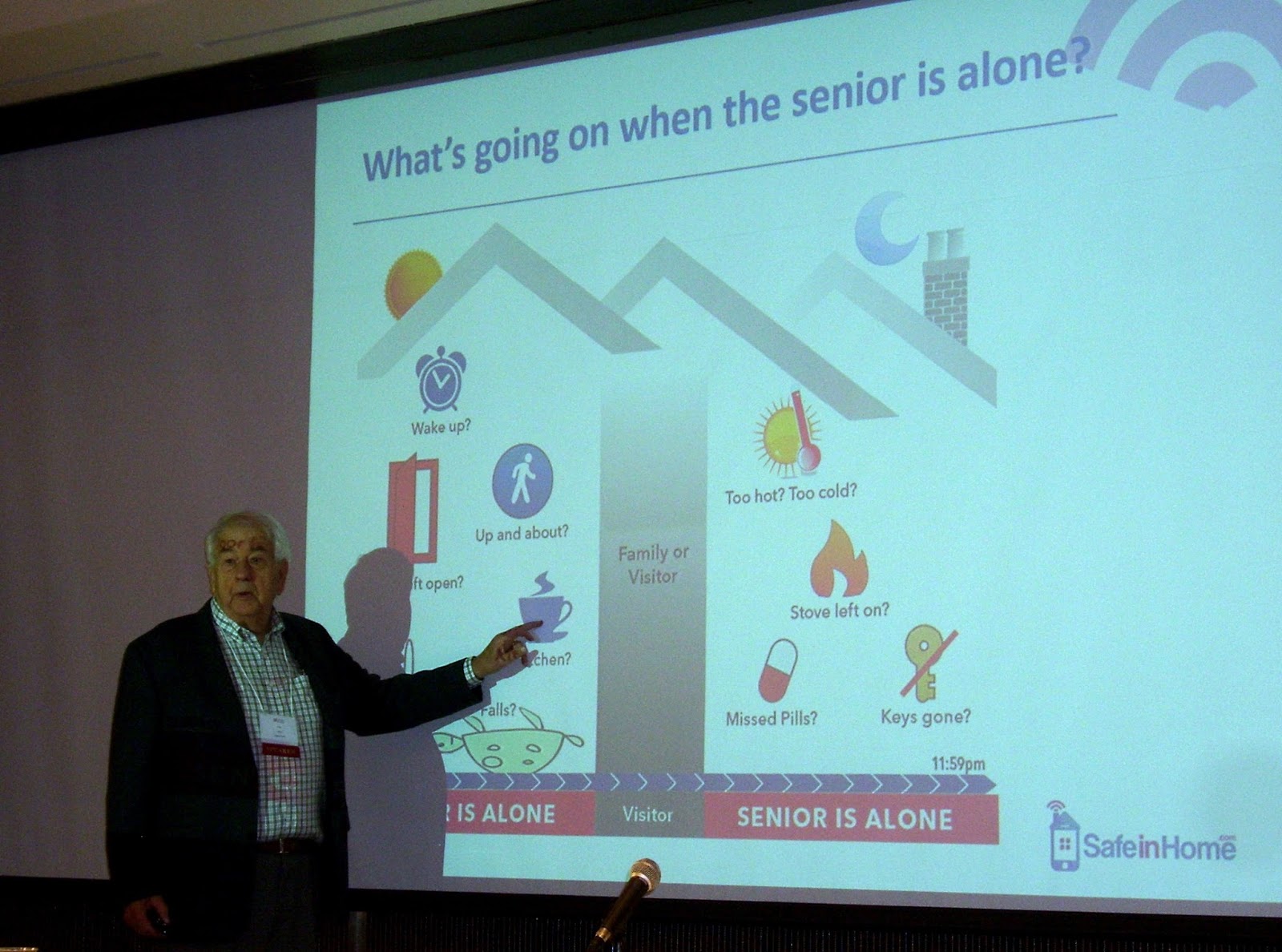
Jack Lloyd invented a smart home system of motion detectors to track movements, software alerts to find breaks
in a senior’s normal activities that could indicate a fall, sensors to detect
if pillbox has opened (but not whether one has swallowed pill) that are transmitted via cell signal to smartphone of the caregiver or family
member. He reminded us that 10 million
seniors age 75+ live alone, at least 800,000 with Alzheimer’s live alone, and
families provide 80% of elder care. The
cost of his product is $100 per month.

My favorite presenter was
91-year-old tech designer Barbara Beskind who is legally blind and doesn't own cell phone (except one for emergency use),
laptop, iPod, etc., but she used her OT training to invent ski pole walker for
more natural stride, standing upright and swinging arms—in contrast to hunching over a typical walker that limits one to a
shuffling-gait.

Barbara also created a
communication device where she could point to her needs. As a result of a fall in 2009, she spent
three weeks in a hospital, then two months in a skilled nursing facility with a
roommate. She said the experience gave
her plenty of time to think and observe people’s needs, and suggested that
people who work in the field take a vacation at a memory care unit, skilled
nursing facility or comparable program.
She also told the audience
to stop trying to make life longer because she has already arrived at a long
life, and “it’s not pretty.” She
cautioned against a denial system, thinking aging and death is for someone
else and envisioning the same good health at old age. She said all ages seek identity, which she
defined as personal worth to society.
Older adults are experts in their own lives, and they want products designed to
help independence and dignity; for example, she suggested an app to translate
language to facilitate communication with non-native English language caregivers.
Audience members raised
concerns about privacy, cost and safety (similar to modern health hazards like cell phone radiation and other sources of electromagnetic radiation).

Social worker Mary Hulme and scientist Richard Caro summarized their
research of Activity-Tracking Home Sensor Systems in Caring from Afar: A Guide to Home Sensor Systems for Aging Parents, an e-book that seemed intended more for caregivers rather than the aging parent subject to monitoring. Mary reassured us that technology does
not replace human caregivers but can supplement care already in the home, or
provide oversight for those who need but refuse or cannot afford in-home care
(cost can range from $28 to $30 per hour, or $10,000 per month for 12 hours per
day).


Tech entrepreneurs said
their work was inspired by their grandmothers (Kari Snowberg, Connie Chow), mother (Alex Go) and father (Aenor Sawyer). . . but no
mention about grandfather?

I was reminded of my own
personal reasons for studying gerontology or
working in the aging field--to support "aging in place" for wandering grandparents (pictured above) and aging parents, and thought they would like Barbara's low-tech ski pole walker if needed, but probably not any electronic tracking (too much like helicopter parenting).
“Connection to
others is what binds us to life”

IOA Community Relations
Manager Caitlin Morgan and Tech Enhanced Life’s Richard Caro engage audience to
participate in sharing photos and favorite apps.
Seeing IOA’s slogan,
“Because our connection to others is what binds us to life” in this technology
conference made me think of Sherry Turke’s TED Talk, Connected, but alone? about the impact of technology on our emotional lives after researching
sociable robots designed to be companions to elderly in a nursing home:
“Have we so lost confidence that we will be there for each
other? .
. . And we're vulnerable. People experience pretend empathy as though it were the real thing. So during that moment when that woman was experiencing that pretend
empathy, I was thinking, "That robot
can't empathize. It doesn't face death. It doesn't know life." And as that woman took comfort in her robot companion,. . . I found it one of the most
wrenching, complicated moments in my 15 years of work. But when I stepped back, I felt myself at the cold, hard
center of a perfect storm. We expect more from technology and less from each other. And I
ask myself, "Why have things come to this?"
. . . And I believe it's
because technology appeals to us most where
we are most vulnerable. . . We're lonely, but
we're afraid of intimacy. And so from social networks to sociable robots, we're
designing technologies that will give us the illusion of companionship without
the demands of friendship. We turn to technology to help us feel connected in
ways we can comfortably control. But we're not so comfortable. We
are not so much in control.”
Being vulnerable can make us more human by
acknowledging our interdependence or reciprocity in relationships (like Barbra Streisand who sang, “People who need people are the luckiest
people in the world . . .and yet letting a grown-up pride hide all the need
inside”),
so maybe we ought to expect more from people (filial piety)
than technology?
Psychology experts blame technology overuse for making us socially awkward and “alone together” because technology allows us to control where we put our attention (hanging out with like-minded only), sanitize human relationships (by editing to present ourselves the way we want to be—“I share, therefore I am”), and avoid real conversation (that forces us to adapt, really listen to read emotional cues to understand one another and develop empathy in the moment).
Psychology experts blame technology overuse for making us socially awkward and “alone together” because technology allows us to control where we put our attention (hanging out with like-minded only), sanitize human relationships (by editing to present ourselves the way we want to be—“I share, therefore I am”), and avoid real conversation (that forces us to adapt, really listen to read emotional cues to understand one another and develop empathy in the moment).
Finally,
I thought about connecting experts and the public to dialogue about rethinking
aging. There is tremendous diversity in old age that reflects the richness of human experiences, yet public perception may be
based on more limited exposure (like from age-segregated settings or bad TV) in
contrast to experts who may have a broader understanding so “aging is
understood as both a personal and shared resource and opportunity, and so that
older Americans are viewed as central rather than marginal participants in our
collective life as a nation” (Gauging
Aging, p. 32). Listen to the advice
dispensed to this year’s graduates not to self-segregate with like-minded people but to seek out and build relationships with people who think differently—perhaps
expert older adults J:
“Here at Oberlin, most of the time you’re probably surrounded by folks who share your beliefs. But out in the real world, there are plenty of people who think very differently than you do, and they hold their opinions just as passionately. So if you want to change their minds, if you want to work with them to move this country forward, you can’t just shut them out. You have to persuade them, and you have to compromise with them. . . Today, I want to urge you to actively seek out the most contentious, polarized, gridlocked places you can find because so often throughout our history, those have been the places where progress really happens." – First Lady Michelle Obama to Oberlin graduates
“Here at Oberlin, most of the time you’re probably surrounded by folks who share your beliefs. But out in the real world, there are plenty of people who think very differently than you do, and they hold their opinions just as passionately. So if you want to change their minds, if you want to work with them to move this country forward, you can’t just shut them out. You have to persuade them, and you have to compromise with them. . . Today, I want to urge you to actively seek out the most contentious, polarized, gridlocked places you can find because so often throughout our history, those have been the places where progress really happens." – First Lady Michelle Obama to Oberlin graduates
“So one piece
of advice is try to look beyond the caricature of the person with whom you have
to work. Resist the temptation to ascribe motive, because you really don't know
-— and it gets in the way of being able to reach a consensus on things that
matter to you and to many other people.
Resist the
temptation of your generation to let "network" become a verb that
saps the personal away, that blinds you to the person right in front of you,
blinds you to their hopes, their fears, and their burdens.
Build real
relationships — even with people with whom you vehemently disagree. You'll not
only be happier. You will be more successful.
The second thing I've
noticed is that although you know no one is better than you, every other person
is equal to you and deserves to be treated with dignity and respect.” – Vice
President Joe Biden to Yale graduates