Wednesday, May 31, 2017

Older Americans Month: Age Out Loud

When I heard that this year’s Older Americans Month theme was “Age Out Loud,” I thought about the relatively loud Baby Boomer Generation (born 1946-1964), which followed the Quiet Generation (born 1925-1945) and came of age during the Free Speech Movement (student leader Jack Weinberg, at age 24 in 1964, infamously advised, “Don’t trust anybody over 30”), Gathering of Tribes for a Human Be-In (its press release announced “a new nation has grown inside the robot flesh of the old”) and Summer of Love.    
Some of my Older American shut-in clients came to San Francisco as flower children during the Summer of Love 50 years ago.  While they view the Summer of Love as a memory and nostalgia for youthful idealism (“imagining a world in which we wanted to live and making it real by acting it out,” according to Peter Coyote), I view it as history for learning about its enduring influence: rise of youth culture (questioning authority in transition from gerontocracy to gerontophobia), women’s liberation, do-it-yourself, back-to-nature, communal living, open source collaboration, higher consciousness (via Eastern spirituality, psychedelic drugs like LSD and cannabis), personal authenticity, ecological awareness, etc.  This month I had a blast attending several groovy Summer of Love commemoration events. 
San Francisco Arts Commission’s Art on Market Street commemorated Summer of Love with poster drawing of Digger Emmett Grogan on bus shelter.  In San Francisco, low- to moderate-income seniors age 65+ ride Muni bus free!
  
Hippie Modernism: The Struggle for Utopia  
“It is possible that it is possible … Take the no out of now then…”  Berkeley Arts Museum and Pacific Film Archive’s Hippie Modernism: The Struggle for Utopia exhibit explored the youth-driven counterculture’s possibilities for utopia in design and technology.       
The Diggers came out of San Francisco Mime Troupe (anarchist guerrilla street theater group) based in Haight-Ashbury. Their 1% Free (1967) poster, designed by Digger Peter Berg and showing two Chinese tong men waiting beneath the Chinese character for “revolution,” suggested that Free people were a minority.  Hippies from the 1960s were predominantly white, middle-class youth.
The Diggers’ agenda was to create a Free City, by putting free before any word: food, store, shelter, healthcare, entertainment, etc.—viewed as human rights instead of commodities.  This challenged “business as usual” because doing things for free (and anonymously) could not be co-opted, and transformed the audience to participants who could be free themselves! Why wait for retirement to drop role-playing “employee” and become “life-actor”? As Digger Peter Coyote explained in his memoir, Sleeping Where I Fall (1998), “If you wanted to live in a world with free food, then create it and participate in it.  Feeding people was not an act of charity but an act of responsibility to a personal vision.” 
Starting Fall 2017, Free City College Program is a 2-year pilot program offering free tuition to San Francisco residents!
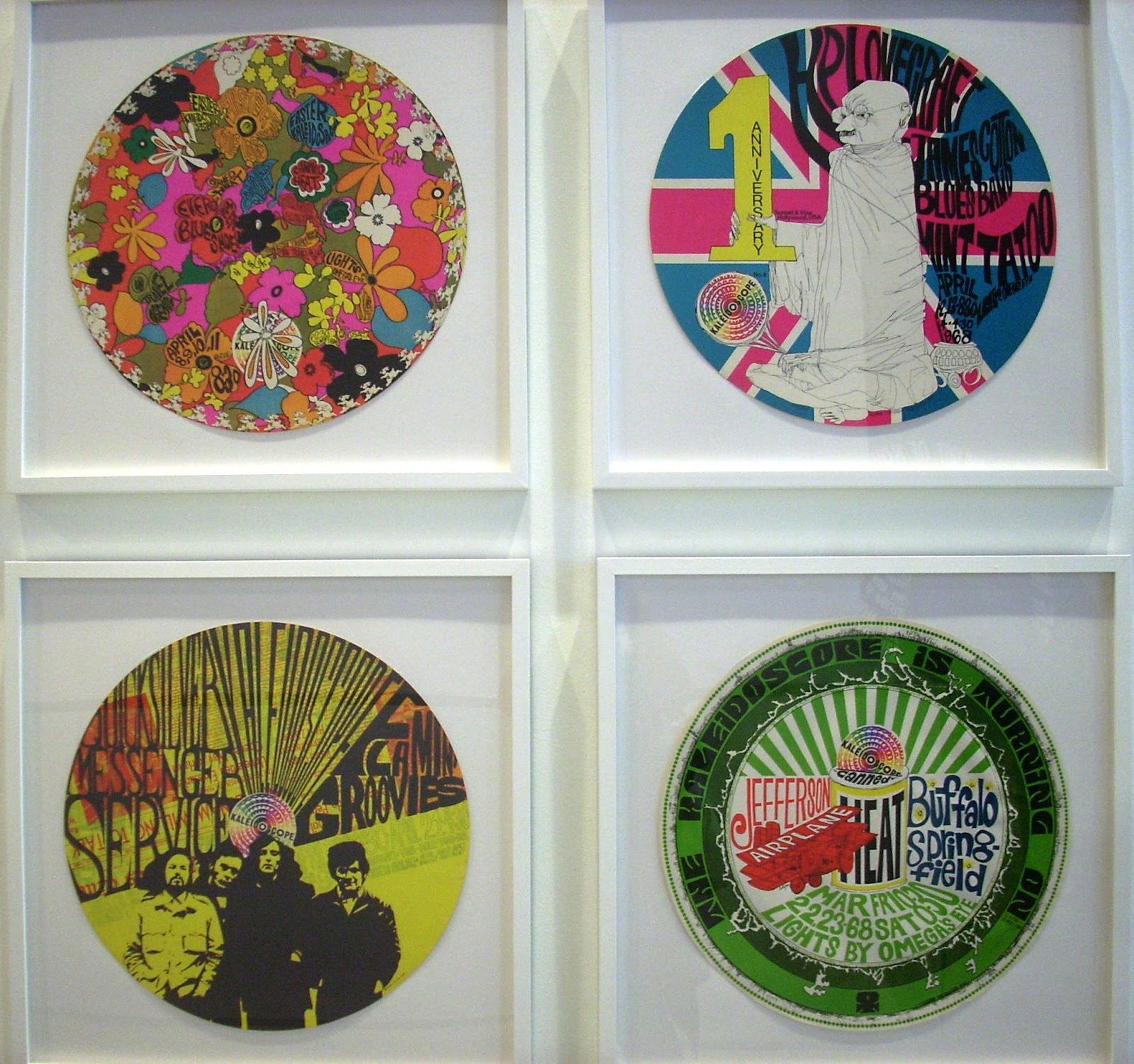
Psychedelic posters break all the print design rules for seniors
  • use simple, easy-to-read typefaces
  • avoid long blocks of text
  • incorporate lots of white space to reduce eye fatigue
  • keep use of italics to minimum
  • maintain high contrast
“We are all handicapped … what the people really NEED” from Work Chart for Designers by Victor Papanek 
This 1973 Community Memory terminal, set-up at Leopold’s Records in Berkeley, functioned as an electronic bulletin board to democratize information sharing and considered to be the world’s first digital social network. 

de Young Museum hosted a panel discussion, Reflecting the Love Generation with curators Jill D'Alessandro (textile arts) and Colleen Terry (graphic arts) in conversation with music historian Dennis McNally and music journalist Joel Selvin, contributing authors to the catalogue for The Summer of Love Experience: Art, Fashion, and Rock & RollThey discussed free spirits drawn to San Francisco during the Summer of Love after reading Jack Keroauc’s On the Road, and the draft during Vietnam War as impetus for the Summer of Love’s philosophy of peace and love 
de Young's exhibit website includes digital stories that provide historical and cultural context: The Beginnings of the San Francisco Sound; Trips Festival; Awakening in the Park; Music and Dance Venues; Posters; Idealism on Haight; Levi’s: Practicality and Ideology; Politics; and Legacy. 
“Don’t trust anyone over 30” and gentle reminder "Be nice to each other." 
The Summer of Love Experience attracted all ages, from Hippies to Hipsters.

On the Road to the Summer of Love 
On the 50th anniversary (May 13) release of “San Francisco (Be Sure to Wear Some Flowers in Your Hair),” Summer of Love anthem sung by Scott McKenzie, California Historical Society (CHS) offered free admission to visitors wearing flowers in their hair.  
On the Road to the Summer of Love exhibit was curated by Dennis McNally, former publicist of the Grateful Dead.  
Human Be-in was organized in response to a new law in California banning the use of LSD, effective October 1966.

Summer of Love in Tenderloin 
Executive Director Katie Conry welcomed guests to Tenderloin Museum’s 2ndAnniversary Community Day.  
The Diggers' "Invisible Circus" Remembered as a 72-hour “environmental community happening” at Glide Church in February 1967, a month after the Human Be-In event.  Based on the idea that “love is communication,” The Communications Company (Com/Co) printed flash bulletins, notifying everyone what was going on, how to get there, and the news right after it happened--prototype for World Wide Web. 
Participants were invited to “do your thing, be what you are … Anyone who wants to can shape history … Those who do not create the future are required to endure the future of those who do." 
“Do you feel more like you do now than before when you came in?”
Shaping San Francisco co-director LisaRuth Elliott interviewed Judy Goldhaft, original participant in the Diggers, co-founder of Planet Drum Foundation and now exercise instructor at The Granada Hotel.  Judy recalled that Diggers used humor and improvisation to coalesce society, like the Death of Money parade.  She thought the Diggers treated women as equals, and her daughter Ocean (in the audience) said she felt empowered by female Diggers.  
David Talbot discussed Summer of Love, Season of the Witch, and the Tenderloin. In Season of the Witch (2012), David wrote that the Diggers’ women did the “grunt work that kept it all going.”  While the Diggers’ act of giving away free was performance, lasting institutions resulted from “do it ourselves” ideas like Huckleberry House for teenage runaways when it was against the law and Haight-Ashbury Free Clinic stood for healthcare as a right, not privilege.  The Diggers’ "feed-in" actions at City Hall were meant to “affirm responsibility”–to do what City government should.  As hard drugs took over, hippies left for communes or intentional communities; today, San Francisco has become so expensive, even in the Tenderloin, it is not as welcoming to creative types who cannot afford it.

Women of the ‘60s Counterculture: Planting the Seeds of Liberation 

At the San Francisco Public Library, CHS Public Programs Manager Patricia Pforte introduced Women of the ‘60s Counterculture: Judy Goldhaft, Salli Rasberry, Delia Moon, Denise Kaufman, Alexandra Jacopetti Hart, and Gretchen Lemke-Santangelo (moderator).  They shared personal stories of how growing up in dominant 1950s culture (Father Knows Best, misogyny, repression) created path to counterculture’s values (self-expression, living simply, everything free), the role of psychedelics in shaping values (“lies of older generation” that smoking pot was dangerous, LSD opened to multiple realities/possibilities/creativity/feelings of nature, etc. yet made illegal).
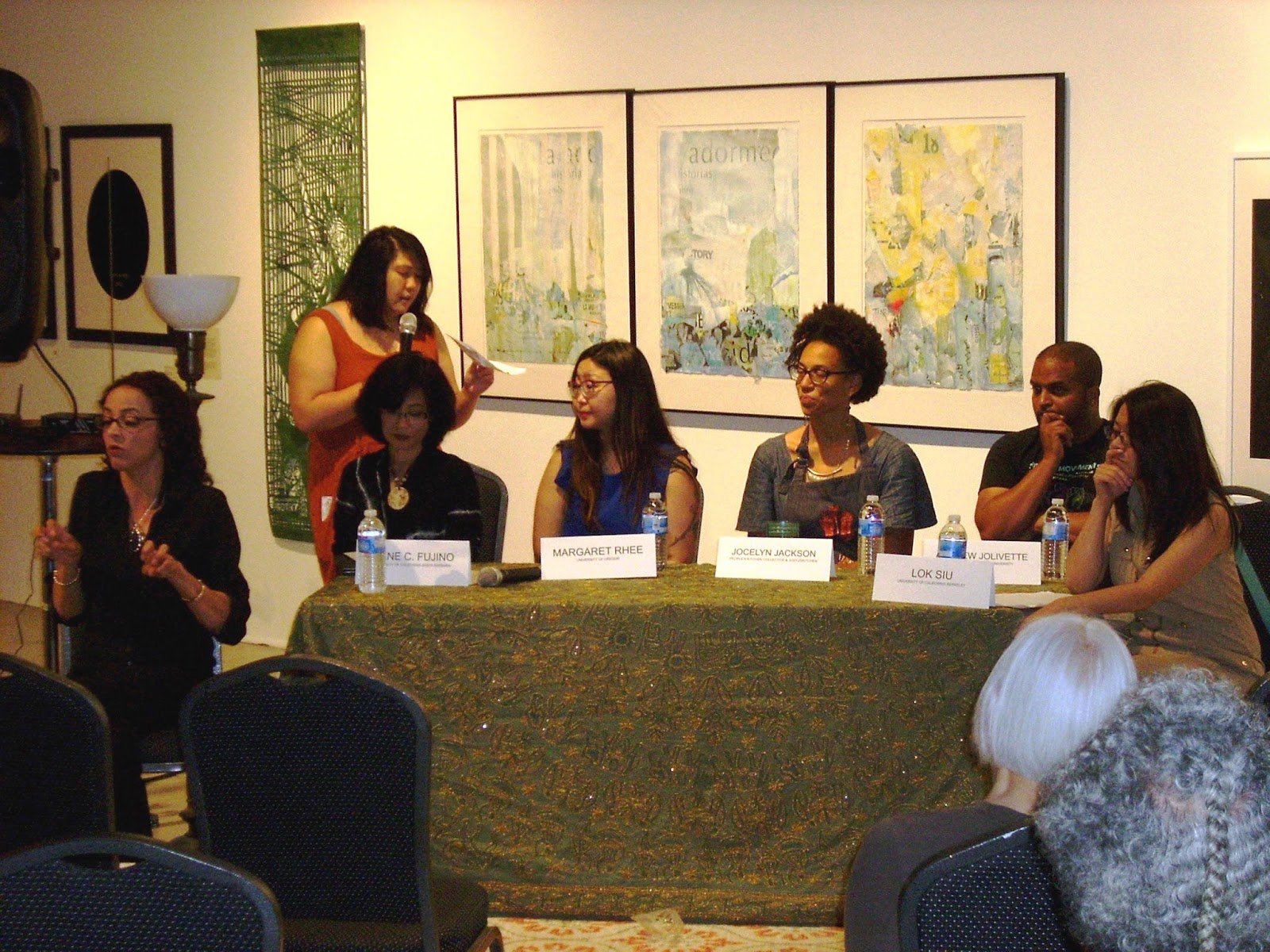
 
SOMArts hosted this month’s exhibition, Shifting Movements: Art Inspired by the Life & Activism of Yuri Kochiyama (1921-2014) with Passing It On: Other Feminist Futures Panel.   
With refreshments provided by People’s Kitchen Collective, the discussion reflected on Yuri’s legacy:  radical hospitality, leadership as relationship building, solidarity between communities (Asian and Black), intergenerational knowledge sharing, womanism, etc.
Meghdoot (The Cloud Messenger) by Pallavi Sharma in collaboration with other artists; each rain cloud depicts inner turmoil on present state of the world and acts as prayer.
Consciousness = power.  Individual clouds are separate but create formations and communities together, pushed together and apart by winds of social change that cannot always control.
Consciousness-raising identity in response to "othering" 
Yuri cradled Malcolm X after his assassination in 1965
Yuri’s advice through her ages on T-shirts: "decolonize your mind" and "ultimate objective in learning anything is to try to create and develop a more just society."
Resistance & Compassion (2017) mandala by Nancy Hom 


Building Community
San Francisco Main Library hosted Digital Inclusion Week, May 8-13, 2017, which included Tech ExpoLife Got Wider: Meanings Associated with the Computer Use of Older Adults exhibit, and Cyber-Seniors documentary screening.
 
May 16, 2017 Senior & Disability Rally at City Hall called for funding more home and community services, such as rental subsidies, IHSS retention pilot, internet access, transportation to and from Adult Day Programs, food through home-delivered and congregate meals, etc. 

Aging With Community: Building Connections that Last a Lifetime was the topic of the May 17, 2017 hearing before the U.S. Senate Special Committee on Aging.  Senator Bob Casey said, “Older Americans want to be out and about, ‘aging out loud,’ in their cities and towns.”  Some ideas to connect seniors with communities:
Aging and Disability Friendly San Francisco joined both WHO Global Network of Age-Friendly Cities and Communities (2014) and AARP Livable Communities (2015). 

Sunday, April 30, 2017

Oh, the places you’ll go!

A former client recently called to let me know that she has settled in San Antonio, where her niece provides home care that my client could not afford while living alone in San Francisco.  Now my client looks out into a garden, instead of the skyline from her former Tenderloin studio apartment.  Her new home is in a cul-de-sac with no sidewalks for wheelchair accessibility, but then she quickly added that it is too hot outside for her to leave her air-conditioned home anyway.  I mentioned that she missed the recent power outage caused by an electrical fire at PG&E substation in Tenderloin.  My client said she missed San Francisco, though she was mostly homebound except for outings to medical appointments.  
Last month, SF Main Library hosted a panel discussion, From Homelessness to Housing in San Franciscomoderated by San Francisco Chronicle Editor-In-Chief Audrey Cooper, and featured  BART Board Director Lateefah Simon, District 2 Supervisor Mark Farrell, San Francisco Chronicle Reporter Kevin Fagan, Department of Homelessness and Supportive Housing Director Jeff Kositsky, and Coalition on Homelessness Executive Director Jennifer Friedenbach.  Jeff proposed ending the home mortgage income tax deduction, which has been used by at least one-third of upper-income taxpayers; instead, he favored Germany’s model of tax incentives for rentals.  (Trump’s proposed tax plan to retain the mortgage tax deduction while doubling the standard deduction would likely further benefit higher-income taxpayers instead of broadening home ownership.) 
Several homebound clients, formerly homeless and now living in permanent supportive housing, appeared in a related exhibition, Everyone Deserves a Home, at SF Main Library. This exhibit showed photos of residents holding signs handwritten in response to “What does home mean to you?” and oral histories of their experiences of coming to San Francisco and their struggles (trauma, neglect, substance abuse, poverty, racism, etc.) that led them to their current home.

While home is important to age in place, the consequences of isolation and loneliness from being homebound and aging without community was the topic at the April 27, 2017 hearing before the U.S. Senate Special Committee on Aging. Experts testified on the negative mental, behavioral and physical health outcomes of isolation and loneliness, including the oft-quoted research finding that prolonged isolation is comparable to smoking 15 cigarettes a day!  (Effective April 1, 2017, California has imposed a $2 tax on tobacco products in an effort to discourage smoking, but it cannot legislate away social isolation and loneliness—though many smokers are already isolated.) 

Therefore, I encourage my homebound clients (especially if living alone and watching TV) to venture outside of their home (comfort zone) and into our communities, when possible.  And thanks to technology, I hope my blog can help bring the community (engagement, resources) to them!

SFSU Gerontology Program Coordinator Darlene Yee and College of Health & Social Sciences Dean Alvin Alvarez welcomed 160+ guests to SFSU Gerontology Program’s 30th Anniversary Dinner held on campus. (SFSU Gerontology Program—the first and thus oldest graduate gerontology program in the California State University and University of California systems—is one of the educational trip offerings at this summer’s IAGG Congress!)
Serenaded by campus musicians 
Dinner plate 
Faculty table with Professor Brian de Vries, lecturer and California Advocates for Nursing Home Reform (CANHR) founder Pat Mc Ginnis, and Professor Annabelle Pelham
Classmates Ardath, Diane, Kay, Mary, Lois and Raenika 
Classmates May (holding up donation envelope) and Ardath 
Pat Mc Ginnis presented Distinguished Long-Term Care Advocate Award to Mark Leno, State Senator (2008-2016), for his advocacy of consumer protections for aged constituents: increase minimum wage and sick days for IHSS workers (SB 3), ban on admissions to RCFE if risk of harm (SB 1153), RCFE Eviction Protection Act (SB 897), etc.
Bayview Hunters Point Multi-Purpose Senior Services Director Cathy Davis and Aging Commission President and SFSU Gerontology alumna Edna James

I took vacation leave to attend worthwhile JCCSF’s 10th Annual Art of Aging Gracefully Resource Fair: Stay Vital, Healthy and Fit, organized by Adult Programs Manager Shiva Schulz. 
Margaret Chesney, Director of Osher Center for Integrative Medicine at UCSF, presented “Outsmarting Stress, Enhancing Resilience & Optimizing Health in Today’s World.”  She recommended BREATHE strategy to enhance well-being:

Be present with self in the moment - slow down
Realistic goals - celebrate meeting them
Everyday events – notice positives and share with others
Acts of kindness – create positive events for others
Turn negatives around – reframe to find silver lining
Humor – smile
End each day with gratitude
Department of Aging and Adult Services (DAAS) Nutritionist Linda Lau at one of the busiest resource tables.  According to the most recent DAAS Needs Assessment, senior meals funding has shifted from congregate to home-delivered meals.  Does this reflect pattern of growing isolation of seniors at home? When clients tell me they are discouraged from eating at congregate meal sites because site staff/volunteers attempt to collect “suggested contribution,” I advise them to file complaint with DAAS 
Health Librarian Janet Tom at SF Public Library table. I often refer homebound clients to Friends for Life to borrow books, DVDs, CDs, etc. by mail. SFPL also has its own youtube channel.
Office on Women’s Health hosted Women’s Health Leadership Institute, which I participated in almost 4 years ago, so always happy to reconnect with Regional Coordinator Kay Strawder (pictured at right) and Public Health Advisor Sheila James (not pictured at JCCSF because she was participating in Walk to Work Day).  Since women outlive men, the future is female …. but with attempts to repeal Obamacare, what is the future of women’s health?

                                  SF Public Library – Main Branch                                         
Filmmaker Felicia Lowe discussed genealogy research after a screening of her documentary, Chinese Couplets, exploring the life of her mother who assumed the identity of a paper daughter to immigrate to the U.S. during the Chinese Exclusion era.  Once settled in the U.S., Felicia’s mother reinvented herself several times through roles in her first marriage, motherhood, business, widowhood, etc. Near the end of life, Felicia's mother expressed contentment that she finally had financial security through remarriage to a wealthy man.
  
Like Curious George Saves the Day: The Art of Margret and H.A. Rey (exhibit 5 years ago), I looked forward to this month’s opening of Roz Chast: Cartoon Memoirs – this time with the living artist in person!  
New Yorker cartoonist Roz Chast's memoir, Can’t We Talk About Something More Pleasant? is about an only child providing care for elderly parents until the end.
Exhibit included short film of Roz revealing that she wrote Can’t We Talk About Something More Pleasant? because “I didn’t want to forget how they talked, and I didn’t want to forget how they were …” 
Couch below speech balloons painted on wall provided photo opportunity
  
Frances Neer Visually Impaired Persons Forum presented Case Management with Tracy Moore and Cherie Golant of Institute on Aging.  Cherie described her case manager role as one who conducts an assessment, develops and implements a care plan, helps navigate systems and connect clients to resources.  As a private case manager, Cherie offers free 30-minute consultation by phone and then charges $135 per hour; services provided are limited to client’s ability to pay. A case manager can have different backgrounds and training (MSW, RN, LVN, PT OT, MA Gerontology).  The government also funds case management services through Multi-Purpose Senior Services (MPSS), Community Living Fund (CLF), various senior centers and non-profit agencies.

 
Journalist Belva Davis moderated Alzheimer's Association 9th Annual African American Caregiving and Wellness Forum at Ed Roberts Campus in Berkeley.
Rochelle Woods, MD, delivered keynote, “Self-Care While Caring for Someone with Dementia” reminding us that African-Americans are almost twice as likely to develop Alzheimer’s, and tend to take care of family to age-in-place.  African-Americans, especially women, have capacity to tolerate stresses, but are more susceptible to effects of taking care. She said caregivers need to put their mask on first (maintain mind-body-spirit, MBSR), educate about dementia (The 36-Hour Day) including support, have fun (old man dancing), be smart and savvy (advance directives, power of attorney, life care planning).
Heather Gray presented “Understanding and Responding to Dementia Behaviors” reminding us that people with Alzheimer’s still want independence and opportunities for participation/contribution, yet may not have language to express their needs.  Instead of stepping in and insisting something be done a certain way, let go if the person with Alzheimer’s can remain safe and content/engaged/involved.  It takes a village, so reach out to the community for support. 
“Ask the Experts Panel” Discussion, with presenters plus Rita Hartgrave, MD, addressed practical issues like when it’s time to go to nursing home, taking away car keys, bathing, etc. 
John Olichney, MD, presented “UC Davis’ Disparity in Brain Aging Research,” finding low levels of vitamin D is associated with cognitive decline.  Since the body makes vitamin D through sun exposure, many older adults (especially shut-ins) are low in vitamin D because they are not outside enough.  African-American and Hispanic subjects had lower levels of vitamin D than white subjects, as darker skin reduces the amount of sunlight absorbed. Overall, subjects with inadequate Vitamin D levels lost episodic memory and executive function more quickly. 
Cynthia Carter Perrilliat emphasized personal approaches to grief (process of healing from loss) in her talk, “Managing Grief and Loss While Caregiving.”
Asha Koshy, Program Manager at Bay Area Community Services Adult Day Health Care, presented “Connecting to Loved One Through Home-Based Activities.” She reminded us of 3 keys for failure-free activities that engage:
  1. go with the flow
  2. praise effort
  3. acknowledge skill
Activities can include arts and crafts, music therapy, cooking, reminiscing and exercise.  Create a routine that is SPECIAL:
Schedule
Peace
Eliminate caffeine, especially at night
Cue what to expect
Include in activities
Activity
Lights
Intergenerational drumming at Berkeley Flea Market outside Ashby BART Station.
  
Black Cuisine in Bayview 
Last month, I volunteered at 37th Annual Black Cuisine Festival, fundraiser for Bayview Senior Servicesat George W. Davis Senior Center.
Dance outdoors to Bobbie "Spider" Webb and make vitamin D!

April 15 Tax March protesters called on Chicken Don (30 foot inflatable made in China) to release his tax returns, as every U.S. President has done so for past 40 years.
"reject kleptocracy”
Dark Room Truck performs “Dump Trump Bump” protest song  
Earth Day “eye heart science” buttons 
Intergenerational March for Science from Ferry Building to City Hall


Now in its 9th year, Livable City’s Sunday Streets Tenderloin offered live music, arts and crafts, information sharing by community non-profit and government agencies, etc.—opportunities to increase physical activity for all ages in a car-free environment! 
Curry Senior Center, providing medical and social services since 1972 to seniors who make up half of the population in the Tenderloin, gave away toothbrushes! Alisa Oberschelp, MD, and Angela Di Martino wear black Curry Senior Center T-shirts.
Central City SRO Collaborative organizes with SRO (single-room occupancy) tenants in San Francisco’s Central City neighborhoods including Tenderloin and South of Market communities. 
Permaculture is the answer
Butterfly effect: Be the change you want to see in the world! Artists transform 4 Corner Friday wall at Golden Gate and Hyde. 
“I’m at peace with myself”