Showing posts with label dementia. Show all posts

Tuesday, August 31, 2021

Paved paradise

“Don't it always seem to go
That you don't know what you've got
Till it's gone
They paved paradise
And put up a parking lot”

--Joni Mitchell, “Big Yellow Taxi” (1970) 

Joni Mitchell was inspired to write those lyrics during her first visit to Hawaii, a two-day trip in 1969.   

My parents have been aging in place, in Hawaii’s paved paradise, in one of the oldest neighborhoods undergoing transformation with higher density monster homes and crowded parking, replacing more traditional single-family dwellings with tropical fruit (mango, papaya, noni, breadfruit, etc.) and nut (kukui, macadamia) trees. 

Due to COVID-19 pandemic, I had not seen my parents in-person since my wikiwiki visit last year in January. When Hawaii Safe Travels Program was revised last month to allow vaccinated (yours truly) to skip COVID-19 test/10-day quarantine, and Hawaiian Airlines offered $250 SFO-HNL roundtrip airfare deal, I was ready to go!  

As my departure drew closer, reports from Hawaii Department of Health (DOH) about skyrocketing COVID-19 cases, hospitalizations and deaths had me considering whether to postpone my trip scheduled this month. Hawaii officials blamed community transmission and residents traveling back from Las Vegas (aka 9th island, which had COVID-19 positivity rate of 14% last month). Hawaii DOH Director Libby Char warned, “This is a horrible time to travel. Stay home unless you have to travel. You don’t know that the person on the plane sitting next to you doesn’t have this.” 

Earlier this month as San Francisco experienced surge of COVID-19 cases and hospitalizations, SF Department of Public Health Director Grant Colfax projected peak numbers if behaviors remain constant (i.e., no changes to vaccine uptakes and interactions). 

Projected peak numbers did not materialize, thanks to SF public health policies leading to behavioral changes via reinstated indoor mask mandates, as well as vaccine mandates among all city employees, health care workers, plus patrons of bars, restaurants and other indoor establishments. 

“We certainly can try to teach critical thinking but you’re fighting a societal trend. It’s like giving educators too much credit… there’s an educational process in an informal way, it’s people talking to one another, and having institutions that encourage certain behaviors… teach you that you are part of something larger, and that’s a much more important way to change the process of thinking…”—University of Hawaii Professor Emeritus of Political Science Neal Milner, “Lying and Disinformation in America,” Think Tech Hawaii (July 1, 2021)    

Yes, we are part of something larger than ourselves! When I hear people objecting to mask and vaccine mandates (SF provides exemptions based on religious belief and qualifying medical reasons) as a violation of individual civil liberties, my (utilitarian) critical thinking leads me to validate legitimacy of mandates as harm reduction if they further collective civil liberties by protecting the greatest number and most vulnerable (older adults, people with disabilities, especially immunocompromisedessential workers exposed to public, children under age 12 who aren’t eligible for vaccine, etc.). Of course, belief in vaccine protection may be influenced by “inequality-driven mistrust” related to inability to access and evaluate (critical thinking!) trusted sources of information. Wisdom and fear contributed to 90% vaccination rate among older adults in USA!  

This COVID-19 pandemic is projected to continue another year or longer, and I’ve come to view it like the volatile stock market (given unpredictable human behavior) so it’s about risk tolerance. Living is full of risks, so my parents and I decided that investing in psychosocial benefits of a reunion after more than 18 months of physical separation (missed Mum’s home cooking!) outweighed COVID-19 risks, which we’ve mitigated by getting fully vaccinated (mahalo to Queen’s Geriatrics staff who personally delivered vaccines to my parents at home!) and practicing routines like wearing mask when around other people, seeking physical distancing and ventilation when possible, washing hands before touching face, etc.

At SFO Hawaiian Airlines gate, I presented my Safe Travels QR code for orange wristband that allowed me to quickly exit HNL. Boarded nearly full flight, grateful for aisle seat and kept mask on, except to take quick bites and sips (complimentary panini and drink served inflight). SFO is noted to have “some of the most well-behaved travelers” because its vendors do not sell alcohol to-go; Hawaiian Air suspended in-flight alcohol sales so spared unruly behavior by drunk (cognitively impaired) passengers.

Honolulu Star-Advertiser shouted headline (in capital letters): “IGE URGES TOURISTS TO STAY AWAY.” Gov. David Ige seemed to echo Dr. Char when he discouraged travel, at least through October (coinciding with shoulder season): “Now’s not a good time to visit Hawaii…I’m asking all residents and visitors alike to restrict travel, curtail travel, to Hawaii to essential activities only.” Wow, is Haunani-Kay Trask (died from Alzheimer’s last month) smiling from her grave?! 

According to Hawaii’s COVID-19 Data dashboard, majority of COVID-19 cases are “community-associated” (i.e., “most likely infected within the community”); and “travel-associated” (i.e., “most likely infected outside of Hawaii or by having close contact with a confirmed case who had recently traveled”) cases are mostly from residents rather than non-residents. (Perhaps more cases might be from non-residents who shed virus during short-term visits and only test for COVID-19 to be “confirmed case” after they return home?) 

Critical thinking practice: If community spread is the root of surge in coronavirus infections, why not target interventions to mitigate community transmission rather than travel? Restricting travel/limiting number of tourists would harm Hawaii’s economy, which already ranks worst in the nation, and worsen job opportunities for residents who have relied on COVID-19 safety net (expired federal eviction moratorium, expiring federal unemployment aid).

“Hawaiʻi may look like paradise, but it isnt always for the people who live here.”—Michelle Broder Van Dyke, “Seven months of solitude,” Slate (Oct. 23, 2020) 

COVID-19 pandemic has exposed inequities, including divide between Hawaii residents and visitors/tourists. When Hawaii limited tourism for seven months (by imposing 14-day quarantine) last year due to COVID-19, all was not lost to residents who felt “like going back in time” (pre-jet era) to enjoy more of aina (the land) and healing of nature (perhaps undo climate change damage) without crowds of tourists.

This tranquility was lost as Hawaii reopened for tourism. Perhaps social skills worsened after months of isolation because Hawaii has been run to the ground by disrespectful travelers behaving badly, like disturbing endangered Hawaiian monk seals, and by elitist Bobos in Paradiselike 60-year-old former resident/retired U.S. President who is paving paradise for extravagant beach mansion and controversial renovation of century-old seawall on Waimanalo Bay. 

When “overtourism” created water shortage in Maui, residents were expected to make sacrifices (subject to fines for “non-essential” water use) while water was diverted for tourists staying in resorts that were allowed to fill their pools; why are there pools when beaches are nearby?

“Locals and kanaka maoli are being told to stop gathering, our keiki sports are canceled, while luaus for hundreds of unmasked visitors are taking place every night.  Nothing is sacred with the tourist industry and Hawaii has become a playground for visitors.” –Healani Sonoda-Pale, “Several Native Hawaiian organizations ask leaders to stop prioritizing tourism,” KHON2 News (Aug. 8, 2021) 

Residents, mostly Native Hawaiians (Kanaka Maoli), pushed back, demanding that leaders give consideration to aloha spirit: stop prioritizing tourists over residents, educate tourists to respect aina.

Last December, Hawaii’s Movers and Shakas program launched to seek “brain gain” (reversal of brain drain) by offering remote workers free roundtrip airfare + discounted Waikiki hotel rates + “connect with aloha” (cultural orientation + volunteer 15 hours) for at least one month on Oahu. This visitor control program motivated 90,000 people to apply (no fee, low-barrier) for 50 slots!  

No worries about demand for tourism in Hawaii, which can afford to do better to protect its natural and cultural resources (similar to travel standards set in Bhutan and Galapagos Islands) to promote livable communitiesThis latest pause on tourism could be an opportunity to reimagine Hawaii’s future beyond economic growth by using Social Progress Index to provide people “with the things they really care about. Are people healthy and safe? Do they have clean water and a roof over their heads? Can they freely access information? Are their rights protected?” 

Lucky you (seniors) live Hawaii, continued … 

Hawaii is ruled by gerontocracy (and Democratic elite who maintain their status quo): David Ige, aka nation’s “least popular” Governor, is age 64 and will be termed out next year; his predecessor Neil Abercrombie, now age 83. At age 65, Vicky Tiu Liu Cayetano (famous for being child star in Elvis Presley film, laundry business operator, former Republican and former First Lady who championed CarePlus long-term care proposal when her hubby Ben was Gov.) decided to run for Governor out of “desire to do more for the community.”  Honolulu Mayor Rick Blangiardi is age 74; his predecessor Kirk Caldwell, now age 69, intends to run for Governor.

Yet, kupuna politicians do not appear any wiser when trying to diversify Hawaii’s economy or accommodate more “sustainable tourism,” facing similar challenges by many Small Island Developing States (SIDS), due to small population size, low capacity, remoteness, narrow resource and export base, high dependence on imported sources of energy, vulnerability to climate change, exposure to natural disasters, historical trauma from colonization, etc.

Runaway tourism has ruined the quality of life for many residents, prompting kupuna to “run away and go live in Las Vegas” after retiring from Hawaii government job. Kupuna give up Hawaii’s humid weather (natural skin moisturizer!) and Pacific Ocean for retirement lifestyle in Las Vegas’ arid desert that offers more affordable housing, lower cost of living, Trader Joe’s, legalized gambling, no state income tax, no tax on retirement income, low property taxes, etc.

Honolulu Star-Advertiser’s Live Well section provided good coverage of healthy aging, though many articles were at least a month old (e.g., Living apart together published last month, and Seniors may need rehab originally published in May).  

Advertiser also had article about shortage of physicians participating in Hawaii’s medical aid-in dying (MAID), and later today I wondered whether this had any bearing on “elderly couple” who died of gunshot wounds at The Plaza Assisted Living in Waikiki, which police are investigating as murder-suicide or two suicides, because lethal prescription under MAID is less violent option but harder to access than firearms.

Guess how old?

In the eyes of the beholder, “young” and “old” are “really” relative terms: in SF Chinatown, 24-year-old Good Samaritan described his “bear-hugging” bystander intervention when "there was this really young guy beating up this really old man.” Turns out “really young guy” was age 44 and “really old man” was age 56!!! 

“Hawai’i seniors look young, so be sure to ask for these discounts before ordering or being served.”—Generations 808 Senior Savings 

Last month, Gov. Ige signed law lowering age from 62 to 60 to apply enhanced penalties for crimes against “our most vulnerable” kupuna, by perpetrators who “reasonably should know” that their victims are age 60+.  

Disturbing video went viral of a 37-year-old man knocking over a woman (race not identified) who falls on her head in Honolulu; woman’s age estimated “80 years old” in Honolulu Star-Advertiser and “appeared to be in her mid-70s to 80s,” in Hawaii News Now

“Introverts will inherit the earth”

“10. The introverts will inherit the earth. The virus that has killed 626,000 people in the U.S. and 563 people in Hawaii (as of Saturday) relies on person-to-person transmission. Some people simply cannot stand to be alone. They must venture out to gatherings no matter the cost. They are drawn to coughing, Covid-covered crowds like a moth to the flame, can’t be trusted to work from home, must be part of a herd to feel safe. Those who are happy with solitude greatly reduce their potential for exposure.”—Lee Cataluna, “10 Lessons We Should Have Learned From The Pandemic,” CivilBeat (Aug. 22, 2021) 

Something new every day with record-breaking COVID-19 cases (reported in Local Business section of Star-Advertiser): By mid-August, Hawaii’s COVID-19 cases reached four-digits for the first time (1,167 on Aug. 13, which included backlogged cases; 1,035 on Aug. 27, not including backlog). Hawaii reported over 10,800 COVID-19 cases in last two weeks!

“With the future so unknown…

I’ve just got to stay at home…

Suck it up, stuck at home…

Tour the paths around my home

I’ll just watch travel shows –

Eat exotic takeaways

Wear all my ‘ethnic’ clothes…

Watch a subtitled film

Close my eyes, pretend I’m there…

I’ve got travelling syndrome

But for now, cannot roam

Covid-19, be gone!”

--Shirley Serban, “Stay Away” parody song of COVID travel restrictions, tune of “Orinoco Flow (Sail Away)” (Jul 17, 2020) 

With Delta variant surge and restrictions on gatherings, in-person events were canceled/postponed (e.g., Aging in Place Workshop/National Senior Citizens Day, Made in Hawaii Festival/Statehood Day). My to-do list would have included joining DeTours for more enlightened visit, but decided to “stay home” with my parents. Later I could indulge in armchair travel, Detours: A Decolonial Guide to Hawai'i (2019). 

As homebody choosing “local,” I was careful about maintaining physical distance from my parents (though challenging to hold conversation with Pop who is hard of hearing), doing “essential work” (family business operations with Mum), hanging out in our patio, venturing alone in “best walkable neighborhood” by foot… 

In time for this month’s 12th Annual Pedestrian Safety Month, U.S. Senator Brian Schatz introduced The Vulnerable Road Users Safety Act. Much welcomed as Hawaii is notorious for being nation’s deadliest for senior pedestrians, and the popularity of large vehicles in Hawaii poses safety risk to “vulnerable road users.” 

Age-friendly small town

“Since statehood, Senate District 10 residents have been among the oldest in the islands, and thus, my top district priority is long-term care for senior citizens.”—Hawaii District 10 (includes Kaimuki) State Senator Les Ihara, age 71 

Red dirt in Kaimuki construction site. NIMBY residents have protested and called cops to halt construction of monster homes built to maximum density. 

Newer monster homes dominate this block. (No street parking here due to TheBus line; last month, TheBus discontinued paper passes/transfers in favor of convenient smart transit card, Holo—functions like SF Bay Area’s ClipperCard.) Developers of monster homes argue they are filling need for affordable and multigenerational living, and perhaps rental units. 

While I favor multigenerational living (especially if this enables more kupuna to age in place), why construct eyesore monster homes that look like motels with window air conditioners (worse than three-family Richmond Specials in SF)?  

Kaimuki is desirable 8-80 model: people-centered with emphasis on sustainable mobility, parks and public spaces that try to work for all ages (“whether age 8 or 80”). My grandparents (who didn’t drive) and I (before getting my driver’s license at age 16) could walk or hop on The Bus to easily access whatever we needed.  Kaimuki was rich with after-school activities for latch-key kids, ranging from team sports (which I avoided, though I competed in Math League during high school) to the public library (which Tiger Mum encouraged and I loved to read magazines).

The real estate adage, “location, location, location” has coupled Kaimuki's stable community of residents who desire to age in place + monster home development. In 2015, Kaimuki was subject of age-friendly study by University of Hawaii at Manoa’s College of Tropical Agriculture & Human Resources Cooperative Extension Service in the Department of Family & Consumer Sciences (chaired by gerontologist Bobbie Yee, who lives near Kaimuki...and classmate of my Aunt Char who married Bobbie's cousin). 

Always eager to support local food, strolled over to Kapiolani Community College (KCC) Farmers’ Market on Saturday morning: at entrance, table with optional sign-in for contact tracing and hand sanitizer dispenser. This popular outdoor market sells all-local produce and prepared foods, attracting lots of tourists. After my visit, KCC decided to temporarily close its Farmers Market over next four Saturdays due to COVID-19 surge.

Similar to Samoan palusami and Hawaiian laulau, these luau bombs made of taro leaves stuffed with generous fillings (choice of beef, pork, mahi mahi, or vegan taro + sweet potato) were ono-licious!

At right, Hawaii 5-0 cop eyeing Luau Bombs booth.

Wanted: Tree huggers, grassroots advocacy

After KCC Farmers Market, planned to volunteer with Trees for Kaimuki at nearby Diamond Head trail (Leahi Peace Garden and Fort Ruger Path) but 9 am event canceled due to COVID-19 spike. 

In my small kid time, I understood the value of trees in facilitating connections between neighbors – literally, tree branches bearing fruits and nuts crossed over to one another’s property, so raking leaves and exchanging of fruits led to sharing recipes and small talk. Permaculture principle of edge effect to increase diversity! My ohana (extended family) would enjoy macadamia nuts (from makai side neighbor) and starfruit (from mauka side neighbor). Mauka neighbor enjoyed mangoes from our tree, so no complaints about raking leaves! Gung-Gung also cultivated trees growing papayas, tangerines, bananas, chili peppers, etc. in abundance to gift to neighbors.

At Kaimuki Neighborhood Board Zoom meeting, Trees for Kaimuki supporter Becky Gardner introduced “RESOLUTION URGING THE CITY & COUNTY OF HONOLULU TO ADOPT AND IMPLEMENT A TREE ORDINANCE TO PROTECT AND PRESERVE TREES THAT MAKE OUR COMMUNITY MORE LIVABLE; MITIGATE THE PROLIFERATION OF MONSTER HOMES; AND ENHANCE OUR ENVIRONMENT - IN THE FACE OF CLIMATE CHANGE.” 

"Trees make Kaimuki home": Kaimuki faces threat of becoming a heat island, as more monster homes are built with heat-trapping concrete replacing trees and green spaces. According to Trees for Kaimuki, the tree canopy in Honolulu is 22%, Kaimuki is 17%, and goal is to increase/double Kaimuki’s tree canopy to 35% by 2035 under plan by City and County of Honolulu! Yay, more shade to cool the neighborhood and protect older adults who are more prone to heat stress (more than 80% of heat-related deaths are people age 60+).  

They took all the trees
Put 'em in a tree museum
And they charged the people
A dollar and a half just to see 'em

--Joni Mitchell, “Big Yellow Taxi” (1970)

Eclectic “vintage charm”

Wore mask for COVID/sunburn protection and limited exposure to indoor air-conditioning during quick trips for shopping and take-out food, revisiting pastime of eating along Waialae Avenue in Kaimuki Town!

Mural of aloha print designs and “Keep it Kaimuki” movement to maintain its “vintage charm” of mom + pop, locally owned independent businesses (including Civil Beat, non-profit and independent news outlet dedicated to watchdog journalism). Kaimuki has few fast food chains, and supermarket and drug store chains anchor Kaimuki Shopping Center (open-air, unlike air-conditioned Kahala Mall, which “postponed” its senior walks during pandemic).

Favorite vegan restaurant Juicy Brew with food prepared by Hee sisters. Connected to Chef Jennifer Hee’s nourishing food and her essay (“Paternal instinct: How can two people so closely related have such different outlooks on life?”) about negotiating expectations of her Asian Parent. 

Juicy Brew’s ready-to-eat bento so colorful and artful! Though not marketed as such, noted that age-friendly menu offers edibles for people who might have chewing difficulties due to missing teeth or dentures. Also, vegan diets benefit older adults, though need to be careful to consume enough calcium, protein, and vitamin B12. 

Mum could not understand spending $6 for purple rice yogurt (calcium-rich; purple forbidden rice chewy like boba but less sugary), like why can’t you DIY: boil rice at home and then drop cooked rice into yogurt blended with red jujube (Chinese date)?


Notably newer to Kaimuki were colorfully painted public parklets and utility boxes. Jennifer Noel’s ARTBOX Kaimuki and streetARThawaii won 2018 Awesome Foundation grants to paint utility boxes on Harding and Waialae Avenues in Kaimuki.

Historic renovation plan for 85+ year-old Queen Theater, vacant blight for at least the past 20 years. Nearby old businesses include hole-in-the-wall, made-to-order bento takeout (cash only, no website) and well-preserved (pun intended!) 70+ year-old crack seed store.

Historic house in Kaimuki: lava rock base, single-story with attic, porch awning, windows that open (no need air-conditioning), lush mango tree, “driveway” parking (no garage). 

Love this fence made from surfboards!

Virtual learning in Hawaii time

Connect+Cities was worth getting up early to attend 7 am program, especially to hear from Jasmine Little of Culdesac Tempe, which is building the 1st car-free neighborhood from scratch to prioritize people over cars (actually plan includes shared bikes/scooters/cars to get around). 

Former Hawaii resident and Columbia Social Work Policy Professor Jeanette Takamura was subject of American Society on Aging (ASA) Legacy interview. She shared how Hawaii upbringing shaped her: diversity baked in aloha spirit, and preference for being called “auntie” instead of senior citizen. Her proudest accomplishments as caregiving champion: establishing National Family Caregiver Support Program (NFCSP) as Assistant Secretary of Aging (1997-2001), and putting together long-term care financing package (but could not get financing in 1989) as Director of the Executive Office on Aging in Hawaii.

Dorothy Colby, Certified Positive Approach to Care Trainer and Hale Kūʻike Director of Community Engagement, presented virtual workshop, It's All in Your Approach: Making Positive Connections with People Living with Dementia. As dementia progresses, person’s field of active vision gets smaller, and Positive Physical Approach helps facilitate communication. You (without dementia) can follow these steps to connect more effectively with person who has dementia:

1)   bring flat, open palm up near face = visual cue to look at you

2)   say “hi!” and use preferred name = verbal cue to look at you

3)   look friendly: smile, make eye contact

4)   move slowly toward person from front within visual range

5)   move into supportive stance: shift toward side position (instead of standing in front, which can be perceived as confrontational body language)

6)   put your hand-under-their hand (guide and help with movement, offer sense of control)

7)   get to same level eye contact (sit, kneel or squat) and respect intimate space

8)   make connection, then wait for response/acknowledgement before you start your care

Care partnering emphasizes doing “with”: compliment, then ask for help; ask person to try, use visual cues to offer concrete choices, break task down to single steps at a time.

Understanding changes to vision and language inform how we communicate with person who has dementia, in this order: 

1)   Visual – show (gesture/point)

2)   Verbal – tell (limit words, give simple and short pieces of information)

3)   Tactile – touch only if person is aware

Dorothy’s Positive Approach to Dementia Workshop series available at Catholic Charities Hawaii Caregiving for Persons Living with Dementia Trainings online

“Raising” parents

AARP Movies for Grownups hosted screening of It’s Not a Burden: The Humor and Heartache of Raising Elderly Parents (2021). 

Filmmaker Michelle Boyaner’s personal journey of caring for her divorced aging parents—mother Elaine with dementia, and father Morris with hoarding disorder—taught her to “appreciate what you have at the moment you have it.”

In addition to documenting the “raising” her own parents, Michelle reached out to feature other families to share their diverse experiences doing the best they can.  Notably, women are primary (unpaid) caregivers/advocates.

Elaine said she “had to give up an awful lot of dignity” for someone to bathe her when she moved into a board and care home. Michelle shared that she had to give up years of anger and “civilized estrangement” towards her mother who divorced Morris and moved away to start a new life. Based on awareness that her mother is different now, particularly with dementia, Michelle practiced forgiveness and bonded through caregiving experience.

In parking lot, Michelle considered "meet people where they're at" advice to try and join her mother’s world.

“Kindneys”

Love “kindneys” (sic) from UCSF geriatrician Dr. Anna Chodos’ presentation on Mobility: Falls and Gait. Her point was aging increases risk of kidney and bladder problems associated with urinary incontinence that can limit mobility. Yet, I wished she addressed the role of "kindneys" (kindness) and connection (“The Rabbit Effect”) in promoting overall health and well-being.

Kindness is like aloha spirit, characterized by benevolence, truth, caring, and tough love. 

“There are three ways to ultimate success: The first way is to be kind, the second way is to be kind and the third way is to be kind.”—Mister Fred Rogers 

Ways to be kind: Look out for one another + sacrifice for the common good!!! Stop paving paradise + cultivate trees!!! Get COVID-19 vaccine + wear mask to protect self and others!!!

“The modern meritocracy is a resentment-generating machine…The ability to perform academic tasks during adolescence is nice to have, but organizing your society around it is absurd. That ability is not as important as the ability to work in teams; to sacrifice for the common good; to be honest, kind, and trustworthy; to be creative and self-motivated. A sensible society would reward such traits by conferring status on them. A sensible society would not celebrate the skills of a corporate consultant while slighting the skills of a home nurse.

Some 60 years after its birth, the meritocracy seems more and more morally vacuous. Does the ability to take tests when you’re young make you a better person than others? Does a society built on that ability become more just and caring?”—David Brooks, “HOW THE BOBOS BROKE AMERICA: The creative class was supposed to foster progressive values and economic growth. Instead we got resentment, alienation, and endless political dysfunction,” The Atlantic (Aug. 2, 2021) 

Kindness could go a long way to see us through the end of this pandemic. With Delta variant surge, KZYX Local Coronavirus Update with Dr. Drew Colfax returned this month (after “grand finale” show on June 28). As emergency room physician directly serving COVID-19 patients and former public defender, he is more passionately outspoken than his older brother (SF DPH Director Dr. Grant Colfax) and love how he closes each week’s program with his timeless prescription, “Be safe, be patient, be kind.” 

Wednesday, March 31, 2021

Meeting of minds

At this month’s American Association for Geriatric Psychiatry (AAGP) virtual meeting of curious minds, AAGP President Brent Forester, MD, MSc, welcomed 1,205 attendees, noting 25% are trainees (222) and students (58).  (At $20 member student registration rate, best investment ever!) Due to COVID-19 pandemic, last year’s annual meeting was canceled, and Dr. Forester said he was glad to be back attending his 25th AAGP meeting. 

I was glad to attend my 2nd AAGP meeting—even if this was virtual and not in Hawaii (with fab food!) like my 1st AAGP meeting

As expected, this meeting offered many sessions on Alzheimer’s disease (AD) and related dementia, cognitive decline, and depression. (These are related issues based on research finding that older adults with recent mild cognitive impairment or dementia diagnoses were at increased risk of attempting suicide.)  On-demand sessions, which attendees can access over next six months, offered more varied topics: forensics, moral injury/stress first aid, hoarding disorder, productive aging and creativity, late life schizophrenia, psychotic depression, geroscience and mental health, sex differences in late-life neuropsychiatric disorders, etc. 

Starting after Daylight Savings Time, AAGP’s weeklong meeting provided virtual daily program from 11 am to 4:30 pm EDT, with 15-30 minute breaks to rest our eyes from screens.

Dr. Forester (talking head in clouds?!) shared why he got into geriatric psychiatry, and his reasons were similar to why I entered gerontology field: family role models (grandparents); advocacy efforts are critical; many research questions await investigation; holistic and comprehensive approach to dementia (neurobiological, clinical syndrome, family/caregiver, community, population); and interdisciplinary care team.

He discussed the impact of COVID-19 and geriatric psychiatry. Challenges: disparities based on age, race/ethnicity; long-term care (LTC) calamity; barriers to accessing technology; social isolation.  Opportunities: telehealth effective (almost like house calls); renewed focus on geriatric mental health, financial and psychosocial impact of dementia; studying psychiatric medication to combat COVID-19.

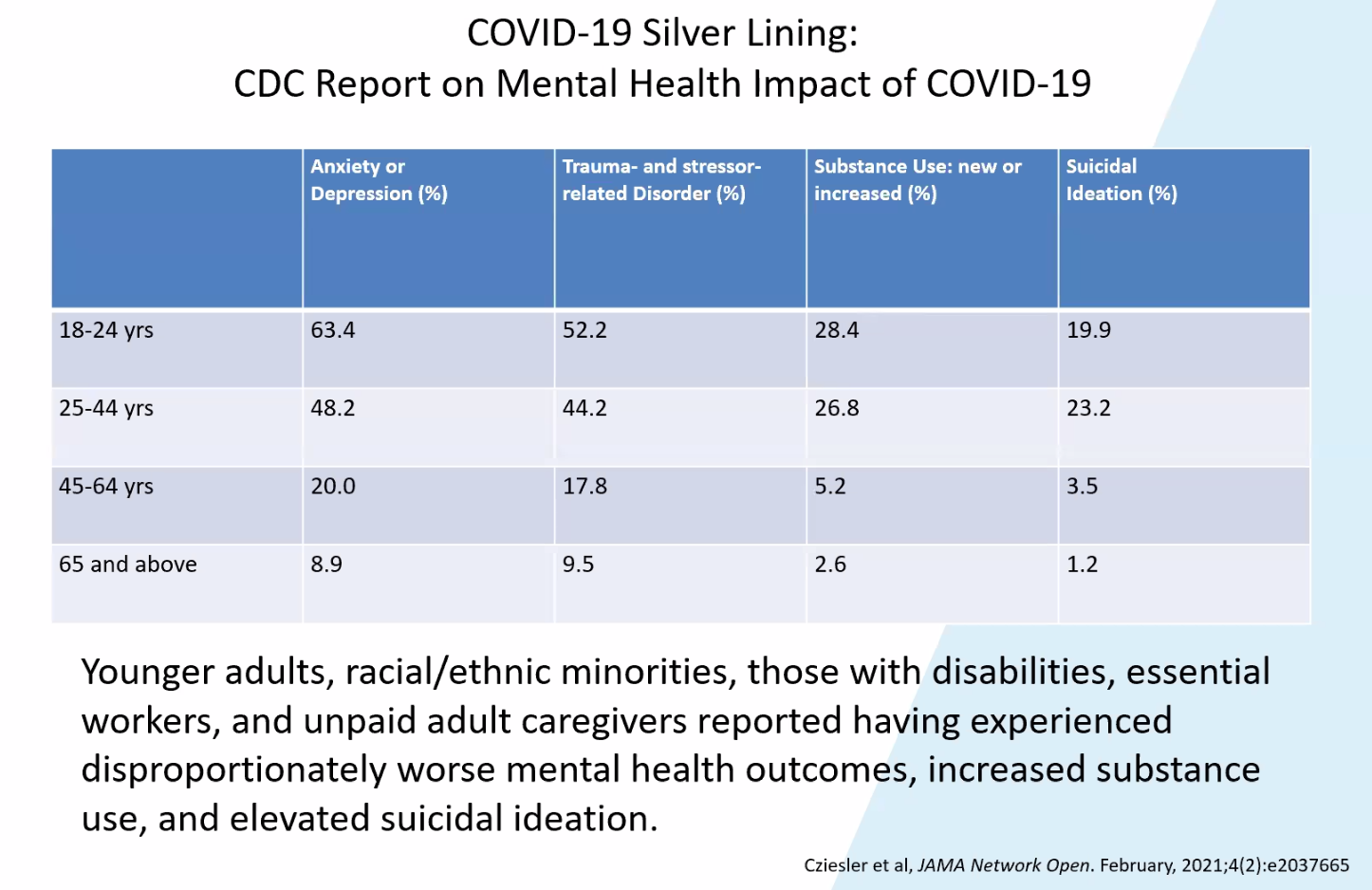
Despite their increased COVID-19 related morbidity and mortality, older adults age 65+ experienced less adverse mental health symptoms among age groups who completed internet-based COVID-19 Outbreak Public Evaluation (COPE) surveys in September 2020.  Dr. Forester discussed how older adults age 65+ might be more resilient to adverse mental health outcomes than younger age groups during COVID-19: internal factors (cognitive capacity, personality, physical health); external factors (social status, financial stability); countering loneliness via “oneliness” (ability to be alone but content); wisdom (empathy & compassion; emotional regulation; ability to self-reflect; acceptance of diverse perspectives; better social decision-making; spirituality).

[External factors like social determinants of health impact one’s resilience and measure of well-being/happiness.  A survey, conducted last month by the Harris Poll, found that many parents of children under age 18, essential workers, younger people and Black and Hispanic people have experienced disproportionate share of pandemic stress.  Younger adults were most likely to admit their mental health worsened during this pandemic (less stigma might be a factor?). Findings from a study on age differences in psychological well-being during pandemic based on University of Michigan data: older people reported less pandemic-related stress, less life change as they were likely already retired and spend more time at home, less social isolation, and lower negative relationship quality than younger people.  In contrast, younger people may be relatively more vulnerable to pandemic-related stress and social isolation due to greater life changes related to university closures, moving back home with parents, increased unemployment/reduced income, etc. Excessive screen time appears to be messing minds of young people attending Zoom school--so much that last month SF sued its own School District and Board of Education for failing to reopen schools for in-person instruction, while Board (facing recall) was distracted renaming 44 schools.] 

Love this slide from Dr. Forester’s presentation, which highlights the value of empathic curiosity and listening to the lived experiences of people and their support network for a “comprehensive, longitudinal and interdisciplinary treatment plan”…and acknowledges how this essential work may be hampered by shortage of providers with expertise and motivation to serve older adults. 

After discussing context of health care “transformation” (past v. 2021: care built around institution v. patient; payments incentivize more v. better care; responsible for immediate outcome v. ongoing health; grudging acceptance of cost v. unable to sustain cost burden), Dr. Forester highlighted role of geriatric mental health in “epicenter of population health strategies” to improve quality of care at individual and population levels, while reducing overall costs of care given behavioral health + geriatric care as drivers of health care spending (especially AD as “long-term epidemic of our time”). He discussed interdisciplinary models of dementia care: Mass General Brigham Memory Care Initiative; UCLA Alzheimer’s Dementia and Care Program; and CRESCENT (lower cost adaptation of UCSF Care Ecosystem).

During mid-day break, time to visit Exhibit Hall and Speed Roundtable Topics!

Stopped by to see Meet AAGP Presidents, including Elliott Stein, MD (AAGP President 1985-87) with whom I had the pleasure of working during my stint at SF Campus for Jewish Living, where he was Medical Director of the Acute Geriatric Psychiatric Hospital and available for consultation during interdisciplinary team meetings involving long-term residents.  This Zoom meeting is also closest I’ve gotten to Marc Agronin, MD, author of Therapy with Older Clients: Key Strategies for Success (2010)--my cherished go-to book, and love his explanation on why older people do not need bucket list! Current AAGP President Forester specializes in older adult bipolar disorder (OABD). 

Next moved over to Perspectives from Senior Geriatric Psychiatrists with Dilip Jeste, MD, Director of University of California San Diego Center for Healthy Aging, known for his research on wisdom in later life and advocacy for multigenerational activities; and Helen Lavretsky, MD, UCLA geriatric integrative psychiatrist known for her research in complementary and alternative therapies for mood disorders. 

Laura Gitlin, PhD (sociologist), Dean of the College of Nursing and Health Professionals at Drexel University, presented on Home and Community based Interventions for Dementia Care: The Challenge of Bringing Evidence to Practice in pre-recorded video.  As viewers asked questions in chat box, she responded in real-time. After video presentation, there was live Q&A.  She developed COPE (Care of People with Dementia in their Environments)/TAP (Tailored Activity Program) as non-pharma interventions intended to be built into routine care, including integration with trained occupational therapists, nurses and recreational therapists. Because the therapeutic relationship is critical, caregivers who are clinically depressed may need their depression addressed first or simultaneously with COPE/TAP.  There are ongoing pilots to support reimbursement potential for COPE/TAP through Medicare Part B. 

William Reichman, MD, Baycrest (Toronto) President & CEO, presented on LTC Across the Globe. In Canada, over 80% of COVID-19 deaths occurred in LTC facilities so there is growing movement to reform industry and develop alternatives. 

·       Pioneer Network advocates person-centered Culture Change Movement (1997) with innovations: homelike environment; outdoor settings; choice in dining options & scheduling of activities; ambient sounds, pleasant music; programming including pets & children; staff have flexible roles & responsibilities; residents & family engagement in healthcare planning

·       WHO defines LTC as service v. facility, an integrated system—affordable & accessible by poor & marginalized; uphold human rights of care-dependent older people; enhance older people’s intrinsic capacities; person-centered, oriented around needs of older person; LTC workforce treated fairly, with social status & recognition it deserves; national governments take overall responsibility for stewardship of LTC systems—strategies to enable aging in place that is equitable and sustainable.

·       Alternatives to nursing home model include: “age-proof” Dutch Apartment for Life; Naturally Occurring Retirement Community (NORC); Accessory Dwelling Unit (ADU); Dementia Village (Hogeweyk); US Green House/Small House Model

[In “Nursing homes need fixing. Here’s where to start,” Harvard Health Care Policy Professor David C. Grabowski, PhD, recommended these ways to improve staffing for better care: increase minimum staffing levels of direct care workers; increase staff pay and benefits; raise Medicaid reimbursement; increase financial transparency (to ensure public dollars spent on staffing as policymakers intended); provide career advancement; and create better work environment through culture change (by empowering staff based on Green House model). Grabowski’s focus is nurse/nursing aides staffing, yet I think staffing improvement should extend to social services to balance medical model with psychosocial support to residents.]   

Kristine Yaffe, MD, Director UCSF’s Center for Population Brain Health, presented Dementia Prevention at the Population Level: Modifiable Risk Factors.  She noted following trends: dementia prevalence has been lower or stable in several countries—associated with public health strategies, decreased cardiovascular disease, improved education and economic well-being. However, epidemics of sedentary lifestyle, obesity, and diabetes could have opposite effects. 

Sleep is important to clear amyloid (plaques outside neurons) and tau (tangles inside neurons), biomarkers of AD-type pathologic changes in the brain.  In people with advanced dementia, sleep is disturbed, sundowning increased, nighttime sleep fragmented; poor sleep quality is associated with cognitive decline, and thus might be used as early marker for AD. 

Lancet Commission on dementia recommended interventions for 12 risk factors, considering a life course perspective and tackling inequality: childhood education, exercise, social engagement, smoking, management of hypertension, hearing loss, depression, diabetes, obesity, excessive alcohol consumption, head injury, and air pollution. 

Future of Dementia-Related Psychosis (DRP) Care: Accurate Diagnosis and Safe Treatment presented by Dr. Agronin from Miami Jewish Health; George T. Grossberg, MD, from St. Louis University School of Medicine; and Pierre N. Tariot, MD Director from University of Arizona College of Medicine.  Dr. Grossberg provided updated IPA diagnostic criteria for DRP.  (Dr. Grossberg also contributed to DRP: Strategies to Address Barriers to Care Across Settings, white paper published by Gerontological Society of America in Feb. 2021.) 

Next, Dr. Agronin discussed DRG treatment algorithm: #1 safety (immediate risk of harm? environ conductive to treatment? caregiver able to implement?); next consider immediate causes/triggers (UTI, pain); behavioral/nonpharmacologic approaches; and then pharmacologic approaches.  Person-centered interventions are individualized to patient’s symptoms, comorbidities, limitations, strengths, interests and resources: identify and address unmet needs (hunger, thirst, pain); environmental stressors/triggers (excessive noise/stimulation, excess heat/cold); sensory defects; preferences for pleasant and meaningful activities*; understand influence of person’s background; educate caregivers on diagnosis and behavioral approaches. *Therapeutic activities include: sensory (music, art, pet, aromatherapy); physical exercise; socialization (holidays, meals, sing-a-longs); spiritual/religious.  [Why no mention of nature-based or garden therapy—incompatible with locked memory units?]

During Dr. Tariot’s discussion of pharma approaches, there were technical difficulties including overlapping audio streams…amusing so chat box filled with comments like “wow, live demonstration of DRP” and “welcome to the world of a patient with DRP.” (At 2018 AAGP meeting, I participated in Parkinson’s Psychosis Simulation wearing Oculus Virtual Reality headset, which projected visual-auditory hallucinations that were mind-blowing!) In their summary (take-home points slide above), they noted dementias are increasing in prevalence (contrary to Dr. Yaffe’s earlier slide, but perhaps they are looking at different time periods?).

Self-examination was focus of Ageism: A New Look at an Age Old Problem.  Susan W. Lehmann, MD, Johns Hopkins School of Medicine Professor (and co-author, with Dr. Forester, of Bipolar Disorder in Older Adult Patients), considered Dr. Jonathan Maltz’s When should an aging doctor call it quits? (published in WaPo, Mar. 31, 2019; at age 70, Dr. Maltz justified practicing medicine part-time because of his sharp mind, good health and hope that old age “has allowed me to acquire greater wisdom, compassion, resilience and stress tolerance”). 

Should aging physicians (23% are age 65+) be subject to cognitive and psychomotor testing to continue practicing medicine, particularly surgeons whose skills depend on manual dexterity? Is this “fair” or age discrimination? Sir William Osler (1849-1919), co-founder of Johns Hopkins Hospital and considered Father of Modern Medicine, recommended retirement at age 60… at a time when life expectancy was much lower than today. 

Dr. Lehmann noted aspects of cognitive aging that can impact physician clinical performance: crystallized intelligence better preserved than fluid intelligence; language skills intact, especially vocabulary; memory changes (decreases in semantic, working, and episodic memory); vulnerability to decreased processing speed (harder to complete complex tasks), and declines in hearing/visual acuity. 

While there is great variability in cognitive function, Dr. Lehmann noted some concerns about older physicians impacting patient care: older physicians found to have less factual knowledge, less adherence to standards of care, poorer patient outcomes; older surgeons less likely to incorporate new approaches into practice; and patients treated by older physicians had higher mortality than patients cared for by younger physicians.  Further, physicians may not recognize their own impairment, as individuals with neurocognitive disorders often minimize/deny impairment, or lack insight/awareness of deficits; ageism/stigma may prevent them from seeking help; and counting on colleagues to refer physician whose performance adversely affected by cognitive/physical changes is not reliable. 

American Medical Association (AMA) and Society of Surgical Chairs (SSC) considered, but never adopted, age-based screening/assessment for physicians, because this might worsen existing physician shortage; however, hospitals monitor and review age-based practitioner screening programs for mental and physical acuity. 

Mary Blazek, MD, of Michigan Medicine (and English Lit major!), explored Combatting negative attitudes toward older patients in medical students: Are Arts the answer? She found that students enter medical school with ageist attitudes, which likely worsen over time and influenced by attitudes of senior physicians and “hidden curriculum”; and interventions to improve attitudes yielded mixed results. These interventions included making ageism explicit; open discussion/self-reflection; small group learning; patient-centered curricula; better integration of marginalized groups; humanities education. She expressed concern that in virtual learning during this pandemic, students miss “joy” and “liveliness” of in-person interactions, and thus may not be attracting students into geriatrics field.

Dr. Blazek’s presentation suggested that arts promote empathic curiositywhich was reinforced in Association of American Medical Colleges’ report, The Fundamental Role of Arts and Humanities in Medical Education (Dec. 2020). 

According to Dr. Faith T. Fitzgerald, geriatrician and former dean of students at University of California at Davis School of Medicine, curiosity is the most important characteristic for medical students being viewed as more humane; key was taking a lot of courses, and it didn’t matter whether they took humanities or science courses.  She explained:

“What is kindness, as perceived by patients? Perhaps it is curiosity: ‘How are you? Who are you? How can I help you? Tell me more. Isn’t that interesting?’ And patients say, ‘He asked me a lot of questions’; ‘She really seemed to care about what was going on with me.’”—Faith T. Fitzgerald, MD, “On Being a Doctor: Curiosity," Annals of Internal Medicine (1999) 

In a nutshell, the field of geriatrics/gerontology needs more curious people or lifelong learners to combat ageism!

Piruz Huda, NP, presented Integrating Non-pharmacological and Pharmacological Interventions in the Treatment of Behavioral and Psychological Symptoms of Dementia (BPSD), based on his contributions to Staff Training in Assisted Living Residencies (STAR) for dementia care. STAR has been adapted for family caregivers (STAR-C) and VA Community Living Centers (STAR-VA). 

(Recent study from University of Toronto found non-drug therapies to be as good or better than medications in treating depression in patients with dementia.) 

In Equity, Racism and Healthcare Delivery Systems: COVID and Beyond, Thomas Sequist, MD, MPH, Chief Patient Experience and Equity Officer at Mass General Brigham Healthcare System, provided an overview of racial and ethnic health disparities related to COVID-19; described systems- and community-based intervention strategies to promote equity and advance anti-racism in healthcare, both during the COVID-19 pandemic and beyond.  His approach to addressing equity was similar to safety process: resource it (training, counseling, policies), hold accountable and elevate to stated goal. Hospitals are used as a gap in the social safety net, and cannot solve all structural racism. 

Interesting to hear medical profession’s acknowledgement of racism after last month’s controversial JAMA podcast and tweet questioning existence of structural racism in medicine.  See NPR’s “'Providers Don't Even Listen': Barriers To Alzheimer's Care When You're Not White” (Mar. 2, 2021).  In Jan. 2021, American Psychiatric Association (APA) issued apology to BIPOC for structural racism in psychiatry, after APA President Jeffrey Geller, MD, MPH, formed Task Force to Address Structural Racism Throughout Psychiatry and published 9-part series on Structural Racism in American Psychiatry and APA last year.

Last week, UCSF launched Racism and Race: The Use of Race in Medicine and Implications for Health Equity Event Series.  

This AAGP meeting of minds reminded me of the value of diversity and inclusion (theme of 2018 AAGP annual meeting) in person-centered care, as the ultimate question is what does the individual want…to be called? how to be treated in this life on earth? to die alone? So important to advocate for equity to meet people where they are, and offer culturally and linguistically relevant support services.

Ageism

By coincidence, as AAGP held its ageism session on Mar. 18, United Nations declared Ageism is a global challenge and issued a report with WHO calling for urgent action to combat ageism including better measurement and reporting to expose ageism with harm to older and younger people who have been stereotyped in public discourse. During COVID-19 pandemic, age has been used as the sole criterion for access to medical care, lifesaving therapies and for physical isolation.

Media have a role in combatting ageism, and older people are more visible in this year’s Oscar nominated Best Picture films (and Asians recognized as Best Director nominees): 83-year-old Best Actor nominee Anthony Hopkins portraying man experiencing dementia in The Father; 73-year-old Best Supporting Actress nominee Youn Yuh-Jung as caring grandmother in Minari (Lee Isaac Chung, also nominated for Best Original Screenplay); and 63-year-old Best Actress nominee Frances McDormand as van dweller in Nomadland (Chloe Zhao)! Also, interesting to see The Mole Agent, nominated for Best Documentary featuring octogenarian Sergio Chamy as undercover agent in a Chilean nursing home (unlikely to happen in USA)! 

AARP released Age Diversity and Inclusion Worksheet for employers! 

Joined SF Supervisor Gordon Mar’s District 4 Virtual Town Hall: Supporting Seniors, as an opportunity to ask about SF’s efforts to end ageism, but my submitted questions were ignored:

·       What’s the impact of SF Reframing Aging/End Ageism SF campaign that was launched in Fall 2019?  Btw, I note this program is called Supporting Seniors, though Reframing Style sheet refers to research to support changing language to change the culture: use older people/older adults, which is perceived as “more capable” than seniors.  I know many people age 60+ who prefer to be called senior as more honorific term.

·       As SF reopens, are there plans for more intergenerational opportunities as age segregation appears to “other” seniors/older people?

Attendee Esfir commented in chat box: “Older adults could be any age, 20 years old is older adult for a child. We are seniors, we can be recognized right away, otherwise there will be a lot of confusions.”  My response: “Agree, people should be called what they want. Thank you!”

Anyway, panelists talked about pivoting in-person to virtual services during pandemic, including food (March is Senior Nutrition Month!) which was made available for pick-up (no congregate dining) or delivered to seniors at home. 

·       Self-Help for the Elderly CEO Anni Chung spoke about her agency’s efforts to vaccinate clients 

·       SF Department of Disability & Aging Services (DAS) Executive Director Shireen McSpadden discussed plans for mobile units to vaccinate homebound seniors

·       Community Living Campaign Connector Margaret Graf announced that her in-person Senior Power meeting reopens next month, in an open-air tent as drop-in senior center, with activities like watercolor painting and poetry reading—while observing masking and physical distancing.

My question about intergenerational opportunities was partly answered when I received agenda for next week’s DAS Commission meeting that will consider granting $1.3 million to senior centers for intergenerational programming.  Ok, and why not make more organic intergenerational connections at integrated spaces at lower cost?

We need to be creative in bringing older and younger people together through daily encounters and the discovery of shared interest — through proximity and purpose. Down deep, there's self-interest running up and down the generational chain. We need each other.”—Marc Freedman, “My COVID-19 Experiment With Multigenerational Living: Could I survive a dose of my own rhetoric when my in-laws moved in behind our house?” Next Avenue (Mar. 24, 2021) 

More violent elder abuse

While COVID-19 hospitalizations and deaths of older people have decreased (thanks to vaccine), reports of elder abuse have increased at frightening pace… often caught on surveillance video, followed by GoFundMe campaigns for victims, and more mainstream media coverage of Asian victims (mostly monolingual, non-English speaking immigrants) by SF Bay Area ABC7 anchor/reporter Dion Lim (herself a daughter of Chinese immigrants) as she has interviewed older Asian victims like 84-year-old Rong Xin Liao who was waiting for bus when 23-year-old male kicked him off his seated walker causing his head to hit the ground in SF Tenderloin.   

·       26-year-old male suspect robbed and knocked to the ground 75-year-old Pak Ho (Chinese), who had been taking his usual morning walk in Oakland Chinatown and died two days later 

·       39-year-old man attacked 83-year-old Ngoc Pham (Vietnamese), and then 75-year-old Xiao Zhen Xie (Chinese), in SF Downtown near Civic Center Farmers Market; unknown whether attacks were racially motivated hate crimes, but Ms. Xie, who fought back attacker after he punched her face, decided that $1 million donated to GoFundMe for her medical expenses would be donated to Asian American community to combat racism 

·       Three 19-year-old men arrested in attack and robbery of 67-year-old Asian man inside SF Nob Hill/Chinatown laundromat 

·       Three females (16-year-old suspect arrested) attacked 75-year-old white woman, robbing her purse and keys in carjacking in Safeway parking lot in SF Richmond District 

·       32-year-old man fatally stabbed 67-year-old Carol Brown (his mother on Zoom call) and 69-year-old Kenneth Preston (his uncle) in their Altadena home 

·       38-year-old man (on parole for killing his own mother) kicked to the ground, yelled “you don’t belong here” and then repeatedly kicked head of 65-year-old Vilma Kari (Filipina), who had been walking to church in New York 

With so much anger and violence in the community, more important to connect older adults to Aging Services network because service providers are mandated reporters of suspected elder abuse—even when older adult is reluctant to report to law enforcement.  Increased social support for older adults may prevent them from becoming victims of elder abuse, and protect them from negative outcomes of abuse (depression, anxiety).


“Why is the world finally paying attention to crimes against Asians? Because so many vulnerable senior citizens are being attacked…the people who should be respected and honored, which is at the very core of Confucianism.” –May Lee (Mills alum), May Lee Show #55 Respecting Our Elders (Feb. 18, 2021) 

Masks protect against coronavirus,…but what does it mean to say “community protects its ownwhen the most common racial perpetrator for any victim is the same as the victim—except “when victims were Asian, there were no statistically significant differences between the percentage of incidents in which the offender was perceived as Asian (24%), white (24%), or black (27%)”--according to U.S. Department of Justice (DOJ) reporting of Table 14, Percent of violent incidents, by victimand offender race or ethnicity, 2018).  (Why did DOJ’s Criminal Victimization report, 2019, exclude reporting Asians as victims in Table 16?!) 

Speaking about anti-Asian racism seemed to be silenced out of fear that this might “take away from anti-Blackness…until Mar. 16 mass shootings killing six Asian immigrant women (three were age 60+: Soon Chung Park, 74, Suncha Kim, 69, and Yong Ae Yue, 63) in massage parlors, which the 21-year-old white male shooter with sex addiction mansplained that he wanted to “eliminate” source of his “temptation.”  Suddenly, blaming white supremacy became common cause for outpouring of solidarity with Asians, formerly invisible until viral videos of anti-Asian attacks…and re-examination of massage parlors as fronts for prostitution/human trafficking

Given generational divide over how to respond to attacks on older Asians (mostly immigrants who want more police for protection v. younger, mostly American-born who seek community solutions like investment in mental health), SF Mayor Breed decided to please both: day after Atlanta mass shootings, she immediately directed police to increase patrols in “areas with high number of Asiansand then week later, she announced plans for Community Safety Teams and Senior Escort ProgramAlso, SF Police Department established a Community Engagement Division to address racist incidents, including an anonymous tip line for Cantonese and Mandarin speakers. 

Asian and Pacific Islander Older Adults

Last Friday, Mayor Breed announced plan to bring mobile vaccinations to Chinatown seniors.  Finally, it has taken a pandemic and rampant violence inflicted on Asian seniors for SF government to pay attention to anti-Asian racism and marginalized Chinatown seniors who may struggle with access to online systems and English only platforms for vaccination appointments, as well as limited public transportation options and safety concerns in getting to/from vaccination sites.  And vaccination needs to be available to others who live in close quarters with seniors, especially in single-room occupancy hotels. 

California Department of Aging hosted Culturally Informed Policy and Programs With and For Asian and Pacific Islander (API) Older Adults with two Asian presenters (Korean male, Taiwanese female) who barely mentioned Pacific Islanders and not much on Southeast Asian Americans. 

Joon Bang, President & CEO of National Asian Pacific Center on Aging (NAPCA), provided overview of Asian American Pacific Islander (AAPI): 

·       AAPIs age 55+ make up 4% of U.S. older adult population, and 20% of AAPI population

·       AAPI is umbrella for 50+ unique cultural identities & 100+ spoken languages.  Because 56% of Asian older adults have limited English proficiency (especially Hmong, Cambodian, Laotian, Vietnamese, Korean and Chinese), language barriers can lead to isolation, loss of opportunities, and prevent access to medical and social services

·       Historically, AAPI cultures are group-oriented with emphasis on family as source of identity, traditional household is multi-generational; filial piety (respect and care for older parents) expected so AAPI families less likely to put older family members into facility; 42% of AAPIs care for older adults v. 22% of general population. 

Joon discussed “cultural competence best practices”; however, because AAPI is not a monolith, cultural humility might make more sense to recognize diversity: avoid assumptions, be curious and learn from clients.  And there is great need for more culturally relevant home- and community-based programs—notably, On Lok’s Program of All-Inclusive Care for Elderly (PACE) that has become a national model

Yvonne Sun, LCSW, Division Director of Special Service for Groups SILVER (Los Angeles), discussed some challenges in service delivery to AAPIs:

·       culturally specific help seeking behaviors often are interpreted as “evasiveness” or “resistance” to care due to indirect communication styles; collective orientation involving family/community leaders as gatekeepers prior to accepting care (may conflict with individual privacy in medical model); stigma (concern with reflection on family system); trauma/immigration history with public system/U.S. government (e.g., lack of trust by Filipino WWII veterans who were promised but not given benefits); reliance on family caregiver (expectation to take care of own)

·       language proficiency

·       lack of culturally appropriate providers/services

·       level of understanding of service provider role

·       assessment of need on incomplete/inaccurate data, thus lack of utilization of services does not reflect lack of need in API community

·       avoidance of confrontation in communication style might lead to dropping out of care (v. challenging professional).

Yvonne’s best practices included culturally appropriate delivery, which may include collaborative style, taking time to build trust and allowing client to be teacher, tailoring treatment to client’s interpretation of problem, being open to non-traditional approaches, etc.

Justice in Aging selected attorney Denny Chan as its new Equity Advocacy Director, and posted video of him sharing how his work has been informed by historical inequities played out in his own family, including his 87-year-old immigrant Chinese grandmother who faced barriers accessing health care and services due to being limited English proficient and less physically mobile.   

“Other” & belonging (via advocacy/engagement)

“Other” represents race/ethnic group with highest COVID-19 case rate in SF: 3.4% of confirmed cases yet only 0.5% of SF population!

According to SF Department of Public Health COVID-19 data tracker to date: 463 deaths (58.7% male; 61% age 80+, 17% age 70-79, 13% age 60-69, or 91% of deaths age 60+; 38% Asian, 21.4% Latinx, 27.6% White, 7.6% Black; 0.9% homeless).  Total COVID-19 deaths: over 550K in U.S., over 2.77 million worldwide.

Last year COVID-19 displaced suicide as top 3 cause of death after heart disease and cancer, in U.S.

Tomorrow COVID-19 vaccine eligibility opens for age 50+, though very limited vaccine supplies; on April 15, vaccine eligibility expands to age 16+.  Thrilled my turn for vaccination coming soon!!! 

California ranks among the worst in U.S. for vaccine equityso Governor Newsom (still facing recall efforts) wants to flood poor areas with vaccine

California Alliance for Retired Americans (CARA) hosted Fabulous Friday Forum with Josh Kornbluth’s Citizen Brain monologue about his learning journey as Atlantic Fellow for Equity in Brain Health at UCSF Global Brain Health Institute, followed by discussion with UCSF Memory & Aging Center neuropsychologist Kate Rankin, PhD.  During his fellowship, Josh realized that brain health is a social justice issue, as he learned how inequality, poverty, malnutrition, limited education, etc. among populations stunted brain development.

Kate emphasized that empathy does not mean agreement or forgiveness, but it is a “superpower of attention” that calls on us to include everybody (their experience, their voice, their truth) and ask what they want.  One way to build empathy is to hear each other’s stories of what brought them to where they are, to understand more of the reality of the world we live in through the eyes of the other person, by opening our minds and hearts to stories that we weren’t expecting to hear, and keep listening.  The process of incorporating other people’s views then changes our brains, and empathetic people also have social motivation (desire to help) to assert ourselves, like fight back if racists are killing people of color!

This empathy/attention sounds similar to cultivating “beginner’s mind” characterized by curiosity, openness, and humility. Good points because political correctness/cancel culture (so dominant in SF bubble)—being told what to think—is antithetical to empathy, which involves how to think with greater openness to other perspectives (and no need to agree/forgive).

In his latest video “Othering & Belonging” (Feb. 4, 2021) from Citizen Brain series, Josh offered democracy as solution so everyone belongs, favoring our kind/caring side over our primitive scared/angry side—urging “old folks to catch up”! Also, like the way he defines his multiple identities without reference to race and age because I find greater common ground and potential for engaging in more meaningful ways through Josh’s identities of being movie lover, museum goer, wearer of aloha shirts, etc.

“Democracy had become the shared civic religion of a people who otherwise had little in common… groups excluded from democratic government turned to democratic governance to practice and press for equal citizenship…

This is where the truly hard work begins.  Democratic governance is never the most efficient means of running an organization, as anyone who’s attended a local zoning hearing can attest.  Its value lies instead in harmonizing discordant interests and empowering constituents.  A nation of passive observers watching others make decisions is a nation that will succumb to anger and resentment—witness the United States.”—Yoni Appelbaum, “Losing the Democratic Habit,” The Atlantic (Oct. 2018)

In new book, How Rights Went Wrong: Why Our Obsession with Rights Is Tearing America Apart (2021), Columbia Law Professor Jamal Greene criticizes how courts have framed rights as binary, all-or-nothing conflicts, with clear winners and losers; instead of discriminating between rights that perpetuate divisiveness, he proposes to reconcile competing rights with justice for all (i.e., weighing benefits/burdens of government action v. deciding values)! 

“We have democratic institutions — legislatures and governors and mayors — precisely to reconcile our rights, through law.  But first, we need to see each other as rights bearers and as equal citizens who disagree with one another but who must figure out a way to live together.”—Jamal Greene, “Americans are obsessed with ‘rights.’ In the pandemic, that’s killing us.” Los Angeles Times (July 2, 2020) 

Transit is important to further mobility and connections to community, and pedestrians and drivers of motor vehicles need to figure out a way to travel safely.  At SDA Transit Justice meeting, Walk SF organizer Brian Haagsman presented Vision Zero approach to “end all severe and fatal traffic crashes by 2024” because traffic deaths are preventable using a systems approach:

·       prioritize safe streets first using data where most crashes occur to target improvements (high-injury network where top primary collision factors are drivers’ failure to yield to pedestrians, unsafe speed and not stopping at a red signal) 

·       end inequities in traffic violence, as low-income, immigrants, communities of color, seniors and people with disabilities are twice as likely to live on high-injury corridors

·       address deadly speeds via automated speed camera enforcement, which has been reintroduced (AB 550) by Assemblymember David Chiu, with stronger protections for privacy and equity. 

Assemblymember Phil Ting introduced AB 1283 (aka Freedom to Walk Act) to decriminalize jaywalking outside of a marked or unmarked crosswalk or against a traffic light when it doesn’t lead to an “immediate hazard”—in response to concerns of disproportionate enforcement against communities of color and need to prioritize enforcement against drivers.  To date this year, four pedestrian deaths in SF included two seniors age 85 and 79, both in high injury corridors. 

Gray Panthers hosted meeting focused on Long-Term Supports and Services for All! Michael Lyon reviewed Gray Panthers’ 6- Point Plan.

Lindsay Imai-Hong, California Director of Hand in Hand Domestic Employers Network, presented on Long-Term Supports and Services 4 All Coalition.  Check out Quality Jobs Are Essential:California’s Direct Care Workforce and the Master Plan for Aging. 

FrameWorks Institute hosted Moving Mindsets-The Ways Minds Can Shift with Felicia Wong, CEO at Roosevelt Institute, who talked about replacing the dominant neoliberal mindset with something new and different “that is as yet unnamed.”  She noted that President Biden, as a moderate, traditionalist, creature of the Senate, just signed $1.9 trillion COVID-19 stimulus package and promised another $3 trillion to transform the economy including making care central—not at all expected from centrist Biden a year ago—which could represent a mindset shift, something deeper than a response to the pandemic to a culture of care that has been missing yet necessary to move forward.

With FDR as his role model, Biden appears to be using Keynesian economics or deficit spending as an investment in our collective future.  At age 78, Biden is much older than FDR (who assumed Presidency at age 51, and served for 12 years until his death at age 63) and has the advantage of “age-acquired wisdom to express a longer view of history.”  Biden’s American Jobs Plan proposes $400 billion to expand infrastructure of care economy: “access to quality, affordable home- or community-based care for aging relatives and people with disabilities”! 

This culture of care resonates in Biden’s call for civility and riddance to bullying antics.

"If you're ever working with me and I hear you treat another colleague with disrespect, talk down to someone, I promise I will fire you on the spot… Everybody, everybody is entitled to be treated with decency and dignity."—President Joe Biden, Swearing-in his appointees (Jan. 20, 2021) https://thehill.com/homenews/administration/535142-biden-swears-in-senior-staff-and-warns-disrespect-each-other-and

Mission Hospice Community Education Manager Susan Barber hosted evening of poetry reading and talk with Barbara Karnes, RN, who shared stories and read excerpts from her colorful end-of-life (EOL) booklets: Gone from My Sight: The Dying Experience (“blue book,” 1986); My Friend, I Care: The Grief Experience (yellow, 1991); The 11th Hour: A Caring Guideline for the Hours to Minutes before Death (purple, 2008); How Do I Know You? Dementia at the EOL (lavender, 2016); Pain at EOL: What You Need to Know about EOL Comfort and Pain Management (peach, 2019); and A Time to Live: Living with a Life-Threatening Illness (green, 1994). 

Barbara shared her experiences as nurse, inspired to write her “little blue book” one year after Medicare hospice benefit began in 1984, explaining the “normal/natural” process of dying as a dying patient’s daughter took notes; afterwards, Barbara got out a legal pad and began writing like she was talking to someone who wanted to understand about how people die without being pathological, explaining that caring for people at EOL is different than getting better. At EOL, dying people might seek medical aid in dying (MAID). 

“Seniors in the long-term care centres should be the ones who are speaking up and running the place.  Some of them are not competent, that’s true. But many of them are. And they could take on the challenge.”-- 98-year-old Canadian retired geriatrician Ronald Bayne chose death at home by MAID over going into LTC facility, “Why did a geriatrician who fought to give seniors hope seek medically assisted death in the middle of a pandemic? He told us,” The Globe and Mail (Mar. 1, 2021)  

According to palliative care physician Diane Meier, people request MAID for existential and spiritual reasons, and “the only treatment for that is relationship, attention, sitting with. Not trying to fix. That willingness to be with and engage the person in giving voice to that suffering.”  But human connection is more distant during this pandemic. 

Barbara took issue with No One Dies Alone (NODA) when family/significant other of the dying person wants it more for their comfort than the dying person who may not care.  Susan chimed in, recounting experience of NODA being imposed on a reclusive person who seemed to wait to be left alone to die. 

During this Social Workers are Essential month, NASW-CA hosted Advance Directives 101 with Mario Espitia, LCSW, a palliative care social worker who said he learned on-the-job since most MSW programs do not address death and dying.  Coming up Apr. 16: National Healthcare Decisions Day!

Better dead than co-ed?

March is Women’s History Month, and Mills College Her-story looks like it might become history, another COVID-19 casualty? Mills grad student Paige inspired some hope, sharing her experience as an engineering undergrad at Sweet Briar when it faced closure due to financial challenges from both declining enrollment and endowment in 2015, but survived as a private women’s college due to alumnae’s legal actions and “Saving Sweet Briar” fundraising.

What is happening with Mills College is not unprecedented. Women’s colleges have suffered from declining enrollment in recent years, with several forced to close or start admitting men in order to survive. There are just 34 women’s colleges left in this country, down from 230 about 60 years ago…

This isn’t the first time the Mills community has gone up against challenge. Mills has survived the Civil War, World War I, the Depression, and World War II. In the 90s, student protesters occupied the campus for 13 days, rescinding school leadership’s attempt to start admitting men. The tenacity of the Mills community is boundless, organizing to Save Mills is happening, but is it enough?—Molly Curley O’Brien (Mills alum), “A Requiem For Mills College,” KQED (Mar. 24, 2021) 

Mills enrollment dropped sharply after 2014, following termination of experienced admissions staff and elimination of Alumnae Admissions Representative program. [Huge mistake because students see their future among alumnae in recruiting process—like Hazel Soares (1915-2019), who graduated from Mills at age 94, proving it’s never too late to use hubby’s GI benefits from WWII to pay for college!]  Instead, former Mills President (corporate attorney, with no academic teaching/publishing experience, who ultimately resigned in 2016 while facing faculty no-confidence vote) relaxed admissions standards by going test-optional (as done at Smith College since 2008) and allowing non-binary/transgender applicants who self-identify as female.

On Mar. 17, Mills announced plan to cease as degree-granting college in 2023—171 years after its founding in 1852—and transition to a think-tank to promote women’s leadership and advance gender and racial equity. But not so fast, as an exciting intergenerational Save Mills College Coalition is fighting to preserve women’s college tradition for all ages! 

It’s a beautiful day in the neighborhood to view spring flowers, but no time to smell flowers during pandemic mask wearing…