Grassroots Palliative Care: Fully Engaging
Our Communities
with Ken Ross (Elisabeth Kubler-Ross Foundation), Susan Barber (Mission Hospice & Home Care), Nate Hinerman (Golden Gate
University), and Redwing Keyssar (Jewish Family & Children’s Services).
Senior
Division Director Cathy Spensley and Director of Geriatric Mental Health Ed
Fowler, both of Felton Institute, discussed Integrating
Mental Health and Aging Services to Create Change (Mental Health) based on
their Geriatric Mental Health Model.
Policy & Advocacy
My required
Volunteer Orientation and Training began on the first day of the conference at 7:30
am, and lasted only 10 minutes. I
received my assignment as room monitor at Imperial AB, which featured all
Policy sessions! Since I didn’t have to
report to my assigned room until 8:30 am, I stopped by a table in the lobby
level to pick-up printed materials on caregiving, and was warmly
invited to the meeting room…
Wow,
hearty protein-rich breakfast at 12th
Annual National Conference of Caregiver Advocates: Engaging Caregivers Across
the Lifespan.
By 8:30
am, I reported to my assigned room, where my role as monitor involved checking
conference badges and taking attendance.
Because the registration line to pick-up conference materials (including
badges) was so long and registrants didn’t want to be late for 9 am session, I
had to write names of registrants without conference badges for Innovation for Impact: What We Have Learned
featuring AARP Foundation staff: Paolo Narciso (Income Security), Kim Perry
(Food Security), Marc McDonald (Grants), Zac Leverenz (Impact) and Emily Allen
(Programs).
· 40% skip recommended
medical test/treatment because of cost
· 44% don’t go to a
doctor when sick/injured because of cost
· 30% had to choose
between paying for medical bills or basic necessities like food, heating or
housing
· More people fear
medical bills that come with serious illness (40%) than fear illness itself
(33%)
· Support for greater
spending on Medicare and Social Security grows with age (no surprise)
Panel
proposed 3 solutions:
· End individual,
procedure-oriented fee for service in favor of population-based value metric; HCBS
also need to end silo funding based on units of service, which is a variation
of fee for service
· Medicare should negotiate
pricing of prescription drugs, including generic v. brand name
· Increase price
transparency
Comments
during Q&A:
· Consumer has burden
to use Medicare Plan Finder website for price
comparison; only 10% change plans, yet usually lose savings when they keep the same plan.
· Learn from states:
spend money on social services to save money on healthcare
· Single-payer
healthcare is galvanizing sound bites like an easy solution v. value-based
payer model
West Health partnered with SCAN Foundation to
launch “We Stand With Seniors” campaign on the specific challenges faced by
seniors and their families in accessing high-quality, affordable healthcare,
dental care and supportive services. In
the months leading up to the election, the campaign urges candidates running
for governor and other statewide offices to develop a concrete plan to provide
for healthcare needs of vulnerable seniors.
· Michael Gelder, Center
for Research on Health & Aging member, talked about ACA moving from fee for
service to pay for value, shifting care closer to patients’ homes while
combining traditional medical care and HCBS—these are most pressing for the sickest,
highest cost, end-of-life and homebound patients; savings would be realized
5-10 years (versus current emphasis on short-term); financial incentives to
integrate social services into primary care include capitation (e.g., Program
of All-Inclusive Care (PACE) for Medicare-Medicaid dual eligibles based on adult
day health center model, started in San Francisco, now in 29 states, but not
scalable as national model because resource intensive and difficult in rural
settings).
· Robyn Golden, Rush
University Medical Center VP, discussed the importance of seeing person’s home
situation, potential for teamwork and care coordination facilitated by tech
surveillance; challenge is “internal medical doctor does not talk to
psychiatrist, surgeons don’t talk to anyone”; though it is more effective to
meet people where they are in their homes, there is stigma associated with home
visits.
Federal
Funding for Aging Programs: What’s Ahead and What We Can Do about It (Policy
& Advocacy)
· Amy Gotwals, n4a Public Policy &
External Affairs Chief: turnaround was stunner, bipartisan Budget Act lifted caps
to increase non-discretionary domestic (NDD) funding levels! Trump eliminations
avoided, programs with most advocacy rewarded—Older Americans Act programs saw
big increases! Aging in place requires resources and options so need to educate
and fight cuts to vital programs in budget!
· Lindsey Copeland,
Medicare Rights Center Federal Policy
Director: threat to Medicaid is threat to Medicare, dual eligibles are
vulnerable. Medicaid important to 6
million low-income seniors + 10 million people with disabilities = 62% of
Medicaid spending; 2/3 of seniors in nursing homes rely on Medicaid = LTSS.
Need year-round appropriations advocacy!
ASA Chairs’ Lecture—Provocateurs and Predictions: A Brave New World for Aging with
moderator Joanne Handy (Trinity Continuing Care Board Chair) and panelists who
provided their insights on disruptors in aging services:
· Richard Browdie
(Benjamin Rose Institute on Aging President & CEO): New ACL Secretary Lance
Robertson is “bright light” in Trump Administration; President’s threats to cut
aging programs scared a lot and reignited advocacy; trend to medicalize social
determinants of health; reframe aging might be a way of “finding new words to
make problem go away.”
· Robyn Golden (Rush
University Medical Center VP): poked fun at “digital solution” to social
determinants of health; Amazon hired geriatrician, need to cut silos of
care; not enough disruption in housing and caregiving; need to change view that kids, not old, represent
hope--need to be comfortable talking about future, how can
still have meaning in old age to rid stigma/fear.
· John Feather
(Grantmakers in Aging CEO): millennials are not buying cars, so auto industry
has transformed to mobility company, creating personal devices for people with
disabilities to move; immigration reform to address labor shortage—majority of
MDs serving rural communities are foreign born because can’t attract Americans
to do this work.
Diversity & Cultures
Kevin Prindiville, Justice in Aging Executive Director, began session, Fifty and Forgotten: Focus on Wealth and Women in Their Fifties (Diversity & Cultures of Aging), stating that women are disproportionately impacted by poverty (as detailed in the report, Aging, Women and Poverty: We Must Do More) due to systemic causes: unequal pay (women earn 80 cents on men’s dollar); caregiving (75% of women are caregivers, often underpaid); longevity (women’s life expectancy 81.2 v. men’s 76.4); and higher healthcare costs.
Jhumpa Bhattacharya, Insight Center for Community Economic Development (CCED) Director
of Racial Equity and Strategy, suggested wealth as the broader issue (than
income) providing a holistic view of economic security as it is passed down
generations, showing how economic injustices of past connect to the present and
future. Women experience a motherhood penalty from time spent
out of the labor force or working part-time for caregiving, as there is no paid
family leave; men in pre-retirement age (50-64) have 1-1/2 times the wealth of
comparable women-- $60,500 v. $38,200, according to Women and Wealth (2015) study by Mariko
Chang. Also, women, especially Black and Latinx, are less likely to have
access to the wealth escalator (employee benefits, government benefits,
favorable tax breaks to turn income into wealth more quickly).
Anne Price, Insight CCED President, added the impact of wealth stripping (schemes to extract wealth
from communities, e.g., payday lending). Therefore, she concluded
need to focus on wealth building/wealth stripping using an intergenerational
approach.
Jhumpa noted that millennial women do not fare better, given
student loans, gig economy with no benefits, and fewer entering STEM careers
than Gen X (possibly due to tech’s frat culture).

Courageous Aging: The Extraordinary
Struggle to Maintain an Ordinary Life (Diversity & Cultures of Aging)
featured panel discussion on diverse elders:
· Daniel Maher (NP,
Rush University Senior Care) on Disability: 5% of older people are in LTC facilities, 80% of older people have at
least one chronic condition, 13% of older household population with a
disability lived in poverty, 13% of older population uses 40% of prescriptions,
more than 25% of older people fall each year, but less than half tell their
doctor, over 95% of hip fractures are caused by falling (usually by falling
sideways).
· Randella Bluehouse (Executive
Director, National Indian Council on Aging) on American Indians:
2.6 million American Indian/Alaskan Natives (AI/AN) age 55+, who represent 44%
of total AI/AN population; diverse group with 573 federally recognized tribes
and 229 tribes/villages in Alaska; most live outside tribal areas, face
discrimination/hate crimes in border towns; challenges include geographic
isolation, poverty, medically underserved, digital divide, lack of phone connectivity, poor infrastructure,
access to culturally approriate services.
· Leland Kiang (Information
& Referral Manager, IONA Senior Services) mentioned need to rethink
community, such as choir or bingo participation accessible by phone. (Missed this first presenter due to room
monitor outside who initially refused to allow me to enter room, which she
claimed to be standing room only; yet after much coaxing, she finally allowed
me to open door and I easily found empty chairs in front rows to sit.)
· Imani Woody (President
& CEO, Mary’s House for Older Adults) on Social Issues of LGBT Elders: 3
million LGBT elders (age 55+) in U.S., more likely to be childless (90% LGBT
elders have no children v. 20% overall older adult population) and living
alone; survived by scanning for clues (countless put in mental institutions
because homosexuality was classified as mental disorder until 1973, when it was
replaced by sexual orientation disturbance until 1987); by
ignoring/avoiding LGBT issues, providers contribute to isolation—indications
are Gen Silent that fought hardest to come out is going back into
closet to survive as they face housing discrimination, so she wears LGBT Pride
Rainbow pin to create visibly welcoming and inclusive environment; aging and
social services need to dismantle institutionalized ageism, heterosexism, and
classism through policy, marketing and staffing; instead of “disrupt” aging,
embrace aging! (audience applause) When she quoted Bette Davis’ “aging ain’t
for sissies,” someone called out, “what’s wrong with being a sissy?”
· Tom Callahan (Director
of Senior Living Resources, Archer Law Office) on Economic Issues of LGBTQ
Elders: LGBT adults face employment
discrimination and earn less than heterosexual counterparts; 41% LGBT struggle
financially, spending (Kardashian effect) but not saving money; lesbians’
greatest fear is they will run out of money before they die; gay men’s greatest
fear is they will become disabled and dependent on someone else. His advice was to plan for aging, which will
be there sooner or later, and do not be afraid to ask for help.
How to Manage and Promote a Lifelong
Learning Program in the Modern World (Lifelong Learning)
· Linda Maurice (Lifelong
Learning Institute Director, Nova Southeastern University) on Reaching the New Generation of Lifelong
Learners: Marketing, Advertising, Social Media and Networking. Ideas for getting word out free: community
calendars, social media, word of mouth, networking groups, partnerships,
inhouse brochures/flyers, peer incentives.
· Sandra von Doetinchem
(Founder, Silverlearning.org) on Exploring
New Target Groups: Lifelong Learning in the Fourth Age. Lifelong
learning programs typically target older adults who are female, with higher
education/socio-economic background, in their 60s and 70s, healthy, active and
mobile; her presentation focused on “others” who are in Fourth Age (age 80+ or
85+) with physiological (multimorbidity, immobility, sense impairments),
cognitive/psychological (cognitive decline, prevalence of dementia, loneliness,
depression) and social (isolation) risk factors. Access issues to consider
include transportation, programs held in living environment, distance learning
(phone, online, TV).
· Janna Overstreet
(Director, Ringling College Lifelong Learning Academy) on Managing Purposefully: mission to build community—8 million over
age 50 are socially isolated, staff doing more with less, more
faculty/volunteers needed; practice servant leadership—hear what people have to
say; active fundraising gives others opportunity to invest in what they believe
in and leave legacy.
With Lifelong Learning Consultant Hope Levy, attended Roundtable, How to Plan Events that are Accessible to
All, presented by Irene Stewart, Aging & Disability Services Planner, Seattle Human Services Department. ADA in a nutshell – best conference handouts
and practical tips, with emphasis on facilitating “meaningful experience” for
attendees.
Journalist
Kerry Hannon moderated Solo Aging: 360-Degree Perspective (Aging
in Community).
· Wendi Burkhardt,
Silvernest Founder and CEO, explained that as a 52-year-old with no children, she
developed her “Golden Girls 2.0” business idea after
her widowed mother faced isolation and invited a friend to move in. This sparked her to create fee-based online
roommate matching service that pairs boomer generation home residents (owners/renters)
with prospective housemates of any age. Her business has 40,000 users, with 70% age
65+ women who live alone.
· Maria Carney, Northwell
Health Geriatric Chief MD, was an internist/geriatrician for 20 years in a
hospital, where she increasingly saw patients who were alone and needed to
involve a social worker earlier to bring in resources for decision-making and
caregiving needs, as treatment plans require identification of a social
network. She shared 10 steps in caring
for an elder orphan (anyone can be in this situation): identify all medical
issues; identify cognitive and functional abilities; obtain detailed social
support information; create manageable & realistic treatment plan; utilize
service delivery to home; make safety and injury prevention a priority—address
safety & injury issues; address goals of care & advance directives;
understand privacy issues (HIPAA); assess decision-making capacity and involve
individual as much as possible; determine if guardianship is needed, and if so,
seek it. Dr. Carney said advice was practical, noting likelihood of chronic illness in old age when we will need someone to care for us, and introverts could express their “time alone” orientation.

· Carol Marak started Elder
Orphan Facebook group for people aging alone to exchange resources on issues
relating to housing, rides, health and medical decisions, social support to
reduce isolation. She also wanted to
build awareness because worlds shrink as people die, so we need to create
relationships and find out who will be like family you can trust with your
life.
· Sara Zeff Geber,
Life Encore founder and author
of Essential Retirement Planning for Solo
Agers: A Retirement and Aging Roadmap for Single and Childless Adults (2018),
noted that U.S. General Accounting Office predicts by 2020, the number of solo
agers (no living children or siblings) will be 1.2 million—almost twice the
1990 figure. She advised solo agers—while
still healthy, able-bodied in their 50s and 60s—to get started building social
support, “at least join a village because your world begins to shrink when you
no longer drive.” She also provided a
Solo Agers’ Life Plan checklist: have conversations with relatives, close
friends, spouse; visit experts (financial advisor, attorney, fiduciary,
insurance agent, physician); put it in writing (POA-finances and healthcare,
will and/or trust, advance directive for healthcare); and explore options
(research online, visit potential communities, talk to people with experience).
As a do-it-yourself type, I thought her
checklist applied to anyone.
· F. Scott Moody
started K4Connect CEO for people with disabilities to live simpler (single
application to integrate smart technologies), healthier (activity tracker,
blood pressure monitor, telehealth) and happier (connect with video/audio chat). He said technology is not hard to grasp,
problem is poor design like teenage clothing does not fit older people.
Networking + Receptions
Since I
have been focused on working with homebound older adults, trying to promote aging in community and prevent institutionalization in a locked facility or
nursing home, I miss being out in the community … so took full advantage of the
conference’s receptions, especially to reunite with classmates!
Meet-up
with SFSU Gerontology classmates Diane, Mary and Brittany before Opening
General Session.
Meet-up
with SFSU Gerontology alumna Hope at Exhibit Hall
Hope and Sheila at Exhibit Hall
Exhibit
Reception featured grilled veggies, pita bread and Mediterranean dips, cheese
and crackers. Similar fare throughout
conference receptions, so this is about the only food porn in this blog post!
Andrew
Scharlach chatting with Tony Sarmiento at UC Berkeley Social Welfare exhibit
booth.
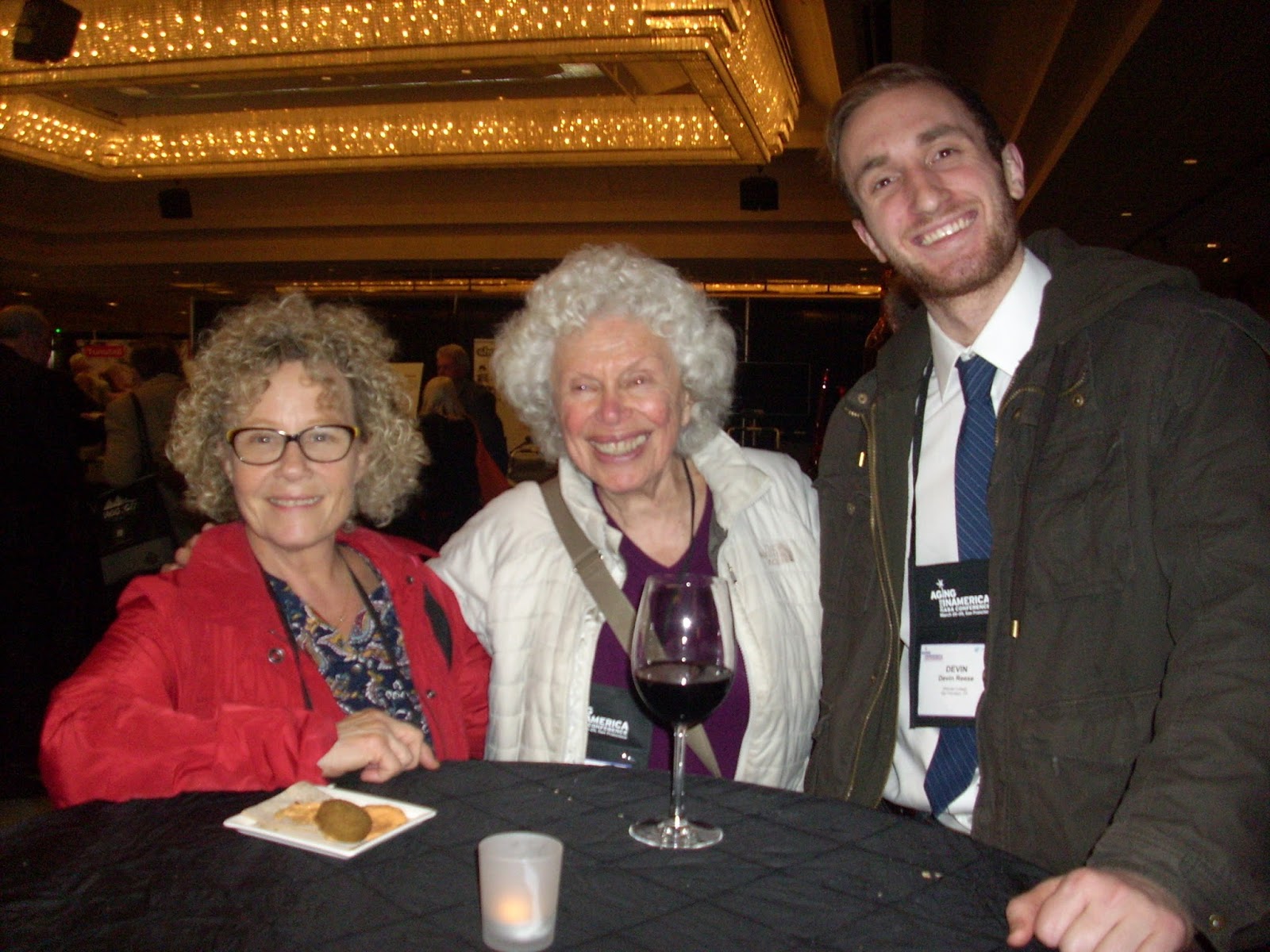
SFSU Gerontology alumna Ann
Colichidas of Vitality for Life, Sheila and Watson Fellow/filmmaker Devin Reese
Victor (holding poster, Culturally Adaptive Digital Avatars for Psychosocial and Self-Management Support of High-Risk Elders) and Brittany Wang of Gerijoy with classmate Maggie outside Hilton Union Square.
SF
Senior Center Director Sue Horst and Program Coordinator Crystal Booth; 30th
Street Senior Center Director Valorie Villela (presented on Bullying
Elimination Training Program for Staff and Older Adults); and Senior Center
without Walls Director Amber Carroll (presented on Without Walls: Programming
Over the Phone for Older Adults and Increasing Connection, One Call at a Time).
SFSU
classmates Mary and Diane with UCB MSW alum Darrick Lam, CEO of ACC Senior
Services (and former ACL Program Specialist who supervised my SFSU Gerontology
internship) at SF Senior Center reception for UC Berkeley School of Social Welfare celebration of its 50th Anniversary of MSW Aging Services and
upcoming retirement of Professor Andrew Scharlach.

SFSU Gerontology classmates Mary,
Brittany, Lois and Diane at Aging 2.0
reception at Rex Hotel.
Women’s History Month: "Nevertheless, She Persisted"
At age
96, Betty Reid Soskin is the oldest U.S. Park Ranger. As field representative for California State
Assemblywomen, she was actively involved in planning for Rosie the Riveter/WWII
Home Front National Historical Park, focusing on the contributions of women to
the War effort. Earlier this month, she
was at the SF Main Library to discuss her new book, Sign My Name To Freedom: A Memoir of a Pioneering Life (2018),
based on selections from her blog, Cbreaux:
I've suspected for a long time that much
of the interest in my work tends to lie in the fact that I'm such a late
bloomer. Though I cannot say that I didn't work -- I'd been a
stay-at-home mom for the first half only but after having helped to start our
little family business in Berkeley until motherhood took over my life.
Didn't have my first significant formal job until I was
almost fifty, and have been working ever since. That the National Park
Service hired me as a permanent park ranger at 85 continues to bring smiles to
the faces of the elders who stop in, especially when I playfully suggest that
they keep their resumes updated, "you never know when the call will
come!"


 Money magazine reported, “A Growing Cult of Millennials Is Obsessed With Early Retirement. This 72-Year-Old is Their Unlikely Inspiration” (April 17, 2018), referring to Vicki Robin, co-author of Your Money, or Your Life (YMoYL). (When I read YMoYL originally published in 1992, it inspired me to maintain my simplified lifestyle and reject consumerism because money=life energy; YMoYL has been revised to emphasize financial interdependence, such as a community building to share resources and support.) Apparently, millennials are focused on “Financial Independence, Retire Early (FIRE) with more emphasis on the goal of FI than what to do for the rest of their retirement lives before they die?! When older adults retire at age 70, the “biggest challenge is to make your life as meaningful as it was when you were working,” according to Dr. David B. Reuben, Chief of Geriatrics Medicine at UCLA. Towards the end of life, we may think even more about making a contribution to society based on Erik Erikson's theory.