Showing posts with label lifelong learning. Show all posts

Friday, April 30, 2021

Infrastructure

in·fra·struc·ture  (ĭn′frə-strŭk′chər) noun

1. An underlying base or foundation especially for an organization or system.

2. The basic facilities, services, and installations needed for the functioning of a community or society, such as transportation and communications systems, water and power lines, and public institutions including schools, post offices, and prisons.

https://www.thefreedictionary.com/infrastructure

Care infrastructure

Woo-hoo! So refreshing to learn care is included as infrastructure because care (aka “domestic work” often performed by women, unpaid/underpaid) has to get done before any other work can get done! Inspired by women, President Biden’s American Jobs Plan proposes to invest $400 billion over eight years in care infrastructure

#CareCantWaitCoalition launched $20 million campaign to push Congress to invest in care infrastructure, notably the following to care for aging adults: 

·       Invest $450 billion in Medicaid home and community-based services (HCBS) to create over one million high-quality, union protected direct care jobs, expanding HCBS to people with disabilities and aging adults, and supporting unpaid family caregivers who rejoin labor force.

·       Pass Paid Family and Medical Leave legislation to ensure all working people have access to at least 12 weeks of paid leave to address a personal or family related illness.

Aging and tax expert Howard Gleckman wants Biden to be more ambitious in pushing for a public long-term care (LTC) social insurance plan because millions of middle-income Americans are not poor enough to qualify for Medicaid yet cannot afford paid LTC.  Check out Rethinking Care for Older Adults

As part of nursing home care reform, state governments have proposed legislation to increase minimum staffing levels in nursing homes, and surprisingly, investors are demanding that for-profit nursing home operators improve staff working conditions and quality of care (increase staffing levels, boost pay, offer pandemic hazard pay and sick leave, allow staff to unionize, improve safety). 

Last month, Pivotal Ventures named Building Women's Equality through Strengthening the Care Infrastructure, led by several members of #CareCantWait Coalition, as one of ten finalists for Equality Can’t Wait Challenge. 

At Care Can’t Wait Summit, Time’s Up CEO Tina Tchen presented It’s Time to Care: The Economic Case for Investing in a Care Infrastructure (Feb. 2021).  During COVID-19 pandemic between Feb. 2020 and Feb. 2021, over 2.3 million women (compared to 1.8 million men) dropped out of the labor force, mostly due to caregiving responsibilities—wiping out a generation of economic gains; over half of these women affected were Black (600,000+) and Latina (618,000+).  

Building on American Rescue Plan and American Jobs Plan, Biden administration announced American Families Plan, the third COVID-19 recovery package released this week that proposes comprehensive family and medical leave, and extension of tax credits to lower and middle-income workers and their families in American Rescue Plan.

In a capitalist system, care is valued if monetized so many family caregivers aren’t “counted” and thus remain mostly invisible.  AARP hosted screening + discussion of Sky Blossom: Diaries of the Next Greatest Generation (2020), a documentary giving visibility to millennials who provide (unpaid) care for military veteran parents or grandparents.  Sky Blossom’s millennial caregivers included 18-year-old Kaleo and 26-year-old Kamaile, brother and sister in Kauai, prioritizing care of 80-year-old grandpa Bobby, a former Marine who developed dementia; they explain their culture of kuleana (responsibility) for “grandpa is the last we have,” after their mother died by suicide, and “school is always there” as they postpone their own plans for college and gain hands-on adulting.  AARP released companion Financial Workbook for Veteran and Military Family Caregivers: A Practical Guide Focused on Health, Housing, and Money Management (2021). 

Sky Blossom Director Richard Lui became Gen X caregiver/frequent flier, adjusting his MSNBC anchor work schedule so he could commute from NY to SF to help care for his father, a retired social worker diagnosed with Alzheimer’s disease eight years ago.  Richard’s caregiving experience then became a seven-year “selfless” exploration and genesis for his new book, Enough about Me: The Unexpected Power of Selflessness (Mar. 2021). 

Last month’s PBS documentary, Fast-Forward, followed four pairs of millennials and their boomer parents as they go through “aging boot camp” (wearing MIT-produced “aging empathy suit,” which was more like “disabling empathy suit”) that challenges them to confront changes at age 70+ (mostly physical limitations that can be socially isolating).  In this simulation, changes are abrupt, while in real life changes are gradual so we can adapt and plan for greater interdependence. 

To its credit, Next Avenue developed companion seven-day email course + digital toolkit (Assemble Your Team, Share Your Plan, Complete an Advance Directive) that considered solo agers without available family caregivers. Yet, wondered why isn’t more attention paid to so-called elder orphans/solo agers? This has been my Old Maid Project, as I want to focus on older women who are more likely to live alone than men.  

During virtual Careers in Aging Week, Susan Ryan, Senior Director of The Green House Project and host of Elevate Eldercare podcast, presented keynote Catching the Wave of Opportunity.  She shared her own career trajectory from nursing home nurse to LTC reformer after she learned about culture change/The Green House Project. 

In addition to data driving decisions in longevity economy where “demographics demand disruption,” (111 million American consumers age 50+ generate $7.6 trillion in economic activity; Karen Sands’ Gray is the New Green: Rock Your Revenues in the New Longevity Economy), COVID-19 pandemic has put aging services in the spotlight—not just about keeping infection away, but relationships matter, empower workers, wellness is biophilic, etc.

The Green House Project founder Dr. Bill Thomas is pushing deinstitutionalization further with his new Canopy model, a “middle market” offering designed to make “better homes and better communities” to bring nursing home care to people living in their own homes with access to outdoors (more in Politico article, “Will the Nursing Home of the Future be an Actual Home?”). 

Internet infrastructure

Biden’s American Jobs Plan proposes $100 billion to bring affordable internet (aka “electricity of the 21st century”) to all Americans by 2029! Digital equity took on greater importance during COVID-19, especially among older adults staying safer at home and relying on internet access for telehealth, social connection, news and health information, ordering essentials, scheduling vaccine appointments, etc. SF Age & Disability Friendly Implementation Workgroup heard from consultant Cecile Puretz about Thriving in Place-Empowered SF Technology Access Survey in progress (digital in six languages, phone, print, ASL vlog, braille). 

Meeting closed with farewell to Shireen McSpadden who is leaving SF Department of Disability and Aging Services after five years as its Executive Director to lead beleaguered SF Department of Homelessness and Supportive Housing, where she intends to bring an aging and disability lens to her new position.  More housing designed to accommodate people with disabilities, please! 

Education infrastructure:  City College, Lifelong Learning, Mills College

Educate to liberate: Lessons in community mural at City College of SF-John Adams Campus

Biden’s American Families Plan proposes $109 billion to make two years of community college free.  Since 2017, City College of SF has been tuition free to SF residents, regardless of financial need… however, now it faces proposed budget cuts jeopardizing programs that benefit many older adults such as English as Second Language (ESL) and nursing. (Last year, SF Dignity Fund and non-profits stepped in to restore Older Adult classes that were cut from City College of SF’s budget.) 

At Save City College of SF Town Hall, Senior & Disability Action (SDA) joined Gray Panthers and other advocates to protest proposed cuts to faculty and classes at City College of SF.  SDA Executive Director Jessica Lehman demonstrated how to leave a brief voice-mail message with SF Supervisors (who continue to work remotely during pandemic) and ask them to vote yes on expanding the Workforce Education Recovery Fund (WERF) to prevent massive cuts to City College of SF, which trains essential workers like nurses, paramedics, fire fighters, construction managers, plumbers, etc.

SDA member Angie Bagares shared that she supports City College of SF because it gave her an opportunity to return to school at age 58 to train as licensed vocational nurse (LVN) and graduate at age 63 with a new career—and she experienced no age discrimination.  She has encouraged people working in fast food industry to consider nursing, computer and self-defense classes at City College, as well as ballroom and Latin dancing.  Angie has given back by teaching dance at senior centers and performing at community events.   

Ten years ago, I enrolled at City College of SF to take up “hobby” classes in environmental horticulture, public health (taught by Vicki Legion, who co-authored new book, Free City! The Fight for San Francisco's City College and Education for All) and nutrition (including internship with SF Department of Aging & Adult Services!)—and this led to my return to graduate school and then giving back via my encore career in gerontology, including lots of volunteer advocacy work to promote aging in place and LTC reform!

Ken Stern, Chair of Longevity Project hosted After COVID-19 - The Future of Lifelong Learning & Workforce Development: What Should Congress Do? In pre-recorded keynote, Congresswoman Lori Trahan talked about Protecting Older Workers Against Discrimination Act (POWADA) and expanding national apprenticeships. 

Maria Flynn, President and CEO of Jobs For the Future, Inc. (JFF), called for federal support to develop information infrastructure or universal career navigation services for workers in today’s evolving labor market.  Of the 10 million jobs lost last year, up to 40% of these jobs may never come back, so displaced workers need access to information to make informed choices about their education and career pathways as they train for new opportunities. 

Chip Conley, author of Wisdom@Work: The Making of a Modern Elder (2018), talked about wisdom worker correlated with age and emotional intelligence to create psychological safety in the workplace; and half of American colleges will go out of business in ten years (as predicted by late Harvard Business Professor Clayton Christensen, and pandemic’s online learning may have accelerated this trend?), so need to repurpose campus for lifelong learning and integrate all ages. 

At Mills College Town Hall, President Beth Hillman explained reasoning behind last month’s decision to transition from College to Institute, including “deferred maintenance costs.”  As gerontologist, I wondered why Mills has not prioritized ADA required accessibility needed to attract students of diverse physical abilities? (I previously communicated my concerns when I brought LTC residents for an outing to campus Art Museum with stairs only to access back gallery; visitors unable to use stairs viewed exhibition catalogue instead.)   

Last year, I suggested that Mills join Age-Friendly University Global Network as a way of boosting enrollment and age diversity in campus life (15% of Mills students are age 23+).  Strengths: age included in diversity statement; faculty with gerontology expertise (e.g., Psychology Professors Christie Chung on memory and aging and Dean Morier on aging attitudes); lifelong learning with Alumnae Association of Mills College (AAMC) (though travel programs suspended during COVID-19 pandemic), etc.  However, the historic 135-acre campus needs to improve physical accessibility.

Forbes suggested that “Being ‘Woke’ Means Going Broke for Mills College,” which read like how higher education has turned into “coddling of the American mind” (i.e., pursuit of “social justice” over “truth,” loss of viewpoint diversity, thinking “pathologically” in terms of privilege/oppression binary with emphasis on gender/sexual orientation and race/ethnic identities, etc.).  Mills’ 36% tuition reduction in Fall 2018 was major contributor to going broke and arguably lowered prestige by appearing desperate (especially without accompanying recruitment efforts involving enthusiastic alumnae speaking to value of women-centered, liberal arts education).  I submit that being woke should consider longevity dividend/age-inclusivity by welcoming more older adults to campus to study for encore careers and/or lifelong learning! 

“Women’s colleges have traditionally reached out to populations that were excluded from other colleges.  Initially they catered primarily to well-off young women who were excluded from the institutions that only men could attend.  Today we’re seeing that it’s often first-generation and underserved students who are excluded, and these students are being drawn to and welcomed by women’s colleges.”—Linda Cohen Turner (Mills ’68), President of The College Choice, “Evolve or Die,” Mills Quarterly (Summer 2015) 

Love Zoom bookcase behind Alexa Pagonas (Mills ’91), attorney/talent manager from Beverly Hills, who asked whether Mills College Board of Trustees considered all options before extinguishing “Fires of Wisdom” (Mills anthem). 

Few weeks later, AAMC Town Hall was held to discuss options. Save Mills College Coalition retained law firm to request that California Attorney General, newly appointed Rob Bonta (former adjunct policy professor at Mills!) investigate Board of Trustees’ unlawful action to close Mills.  Attorney Julia Almanzan (Mills ’92) from Los Angeles went further in presenting UC Mills option: University of California (UC) system gets another campus without having to build it! Mills campus has historic human-scale buildings designed by Julia Morgan, stunning botanical landscape (famously photographed by Ansel Adams), but really need to improve ADA accessibility! UC Mills appears to be viable option, as this fall Mills will begin hosting 200 first-year UC Berkeley Changemaker in Oakland students of all genders (an announcement that displeased some).  

Lori Bass (Mills ’92) was on target when she said Mills is about amplifying marginalized voices! This was largely the reason why Mills was my dream college, inspired by Jade Snow Wong (JSW, 1922-2006) who wrote about her Mills experience (as transfer student after two years at SF Junior College/City College of SF) in Fifth Chinese Daughter (1950, Harper & Brothers; 1976 video for public TV) …long before Maxine Hong Kingston (The Woman Warrior, 1976) and Amy Tan (The Joy Luck Club, 1989) published stories about their Chinese immigrant family experiences.  As a daughter of Chinese immigrants, so powerful to read JSW striving to assert her independence and explore the larger world, via Mills liberal arts education with international student body.  I especially got a kick learning that JSW majored in economics and sociology with intention to become a social worker in SF Chinatown, but discovered her passion in a ceramics class taught by F. Carlton Ball.

At times, JSW appeared like The Chinese Lady, recruited by Mills President Aurelia Henry Reinhardt who “had a lifelong interest in the Oriental people” (p. 147), and befriended by Mills classmates who “were perpetually curious about her Chinese background” (p. 161).  After her Mills graduation and wartime office employment, JSW began her business making exquisite pottery in a storefront window in SF Chinatown, popular with Caucasians but considered a “mud-stirring maiden” spectacle by fellow Chinese.  Yet these experiences served her well as after publication of her first memoir at age 27, she embarked on a speaking tour throughout Asia at the invitation of U.S. State Department, and made several visits to People’s Republic of China—described in her follow-up memoir, No Chinese Stranger (1975, Harper & Row).  As JSW became a renowned ceramist and author, she also ran her namesake travel agency with her hubby and raised four children (including two daughters who are Bent Twigs aka Mills legacy).

After I arrived as an awestruck student at Mills, I excitedly contacted Constance Wong Ong (Mills ‘42), as JSW’s name appeared on Mills alumnae records, to invite her to speak on campus. And just like JSW, I used my Chinese privilege to write papers about my immigrant family, which were well-received by one English professor who encouraged me to write more and publish, but my family was too traumatized by Communist persecution so I was forbidden (silenced).  During my last semester at Mills, I enjoyed my “spring fling” internship at Harper & Row (publishers of JSW’s books!); afterwards, I studied abroad in China and Hong Kong, and made several return visits.  Fast-forward, I now facilitate amplifying voices of marginalized older adults!

Mills undergraduate senior Lila Goehring said she left Ohio as a "mild-mannered Midwestern girl" to attend Mills, where she learned that her voice matters and to take up space. While volunteering at reunion in 2019, an alum told students that they were “going to dream about this place” (Mills) for the rest of their lives.  Lila reflected on this: “you were once me and I will be one of you in 24 days, but we have to make sure that future students get to dream about his place, too.  So I urge the trustees, remember what Mills taught…” in the immortal words of former Mills Math Professor and Dean Hettie Belle Ege (1861-1942), “Remember who you are, and what you represent.”

If Mills is to continue as a degree-granting college, it needs to restore admissions staff and Alumnae Admissions Representative program outreaching to potential students of all ages. (Intergenerational activism goes beyond a teen who pays $350 for two-bedroom “senior citizen apartment” where she enjoys hanging out with her neighbors age 65+, listening to their stories and eating their home-cooked meals.) 

David Bernstein, PhD, chair of Music Department and Faculty Executive Committee, joined Mills faculty in 1989.  During his first year at Mills, he “didn’t really understand what was going on” with the 1990 student and alum protest to reverse trustees’ decision to admit men in undergraduate program (Mills graduate programs are co-ed), but then came to “understand how wonderful women’s education is” and encouraged us to gather that same momentum (many 1990 strikers resumed their activism with Save Mills Coalition/UC Mills) and “faculty would be totally behind you.” Ah, like music to the ears!

Professor Bernstein (not “Dr.” as Jill Biden, EdD calls herself) is concerned about protecting endowment that has enabled Mills Music Department to prosper with international recognition, and feels for students who are dedicated to learning at Mills.  He called out “corporate machine” that’s running (or did he say ruining?) Mills with no intellectual breadth or appreciation for the incredible legacy of Mills; with no shared governance, faculty is feeling very disenfranchised by the administration but certainly not giving up—“there’s a lot of fight in us”! He said faculty members are worried about their jobs, but as he’s further on in his career, he’s more concerned about younger colleagues finding another job during this challenging time in higher education. (Listen to Mills’ musical legacy online.) 

Gerontocracy thriller

Chris Mann does geriatric moonwalk in Ben Stiller Thriller (Parody) 

Seems like Biden is doing moonwalk: moving forward with “once-in-a-generation" investment in massive infrastructure proposal, harkening to FDR’s first 100 days to set foundation for using government to rebuild economy from ground up. 

“…a funny thing happened on the way to the old folks home, Biden…is now spearheading the most transformative administration since FDR…he got better at 78. What a mind-blowing concept that must be to the younger generation, for whom writing someone off simply because of their age is the last acceptable prejudice…

America, you’re not that young anymore…it’s time you grew up…Biden is the right man for this moment because he is old.  Been there, done that: It’s a virtue.  He’s getting things done…”—Bill Maher, “The Able Guy” (Apr. 23, 2021) 

After Justice RBG’s death at age 87 last year, Justice Stephen Breyer succeeded as oldest living Supreme Court Justice and now he is facing pressure to retire at age 82 by some Democrats who want Biden to nominate Black woman (presumably younger and liberal) to U.S. Supreme Court.  Representation of older working justices needed on Court to raise insightful questions when deciding age discrimination cases like Babb v. Wilkie.  

Virtual Hawaii

Hawaii Executive Office on Aging Director Caroline Cadirao discussed serving the needs of Hawaii’s older adults: of 1.4 million residents in Hawaii, 25% are age 60+, 87% live with one or more chronic conditions, 12% require LTC.  Nearly 12% of Hawaii households are multigenerational—source of instrumental support to age in place?

Kupuna Care services assist “frail and vulnerable older adults” to age in place. 


Last month, AARP Hawaii hosted Think of Your Future Saturday series that included consideration of LTC costs in Hawaii.  

Hawaii LTC Ombudsman (LTCO) John McDermott presented on LTC Options in Hawaii, and what to do now:

·       Make sure your doctor knows you well

·       Make your home “age friendly”

·       Prepare for the worst – tour facilities, important documents & finances in order, conversations with family, no surprises

·       Keep up with community resources

In Hawaii, there are 1,727 LTC facilities providing 12,876 beds; since COVID-19 pandemic, the number of residents occupying these beds declined due to deaths and residents moving out by family members deciding to provide care at home. 

John mentioned checking out CMS nursing home compare ratings, but they are unreliable

John’s LTCO team is responsible for making quarterly visits, investigating and resolving complaints relating to care and rights of residents in LTC facilities.  His LTCO staff consists of himself, volunteer coordinator, Oahu specialist, and part-time contracted specialists for each island county (Maui, Kauai, Hilo, Kona)—falling short of minimum staff recommendation by National Institute on Medicine, so he urged us to call Governor’s Office for funding and/or become LTCO volunteer. 

After this presentation, Hawaii Department of Health ordered Oceanside ALF on Oahu to close by today, after revoking its license due to finding of neglect by Adult Protective Services (instead of LTCO); ALF owner appealed so operations continue and will allow time for residents to find alternative housing. 

California Department of Public Health has a horrible record of allowing nursing home operators to operate while license applications are pending for many years (e.g., Brius Healthcare) and while appealing license denials (e.g., ReNew Health Group). 

Alzheimer’s diagnosis

From this month’s American Association for Geriatric Psychiatry (AAGP) webinar, Behavioral and Psychological Symptoms of Dementia: Update on Treatments, Mechanisms and Management in the Clinic and Community—Only about the half of people with Alzheimer’s disease (AD) are diagnosed, with disclosure to only 45% of caregivers and 33% of those with the disease. 

Among Medicare beneficiaries, Blacks, Latinx and Asians are less likely than whites to receive timely diagnosis of AD—possibly related to less comprehensive screenings and underrepresentation in clinical trials, so individuals and caregivers need to advocate for themselves. 

In "Neurologist Faces His Alzheimer Diagnosis Determined to Lessen Stigma Surrounding the Disease" (Apr. 28, 2021), JAMA interviewed retired neurologist Daniel Gibbs, MD, PhD (more schooling=greater cognitive reserve!) about his diagnosis of AD five years ago at age 64, and his “coming out” to reduce stigma so people can accept and deal with it openly: starting to lose his sense of smell 15 years ago was the first clue, followed by a DNA test that revealed he had two copies of APOE4 allele that put him at risk for developing AD.  When he started practicing neurology in 1989, "nothing could be done" for AD so he would avoid making a diagnosis until as late as possible.  

With scientific understanding of lifestyle modifications (aerobic exercise, MIND diet, social engagement, new learning, 7.5 hours of sleep, etc.) to minimize risk factors or slow progression of AD, Dr. Gibbs became a “zealot” for early detection of AD when interventions could help.  As a neurologist, he has been able to study his disease, which has been a coping mechanism, to intellectualize changes in his brain. During this process, he has participated in clinical trials, hopeful that discoveries of treatment or cure will benefit his children’s generation.  Look forward to learning more of his unique perspectives as neurologist + patient in his new book, A Tattoo on my Brain: A Neurologist's Personal Battle against Alzheimer's Disease (May 2021)! 

Elder abuse

Association for Gerontology Education in Social Work (AGESW) President and Wayne State Social Work Professor Tam Perry hosted Speaking Out against Anti-Asian Racism and Violence against Older Adults webinar, which was dedicated to UCLA Public Health Professor Steven P. Wallace, who co-sponsored event as Resource Centers for Minority Aging Research (RCMAR) Director but unexpectedly died two days before event. (He was noted for developing California Elder Economic Security Standard Index, which more closely measures actual cost of basic necessities of older adults, and used in California’s Master Plan on Aging!) Only age 63 at the time of his death, he did not live long enough for Social Security and Medicare benefits.

Hunter College Social Work Professor Keith Chan offered Solutions as Gerontological Social Workers…very academic, unlike controversial SF social worker/mayoral candidate Ellen Lee Zhou (SFSU MSW alum) who promoted gun ownership, police patrols and more security cameras in response to violent attacks on SF Chinese in 2019 (pre-pandemic).  As a practitioner serving older adults, I suggested follow-up program to amplify voices of older adults impacted by anti-Asian racism/violence and their perspectives on public safety solutions.

Recently, as four individuals stole from “elderly Asian” couple on their home’s front porch, their son responded by wielding machete and chased suspects who ran into getaway car in Oakland, caught on video. 

Follow-up news reports suggested unhoused people made “random” attacks on older Asians in SF, NYC, and Riverside—so careful not to conflate violence against people who are Asians with hate crimes (that require proof of intent)? Yet, could this pattern suggest “copycat” cases (to get media attention?), caught on videos in broad daylight, picking on “easy targets” who happen to be older Asians, mostly women who are smaller in size than attackers, limited English proficiency, less likely to report crimes to law enforcement, etc.

SF Board of Supervisors committed to work on action plan to prevent anti-Asian crimes by end of May. 

Reopening

Dining outdoors in parklets is cool, but SF “shared spaces” should not allow chairs to obstruct sidewalks for pedestrians including those using walkers/wheelchairs.  Dry weather allows for outdoor dining, but no April showers to bring May flowers …

Founders Sing “Just got my vaccination” (Parody, Apr. 16, 2021) 

Saturday, March 31, 2018

Aging in America 2018 conference highlights

This year’s Aging in America (AiA18) conference was held in San Francisco, HQ of host American Society on Aging (ASA) and my hometown!  Yay, I was spared the expenses of airfare and lodging to attend this conference … and I volunteered one day to receive 50% discount on registration!
At AiA18, ASA continued its Call to Action to remain vigilant in our advocacy to improve the quality of life of older adults and their families, as President Trump threatened to veto and then signed on March 23, the 2018 omnibus appropriations bill, which rejected proposals to cut or eliminate older adult programs and even included increases for some.

There were reminders of the demographic shift underway, thanks to the maturing of America’s baby boomer generation: in the next four years, nearly 15 million Americans will turn age 65; by 2030, 73 million (or 1 in 5) Americans will be 65+! And there was acknowledgement of priorities (not listed in any order) to: address the caregiving shortage (trained workforce); consider technology and accessible design (user input, age-friendly, livable) to enable aging in place; do better with less silos and more integration (social services and medical care to address social determinants of health, aging and mental health, welcome CHRONIC Care Act); invest more in home and community based services (HCBS) provided by community based organizations (CBOs)(“health happens at home and in the community”) and strengthen social networks of support (community connector, village); preserve and expand safety net; offer meaningful options to meet growing needs/wants of diverse older adults (rural, solo/orphan, LGBT, etc.); challenge ageism (“reframeor “disrupt” aging), etc.

General Sessions

Like past ASA conferences during the Opening Session, we heard the usual "We Will Rock You" by Queen.  However, the usual local entertainment was missing – not even San Francisco’s highly acclaimed Community of Voices Senior Choir, Dance Generators, Stagebridge talent, etc.  
ASA Chair Bob Blancato welcomed 3,000 attendees from 50 states and many countries.  AARP sent 88 staff to attend AiA18!  He talked about last year’s collaboration with 8 organizations to Reframe Aging, and the “best bipartisan increases” to Older Americans Act and other aging programs including those targeted for elimination last year. 
ASA Leadership Awards recipients on stage 
Paul Nathanson received ASA Hall of Fame Award in recognition of his 45 years of advocacy for low-income older adults in America, as well as many years of service on ASA Board of Directors.  He was founding Executive Director of National Senior Citizens Law Center (now Justice in Aging). 
Ashby Wolfe, MD, Chief Medical Officer for Region IX of the Centers for Medicare and Medicaid Services (CMS) in SF, presented on CMS Priorities: Putting Patients First, discussing Patients Over Paperwork and new Medicare card. 
Justice in Aging Executive Director Kevin Prindiville talked about defending healthcare and using our voices to: push back on proposals to repeal Affordable Care Act and to add work requirement to Medicaid that would impact older people age 60-64, protect LGBT rights in nursing homes, expand dental care, etc. 
How Technology is Reinventing Aging panel discussion with David Inns (GreatCall CEO), David Rhew (Samsung Electronics Chief Medical Officer), Daniel Herscovici (former Xfinity Home Executive), Lilian Myers (IBM Watson Health Global Leader), Kate Lorig (Self-Management Resource Center Partner) and moderator Ginna Baik (CDW Healthcare Senior Care Practice Leader).  Highlight was watching 5-minute video, Uninvited Guests, by design firm Superflux about an elderly man who lives alone and rebels against smart devices monitoring his every move (calories, steps, sleep, etc.) as they are reported to his helicopter kids who annoy him with check-up calls. 

Kate stole the show with her practical insights (and made up for missing local entertainment): she likes technology as a means to keep in touch with family and friends, wants to remain empowered using technology to make life easier; she does not use tech if there are no instructions unless she goes online to get help.  In response to David Inns' belief that tech is a “game changer to transform aging with predictive analytics from devices to get one’s health trajectory,” Kate replied surveillance might be fine, but problem is one can’t predict do no harm—anxiety and depression from too much data might overwhelm so people don’t want all data and don’t want it in their home.  When Lillian talked about prediction models such as number of toilet flushes to determine if one drinks enough fluids, Kate explained some do not always flush due to drought in Northern California (audience laughter)! David Rhew talked about using tech as an engagement tool to address loneliness epidemic, especially with caregiver shortage, and viewed surveillance with motion sensors (no camera) as non-invasive yet proactive.  Dan talked about access to underserved with affordable Internet Essentials program for low-income older adults, and need to find solution to problem instead of solution looking for a problem.  David Inns said engineering with price needs to be part of design criteria. Kate emphasized design with, not for, older adults, concluding with disability movement's slogan, “Nothing about us, without us!” 
Bob Blancato introduced Spring 2018 issue of Generations on Fundamentals of Community-Based Managed Care: A Field Guide.
The New Wave of Population Health Management: CBOs in the Forefront panel featured:

·       Lance Robertson, Administrator and Assistant Secretary for Aging at Administration for Community Living (ACL), discussed his vision for ACL focusing on 5 pillars: connect people to resources, support families and caregivers, protect rights and prevent abuse, expand employment opportunities, and strengthen aging and disability networks. 
·       Malaz Boustani, Indiana University Professor of Aging Research, talked about need to integrate health and CBO so no one is left behind (100% of population actively managed), while showing slides from Kaiser Family Research on social determinants of health; clinical care determines only 10% of health.
·       Connie Benton Wolfe, Aging & In-Home Services of Northeast Indiana President and CEO, noted 5% of the population with high needs spend over half of medical costs.  She emphasized health happens at home and ROI Simulator developed by Dr. Boustani to demonstrate value of non-medical interventions in potential cost savings.  
Health care spending can be reduced by shifting cost from higher delivery points to lower delivery points (change entry point for health): CBOs, which work directly and intimately with people in home settings, connect them to community services before crises--this reduces emergency visits/inpatient admissions/inpatient length of stay and increases utilization of outpatient services.
AARP Foundation President Lisa Marsh Ryerson delivered “rah-rah” speech, Ending Senior Poverty: Why We Can’t Wait, inspired by Martin Luther King, Jr. saying we need to challenge every form of social injustice though people may be too uncomfortable to talk about poverty and aging; many suffer in silence because they don’t want to be a burden; we need to treat poverty as a disease, instead of individual failing.  She praised last weekend’s March For Our Lives led by youth leaders … (See Teenagers: Saving Our Country So You Don't Have To) 
ASA Public Policy Committee Chair Bill Benson discussed housing (Congress rejected proposal to eliminate HUD, Section 202 support for senior housing construction and rental assistance represents first major investment in six years), Social Services Block Grant (saved by level funding that represents only federal funding for APS, also source of some funding for Meals on Wheels and case management), and SSI (neglected since creation, Paul Nathanson has advocated to modernize).
ASA Board member Paul Downey discussed need to maintain vigilant advocacy, so ASA Board voted to hire a public affairs firm in Washington, DC, to take ASA’s message to Capitol Hill.


San Francisco

At last year’s ASA conference, I skipped sessions with presenters from San Francisco because I wanted to learn what was happening outside of our San Francisco bubble.  At this year’s conference, one couldn’t miss attending the many sessions with San Francisco presenters and learning about best practices.  In fact, San Francisco Department of Aging and Adult Services (DAAS) was honored with two n4a Aging Achievement Awards in 2017 for Cayuga Community Connectors—Every Neighbor a Connection, and IHSS Supplemental Groceries Program 


ASA Chair’s Lecture – Aging A-Z: Inequality, Power and Resistance (Policy & Advocacy): ASA Chair Bob Blancato with Aging A-Z: Critical Concepts in Gerontology (code FLR40 for 20% discount at https://www.routledge.com) authors Nicholas Di Carlo and Carroll Estes, and Brooke Hollister of UCSF.  


Aging starting with Ableism/Temporarily Able-Bodied ...

Brooke, who was mentored as UCSF doctoral student by Carroll and as Health & Aging Policy Fellow by Bob, discussed issues relating to long-term care (LTC) and long-term services and supports (LTSS) (overburdened informal caregivers; underpaid and trained formal caregivers; lack of regulations; bias toward institutional care; lack of coordination across settings; poor quality of care) and policies (CLASS, LTC Commission; LTSS expansion through Medicaid waivers, duals demo, person-centered care, care coordination, and expanded benefits).

Bob noted that Congressional budget was repudiation of Trump priorities (particularly increased funding) and gave kudos to the power of grassroots advocacy—authentic voices can change policy! His contributions to Aging A-Z: Elder Justice Act (seven year effort to pass, needed because data drives dollars) and White House Conference on Aging (which he participated in 1981, 1995, 2005 and 2015). 
SF LTC Ombudsman Program Director Benson Nadell (standing in line for microphone to ask question), Tony Sarmiento (former Executive Director of Senior Service America, Inc. and a presenter at Charting Your Course in Retirement: A Perfect Storm or a Rainbow?) and SF DAAS Executive Director Shireen McSpadden (who later presented on The Dignity Fund: An Idea Whose Time Had Come). 


DAAS Nutritionist (and awesome internship preceptor!) Linda Lau and Self-Help for Elderly Assistant Director Robert Chan presented Let’s Do CHAMPSS: An Effective Nutrition Program with Restaurants and Cafes (Aging in Community).  Since 2014, older adults in San Francisco have option to dine from RD-approved menus on weekdays at restaurants participating in Choosing Healthy Appetizing Meal Plan Solutions for Seniors (CHAMPSS) -- alternative to dining at congregate lunch sites, which have limited serving times and locations in City’s west side (CHAMPSS sites are Chinese restaurants in Parkside, Outer Sunset, and Excelsior). 


Alzheimer’s Association Family Support Coordinator Rachel Main co-presented with Elder Care Alliance, Movie Moments: A Dementia-Inclusive Event Bridging Film and Community.   


Advocating for Profession of Gerontology: Accrediting Programs and Credentialing Graduates by Donna Schafer, who is involved in both, as Board of Governors member of Accreditation for Gerontology Education Council (AGEC) and as Executive Director of National Association for Professional Gerontologists (NAPG).  According to Donna, newly formed AGEC has received applications from USC and American River College, and more established NAPG (founded in 2005) has 300+ members. 


Brain Fitness Forum: Organizing a Successful Community Event by Shiva Schulz, Adult Programs Manager at Jewish Community Center of San Francisco.  In addition to Brain Fitness (June), Shiva also organizes Embracing the Journey (aka End-of-Life, November), Art of Financial Well-Being (winter), and Art of Aging Gracefully (April) – always great sources of material for my blog!
UCSF doctoral student Jarmin Yeh moderated High-Touch in a Tech City: Regarding People-Place Relationships in Designing a San Francisco for All (Technology, Accessibility & Transportation) with presenters who work to create and sustain age-friendly communities based on placemaking 
Cathy Spensley, Felton Institute Senior Division Director: Felton received a Metta Fund grant to reach isolated older adults with histories of trauma, through Visitacion Valley Wellness, which brought together African-American and Chinese communities through back-pack giveaway and surveys at food pantries. 
Susi Stadler, At Home With Growing Older Executive Director and Architect, talked about age-friendly design through Aging 360 Workshops to adapt homes to personal needs as one ages. 
Dan Gillette, CITRIS Senior Research Scientist, discussed development of design for all: autocratic, ergonomic, user-centered, universal, inclusive, empathic (Patricia Moore) and co-design (done together).
Anne Hinton, SF Tech Council Co-Chair (also former DAAS Executive Director) talked about the work of SF Tech Council, hosted by Community Living Campaign, to advance digital inclusion for older adults and people with disabilities. 
Marie Jobling, Community Living Campaign (CLC) Executive Director, reminded us of studies showing that for people to age in place, 20% comes from formal services and 80% from informal support (family, friends, neighbors).  She shared lessons learned from Community Connectors who are catalysts for neighborhood projects that turn strangers into neighbors, and neighbors into friends: weaving community is an art (plant seeds of hope in garden parties); poverty takes many forms, but social capital abounds (SF ReServe employment, food delivery networks); technology and social media are changing everything; standing together, we can make a difference; and independence is knowing who you can depend on.  

[We can depend on Marie and her work with CLC in making San Francisco more age-friendly through advocacy, community building, computer training, healthy aging workshops, etc.  As a student, I could always count on CLC as my subject for research papers to earn “A” grades!  Thrilled for CLC’s Cayuga Community Connectors to receive n4a Aging Achievement Award, and DAAS’ funding Community Connector model (connector with friends and neighbors), designed to accommodate low-income seniors.  DAAS has subsidized the Village model (staff with members and volunteers), but will begin to require minimum $120 annual membership from Village members.]
Discussant June Fisher, Aging 2.0 Chief Elder Officer, emphasized the empowerment theme: design with, not for, older adults and respect for autonomy; she also shared her list of A’s for Aging on screen. 
Robin Roth and Dorothy Quock after screening of Forever, Chinatown  (2016 documentary) about octogenarian artist Frank Wong, who spent the past four decades recreating memories of his youth by building intricate miniature dioramas of old San Francisco Chinatown.  He has donated his Chinatown dioramas to Chinese Historical Society of America
Robin taught Health and Aging at City College of San Francisco, which inspired me to pursue graduate studies in gerontology.  As Co-Chair of San Francisco Hepatitis C Task Force, Robin presented a session, 1 in 30 Baby Boomers Has Hep C: Learn What You Can Do (which I missed due to my volunteer duty on Monday) and starred in public service announcement video.
Chinatown Pretty Dorothy, dressed in apron made from 100-pound rice sack (fitting as her father worked delivering rice), met Frank while she was a Chinatown Wok Wiz tour guide. 
Legacy Film Festival on Aging (LFFoA) Executive Director Sheila Malkind introduced Dial-A-Ride, a British film with English subtitles for greater accessibility (also shown at last year's LFFoA).  This year's LFFoA will be held September 14-16, 2018, in San Francisco!
Grassroots Palliative Care: Fully Engaging Our Communities with Ken Ross (Elisabeth Kubler-Ross Foundation), Susan Barber (Mission Hospice & Home Care), Nate Hinerman (Golden Gate University), and Redwing Keyssar (Jewish Family & Children’s Services).
Senior Division Director Cathy Spensley and Director of Geriatric Mental Health Ed Fowler, both of Felton Institute, discussed Integrating Mental Health and Aging Services to Create Change (Mental Health) based on their Geriatric Mental Health Model.

Policy & Advocacy

My required Volunteer Orientation and Training began on the first day of the conference at 7:30 am, and lasted only 10 minutes.  I received my assignment as room monitor at Imperial AB, which featured all Policy sessions!  Since I didn’t have to report to my assigned room until 8:30 am, I stopped by a table in the lobby level to pick-up printed materials on caregiving, and was warmly invited to the meeting room…
Wow, hearty protein-rich breakfast at 12th Annual National Conference of Caregiver Advocates: Engaging Caregivers Across the Lifespan.  
By 8:30 am, I reported to my assigned room, where my role as monitor involved checking conference badges and taking attendance.  Because the registration line to pick-up conference materials (including badges) was so long and registrants didn’t want to be late for 9 am session, I had to write names of registrants without conference badges for Innovation for Impact: What We Have Learned featuring AARP Foundation staff: Paolo Narciso (Income Security), Kim Perry (Food Security), Marc McDonald (Grants), Zac Leverenz (Impact) and Emily Allen (Programs). 
West Health’s Aging and Policy Summit presented survey results about Americans’ Views of Healthcare Costs, Coverage and Policy, based on a national poll conducted by NORC at University of Chicago and West Health Institute:
·       40% skip recommended medical test/treatment because of cost
·       44% don’t go to a doctor when sick/injured because of cost
·       30% had to choose between paying for medical bills or basic necessities like food, heating or housing
·       More people fear medical bills that come with serious illness (40%) than fear illness itself (33%)
·       Support for greater spending on Medicare and Social Security grows with age (no surprise)
Panel proposed 3 solutions:
·       End individual, procedure-oriented fee for service in favor of population-based value metric; HCBS also need to end silo funding based on units of service, which is a variation of fee for service
·       Medicare should negotiate pricing of prescription drugs, including generic v. brand name
·       Increase price transparency
Comments during Q&A:
·       Consumer has burden to use Medicare Plan Finder website for price comparison; only 10% change plans, yet usually lose savings when they keep the same plan.
·       Learn from states: spend money on social services to save money on healthcare
·       Single-payer healthcare is galvanizing sound bites like an easy solution v. value-based payer model
·       Eligibility for LTSS under Medicaid work requirement 
West Health partnered with SCAN Foundation to launch “We Stand With Seniors” campaign on the specific challenges faced by seniors and their families in accessing high-quality, affordable healthcare, dental care and supportive services.  In the months leading up to the election, the campaign urges candidates running for governor and other statewide offices to develop a concrete plan to provide for healthcare needs of vulnerable seniors.
Integrating Social Services and Home-Based Primary Care for Older Adults (Policy & Advocacy), as alternative to hospital-intensive system, based on presenters’ article, Integrating Social Services and Home-Based Primary Care for High-Risk Patients,” published in Population Health Management

·       Michael Gelder, Center for Research on Health & Aging member, talked about ACA moving from fee for service to pay for value, shifting care closer to patients’ homes while combining traditional medical care and HCBS—these are most pressing for the sickest, highest cost, end-of-life and homebound patients; savings would be realized 5-10 years (versus current emphasis on short-term); financial incentives to integrate social services into primary care include capitation (e.g., Program of All-Inclusive Care (PACE) for Medicare-Medicaid dual eligibles based on adult day health center model, started in San Francisco, now in 29 states, but not scalable as national model because resource intensive and difficult in rural settings).
·       Robyn Golden, Rush University Medical Center VP, discussed the importance of seeing person’s home situation, potential for teamwork and care coordination facilitated by tech surveillance; challenge is “internal medical doctor does not talk to psychiatrist, surgeons don’t talk to anyone”; though it is more effective to meet people where they are in their homes, there is stigma associated with home visits. 

Federal Funding for Aging Programs: What’s Ahead and What We Can Do about It (Policy & Advocacy)
·       Amy Gotwals, n4a Public Policy & External Affairs Chief: turnaround was stunner, bipartisan Budget Act lifted caps to increase non-discretionary domestic (NDD) funding levels! Trump eliminations avoided, programs with most advocacy rewarded—Older Americans Act programs saw big increases! Aging in place requires resources and options so need to educate and fight cuts to vital programs in budget!
·       Lindsey Copeland, Medicare Rights Center Federal Policy Director: threat to Medicaid is threat to Medicare, dual eligibles are vulnerable.  Medicaid important to 6 million low-income seniors + 10 million people with disabilities = 62% of Medicaid spending; 2/3 of seniors in nursing homes rely on Medicaid = LTSS. Need year-round appropriations advocacy! 
ASA Chairs’ Lecture—Provocateurs and Predictions: A Brave New World for Aging with moderator Joanne Handy (Trinity Continuing Care Board Chair) and panelists who provided their insights on disruptors in aging services:

·       Richard Browdie (Benjamin Rose Institute on Aging President & CEO): New ACL Secretary Lance Robertson is “bright light” in Trump Administration; President’s threats to cut aging programs scared a lot and reignited advocacy; trend to medicalize social determinants of health; reframe aging might be a way of “finding new words to make problem go away.”
·       Robyn Golden (Rush University Medical Center VP): poked fun at “digital solution” to social determinants of health; Amazon hired geriatrician, need to cut silos of care; not enough disruption in housing and caregiving; need to change view that kids, not old, represent hope--need to be comfortable talking about future, how can still have meaning in old age to rid stigma/fear.
·       John Feather (Grantmakers in Aging CEO): millennials are not buying cars, so auto industry has transformed to mobility company, creating personal devices for people with disabilities to move; immigration reform to address labor shortage—majority of MDs serving rural communities are foreign born because can’t attract Americans to do this work.

Diversity & Cultures 
Kevin Prindiville, Justice in Aging Executive Director, began session, Fifty and Forgotten: Focus on Wealth and Women in Their Fifties (Diversity & Cultures of Aging), stating that women are disproportionately impacted by poverty (as detailed in the report, Aging, Women and Poverty: We Must Do Moredue to systemic causes:  unequal pay (women earn 80 cents on men’s dollar); caregiving (75% of women are caregivers, often underpaid); longevity (women’s life expectancy 81.2 v. men’s 76.4); and higher healthcare costs. 
Jhumpa Bhattacharya, Insight Center for Community Economic Development (CCED) Director of Racial Equity and Strategy, suggested wealth as the broader issue (than income) providing a holistic view of economic security as it is passed down generations, showing how economic injustices of past connect to the present and future.  Women experience a motherhood penalty from time spent out of the labor force or working part-time for caregiving, as there is no paid family leave; men in pre-retirement age (50-64) have 1-1/2 times the wealth of comparable women-- $60,500 v. $38,200, according to Women and Wealth (2015) study by Mariko Chang.  Also, women, especially Black and Latinx, are less likely to have access to the wealth escalator (employee benefits, government benefits, favorable tax breaks to turn income into wealth more quickly).
Anne Price, Insight CCED President, added the impact of wealth stripping (schemes to extract wealth from communities, e.g., payday lending).  Therefore, she concluded need to focus on wealth building/wealth stripping using an intergenerational approach.

Jhumpa noted that millennial women do not fare better, given student loans, gig economy with no benefits, and fewer entering STEM careers than Gen X (possibly due to tech’s frat culture).
Courageous Aging: The Extraordinary Struggle to Maintain an Ordinary Life (Diversity & Cultures of Aging) featured panel discussion on diverse elders
·       Daniel Maher (NP, Rush University Senior Care) on Disability: 5% of older people are in LTC facilities, 80% of older people have at least one chronic condition, 13% of older household population with a disability lived in poverty, 13% of older population uses 40% of prescriptions, more than 25% of older people fall each year, but less than half tell their doctor, over 95% of hip fractures are caused by falling (usually by falling sideways).
·       Randella Bluehouse (Executive Director, National Indian Council on Aging)  on American Indians: 2.6 million American Indian/Alaskan Natives (AI/AN) age 55+, who represent 44% of total AI/AN population; diverse group with 573 federally recognized tribes and 229 tribes/villages in Alaska; most live outside tribal areas, face discrimination/hate crimes in border towns; challenges include geographic isolation, poverty, medically underserved, digital divide, lack of phone connectivity, poor infrastructure, access to culturally approriate services.
·       Leland Kiang (Information & Referral Manager, IONA Senior Services) mentioned need to rethink community, such as choir or bingo participation accessible by phone.  (Missed this first presenter due to room monitor outside who initially refused to allow me to enter room, which she claimed to be standing room only; yet after much coaxing, she finally allowed me to open door and I easily found empty chairs in front rows to sit.)
·       Imani Woody (President & CEO, Mary’s House for Older Adults) on Social Issues of LGBT Elders: 3 million LGBT elders (age 55+) in U.S., more likely to be childless (90% LGBT elders have no children v. 20% overall older adult population) and living alone; survived by scanning for clues (countless put in mental institutions because homosexuality was classified as mental disorder until 1973, when it was replaced by sexual orientation disturbance until 1987); by ignoring/avoiding LGBT issues, providers contribute to isolation—indications are Gen Silent that fought hardest to come out is going back into closet to survive as they face housing discrimination, so she wears LGBT Pride Rainbow pin to create visibly welcoming and inclusive environment; aging and social services need to dismantle institutionalized ageism, heterosexism, and classism through policy, marketing and staffing; instead of “disrupt” aging, embrace aging! (audience applause) When she quoted Bette Davis’ “aging ain’t for sissies,” someone called out, “what’s wrong with being a sissy?”
·       Tom Callahan (Director of Senior Living Resources, Archer Law Office) on Economic Issues of LGBTQ Elders: LGBT adults face employment discrimination and earn less than heterosexual counterparts; 41% LGBT struggle financially, spending (Kardashian effect) but not saving money; lesbians’ greatest fear is they will run out of money before they die; gay men’s greatest fear is they will become disabled and dependent on someone else.  His advice was to plan for aging, which will be there sooner or later, and do not be afraid to ask for help.
How to Manage and Promote a Lifelong Learning Program in the Modern World (Lifelong Learning)

·       Linda Maurice (Lifelong Learning Institute Director, Nova Southeastern University) on Reaching the New Generation of Lifelong Learners: Marketing, Advertising, Social Media and Networking.  Ideas for getting word out free: community calendars, social media, word of mouth, networking groups, partnerships, inhouse brochures/flyers, peer incentives.
·       Sandra von Doetinchem (Founder, Silverlearning.org) on Exploring New Target Groups: Lifelong Learning in the Fourth Age. Lifelong learning programs typically target older adults who are female, with higher education/socio-economic background, in their 60s and 70s, healthy, active and mobile; her presentation focused on “others” who are in Fourth Age (age 80+ or 85+) with physiological (multimorbidity, immobility, sense impairments), cognitive/psychological (cognitive decline, prevalence of dementia, loneliness, depression) and social (isolation) risk factors.  Access issues to consider include transportation, programs held in living environment, distance learning (phone, online, TV).
·       Janna Overstreet (Director, Ringling College Lifelong Learning Academy) on Managing Purposefully: mission to build community—8 million over age 50 are socially isolated, staff doing more with less, more faculty/volunteers needed; practice servant leadership—hear what people have to say; active fundraising gives others opportunity to invest in what they believe in and leave legacy. 
With Lifelong Learning Consultant Hope Levy, attended Roundtable, How to Plan Events that are Accessible to All, presented by Irene Stewart, Aging & Disability Services Planner, Seattle Human Services Department. ADA in a nutshell – best conference handouts and practical tips, with emphasis on facilitating “meaningful experience” for attendees.
Journalist Kerry Hannon moderated Solo Aging: 360-Degree Perspective (Aging in Community). 
·       Wendi Burkhardt, Silvernest Founder and CEO, explained that as a 52-year-old with no children, she developed her “Golden Girls 2.0business idea after her widowed mother faced isolation and invited a friend to move in.  This sparked her to create fee-based online roommate matching service that pairs boomer generation home residents (owners/renters) with prospective housemates of any age.  Her business has 40,000 users, with 70% age 65+ women who live alone.
·       Maria Carney, Northwell Health Geriatric Chief MD, was an internist/geriatrician for 20 years in a hospital, where she increasingly saw patients who were alone and needed to involve a social worker earlier to bring in resources for decision-making and caregiving needs, as treatment plans require identification of a social network.  She shared 10 steps in caring for an elder orphan (anyone can be in this situation): identify all medical issues; identify cognitive and functional abilities; obtain detailed social support information; create manageable & realistic treatment plan; utilize service delivery to home; make safety and injury prevention a priority—address safety & injury issues; address goals of care & advance directives; understand privacy issues (HIPAA); assess decision-making capacity and involve individual as much as possible; determine if guardianship is needed, and if so, seek it.  Dr. Carney said advice was practical, noting likelihood of chronic illness in old age when we will need someone to care for us, and introverts could express their “time alone” orientation.
·       Carol Marak started Elder Orphan Facebook group for people aging alone to exchange resources on issues relating to housing, rides, health and medical decisions, social support to reduce isolation.  She also wanted to build awareness because worlds shrink as people die, so we need to create relationships and find out who will be like family you can trust with your life.
·       Sara Zeff Geber, Life Encore founder and author of Essential Retirement Planning for Solo Agers: A Retirement and Aging Roadmap for Single and Childless Adults (2018), noted that U.S. General Accounting Office predicts by 2020, the number of solo agers (no living children or siblings) will be 1.2 million—almost twice the 1990 figure.  She advised solo agers—while still healthy, able-bodied in their 50s and 60s—to get started building social support, “at least join a village because your world begins to shrink when you no longer drive.”  She also provided a Solo Agers’ Life Plan checklist: have conversations with relatives, close friends, spouse; visit experts (financial advisor, attorney, fiduciary, insurance agent, physician); put it in writing (POA-finances and healthcare, will and/or trust, advance directive for healthcare); and explore options (research online, visit potential communities, talk to people with experience).  As a do-it-yourself type, I thought her checklist applied to anyone.      
·       F. Scott Moody started K4Connect CEO for people with disabilities to live simpler (single application to integrate smart technologies), healthier (activity tracker, blood pressure monitor, telehealth) and happier (connect with video/audio chat).  He said technology is not hard to grasp, problem is poor design like teenage clothing does not fit older people.

Networking + Receptions

Since I have been focused on working with homebound older adults, trying to promote aging in community and prevent institutionalization in a locked facility or nursing home, I miss being out in the community … so took full advantage of the conference’s receptions, especially to reunite with classmates! 
Meet-up with SFSU Gerontology classmates Diane, Mary and Brittany before Opening General Session. 
Meet-up with SFSU Gerontology alumna Hope at Exhibit Hall 
Hope and Sheila at Exhibit Hall
Exhibit Reception featured grilled veggies, pita bread and Mediterranean dips, cheese and crackers.  Similar fare throughout conference receptions, so this is about the only food porn in this blog post! 
Andrew Scharlach chatting with Tony Sarmiento at UC Berkeley Social Welfare exhibit booth. 
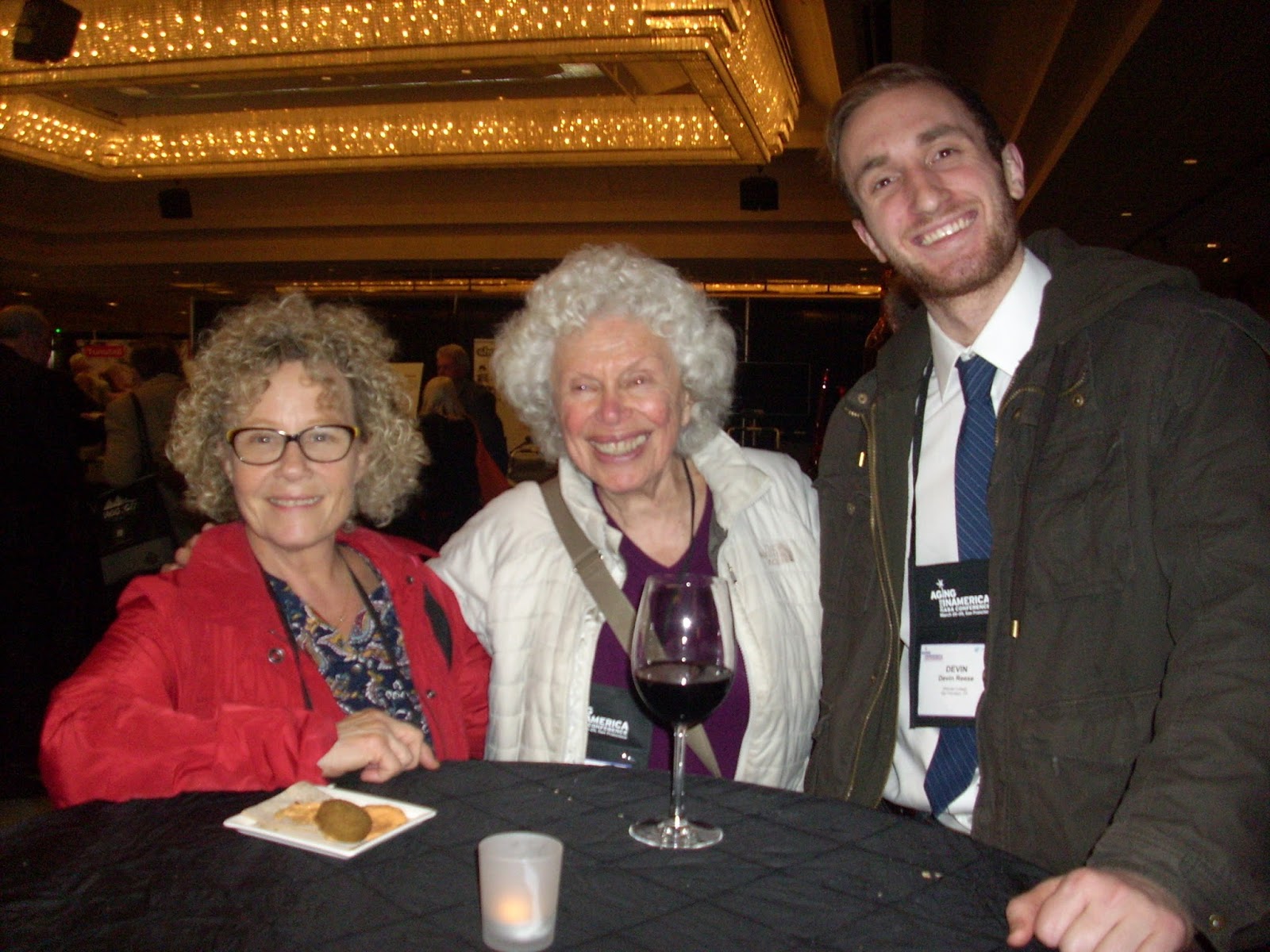
SFSU Gerontology alumna Ann Colichidas of Vitality for Life, Sheila and Watson Fellow/filmmaker Devin Reese 
Victor (holding poster, Culturally Adaptive Digital Avatars for Psychosocial and Self-Management Support of High-Risk Elders) and Brittany Wang of Gerijoy with classmate Maggie outside Hilton Union Square.  
SF Senior Center Director Sue Horst and Program Coordinator Crystal Booth; 30th Street Senior Center Director Valorie Villela (presented on Bullying Elimination Training Program for Staff and Older Adults); and Senior Center without Walls Director Amber Carroll (presented on Without Walls: Programming Over the Phone for Older Adults and Increasing Connection, One Call at a Time).
SFSU classmates Mary and Diane with UCB MSW alum Darrick Lam, CEO of ACC Senior Services (and former ACL Program Specialist who supervised my SFSU Gerontology internship) at SF Senior Center reception for UC Berkeley School of Social Welfare celebration of its 50th Anniversary of MSW Aging Services and upcoming retirement of Professor Andrew Scharlach.   
Family Caregiver Alliance Executive Director Kathy Kelly and ASA Chair Bob Blancato at 10th Anniversary of Rosalinde Gilbert Innovations in Alzheimer’s Disease Caregiving Legacy Awards reception at Parc 55. 
SFSU Gerontology classmates Mary, Brittany, Lois and Diane at Aging 2.0 reception at Rex Hotel.


Women’s History Month: "Nevertheless, She Persisted"
At age 96, Betty Reid Soskin is the oldest U.S. Park Ranger.  As field representative for California State Assemblywomen, she was actively involved in planning for Rosie the Riveter/WWII Home Front National Historical Park, focusing on the contributions of women to the War effort.  Earlier this month, she was at the SF Main Library to discuss her new book, Sign My Name To Freedom: A Memoir of a Pioneering Life (2018), based on selections from her blog, Cbreaux:

I've suspected for a long time that much of the interest in my work tends to lie in the fact that I'm such a late bloomer.  Though I cannot say that I didn't work -- I'd been a stay-at-home mom for the first half only but after having helped to start our little family business in Berkeley until motherhood took over my life.  Didn't have my first significant formal job until I was almost fifty, and have been working ever since.  That the National Park Service hired me as a permanent park ranger at 85 continues to bring smiles to the faces of the elders who stop in, especially when I playfully suggest that they keep their resumes updated, "you never know when the call will come!"