Showing posts with label Kung Pao Kosher Comedy. Show all posts

Monday, December 31, 2018

Slow space

In the heartwarming documentary, Won’t You Be My Neighbor?, we learn that young Mister Fred McFeely Rogers (1928-2003) was sometimes “quarantined in bed” due to childhood diseases, including asthma and scarlet fever.  While homebound, he created his own make-believe neighborhood – the foundation for his fearless public TV show, Mister Rogers’ Neighborhood (1968-2001), an alternative to the prevailing slapstick cartoons and his form of evangelism ("love your neighbor as yourself") after he trained and ordained as a Presbyterian minister.  We also learn about Mister Rogers’ quiet power of “slow space”—the value of silence for reflection and “time to explore the deeper levels of who we are, and who we can become.” 

“…the space and time to be liked exactly as you are feels like the most precious gift imaginable. The tranquil rhythms of Won’t You Be My Neighbor? remind us how simple the job of being a good friend, a good parent, or a good citizen can be: You offer up your heart, your patience, and your silence, and make some room for whatever your neighbor might bring.” –- Heather Havrilesky, “Why Did We Ever Leave Mister Rogers’ Neighborhood?New York Magazine (May 28, 2018) 

When older adults reside in age-segregated facilities, their world of connections can get smaller… especially as peers die.  It’s hard for residents to share slow space with staff who are too busy checking off their daily tasks.  Moving into assisted living/skilled nursing facilities really means joining a disability community, as one 80-year-old resident told me that she felt she had “aged ten years” because she was surrounded by so many residents with multiple impairments, navigating the traffic jams of walkers/wheelchairs and especially discouraged by a resident she befriended only to miss her due to her friend’s frequent hospital stays.  Residents also complain that their children are “too selfish, self-absorbed, and busy with their own lives” to contact them.  Isolation and loneliness can compound due to stigma of ageism and ableism, as I have encountered people outside of facilities who “do not wish to go there” when I extend invitations to visit facilities.
I’ve been indulging in slow space …in life review with older adults, while incorporating Mister Rogers’ kindness, openness ("feelings are mention-able and manage-able") and unconditional positive regard (“Those who try to make you feel less than you are is the greatest evil” and “No person in the whole world is just like you, and I like you just the way you are”) … much needed, given longer and more complex lives.  I also love the company of fellow introverts and models of civility and humility, PBS TV personality Fred Rogers and Supreme Court Justice Ruth Bader Ginsburg, who are subjects of my two favorite films this year, Won’t You Be My Neighbor? (95 minutes) and RBG (98 minutes, plus DVD extras).  I admire RBG's gender equality advocacy and Olmstead decision; wish her complete recovery from lung surgery, as 85-year-old RBG expects to serve at least 5 more years on the Supreme Court!

Last month, I managed to be a shut-in for a week to avoid outside air pollution from the deadly Camp Fire (160 miles northwest of San Francisco).  Even after the rains washed out the smokey air, my allergies were severe enough that one facility resident told me that my sniffling made her “nervous” and then suggested that I get a nose operation, like she did, to clear my nasal passages.  Like Rudolph the Red-Nosed Reindeer, I did not get a nose job! Instead, I ended up taking antihistamines (children’s dosage) for the first time in my life …

One side effect of taking antihistamines is drowsiness, which is safer experienced as a shut-in, especially avoiding traffic during winter holiday season.  Also perfect for winter with longer periods of darkness, I welcomed slowing down and sleep, particularly sleeping on the side, which may be necessary to clean the brain of toxins.  Researchers are studying the theory that sleep is necessary to clean the brain of toxins, as this failure may lead to build-up of damaged proteins in the brain that are associated with loss of brain cells in conditions such as Alzheimer’s and Parkinson’s diseases.  
Anyway, as a sleepy shut-in, I stayed wide awake watching Miri Navasky’s Frontline documentary, Living Old: The Modern Realities of Aging in America (2006), featuring the old-old (age 85+), our fastest growing segment of the population, who often have chronic conditions that require long-term care—60% of people who live past 85 will go into a nursing home, and if they stay past 6 months, they may never leave.  Documentary was made 12 years ago, but relevant take-aways:
·     “When you're young, you want to live forever, ...but many people don't want to live forever when they're old,” said William Coch, MD, family practitioner in a rural New York community with a large older adult population.
·    Someone with three or more daughters or daughters-in-law has a better-than-even chance of not ending up in a nursing home or institution,” according to Leon Kass, MD, Chair of President’s Council on Bioethics which issued the landmark report, Taking Care: Ethical Caregiving in Our Aging Society (September 2005). 
·     David Muller, MD, co-founder of Mount Sinai’s Visiting Doctors, made a house call to retired physician Henry Janowitz, a widower with two daughters who live too far away to be involved in his daily care, so he spends $150,000 a year (over $187,000 adjusted for inflation in 2018) for 24-hour help to remain at home! (Incidentally, as Chief of Gastroenterology at Mount Sinai, Dr. Janowitz trained over 100 gastroenterologists, so he was able to boast that he could get sick in any major town in the U.S., as long as it is a digestive problem, and be treated by one of his students!) 

To age in place when you require long-term care, you need social capital (ready, willing and able family members nearby) and/or financial capital (to pay the cost of care). Then when you move to assisted living or skilled nursing facility, it still pays to have social capital for monitoring care (get chummy with your local long-term care ombudsman!) and providing companionship. 
Filmmaker Miri Navasky dedicated the documentary to her grandmother, Estelle Strongin (1911-2006), who was featured as a 94-year-old stockbroker, working every day until she died of heart failure three months after filming.  May her memory be a blessing.
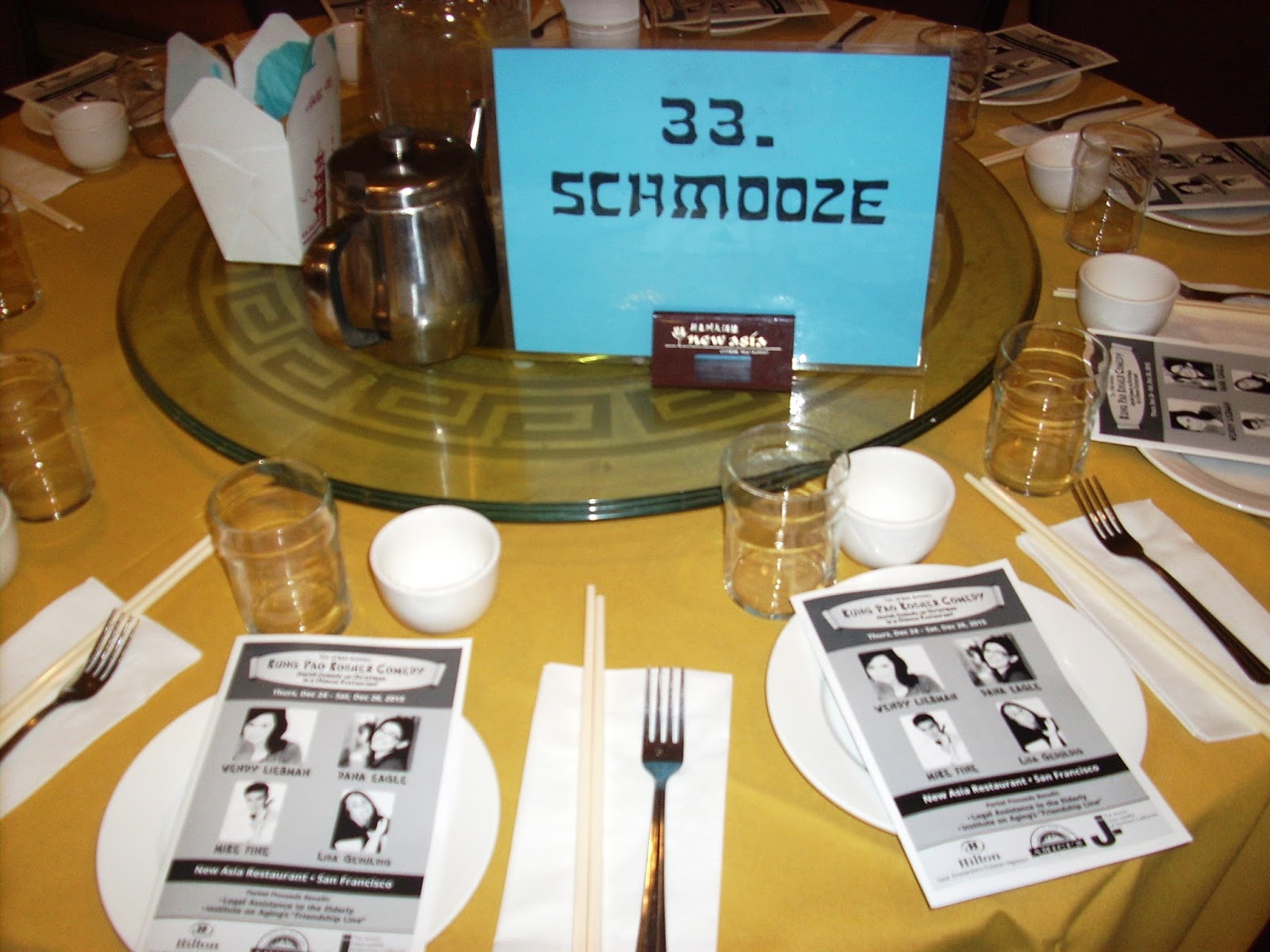
On a cheerier note, I volunteered at the 26th annual Kung Pao Kosher Comedy (KPKC), which sold-out all 6 shows (370 seats each) during its 3-night run at New Asia Restaurant.  (Mixed feelings about City of San Francisco’s plan to convert Chinatown’s largest banquet hall into affordable housing.)  KPKC founder Lisa Geduldig and Volunteer Coordinator Dana Miller started the show with raffle drawings.  
Set American-Chinese menu featured 6 courses (on rectangular table for volunteers v. round tables for ticketed guests): Lisa G’s Intergalactically-Famous Kosher (blessed by very reform rabbi) Walnut Prawns, Kung Pao Chicken, Grandma Lillie’s Braised Tofu and Broccoli in Garlic Sauce, Mixed Vegetable Chow Mein a la Boca Raton, Barbra Streisand’s Famous Green Beans in Hoisin Sauce, Arline Geduldig’s World-Renowned Sweet & Sour Rock Cod Filet) plus Steamed White Rice and Fortune Cookies with Yiddish proverbs.  Volunteering at KPKC has been my tradition since 2015 when Legal Assistance to the Elderly was a beneficiary, as ticket sales cover Charity + Chinese Food + Comedy!
Lisa talked about starting KPKC at age 31 with a sold-out dinner show at 6 pm, next year she added cocktail show at 9:30 pm, but now shows start an hour earlier so the late show is now 8:30 pm.  Noticed Lisa’s trademark gray streak of hair framing her face now blends in with the rest of her graying hair, so not sure about status of her film project, Is That Natural or Did You Dye It?  Seque into Lisa’s more amusing observations about the aging experience:
·     forgetting so she has breadcrumbs all over her home to help find her way
·     finding herself eligible for senior discounts when she turned age 55, though Ross Dress for Less prematurely applied 10% senior discount when she was only 54.5 years old
·     thinking it was Take Your Daughter to Work Day when she went in for a medical procedure to see someone who could be her daughter treating her
·     finally pot is legal, but instead of getting high, she uses it to treat back pain (according to The New York Times’ Older Americans are flocking to medical marijuana, 33 states and the District of Columbia have legalized medical marijuana, along with 10 states that also have legalized recreational use)
Lisa’s 33-minute documentary, Esther and Me (2010), about her friendship with octogenerian Esther Weintraub, former model and stand-up/sit-down comic resident at Jewish Home of San Francisco, is now available for viewing online at http://www.cultureunplugged.com/storyteller/Lisa_Geduldig#/myFilms
Joseph Nguyen was born to a Vietnamese father and a Jewish mother who set-up a one-stop shop where they filed nails and taxes! He wondered why people are proud just because they are born with a race or place—“like, instead of being proud to be Korean, it would be more impressive born a turtle and then you become Korean.”
When Carol Leifer took the stage, she announced her age 62 to applause.  She compared her old-timey name like Carol to today’s popular names like Hannah, Zelda and Sophie—“sounding like an entry list to Ellis Island all over.”  Then she told how she got into trouble with another old-timey name like Richard, which is nicknamed “Dick,” but someone accused her of calling him “a dick.”  She thought WikiLeaks was the name of a new pad.  Carol does not workout because her philosophy is no pain, no pain. 
Carol is author of When You Lie About Your Age, the Terrorists Win (2010), which is best read in her Long Island accent.  The title of her book comes from realizing that lying about her age was a no-go if she couldn’t share her greatest memory to date happened when she saw the Beatles in a live concert at Shea Stadium in the summer of 1966; invariably, people would ask, “How old are you?”  In “Shea Stadium and Its Effect on the Aging Process,” Carol reasoned, “when you deny your age, you deny yourself … be who you are—memories and all.”  She gloats over the realization that aging is the great equalizer (or “old age is the revenge of the ugly ones”), so pretty girls who relied on their looks are “seriously having a hard time now… When you don’t turn heads anymore and yours still just bobbles? Kinda sucks, when you made sure to hit all those beauty appointments, but never once stopped at a library. Geez, having a conversation is hard!”
Well, I never relied on my looks and libraries are my favorite hangout! I love the San Francisco Main Library's current exhibit, Visual Poetry: A Lyrical Twist.  While I missed the opening event last month while homebound, SF Public Library recorded the event, which included readings by 85-year-old poet Jack Hirschman: “One day I’m gonna give up writing and just paint! … I’m gonna give up sitting and just breathe! I’m gonna give up breathing and just die! I’m gonna give up dying and just love! I’m gonna give up loving and just write!"  

Saturday, December 31, 2016

Freedom

Since George Michael's death at age 53 this past week (truly his “Last Christmas), I’ve been listening to this bootleg cassette tape of his addictive pop music when he was part of the duo Wham!  I remembered Wham! made history as the first Western pop group to perform in China in 1985, which was captured in their “Freedomvideo, as well as their “Foreign Skiesdocumentary.  Those images made me nostalgic for pre-1989 China, where I did my study abroad at Peking and Fudan universities: the lack of bourgeois vanity in make-up free faces and utilitarian Mao suits; moving qi via martial arts and bicycling; all ages occupying public places, etc.  Interestingly, I was the only Chinese participant in a mostly Jewish group (also Maoist/Marxist sympathizers) led by intellectual property expert Peter Jaszi of The American University, when I bought this copyright infringement tape (Made in China)! Growing up during the harshness of Reaganomics and the rise of homelessness, China’s socialist safety net was appealing ... if only it could exist with political freedom! 
Make It Big (just like 1980s Wham! George Michael J) hair and skirt (useful for squat toilets) … at the end of my China study abroad, I visited my mum's elderly aunt and uncle in Hong Kong

Since the outcome of last month’s election, many clients have reported anxiety, depression and stress (—but no memory loss!) over the future of disability rights and safety net programs (Social Security, Medicare, Medicaid, etc.) under Republican control of the Presidency and both houses of Congress.  I cheerfully remind clients of our San Francisco bubble: Proposition I aka Dignity Fund passed, which means increased funding for home and community based services for seniors and people with disabilities!

I thought about the wisdom of 67-year-old Carolyn Davidson, who took a part-time job at a senior center following her retirement 5 years ago after decades as a social worker supporting older adults.  When her skin cancer diagnosis and treatment last year prevented her from working, her financial resources were strained: 
“Retirement has left her on a fixed monthly income of $1,088 from Social Security, which suits her just fine. She also receives $194 in food stamps and gets help from a local food pantry operated by Catholic Charities Brooklyn and Queens, one of the eight organizations supported by The New York Times Neediest Cases Fund…
Because Ms. Davidson’s income disqualified her from receiving traditional Medicaid, she had to enroll in a reduced Medicaid plan for higher earners and has had to use her own money to pay off portions of medical bills. After paying her $663 monthly rent and more in utilities, she has only $389 remaining each month to pay for everything else and any unexpected costs.
In April, she received a hospital bill for $239. She could not afford it. The debt halted her Medicaid benefits.”
--A ‘Do It’ Kind of Woman Waits for the Strength to Get Back to Being Herself, The New York Times (December 20, 2016) 

Fortunately, as an experienced geriatric social worker, Ms. Davidson was able to secure relief from a charitable organization, allowing her Medicaid plan to resume.  She also avoided bankruptcy, though she experienced the top 3 reasons why people go bankrupt: unexpected medical expenses, reduction of income and job loss.  As Ms. Davidson told The New York Times, “There are so many things that seniors don’t know they are eligible for, it’s ridiculous.” 
As late Bob Marley, paraphrasing Matthew 16:26, sang in Zion’s Train: “Don't gain the world and lose your soul, Wisdom is better than silver and gold” (mural from Haight Central Market)

Retirement in old age is associated with freedom to live at home and to do what one wants, especially if one has deferred gratification from years in the workplace.   But at any age, lack of income limits this freedom of choice … or one needs to be very resourceful to access opportunities.

Freedom to age in place

In mostly capitalist U.S.A., income and health (or ability to carry out activities of daily living) often determine where and how one can age in place.  
With my work focused on home visits to homebound seniors, in a non-profit that limits training during work hours since focus is on production quantity, my world gets smaller like my clients... so I continually make efforts to attend training/networking events outside of work hours to learn tips and resources available to my clients and future self (as aspiring older adult).  One advantage of these meetings held in evenings/weekends is the availability of food and refreshments! 
SFSU Gerontology Class of 2014 had mini-reunion on-campus (1/3 of class pictured above with popular Professor Brian De Vries) at this month’s Gerontology Celebration honoring classmate Raenika Butler, who was inspired by the work of late African-American gerontologist George W. Davis, and works as Executive Assistant to his partner, Cathy Davis, Executive Director at Bayview-Hunters Point Multipurpose Senior Services (BHPMSS).  In June 2016, they helped realize Dr. Davis’ vision of an “Aging Campus” with the grand opening of Dr. George W. Davis Senior Center and Residence, including 121 units of low-income senior housing.  Over 4,000 applications were submitted; seniors age 62+, with income of $35,700 or less per year, pay rent at 30% of their income.  Mary Schleeter and Diane Houlton, classmates who founded Aging Plan-It, commuted from Sacramento to join us!

At Rhoda Goldman Plaza, assisted living for high-end clients (studios start at $6,027 per month), SFSU alum and elder care consultant Kira Reginato talked about her new book, Tips for Helping Your Aging Parents (without losing your mind), such as preparing a grab-and-go bag for hospital visits, assessing home for accessibility and safety, deciding when move from home is necessary (isolation, safety), kinds of senior housing, etc. Kira hosted a weekly radio talk show, Call Kira About Aging

Freedom to eat

The growing diet divide between rich and poor has been attributed to food cost, time cost, and heavy marketing of junk/fast food to low-income people.  Convenience food manufacturers have come between eaters and the kitchen, so TV dinners and microwaveable meals replace home cooking.  In “The Symbiotic Relationship Between Oral Health, Nutrition, and Aging,” published in ASA’s Generations Fall 2016 issue, Ronni Chernoff wrote about the role of on-demand meal services in promoting food security, from Meals on Wheels to food delivery apps. 
At Home With Growing Older’s forum on Food on the Table–Aging in Place featured Chief Government Affairs Officer Anne Quaintance of high touch, non-profit (one of the highest ranked charities in the Bay Area, according to Charity Navigator) Meals on Wheels San Francisco (MOWSF), and Marketing Manager Clare O’Brien of high tech, for-profit UberEATS.  
The presentations and ensuing discussions were a real commentary on our growing digital divide (UberEATS users who have smart phones to use app v. some MOWSF clients who don’t even have phones) and income inequality (UberEATS users can afford minimum $4.99 delivery charge v. some MOWSF clients can’t afford suggested contribution of $5 daily for 2 subsidized home-delivered meals).  
While Uber has partnered with healthcare providers to enable Americans (or 70% of Americans age 65+) without smartphones to access ride hailing services, this is not yet an option at UberEATS.  Audience also raised concerns about Uber’s contribution to traffic congestion (no less its controversial driverless cars running red lights) in San Francisco. Last year, Uber partnered with AARP's Life Reimagined to recruit older drivers with safer driving records, yet only 23% of Uber drivers are age 50+.
Anne emphasized that MOW delivers more than a meal (“nourishing the whole person”) – relationships that support a client’s ability to live safely at home.  MOWSF actually knows their 3,600+ clients (who are subject to social work and nutrition assessments): 92% are age 60+ and 75% live below poverty. (For more about food justice, check out blog post about my participation in Oxfam’s Hunger Banquet moderated by Anne.)  In contrast, UberEATS is transaction-based, eat anything you can have restaurant made-to-order, so it doesn’t collect data on users (nice for folks who value their privacy), but relies on third-party research firm to estimate 6% of UberEATS users are age 65+.  
Anne with MOWSF Social Work Supervisor Lara Medvedeva and Department of Aging & Adult Services (DAAS) Nutritionist Linda Lau.  MOWSF provides 85% of the home-delivered meals funded by DAAS!

Freedom to dodge Xmas


During Christmastime, articles galore are published about lonely seniors during this holiday season.  This year, National Association of Area Agencies on Aging (n4a) and AARP partnered on a campaign, "Home for the Holidays," to raise awareness about loneliness among the elderly during the holiday season, combating stigma while providing tips and resources to stay connected and engaged.  Age UK has a similar campaign, “No one should have no one at Christmas,” providing befriending services with volunteers who visit or make calls to seniors feeling lonely.

Given the wonderful diversity of San Francisco’s senior population, some of my homebound clients don’t seem affected by more loneliness during this particular holiday season, especially those who don’t buy into this commercial pagan holiday, but find it particularly alienating like Puritans who banned Xmas in the New World.  And I have other clients with profound forgetfulness such that they always seem oblivious to time and thus have no expectation/pressure of imposed merriment, gluttony, gift exchanges, etc. 

In past years, I would escape the commercial holiday season by flying to a developing country too poor for mass consumerism.  Then starting last year, I volunteered at Kung Pao Kosher Comedy, 3 nights of Jewish stand-up comedy in an American-Chinese restaurant with proceeds benefiting non-profit organizations, such as Legal Assistance to the Elderly (last year) and JFCS Seniors at Home (this year). 
Comedian Lisa Geduldig produced and hosted the 24th Annual Kung Pao Kosher Comedy.
Lisa and Volunteer Macher Shani Heckman on stage for raffle drawing before full house of all ages and mostly Jewish at Chinese restaurant... almost felt like my China study abroad experience J! All 3 nights, both 7-course banquet dinner & dim sum cocktail shows, completely sold out!  This year’s comedians included aging and grandma jokes by headliner Elayne Boosler, Eddie Sarfaty (writer of video short, Second Guessing Grandma) and Alex Edelman.
Sunie Levin, author of Make New Friends...Live Longer: A Guide for Seniors (2010), said Seniors need chutzpah: "Yes, I can. Why not? What's to lose by trying?" 

25th Annual Kung Pao Kosher Comedy scheduled Dec. 23-25, 2017!


To my homebound clients unable to attend Kung Pao Kosher Comedy, I recommend ordering take-out from Chinese restaurants that offer free delivery—cut out the middle guy (UberEATS) and tip the restaurant driver, instead! Then, sing-along to Darlene Love’s “Christmastime for the Jews” (named one of the greatest rock & roll Christmas songs by Rolling Stone).  Other suggestions: Wham! playlist and Woody Allen DVDs from SFPL Books by Mail.  

Thursday, December 31, 2015

Alone

"We're born alone, we live alone, we die alone.  Only through love and friendship can we create the illusion for the moment that we're not alone." – Orson Welles

At birth, we’re alone in the sense of separation from our mother’s womb and if we don’t have a conjoined twin.

Living with three generations under one roof while growing up, I didn’t live alone except inside my head; in fact, the only time I had privacy was when I was using the bathroom.  When I went off to college, I was thrilled to be alone in a room of my own (single occupancy) as I fancied myself a writer.

“…a woman must have money and a room of her own if she is to write …”
– Virginia Woolf, A Room of One’s Own (1929)

A Place of Her Own
At SOMArts Cultural Center, A Place of Her Own exhibition entertained the questions, If you had a place of your own, what would it be? Where do you think you come from? Who do you think you are? Where do you need to go? Who do you want to become? How are you going to get there?” The artists, all women ranging from 21 to 89 years old, personally answered these questions, embracing a place of one’s own as a safe space to freely express an evolving self and develop creativity, a state of mind or physical place, alone or return to community.

I missed the exhibit’s opening night last month when I was at GSA meeting, missed its closing celebration due to working late, but then I had the pleasure of being alone in the gallery space on its last night!
Marlene Iyemura’s Circle of Togetherness: “not a physical space.  Instead, it is a transcendental state that encourages self-awareness, critical thought and heartfelt processing … an endless series of enso paintings brought about through meditation… one that fulfills all my needs,…spiritual, physical, or emotional.” 
Natalie Sacramento’s Three Mirrors of Self-Awakening:  “I’d awaken from restful sleep to a place where I accept myself, take action, and heal.  Self-Acceptance mirror pours gold energy on the present.  Self-Prescribed mirror reflects my aspirations and potential.  Self-Healing mirror is where I see my resiliency.” 
Hediana Utarti’s Tree of Life:  “place where humanity is cherished and peace is possible … banyan tree…refuge…” 


Maggie Yee's Studio Euphoria: “place where I can be alone and where creativity does not compete with everyday responsibilities."
Workstation #1: Beliefs Which Hold Me Back, Which Carry Me Forward! Curator Cynthia Tom said about Peeling the Layers: "In order to understand and embrace what is important in your life, you must first figure out what is holding you back and what isn't working."  
Reiko Fujii’s Curating Joy: “where I feel at home with myself, surrounded by the inspirational activities and connections with others that contribute to cultivating happiness, confidence, and inner strength.”
Nancy Arvold’s Knitting Together Community: “landscape with people playing and working together… Creating community requires patience, work, and intertwining individual threads together to make a resilient, beautiful whole.” 
Susan Almazol’s Saying Yes: “where I say yes to the Predictable markers of old age and to the Possible transformation still within reach … transformed walkers playfully depict what’s Possible within the Predictable.” 
Irene Wibawa’s The Cave: “represents essential elements of what I want … structure offers me privacy and protection, reminding me that I am safe to be myself without fear of judgment … wool lining offers me comfort while also reminding me to be soft and kind to myself ….entrance…reminds me that this Place is unapologetic and purposely mine.”
Workstation #3 Aspirations that Carry Me Forward: Declare What You Want!

“Elder orphans”

Much has been written about the “problem of elder orphans” among the baby boom generation, who were one of the first to elect not to have children and now find themselves alone with no one to help care for them when they need it:
  • About one-third of Americans 45 to 63 years of age are single, a 50% increase since 1980, and in a position to become orphans as they age
  • 1 in 5 single baby boomers is living in poverty 
  • Nearly one-quarter of Americans 65 and older, childless and single, could become "elder orphans" with no family social network of friends to provide care to them.
  • In the absence of informal caregiving support, there are not enough nursing homes and facilities to care for the growing number of seniors who are on their own.
Can this “problem of elder orphans” be averted by having children as potential sources of unpaid caregivers? In “The Future of Elder Orphans,” researchers Amy Ziettlow and Naomi Cahn found that few parents, who were cared for by their children, do in fact die alone. 

Maria Torroella Carney, MD, chief of geriatric and palliative medicine at North Shore-LIJ Health System in New York, suggested that elder orphans are a “vulnerable population that’s likely to increase, and we need to determine what community, social services, emergency response and educational resources can help them.” Indeed, one solution is creating age-friendly communities with options like virtual villagesshared housing, and cohabitation.

Aging alone:  Gender vulnerability

More people are aging alone because of demographic (longevity revolution), financial (social security) and personal (quirkyalone is still alone, more older couples divorcing mostly initiated by women) reasons. 

Eric Klinenberg’s Going Solo:The Extraordinary Rise and Surprising Appeal of Living Alone (2012) has a chapter, “Aging Alone,” providing the following statistics:
  • In 1950, only 1 in 10 Americans over age 65 lived alone; today, about 1 in 3 do.
  • A century ago, nearly 70% of elderly American widows lived with a child; today, only 20% do.
  • Majority of single elderly prefer living alone over moving in with children or a nursing home.
  • Only 2% of elderly widows and 20% of elderly widowers remarry.  Women who live alone are less likely to experience mental health problems and diminished vitality than their married peers.
  • According to American Time Use Survey, between 2003 and 2006, the typical single elderly spent an average of 10 hours a day alone.
Klinenberg notes that in our "cult of the individual," baby boomers have made their ability to live alone as a way to maintain independence, which they associate with dignity.  Living alone does not necessarily lead to loneliness and isolation; in fact, most solo dwellers are engaged in social and civic life. 

According to Klinenberg, aging alone is not a social problem except in the event of a disaster.  In his study of the 1995 Chicago heat wave, Klinenberg found that hundreds of people living alone died alone, not just due to the heat but they were without a support network to provide emergency assistance.  Most victims were elderly poor who could not afford air conditioning and did not open windows and doors at night to sleep outside for fear of crime.  In particular, Klinenberg found that elderly men who lived alone were twice as likely as elderly women to die alone in a disaster, presumably due to women’s stronger social relationships

No one dies alone
Earlier this month I attended the premiere of The Letters:The Untold Story of Mother Teresa, which recounted her missionary work including founding a hospice for the poor in the abandoned Hindu temple to goddess Kali in Kalighat Kolkata.  Mother Teresa said, “No one should die alone.  Each human should die with the sight of a loving face.”  
Panel of Sages and Spiritual Care Partners discussed Kol Haneshema: Lessons Learned from Jewish Hospice Care at last month’s Embracing the Journey at Jewish Community Center of San Francisco.  Kol Haneshema program, based on the belief that no one should die alone, matches trained volunteers with an older person.  One sage from the Jewish Home shared the saying of late Rabbi Alvin Fine of Temple Emanu-El:  “Birth is a beginning and death a destination; But life is a journey.”

Not alone
 
Had a very merry time at Kung Pao Kosher Comedy—my 1st time attending because I wanted to support Legal Assistance to the Elderly, which was highly deserving beneficiary this year! 2 shows daily over 3 nights, with over 2,000 attending December 24 to 26.  


Kung pao (part of 7-course dinner) & veggie dim sum (cocktail)


Comedy producer Lisa Geduldig also produced the award-winning documentary, Esther & Me (2010) about her friendship with Esther Weintraub, an octogenarian resident at the Jewish Home in San Francisco, and founded the Jewish Home's Esther Weintraub Comedy Clinic.  Lisa is working on an “upcoming quirky documentary about everyday people (and some celebs) with a gray streak in their hair,” Is That Natural or Did You Dye It? (Lisa combed her gray streak to the right side of her head so it doesn’t show in photo above.) 
Comedian Wendy Liebman said she thought she would be an old maid at age 42, but then married so with husband and two stepsons, she is now the maid! Show also included comedians Mike Fine and Dana Eagle 
Guests received fortune cookies, with Yiddish messages like “A goat may have a beard, but that doesn’t make it a rabbi” and “Guests, like fish, begin to smell after a few days.”