Saturday, October 26, 2013

Coming out: disability awareness

Nearly 1 in 5 Americans has a disability, the nation’s largest minority.  Fewer than 15% are born with their disabilities; if you live long enough, you’re likely to acquire a disability. 

The U.S. has a long history of discrimination against persons with disabilities, keeping them out of public view via institutionalization.  As a result, most Americans may have learned about disabilities through popular media’s distorted images.  For example, disability portrayals feature younger persons more often than older adults, who actually represent the largest group of persons with disabilities.  Instead of perpetuating ableism and ageism, it’s time to learn from the experts—actual persons with disabilities!

Superfest: The Dissies

“Whether films take us somewhere far away outside or deep down inside, they involve an intimate dance between projection and reflection, a giant flickering mirror, not just back to us, but to the society and culture we live in.  They shape how we see ourselves individually and collectively, how others see us, and how we see others.  This is why movies matter, why they occupy a key intersection where entertainment, psychology, and social justice meet.” – Why the Dissies, by Catherine Kudlick, SFSU Professor of History and Director of Paul K. Longmore Institute on Disability 
SFSU’s Paul K. Longmore Institute on Disability  and SF LightHouse for the Blind and Visually Impaired provided an empowering opportunity to critique disability portrayals in their joint presentation of Superfest International Disability Film Festival to a full house at the Women’s Building in the Mission District. This event was fully accessible beginning with the program brochure, which was prepared in both large print and Braille.  The program included ASL interpreter on stage with closed-captioning (for hearing challenged), audio description of video clips (for visually impaired), and ample space for wheelchairs/walkers/canes.
Culture! Disability!Talent! passed Superfest Torch to Bryan Bashin of SF Lighthouse for the Blind and Catherine Kudlick of the Paul K. Longmore Institute on Disability. 
Superfest Committee member Emily Smith Beitiks (Longmore Institute) and Judge Todd Higgins (SFSU’s Disability Programs and Resource Center) mingled with guests, enjoying drinks + popcorn before show began.
Being volunteer usher was an awesome experience for a behind-the-scenes look at putting together a fully accessible event for persons of all abilities! “Bossy” Corbett O’Toole showed me the best seats for the hearing impaired to be close to ASL interpreter, center aisle for those in wheelchairs, back seats for guests with service dogs, etc.
This year’s Superfest featured The Dissies, a one-night retrospective of the “worst of the worst” film clips portraying cringe-inducing disability stereotypes in mainstream movies.  The audience, or experts, then voted by sound ("howl, heckle and hoot") and movement (“have a seizure”).  After a panel of three judges declared the winners, Vannas presented Tiny Tim statuettes to leaders from the disability community who took the stage to deliver fake acceptance speeches.
Master of Ceremonies Lawrence Carter-Long, founder of disTHIS! Film Series (and in his second week as a furloughed federal government employee at the National Council on Disability), watched 230 films to whittle down to 22 contestants.  Based on expert opinion, the winners were (drum roll . . .):  
Worst Portrayal of a Disability by a Non-disabled Actor awarded to Gene Hackman as a blind hermit in Young Frankenstein (1974) for cluelessly ladling soup on his guest's lap and then shattering a wine mug while toasting.  Hey, what happened to a blind person compensating with an acute sense of hearing?! asked Carter-Long. UC Berkeley English Professor Georgina Kleege accepted the award on behalf of Hackman for his representation with such effect that no one would want to come to a blind person’s home for soup.

So Sweet (that They’re Not) honor went to Shirley Temple in Heidi (1937) for urging Clara to walk without crutches “if only you try hard enough.”  This category was a tough call as contenders—other nominees were Mary of The Secret Garden (1987) and Pollyanna (1960)—featured almost indistinguishable "cute, little white girls" helping “pathetic” disabled. 
The Most Amazing Miracle award went to paralyzed Allan Mann of Monkey Shines (1988).  This was another close call with Forrest Gump (1994) for Run, Forrest, Run! scene when Forrest’s leg braces fall off as he sprints like an Olympic track and field athlete away from the bullies. Scientist Joshua Miele put on eyeglasses to get in character for his hilarious acceptance speech, noting that he was “drinking beer earlier and the fact that he didn’t miss his mouth one time was amazing. . . you people are so inspirational” and then thanking the “differently crippled, or whatever.”
The Most Tragic win was Million Dollar Baby (2004 Academy Award Best Picture) for its "better dead than disabled" scene of the former boxer, depressed over her sudden quadriplegic state, asking her coach (played by Clint Eastwood) to put her down like her family’s old dog instead of fighting to change her situation and environment.  Big audience applause when award acceptor Victor Pineda noted that the film’s protagonist would have been better off without Eastwood character.

Audio Eyes (mostly spoken by blind actor Rick Boggs) deserved honorable mention for audio description of video clips.  For example, after The Most Tragic nominee Al Pacino, who played a blind and retired Army officer, in Scent of a Woman (1992), attempts suicide saying, “I got no life! I’m in the dark here!” the sarcastic audio description says he “closes his useless eyes.” 

The Worst Disabled Villain:  Peter Sellers as Dr. Strangelove (1964) who has alien hand syndrome and uses a wheelchair

Crips Gone Wild! (And Ruining Everything):  Danny in Blind Dating (2006)

Hey, only we can laugh at that!: The Ringer (2005)
I enjoyed this view of the stage from the balcony, which was mostly standing-room. After the last laugh, there seemed to be a collective cathartic release from confronting tiresome tragic/heroic stereotypes of disability.  I’m looking forward to next year’s Superfest showcasing more diverse and complex representations of disability culture—as Carter-Long told us, “No handkerchief necessary, no heroism required.”
  
Mental health disabilities

At The Dissies, Glenn Close in Fatal Attraction (1987) was nominated for Worst Portrayal of a Disability by Nondisabled Person.  At the White House Conference on Mental Health this past June, the actress came out to apologize for her portrayal of the obsessive spurned lover who boiled the bunny to death.  Portrayals of persons with mental health disabilities as having suicidal and homicidal tendencies contribute to the stigma that silences those who need support toward recovery to regain control over their lives.

This October 31 marks the 50th anniversary of the Community Mental Health Act, which helped de-institutionalize persons with mental disabilities back into the community.  Yet, the three largest mental health providers in the nation today are jails

Depression is a leading cause of disability.  Women, who tend to ruminate on sources of problems rather than solutions, are twice as prone to depression as men. Depression can cause cognitive impairment: executive function deficit, slower processing speed, psychomotor slowness, attention problems, and lower working and verbal memory.  Depression is emotional suffering, as opposed to apathy, which is loss of motivation that is typical in Alzheimer’s disease or dementia.
Depression actually declines with age, but is the most common emotional problem among older adults.  Yet many older adults are reluctant to talk about depression, seek psychological help, and tend to be noncompliant with medications.  At the SF Main Library, I attended gerontologist Hope Levy’s Brain Fitness class featuring guest speaker Charles Vella, who recommended SPEAK UP for self-care:
Schedule: sleep, eat
Pleasant activities: fun, people
Exercise
Avoid alcohol/drugs
Kind thoughts: challenge negative thinking
Unwind: relax
Practice assertiveness

In addition to self-care, Dr. Vella said that depression can be treated through medications, patient education, cognitive behavioral therapy, and relapse prevention.    

Dr. Vella also discussed suicide = permanent solution to temporary crisis:
·         Elderly make up 13% of U.S. population, but 16% of suicides
·         Most at risk for suicide are older white males; contributing factors are depression, chronic health problems, difficulty adjusting to life change, isolation
·         79% of all firearm suicides are white males age 85+ 
·         61% of gun deaths in America are suicides (50% of all U.S. households admit to having firearms, which is risk factor for completed suicide)
·         Firearms remain most common method of suicide: 46 Americans commit suicide with guns everyday.  Firearms are used in only 5% of suicide attempts, but almost always fatal.
·         Suicide completion rate for men is 4x higher than women
·         50% of completed suicides are done under influence of alcohol, which is a depressant

Suicide Prevention
SFSU hosted Suicide Prevention Regional Conference’s We All Matter: Creating a Community of Caring.  Keynote speaker was Kevin Hines, author of Cracked, Not Broken: Surviving and Thriving After a Suicide Attempt.  As a 19-year-old college student with a recent bipolar disorder diagnosis, he attempted suicide by jumping from the Golden Gate Bridge.  As a survivor, he advocates for a suicide barrier and mental health wellness.
 
In the closing keynote, clinical psychologist Wei-Chien Lee shared her Reflections, or casual sayings that can make depressed persons feel worse – reminding us that “the symptoms of our people are the symptoms of our culture.”  For example, do people really care or mean what they say, “How are you? Let’s do lunch.”  How do predominant American cultural values like rugged individualism (pull yourself up by your own bootstraps) and the exaggerated pursuit of happiness (“don’t worry, be happy” at the expense of other emotions like “smile and the world smiles at you, cry and you cry alone”) affect our well-being?  She concluded her presentation with a sincere Small Actions Count (El Llanto), similar to random acts of kindness philosophy.
Active Mind’s Send Silence Packing is a traveling art exhibit of over 1,100 backpacks that represent the number of students who die by suicide each year. 
Much of the conference and accompanying exhibit focused on suicide prevention among younger adults, but I spotted this backpack about Grandmother.  In addition to stories on some backpacks, white poster boards carried messages like:
Stigma is shame, shame causes silence, silence hurts us all
We may often suffer in silence, but we do not suffer alone
Each suicide produces as many as 100 survivors or people left to grieve

By the way, the Diagnostic and Statistical Manual of Mental Disorders (DSM-5) eliminated the two-month bereavement exclusion so now people who grieve the loss of a loved one can be diagnosed with depression, making anti-depressants more readily available. 


Nihil de nobis, sine nobis (Nothing about us, without us)

As I reflect on disability awareness month, I think about having the cultural humility to meet people where they are, instead of imposing the medical model of disability.  For example, it’s disturbing that the American Psychiatric Association (APA) attempted to pathologize introversion in its DSM-5.  Instead, let people who are the experts in their own lives define their needs; respect the individual and provide a supportive environment.  In this social model, disability is a social construction:  the problem resides in the environment that fails to accommodate people with disabilities, and in the negative attitudes of people without disabilities.  

Sunday, September 29, 2013

Mindfulness

In this age of 140-character tweets, my biggest academic adjustment over the past year has been to adopt the “SF State of Mind,” which seems to emphasize brevity, or KISS (Keep It Simple Sweetie, as one gentle professor reminded my class): course assignments were typically 2’ x 3’ posters; research papers ranging from 5 to 8 pages (like executive summaries); and oral presentations allowed only 2 to 5 minutes on average, and 10 minutes maximum.  

For an introvert like myself, who prefers gray matter – complexity versus black/white simplicity, deep discussions versus chit-chat or sound bites, I had to constantly remind myself to be less intense and think like a blogger instead. . . Now in my second (and, I hope, final) year in graduate school, I felt rewarded upon learning that my culminating experience assignment would be 30 pages! 

Outside SFSU, I use this blogspot for freely wandering and wondering -- without paying attention to length and time restrictions :-)

Senior & Disability Action: Putting the "D" in SDA! Mind your manners

SDA staff use popular education in this skit to cover what to do and what not to do in interactions with persons with disabilities.
Moderator Donna held up a STOP sign to de-brief after each scenario of Jessica (in wheelchair) and Tony (standing as her companion) when they encounter Sarah and James at a meeting.
  • Don’t treat a person in a wheelchair as though she's not able to speak for herself 
  • DO speak directly to the person in a wheelchair, on the same eye level if possible
  • Don’t assume low expectations of a person in a wheelchair by making over-the-top comments like “wow, it’s so inspiring how you actually got up and left the house to come here,” as if doing everyday activities is exceptional
  • DO remember the person is not a disability
  • Don’t be patronizing or pity a person in a wheelchair by offering to “pray so you can be a whole person”
  • DO treat all persons with respect and dignity

Aging While Black Forum
Deloris McGee and Marie Jobling of Community Living Campaign organized their second annual Aging While Black Forum at I.T. Bookman Community Center.  OMI Community Connector Deloris initiated last year’s Forum in response to her community’s request for a culturally sensitive program in the OMI community because blacks are “sicker, poorer, and have more issues to deal with when born into a pre-existing condition of racism and discrimination.” 
Highlight was hearing from Dorsey Nunn, Executive Director of Legal Services for Prisoners with Children (LSPC), who didn’t find humor in a previous speaker’s “joke" about sending seniors to prisons where they can get their basic needs met including video monitoring and guards.  Some audience members actually laughed at this "joke," which made me uncomfortable to think that the invisibility of persons in institutions like prisons and nursing homes might lead to insensitivity and ignorance about true conditions.

Formerly incarcerated as a 19-year-old, now 61-year-old Nunn said that depicting prison as a luxury vacation is like characterizing slavery as good for jobs – the reality is no freedom in prison and slavery.  He invited us to celebrate LSPC’s 35th anniversary next month with Michelle Alexander, author of The New Jim Crow: Mass Incarceration in the Age of Colorblindness, which presents evidence that more Blacks are enslaved behind bars today than were enslaved on plantations in 1850, a decade before the Civil War began and the Emancipation Proclamation was signed.

Nunn also talked about the realities of aging in prison, like a 70-year-old struggling to climb to the top of a bunk bed, defecating on himself, not being able to defend against younger prisoners who play loud hip-hop, falling inside a cell with no one to check on him, etc.  Read LSPC’s report, Dignity Denied: The Price of Imprisoning Older Women in California, by Heidi Strupp and Donna Willmott (note: same Donna as the SDA moderator above).  Consistent with the program’s theme of community building, Nunn also brought attention to the recent prisoners' hunger strike to protest solitaryconfinement.  


On Lok Lifeways Sustainable Long-Term Care: Matter Over Mind?  

Mind matters! Raised in the holistic (mind-body connection) practice of Traditional Chinese Medicine (TCM), I find the Cartesian mind-body split puzzling.  I also find puzzling the notion of emotions being either “positive” (encouraged) or “negative” (discouraged).  According to the Nei Jing (Chinese medical text), the seven emotions—joy, anger, sadness, grief, pensiveness, fear and fright—all appear in healthy individuals, and cannot be separated from the physical.  In TCM, moderation and balance are key, so emotions are acknowledged and expressed appropriately; but when an emotion is either excessive or suppressed, then this disharmony results in compromised health. 
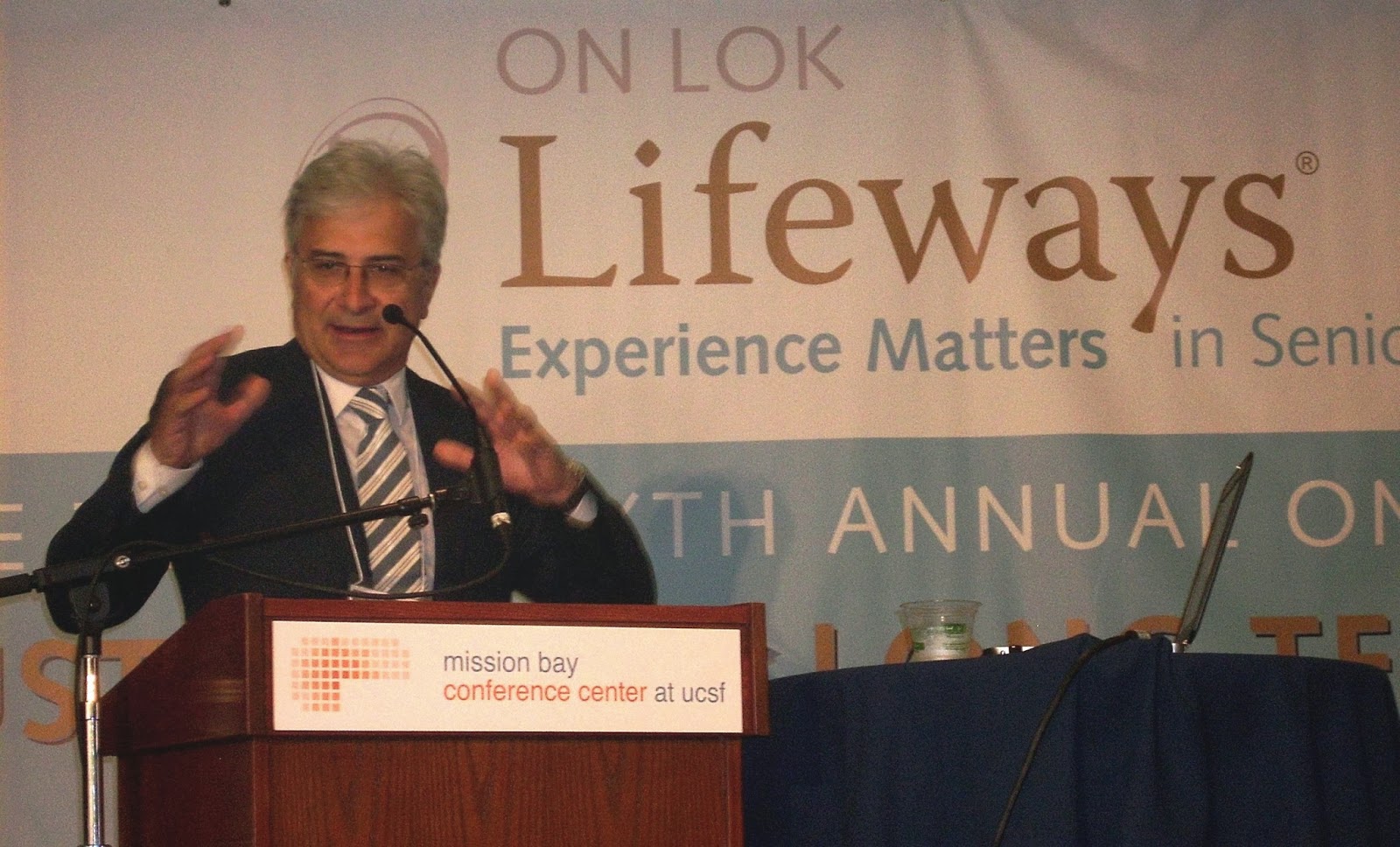
On Lok Lifeways CEO Bob Edmondson welcomes 300+ conference attendees

When I received this year's invitation to the 6th annual On Lok Sustainable Long-Term Care Conference focused on “the latest developments and innovations in meeting the mental health needs of older adults,” I was intrigued by the “Matter Over Mind?” theme, but somewhat disappointed that this emphasis on the “latest” meant there was no presenter representing the “traditional” Chinese medicine perspective.  (Nonetheless, I registered for the conference—just as I did last year because I couldn’t resist the student discount rate!) 

After all, the holistic Chinese perspective influenced On Lok to pioneer the model of coordinated care for older adults with chronic care needs in community settings, rather than institutions, in San Francisco’s Chinatown over 40 years ago.  Based on traditional Chinese “it takes a village” and preventive health services model, On Lok (which means “peaceful, happy abode” in Cantonese) provides high-quality, culturally appropriate one-stop shopping:  medical and social supportive services, like nursing and physical, occupational and recreational therapies; meals; nutritional counseling; social work; home health and personal care; prescription drugs; respite care, etc.  On Lok’s model was so cost-effective while reducing nursing home admissions for participants that it was replicated under a new name, Program of All-Inclusive Care for the Elderly (PACE), in 1987 and then made a permanently recognized provider type under the Medicare and Medicaid programs in 1997.  (In 2006, On Lok renamed its PACE program to On Lok Lifeways.)  
AgeSong CEO/Founder Nader Shabahangi's conference moderator role was rather limited to introducing presenters and fielding questions from the audience.  I thought he would be an interesting presenter himself – especially as I was interested in learning more about AgeSong’s new partnership with University Mound Ladies Home.
Pop psychiatrist Daniel Amen on Preventing Alzheimer's Disease - Former X-ray technician Dr. Amen said the important question is: how do you know what’s going on in the brain unless you look?  He uses single-photon emission computed tomography (SPECT), a form of nuclear imaging test that measures blood flow to the brain.  His belief is that the brain does not deteriorate, but behavior can accelerate or deteriorate the brain, so we have a choice how fast the brain ages and can reverse brain damage.  But often we do not care because we can’t see.  Dr. Amen said we need to start by knowing the health of our brain, as revealed by SPECT scan, and losing belly fat because “the obesity epidemic is the biggest brain drain.”  The rest of his presentation was common-sense advice to reduce risk factors (avoid anything that hurts brain, engage in regular brain-healthy habits).  Yet, Dr. Amen remains controversial due to his use of SPECT to diagnose individuals, and the lack of peer-reviewed studies of his work. 

The next two speakers provided an interesting counterpoint with their emphasis on peer-reviewed research.  Psychotherapies are about as effective as medications in reducing symptoms of clinical depression or anxiety disorders, but without meds’ side effects. 
UCSF clinical psychologist Patricia Arean, on Behavioral Interventions for Late Life Depression, Anxiety and Chronic Illness Management, talked about the evidence-based research to support psychotherapy for older adults: cognitive behavioral therapy, interpersonal therapy, and problem-solving.
On Lok Lifeways Chief Medical Officer Jay Luxenberg on Drugs and Other Therapies for Mental Illness in the Frail Elderly: What is the Evidence?
Next up was a more touchy-feely presenter, Khatera Aslami, who is President of the Board of Directors at Copeland Center for Wellness and Recovery, on Wellness and Recovery Action Plan (WRAP) and Eldercare.  WRAP is a strengths-based approach founded on the principles of hope, personal responsibility, education, self-advocacy and support.  WRAP includes wellness tools, daily maintenance, action plans for triggers/early warning signs/when things are breaking down, crisis planning and post-crisis planning.  Aslami didn’t really address eldercare, other than to briefly mention that Alzheimer’s might prevent new learning to make good decisions about lifestyle, relationships, health care, leisure, etc., and isolated older adults might find it more challenging to have at least five key supporters to call upon when needed.  But her presentation was a good WRAP review as last year I took an introductory class on this recovery model at City College of San Francisco, where I continue to take coursework in its Community Mental Health Worker program
Engineer Joseph Choi founded TheraBaby, life-sized baby dolls that serve as companions for seniors living with dementia.  His own mother, who had late-stage Alzheimer’s disease, had dramatically improved her quality of life after bonding with the first TheraBaby, which also sparked social interaction among other residents.  In July 2012, Choi launched TheraBaby as a social good project by finding sponsors to adopt TheraBaby into senior care organizations in the Bay Area and Hawaii.  At this time, TheraBaby appears with blue eyes only, though Choi says he would consider different looks as his project grows.
Brain-friendly Mediterranean lunch of salmon on bed of greens: what's good for the heart is good for the brain
Psychiatrist Roberto Mezzina on An Open Door/No Restraint System of Care for Recovery and Citizenship in Trieste, Italy, reported that Trieste was able to dramatically reduce hospitalization/institutionalization with community services to promote aging in place, even when more than 27% of the population is over age 65! 
Stanford research psychologist Philippe Goldin on Science and Practice of Mindfulness Meditation, began a meditation exercise when I excused myself to head over to my late afternoon gerontology research class at SFSU.   

I also missed the last presentation on Harnessing Neuroplasticity of the Older Brain to Enhance Cognition, by UCSF neuroscientist Adam Gazzaley.  However, I’d read about Gazzaley’s study suggesting that older adults can improve cognition by playing video games, which are fast-paced and unpredictable, adaptable in difficulty, and challenging to working memory, attention and processing speed.  Sure, this might be one of the “latest developments and innovations,” but I prefer to engage my brain from traditional social interactions in the real world rather than games in the virtual world.  The former is intrinsically rewarding, while the latter is just a means to an end—much like how I prefer getting my nutrition from traditional whole foods, rather than supplements or fortified foods.

Brain Fitness
Psychologist Charles Vella presented Aging, Dementia and Brain Health in gerontologist Hope Levy's popular Brain Fitness series at the Main Library through City College of San Francisco's Older Adults Program.  Here are Dr. Vella’s Ten Commandments for Brain Fitness:
1.     Thou shall exercise daily.
2.     Thou shall minimize risk factors for cerebrovascular disease (hypertension, hyperlipidemia, diabetes, overweight, smoking)
3.     Thou shall eat Mediterranean diet.
4.     Thou shall choose thy parents wisely.
5.     Thou shall maintain intellectual engagement throughout life.
6.     Thou shall cultivate and sustain friendships and good company.
7.     Thou shall obtain restful sleep.
8.     Thou shall enjoy only one drink of alcohol.
9.     Thou shall manage stress effectively.
10.Thou shall not text or use cell phone while driving.

Mindful Eating 
Neuropsychologist Nancy Hoffman on Food and Mood: How the Food You Eat Affects the Way You Feel, at Life Planning Network meeting, hosted by Lee Abel, at AgeSong's rooftop garden.  Hoffman based her talk on nutritionist Elizabeth Somer’s book, Food and Mood, focusing on food sources of neurotransmitters like mood-enhancing dopamine (meat, milk, eggs, fish, beans, tofu), calming serotonin (tryptophan with complex carbs), pain-killing endorphins (high protein, daily exercise) and acetycholine for memory/new learning/attention (egg yolk, wheat germ, soy, cauliflower, chicken).  It was very similar to Marin County psychotherapist Julia Ross’ The Mood Cure, which I read while studying holistic nutrition.

Moving Meditation 
I get my qi flowing during Da Yan Qi Gong class at Botanical Garden inside Golden Gate Park.

Saturday, August 31, 2013

Herstory

While age segregation holds little appeal for me, I can appreciate that aging is a women’s issue and the value of an all-women’s space so that women’s voices can be truly heard.  After all, women live longer than men and thus make up the majority of older adults.  Compared with men, older women are three times more likely to be widowed or living alone, almost twice as likely to be nursing home residents, spend more years and a larger percentage of their lifetime disabled, and are nearly twice as likely to live in poverty.  Women experience higher rates of domestic violence than men, and like women who are the majority of caregivers, women in these situations report higher levels of stress, depression, and other chronic health conditions. (http://www.aoa.gov/AoARoot/Aging_Statistics/Profile/2011/2.aspx & http://www.globalaging.org/agingwatch/cedaw/cedaw.pdf)  
As one of 20 Community Health Workers selected to participate in this month’s Women’s Health Leadership Institute (WHLI), hosted by Region IX Office on Women’s Health (OWH) of the U.S. Department of Health and Human Services, I appeared to be the only participant focused on older adults’ health.  For FY 2013, OWH priorities include enhancing access to information and health care resources that promote the safety and health of older women (aged 50+) in the areas of prevention and behavioral health, abuse in older adults or caregiving.  Check out OWH's publications on Healthy Aging and A Lifetime of Good Health. (Note: California’s Office of Women’s Health was eliminated as of July 1, 2012.)
Kay A. Strawder, JD, MSW, Regional Women's Health Coordinator, welcomes our Region IX cohort.  Our facilitators, Jenifer Metz and Sali Butler, are seated in corner.  (Photo courtesy of Carmen Ferlan, MPH, MIS)

Our training emphasized a systemic or ecological approach to public health problem-solving, addressing the root causes of health disparities, to prepare for our Community Action Project.  Instead of a superficial “blame the victim” for not taking personal responsibility—like Sheryl Sandberg’s belief that men still rule the world because women lack self-confidence so they need to “lean in”—an in-depth analysis of the problem might identify systemic factors, like institutionalized sexism, lack of access to child care and flexible work arrangements; see http://www.nytimes.com/2013/08/11/magazine/the-opt-out-generation-wants-back-in.html.

We participated in several activities to understand the context of advances in women’s rights (I was surprised to learn that “Nebraska is the first state to pass a law making it illegal for a man to rape his wife,” actually took place in my lifetime, in 1976, the U.S. bicentennial year), and to analyze women’s biographies (Dolores Huerta, Oprah Winfrey, Michelle Obama) for stones (obstacles) and shovels (leadership skills used to move obstacles).  My personal choices for inspiring public figure women biographies would be Frances Perkins (U.S. Secretary of Labor during FDR administration, died at 85 years in 1965) and Vandana Shiva (60-year-old environmentalist).
During breaks, classmates led activities like hula (Wilma from Lanai, pictured above in photo courtesy of Carmen Ferlan; note, one male Jose on far left), salsa and merengue (Arletha from Oakland), creating flowers from pipe cleaners (Monissa from Saipan), body fat measurement and aerobics (Phyllis from Santa Clara).

WHLI training took place in the Federal Building, where I bumped into former colleagues at U.S. Department of Labor.  I had been one of the few female investigators, but didn’t pay much attention to this gender imbalance because I was so busy conducting field investigations and keeping current with the ever-changing benefits law (for example, check out how the recent repeal of DOMA impacts ERISA plans).  As an ERISA geek, Labor Day weekend meant celebrating the September 2, 1974 enactment of ERISA! I also paid more attention to traveling and eating, so perhaps I had succumbed to gender neutrality disorder . . .that is, until I began full-time studies in nutrition and gerontology, which are dominated by women!  Nonetheless, where the WHLI application asked, “what cultural group do you most identify with?” I responded “permaculture” instead of “woman.”

Participating in WHLI reminded me of attending “not an all-girls school without men, but an all-women’s college without boys.”  At women’s colleges, women have all the opportunities to rule, which does wonders for building confidence, breaking barriers and making herstory! Ready to break out into Helen Reddy’s “I am Woman, hear me roar!”
 
At the right place and time:  I worked as a proofreader at the College Relations Office, which gave me easy access to interview visitors like Pulitzer Prize-winning columnist Ellen Goodman.  A women’s college graduate herself, Goodman discussed how the "values gap" based on traditional roles for men (high-powered career) and women (home, family) resulted in the Superwoman myth (women can have it all, only if they do it all by themselves) as women have had more success in getting into the male world, than in changing that world.  Here I appear as an awestruck teenager in the presence of Goodman with College Relations Director Susan Shea and College President Mary Metz.  Following her retirement in 2010, Goodman founded The Conversation Project about communicating end-of-life wishes.

I pay more attention to women's leadership.  The idea for University Mound Ladies Home (UMLH) came from Mary Staples, a philanthropist and wife of the man who helped San Francisco businessman James Lick prepare his will.  Founded in 1884, with a bequest from Lick, UMLH is a nonprofit, 74-room assisted living residence for older women.  It hosted the 6-week Healthier Living-Chronic Disease Self-Management Program, attended by residents and the public, but this month’s graduates were all women :-).  I love that UMLH has management and staff trained in gerontology! Check out this interview with SFSU gerontology instructor Pat McGinnis who talks about how quality of care is compromised in the for-profit model in assisted living at http://www.pbs.org/wgbh/pages/frontline/social-issues/life-and-death-in-assisted-living/patricia-mcginnis-get-the-for-profit-model-out-of-senior-care/.  

This year marks the 50th anniversary of the publication of The Feminine Mystique, Equal Pay Act, and March on Washington for Jobs and Freedom.  USF Diversity Scholar Visiting Professor Clarence B. Jones (pictured above) said as a 32-year-old lawyer who assisted MLK, Jr. in drafting “I Have a Dream” speech delivered at the March on August 28, 1963, he never thought he’d live to be 82 years old.  He credited Mahalia Jackson (Queen of Gospel, who was 51 years old at the time) for calling out, “Tell them about the dream, Martin!” which prompted 34-year-old MLK, Jr. to depart from reading his prepared text to describe his dreams for freedom and equality.  This dream was partly realized with the Civil Rights Act of 1964, which banned discrimination based on “race, color, religion, sex or national origin.”

Sisters Rize! video screening at Intersection for the Arts.  In August 2010, Sisters Rize! formed as a women’s group, within Central City SRO Collaborative, to create strong community bonds amongst women, learn new skills and organize actions to address problems in their neighborhoods and SROs.  Over a 12-week period, ten women used a digital flip camera to make video shorts about their lives.  
District 6 Supervisor Jane Kim (seated at left in front row) and Brenda Washington (on stage) whose “Now the Sunshine” documented her bout with cancer.  Other insightful videos were Sandy Manning's "Trying to make it in the world" (preparing breakfast in SRO), Sherrie Taylor's "Been there done that" (domestic violence), and Diane Hawkins' "Pigeons of San Francisco."  Sisters Rize! next project is to learn self-defense.  In the Tenderloin Housing Clinic’s 16 SRO hotels, men outnumber women almost four to one.  
Women lead in the aging field, like Senior & Disability Action Executive Director Jessica Lehman.    
DAAS Executive Director Anne Hinton speaks at SDA reunion in Rosa Parks Senior Center for graduates of Senior Survival School & Senior University.  SDA, DAAS and Coalition partners won a 2013 Aging Achievement Award for SRO Housing Advocacy by the National Association of Area Agencies on Aging (n4a).
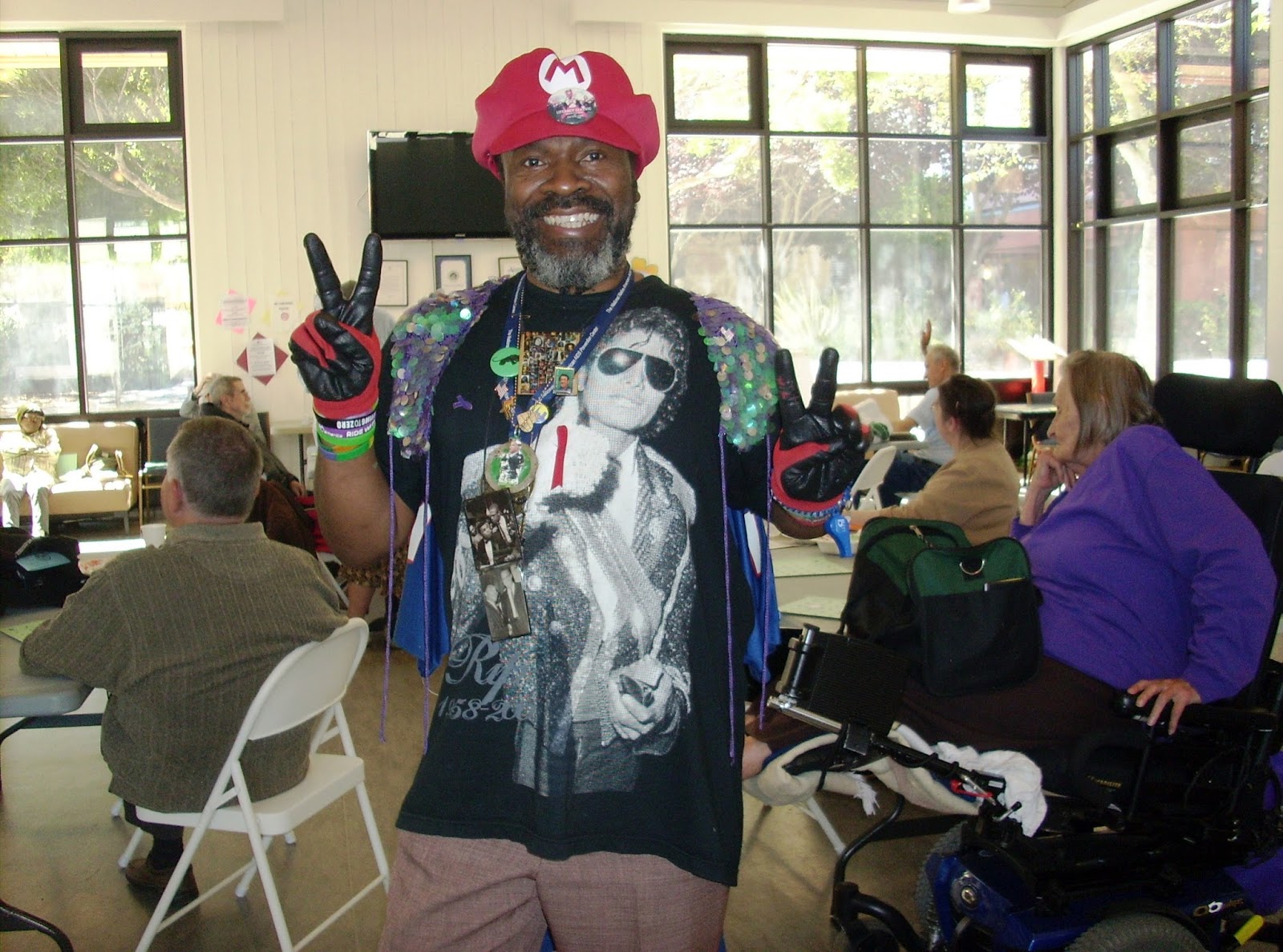
Juicye arrived at SDA reunion, announcing, “Am I Bad? It’s Michael Jackson’s 55th birthday!”    Had Jackson lived to age 55, he would be eligible for additional “senior” discounts!
Contestants from this month’s Dahlia Show