“Regarding people as having lives of equal worth means
recognizing each as having a common core of humanity. Without being open to
their humanity, it is impossible to provide good care to people…To see their
humanity, you must put yourself in their shoes. That requires a
willingness to ask people what it’s like in those shoes. It requires
curiosity about others and the world beyond…
We are in a dangerous moment because
every kind of curiosity is under attack…This is what happens when the abiding
emotions have become anger and fear. Underneath that anger and fear are often
legitimate feelings of being ignored and unheard—a sense, for many, that others
don’t care what it’s like in their shoes. So why offer curiosity to anyone
else?
Once we lose the desire to
understand—to be surprised, to listen and bear witness—we lose our humanity.
Among the most important capacities that you take with you today is your
curiosity. You must guard it, for curiosity
is the beginning of empathy. When others say that someone is evil or crazy,
or even a hero or an angel, they are usually trying to shut off curiosity.
Don’t let them. We are all capable of heroic and of evil things. No one and
nothing that you encounter in your life and career will be simply heroic or
evil. Virtue is a capacity. It can always be lost or gained. That potential is
why all of our lives are of equal worth…”
In this month’s National Resource Center for Engaging Older Adults webinar,
engAGED: Increasing Social Engagement
through Lifelong Learning, National Resource Center for Osher Lifelong
Learning Institutes (OLLI) presented OLLI members' top interest topics, in this order:
history, fine arts, current affairs, literature, religion and philosophy, and
health and wellness. With my insatiable
curiosity (like Albert Einstein, who said, “I have no special talent. I am only
passionately curious”), my idea of recreation is leisurely lifelong learning. As
I go about my existence as a lifelong learner-gerontologist, I am always
scouting for activity programming ideas to bring to older adults at their
residential community or scheduled outings.
Fine arts
Sixty Plus—OLLI at SFSU’s Theater Showcase previewed upcoming productions from local theater companies:


·
Golden Thread Productions: Founding Artistic
Director and SFSU alumna Torange Yaghiazarian introduced Melis Aker’s Field, Awakening with its main character
reuniting with friends from high school on the eve of the 2016 attempted
military coup in Turkey. Liked line,
“You get to do what you wake up for,” but trigger alert for lot of “f-ck” word
in script.

·
San Francisco Playhouse: Patron Services Manager Tiiu
Rebane sang title song from Stephen Sondheim’s Saturday in the Park with George and “Maybe this Time” from Cabaret.
She likened theater participation to an “empathy gym” to practice
compassion.
·
Bay Area Musicals: Founder and Artistic Director
Matthew McCoy discussed the role of theater to make us think, reflect and
feel. Juan Castro and Loreigna Sinclair
sang “In a Place of Miracles” and “God Help the Outcasts” from Disney’s Hunchback of Notre Dame, exploring
themes of disability, immigration, and discrimination.
(SFSU’s College of Extended Learning offers Elder College for people age 50+ who pay $55 per semester to sit in
any regular university course on a space available basis with instructor
approval. City College of San Francisco's Older Adults Program offers free, non-credit courses designed for people age 55+, which are open to all; its Free City Program recently received funding for two years to offer free summer courses.)

Outing to 42nd
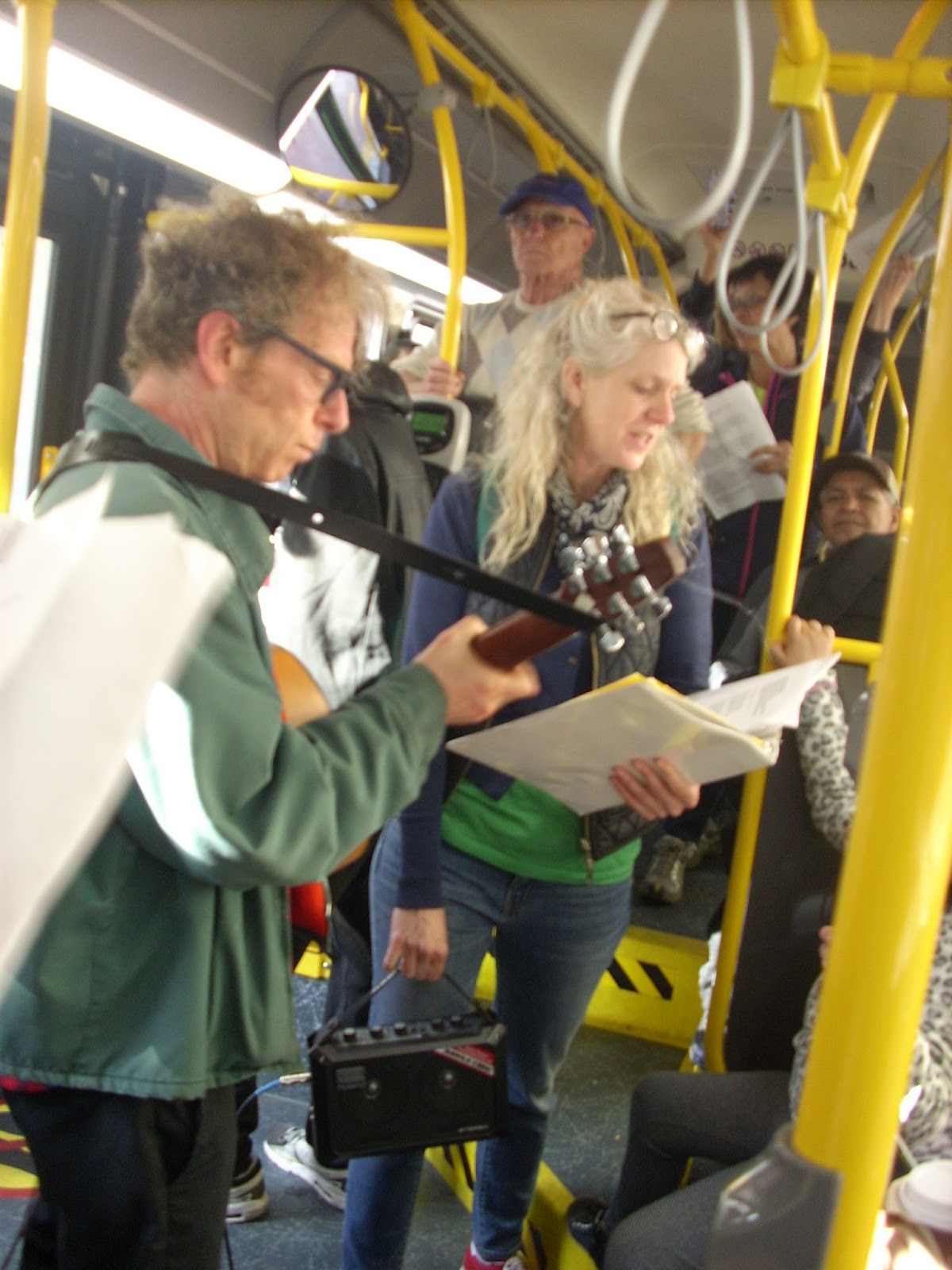
Annual SF Free Folk Festival’s Jug Band Jam,
with Christopher Richard, Miller Wise and Wayne Hagen, inviting folks of all
ages to bring their own instruments to join in on jug-band classics, with
songbooks provided.

Director/Choreographer
Bruce Bierman and Musical Director Ellen Robinson brought along Stagebridge
participants to older adult communities for live performances of A Chorus Line.

In this adaptation of A Chorus Line, Stagebridge participants
audition by introducing themselves, sharing events that shaped their lives and
decisions to become dancers. Of the ten
in this ensemble, only one was male.
History/Literature

Laura Bock, author of Red Diaper Daughter: Three Generations of Rebels and Revolutionaries (2017), and friend Sally Goldin, at this
lively book reading/discussion party. As an only child, Laura wanted to pass on her family legacy by publishing her memoir
at age 70, sharing stories of her “red” grandparents who sought to overthrow
the Russian czar before immigrating to the U.S., her anarchist/communist parents
who were labor organizers, and her own life as “red diaper daughter” carrying
the tradition of activism (as she left for college, her parents advised her,
“Now, make sure you get arrested for something political, and not just for
drunkenness!”) through the 1960s civil rights and anti-war movements, 1970s
women’s liberation and disability rights, 1980s fat and LGBT liberation,
etc. A self-described "groupie," Laura has been a model for community building and interdependence—running a bed and breakfast
business in her family home; co-founding Fat Lip Readers Theater; joining/starting
support groups for fat women, coming-out, disabled lesbian, Jewish women’s
study, hard-of-hearing, old lesbian grief and loss, break-up, etc. Red Diaper Daughter is accessible via
Bookshare for people to read with eyes, ears or fingers.
Health
& wellness
Brain fitnessJune is Alzheimer’s and Brain Awareness Month, and Jewish Community Center of SF (JCCSF) hosted its 2nd Annual Brain Fitness Forum. Some highlights:
Serggio Lanata, MD, of UCSF presented Alzheimer’s
Disease Prevention: What’s the Evidence.

Caitlin Moore, PhD, founder of California Brain Health Center, presented Lifestyle
and Brain Aging: A Multimodal Approach for Optimal Brain Health.
·
Exercise:
anything better than nothing; recommend 30 minutes moderate intensity 5x/week
(can’t sing, but can comfortably talk, during activity)
·
Diet:
Mediterranean (fruits, green veg, healthy fats—nuts, seeds, avocado, dairy and
poultry once/week, wine in moderation), DASH (more grains, few times meat,
fewer fats); best diet is one can stick to, fit into lifestyle (drink greens
“quick way to choke down,” whole fruits as dessert, healthy fats like nuts and
olive oil, whole grains, limit sugar intake, stay hydrated throughout day)
·
Sleep:
6-8 hours, but more is not better; schedule bed time and wake time; no digital
screen 30 minutes before bedtime to give brain break from stimulation; if not
sleep within 20 minutes, do something mindless; address issues that interfere
with sleep—mood/worry, frequent bathroom breaks, pain (treat perception, avoid
“PM” meds)
·
Habits:
quit smoking; control heart risk factors
·
Hearing
loss: tied to memory loss, as part of brain responsible for hearing next to hippocampus (memory), tend to isolate due to
frustration in social situations; Medicare covers hearing evaluation; wear
hearing aids
·
Stay
engaged: participate in mentally and socially stimulating activities to
maintain cognitive reserve (amount of brain damage before show symptoms,
influenced by high education/IQ/complex occupation use brain), find activities
that bring passion involving emotion/spirit—don’t do crosswords if you hate to;
challenge real life—walk dog, memoir writing, gardening, volunteering, find
purpose; avoid loneliness by being proactive like organize outings
·
Compensatory
strategies for memory and attention: minimize distractions, organize/clear
clutter; buy pillbox to avoid risk of missing medication dose; use calendar to
immediately record appointments, prioritize and check off to-do list, store
frequently used items like eyeglasses and keys in memory table; keep positive
mindset; seek help from family, friends, therapist to treat anxiety and
depressed mood
·
Subjective
memory loss: talk to PCP about concerns;
early diagnosis is opportunity to treat symptoms with medication and lifestyle
modification, decide what to do with remaining years
·
Marijuana:
causes memory problems, especially avoid after age 60

JCCSF Lifelong Learning
Programs Manager Shiva Schulz introduced
Just Do It: Exercising Your Way to Brain Health presenters Larriana
Williams, CCC-SLP from ONR, Inc. and Christine Roppo Soares, LCSW from San Francisco Campus for Jewish Living.
·
Plasticity:
brain’s ability to change in response to experience continues throughout
lifespan, remap brain circuits especially after stroke (use non-dominant to
create new pathways)
·
Enriched
environments
·
Power
naps help consolidate new information
·
Focused
concentration most important, attention equivalent to endurance
·
Multi-tasking
is myth: tasks are done sequentially, not concurrently
·
Cognitive
reserve: challenge brain to learn new
·
Puzzles
and games may improve working memory, not improve brain function
·
Aerobic
activity increases blood flow, oxygenation, neural pathways
·
Just
do it: mindful movement (meditation, prayer), breathe, engage, relax, keep
healthy brain vision statement

Meet the Author Francine
Toder signing her book The Vintage Years (2013),
with husband Joe at her side, as she chats with psychologist Beth Krackov.

Game room featured tables
with Scrabble (70 years old!), Scattergories, Taboo, and jigsaw puzzle.

about how empathy works
in the brain with the potential to save the world because empathy allows us to
get along with one another. Empathy is when you imagine what it might feel
like to be in someone else’s shoes. UCSF
researcher Virginia Sturm, PhD, called empathy “the most important thing.” UCSF neuroscientist Bruce Miller, MD, discovered
that people with frontotemporal dementia (FTD) lose their empathy, so they are
often alone and isolated. When empathy
circuit is broken, we connect less especially with people outside our group;
due to divisions, we cannot work to solve problems. In contrast, people who care about and
connect to others can unite humanity.
Our empathy circuits can be strengthened—take a deep breath, imagine why
and how the other person is feeling …

Forum concluded with a
screening of the 95-minute documentary, In Search of Memory: The Neuroscientist Eric Kandel (2009). Austrian-born American
neuroscientist Kandel’s trauma as an Austrian Jew who fled from the Nazis at age
nine contributed to his curiosity about the contradictions of human behavior
and research that won the 2000 Nobel Prize in Medicine for discovering the
central role of synapses in memory and learning.
The film also showed Passover Seder with his family discussing Nobel Prize-winning physicist Isidore Isaac Rabi: when asked why he became a scientist, he replied, “My mother made me a scientist without ever knowing it. Every other child would come back from school and be asked, ‘What did you learn today?’ But my mother used to say, ‘Izzy, did you ask a good question today?’ That made the difference. Asking good questions made me into a scientist.”
Shout out to the many awesome experts who meet older adults where they are (in their residential communities) to engage in the lively exchange of ideas and information to promote health and well-being.
 Serggio Lanata, MD, of
UCSF Memory and Aging Center, presented on Brain Health, including ways to reduce risk of Alzheimer’s
disease and related dementias:
Serggio Lanata, MD, of
UCSF Memory and Aging Center, presented on Brain Health, including ways to reduce risk of Alzheimer’s
disease and related dementias:
Hearing
 Jessie Johnson, Clinical
Practice Manager from Hearing and Speech Center, presented on Cognition and Hearing: Hearing loss, if
untreated, puts people at risk for dementia and social
isolation. Hearing aids and aural
rehabilitation are evidence-based treatment options for improving hearing
(sense) and listening (skill).
Jessie Johnson, Clinical
Practice Manager from Hearing and Speech Center, presented on Cognition and Hearing: Hearing loss, if
untreated, puts people at risk for dementia and social
isolation. Hearing aids and aural
rehabilitation are evidence-based treatment options for improving hearing
(sense) and listening (skill).


The film also showed Passover Seder with his family discussing Nobel Prize-winning physicist Isidore Isaac Rabi: when asked why he became a scientist, he replied, “My mother made me a scientist without ever knowing it. Every other child would come back from school and be asked, ‘What did you learn today?’ But my mother used to say, ‘Izzy, did you ask a good question today?’ That made the difference. Asking good questions made me into a scientist.”
Shout out to the many awesome experts who meet older adults where they are (in their residential communities) to engage in the lively exchange of ideas and information to promote health and well-being.

· Modifiable medical factors: hypertension, hyperlipidemia, type 2 diabetes, smoking, untreated depression.
· Modifiable lifestyle factors: cognitive stimulation (diversify mental activities by exposure to new/different stimuli; engage different regions of brain—e.g., occipital lobe in back of brain processes visual information, so engage it by looking at things that are stimulating like art; temporal lobes at ear level associated with memory and hearing interpretation, so music stimulates emotion and better if you can play instrument or sing); physical activity (older adults who maintain physically active lifestyles reduce their risk of serious illness by up to 50%, compared to sedentary older adults; chart shows muscle mass and strength peak at age 30, and how an active person can minimize muscle loss and remain above disability threshold into old age); nutrition (check vitamin B12 and D levels); social engagement (lessen loneliness by connecting with other people, empathy helps); and adequate sleep.
Dr. Lanata gave way more than the usual 15-minute doctor visit, ably answering questions based on his training in biological sciences, food science and nutrition, physiology, complementary and alternative medicine, and neurology.Hearing


Jessie also presented on
Assistive Listening Devices and Hearing
Related Apps (tinnitus, sound level meter, aural rehab, communication).

California Phones Outreach
Specialist Casey Kho, MSW, presented demonstration of specialized phones to
make it easier to hear, dial and call.
These phones, as well as cellphone amplifiers, are available at no cost
through California Telephone Access Program, to California residents who have
difficulty using a standard telephone.


End-of-life
(EOL) starring medical doctors
Is the brain, which stores memory, overrated? According to Dr. Kandel, “Memory is everything. Without it we are nothing.” A related view
holds that “brain death means really dead” because without brain function, the body
eventually shuts down unless there is medical intervention.
This month I attended two short Netflix documentary screenings about EOL care
focused on palliative care doctors in San Francisco Bay Area, and attended a
presentation on advance care planning by a local patient advocate MD.

JFCS’ Seniors At Home's Palliative Care Program hosted a screening of Extremis
(2016), the Oscar and Emmy-nominated short (24 minutes) documentary about end-of-life
decision making in an intensive care unit (ICU) at Highland Hospital in Oakland. Extremis
features Jessica Zitter, MD, MPH, who practices ICU and palliative care medicine,
treating patients with no hope of getting better. She told us that she got into medicine wanting
to save lives, her medical training taught her to see patients as a collection of
organs like fixing broken machines, and hospital hierarchy was like the
military lacking reflection and humanism.
As a result, the default is to prolong life, without considering quality
of that life. She discussed need to change this culture, after she learned to
be reflective, collaborative and supportive from a nurse, chaplain and social
worker in the palliative care consult team.
She said humility and courage is needed to say what will happen to
patients and families, providing realistic information including breaking bad
news compassionately and discussing option to “pass naturally” when medicine
has no cure. Dr. Zitter is also author
of Extreme
Measures: Finding a Better Path to the End of Life (2017).

Ungerleider
Palliative Care Lecture Series at California Pacific Medical Center (CPMC) hosted
a screening of End Game
(2018), a short (40 minutes) documentary film starring UCSF palliative care doctors, Steven Pantilat, MD, and BJ Miller, MD (also former Executive Director of Zen Hospice Project’s six-bed
Guest House, which recently closed). My
favorite soundbites:
“It’s healthy
people who think about how they want to die, and sick people who think about
how they want to live.” – Dr. Pantilat
“There is nothing inherently medical about dying. It’s much larger than medicine. It’s purely human.”—Dr. Miller
“There is nothing inherently medical about dying. It’s much larger than medicine. It’s purely human.”—Dr. Miller
This screening was followed by a CPMC bioethicist moderating a panel
discussion with Dr. Pantilat (Founding Director of UCSF Palliative Care), Bridget
Sumser (UCSF palliative care clinical social worker), and Shoshana Ungerleider, MD (CPMC hospice and palliative care physician who also produced End Game and funded Extremis). As Dr. Zitter discovered, there is more to medicine than performing procedures to
prolong life; palliative care is the art and science of healing that integrates
the medical and social models of care, so honest conversations can take place enabling
patients (or their proxies) to make informed decisions about their EOL care. (Check out, “Is hospice on your bucket list?”
by Kimberly Baumgarten, RN, FCN.)
In a nutshell, know what matters in
your life and communicate with your loved ones and doctor.

At North Beach Library, NEXT Village SF hosted a presentation
on Patient Advocacy, Difficult Medical
Decisions, Advance Care Planning with Jennifer Brokaw, MD.
Dr. Brokaw worked with NEXT Village co-founder Jonee Levy during her 1-1/2
year struggle with stage 4 lung cancer through Jonee’s death in her home in
February.
During nearly 15 years
of practicing emergency medicine, Dr. Brokaw noticed patients were older and
sicker yet she was asked to “do everything” because patients did not understand
the course of their disease. With Lael Duncan, MD (now Medical Director at Coalition for Compassionate Care), Dr. Brokaw started Good Medicine Consult
& Advocacy Services in 2008--“5-1/2 years ahead of time,” before Medicare
created billing code for EOL discussions.
Dr. Brokaw led an exercise to create our own advance care
plan on 3” x 5” index card.
Side 1:
·
Appoint health care agent (HCA) who
knows you, are in touch frequently with open line of communication, knows and
honors your values and beliefs, ideal if live nearby, and comfortable in
medical setting to ask difficult questions.
·
Goals: address how you want to be
until you die
·
Values: priorities
·
Beliefs: spiritual statement that
give survivors comfort
Side 2
·
Finances: assets to pay for LTC
·
Fears: what experience that you do
not want to repeat
·
Funeral: memorial, donate body to
UCSF
Next steps: You and
2 witnesses sign card. Call HCA to talk
about your wishes. Notify Primary Care
Physician: Medicare/Medicaid will pay for advance health care discussions ($170
for 1st discussion, $80 for 2nd discussion with HCA)
Other documents:
· POLST/MOLST: medical orders that specify interventions,
signed by MD; seek national registry
· Living will: not medical order,
but expresses preferences for EOL care; co-opted by attorneys, not practical,
few are actionable, “doctors get hives from attorneys”
Why the relatively low interest in health and wellness?
In my experience, it has been easier to promote health education programs
among healthy older adults in independent living than frail, older adults in
assisted living where staff take control over many of their activities of daily
living (preparing meals, managing medications, bathing, etc.). When assisted living residents tell me they’ve
had enough health education from doctors’ visits (and one centenarian resident walked
out half-way through Extremis
documentary, complaining that it was repetitive), I have to examine programming
to ensure it’s not presenting just the medical model (defining aging like a
host of diseases to be cured), but also addressing the bigger picture of non-medical
needs that matter for a meaningful life such as purpose, truth, beauty, empathy, creativity, generativity, etc.--long live the humanities in lifelong learning!