The ability to live in our
own home and community is a prerequisite to aging in place. Yet lack of affordability and accessibility
are challenges to staying in home and community as long as one can in the later
years.
Home-less
This month Flyaway Productions presented Multiple Mary and Invisible Jane, a 30-minute aerial dance performance about the struggles of older
homeless women. As part of a trilogy about urban poverty,
this work was based on local investigative journalist Rose Aguilar’s article, “Old, Female and Homeless,” published in The Nation last year. Set against an 80-foot wall of the YMCA in San Francisco

Sleeping in chairs: “You
couldn’t lie down, you had to sit up.”

Carrying your stuff: “It’s
so hard to push pride aside to tell someone I was homeless . . . but people
notice it.”

Living on the streets is
dangerous, with homeless women experiencing high rates of physical, sexual and
emotional violence. A recent UCSF study
found much of the violence on homeless and unstably housed women was inflicted
by acquaintances and strangers. In this context, researchers found that social isolation protected them from experiencing violence.

Multiple Mary (Poppins)
umbrellas represent shelter. The
increase in homeless older women is related to the rising cost of living and
evictions.
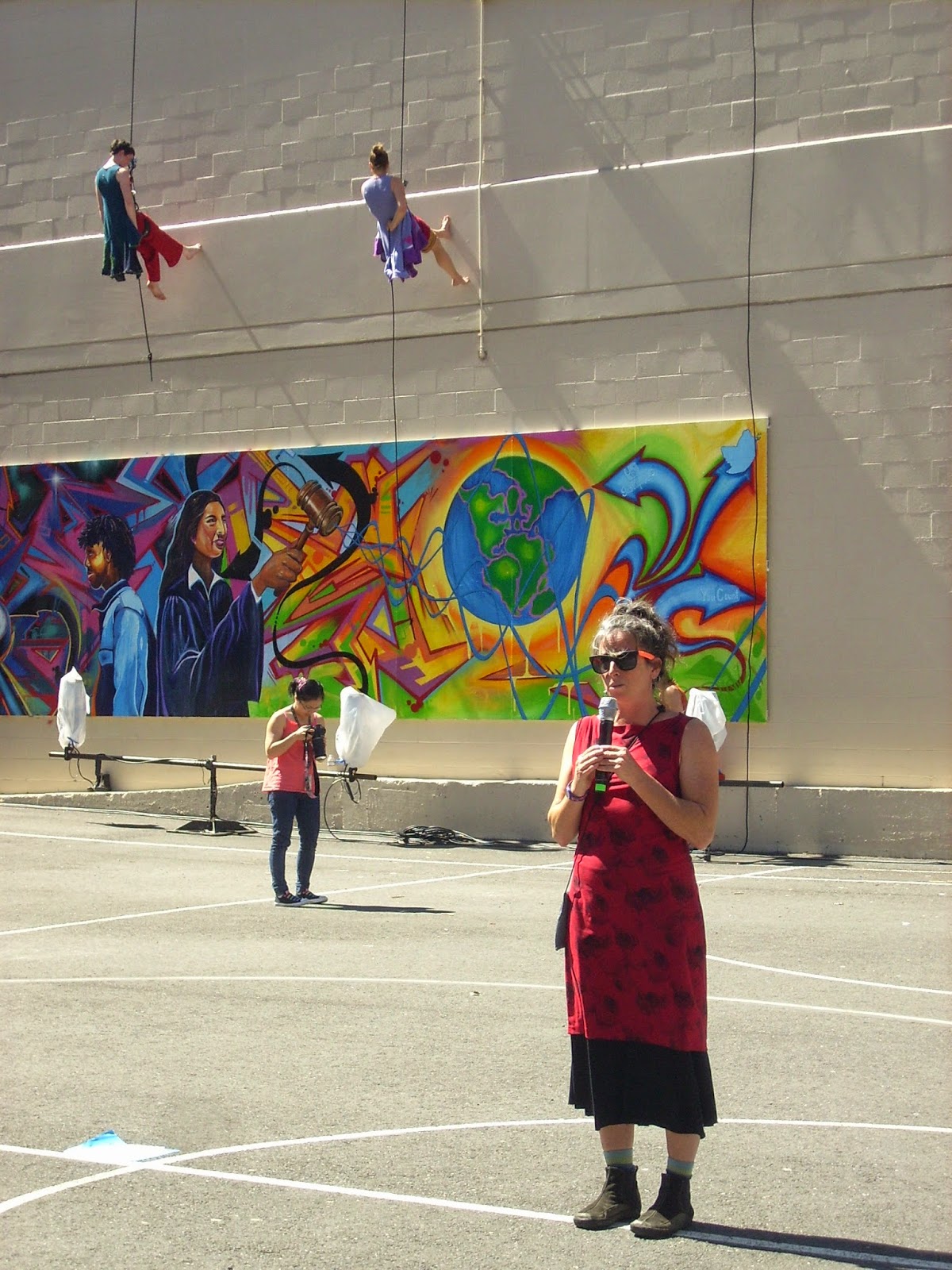

After the performance, Flyaway Productions Artistic Director Jo Kreiter and dancers touch ground for Q & A session. Their goal is to give light and inspire compassion to the plight of the growing numbers of older women living on the streets of
Single Room Occupancy (SRO)
Chinese Historical Society of America (CHSA)’s exhibit, “Living in Chinatown: SRO,” featured artist Frank Wong’s miniature diorama and a life-size version of a Chinatown Single-Room Occupancy (SRO), and a panel discussion on affordable housing.

This Frank Wong miniature was inspired by a SRO containing all the possessions of a bachelor resident of the International Hotel at the edge of Chinatown. SRO housing,
originally intended for low-income, immigrant workers, are typically rooms
measuring 8 by 10 feet with a communal bathroom down the hall. San Francisco
has over 500 SRO buildings with more than 19,000 units located mainly in the Tenderloin, Chinatown, Mission


Life-size SRO contains bed, sink, and rice cooker. A 2010 survey found that more than half of
SROs in San Francisco

Tenants in SROs are being evicted to create vacancies for tourist rentals,
so it was disturbing to hear District Supervisor David Chiu talk about
investing in SROs and legalizing “in-law units as variations of SROs” to
address affordable housing crisis because he has introduced legislation to legalize
and regulate short-term rentals through online social networking
platforms like Airbnb, which has the
effect of removing SRO units intended for lower-income residents,
while flagrantly violating existing leases, local rent control laws and
prohibitions against converting residential units in buildings with four or
more units to tourist or transient use, and failing to pay the City’s 14% transient
occupancy or hotel tax. Further, these laws have not been enforced,
including the failure to collect an estimated $25 million in back hotel taxes.

CHSA hosted a timely affordable housing discussion with CHSA
Executive Director and former San Francisco Planning Commission President Sue
Lee, Chinatown Community Development Center (CCDC) Executive Director Norman Fong, and San Francisco Planning Commission President and CCDC Community
Planning Manager Cindy Wu. Cindy talked
about families crammed into SROs for affordability with an average stay of 7 to 10 years until they have saved enough to move to Visitacion Valley

SRO residents work as
peer organizers through Chinese Progressive Association to improve living conditions in SROs. The
recent college graduate said last year's Ellis Act eviction of Lee family (elderly
couple with disabled adult daughter) from their low-rent apartment of 34 years
empowered her to fight for “just and fair living.” While some people consider SROs as transitional housing, they are permanent housing for others and thus worth taking action to improve habitability.
Last month, California Housing Partnership Corporation released its report, How San Francisco County’s Housing Market is Failing to Meet the Needs of Low-Income Families. It found more than 50% of extremely low-income households are elderly or disabled, and San Francisco is short about 40,845 housing units affordable to the poorest, which means a third of household income; in response, the Mayor’s Office of Housing said it was committed to supplying 10,000 units at below market rate, or just a third of the 30,000 housing units that the Mayor has promised to build or rehabilitate by 2020.


Affordable housing initiatives
Last month, California Housing Partnership Corporation released its report, How San Francisco County’s Housing Market is Failing to Meet the Needs of Low-Income Families. It found more than 50% of extremely low-income households are elderly or disabled, and San Francisco is short about 40,845 housing units affordable to the poorest, which means a third of household income; in response, the Mayor’s Office of Housing said it was committed to supplying 10,000 units at below market rate, or just a third of the 30,000 housing units that the Mayor has promised to build or rehabilitate by 2020.
At the top of San Francisco Planning and Urban Research (SPUR)’s 8 Ways to Make San Francisco Affordable Again is protect the existing rent controlled housing stock. San Francisco
Eviction Free San Francisco (EFSF), a direct action group for housing justice, has organized public protests against the displacement of long-time San Franciscan seniors by serial evictors. This rally and press conference outside San Francisco Superior Courthouse took place before the hearing that quashed the attempted Ellis Act eviction of seniors Patricia Kerman and Tom Rapp based on improper service of their eviction notice by their landlord Kaushik Dattani, who has used Ellis Act on 24 households in the Mission District.
Demonstrators carried signs, “ELLIS ACT IS ELDER ABUSE” and “STOP EVICTING SENIORS.” Earlier this month, the Ellis Act eviction of 63-year-old teacher Benito Santiago was rescinded after protests by anti-eviction activists.
Senior and Disability Action (SDA), winner of this year’s n4a Aging Innovations Award for advocacy, kept busy advocating for affordable housing.
At SDA’s July meeting on Housing, longtime community activist Calvin Welch and Housing Rights Committee Community Organizer Fred Sherburn-Zimmer discussed housing balance and anti-speculation tax legislation.
Angelica Cabande, Organizing Director of SOMCAN (South Of Market Community Action Network) presented Healthy SoMa (South of Market) about the impact of the 1990s dot-com resulting in gentrification and displacement of mostly seniors, veterans, homeless, low-income residents and Filipino community. Now this second tech boom is impacting not just SoMa and Mission Districts but the entire City of San Francisco . Between 2012 and 2013, evictions went up by 115%! Angelica discussed the need for Housing Balance between market rate and affordable housing, with public participation, in order to increase the City’s accountability for meeting its housing goals.
SDA University Organizer Pi Ra and Housing Organizer Tony Robles provided advocacy training on Protect Affordable Housing: Stop the Flipping Speculators at the International Hotel Manilatown Center. Tony’s uncle Al Robles was a poet-activist involved in the almost decade-long fight against eviction of the original I-Hotel Manilatown tenants to preserve low-income housing and their community.
Fred talked about support for anti-speculation tax (Proposition G), which is an additional transfer tax on certain multi-unit residential properties that are sold within 5 years of purchase: up to 24% then scaling down to 14% on the fifth year.
Calvin explained that San Francisco has a shortage of land available to build housing: of its 46.7 square miles, 23 square miles is developable (not beach, parks) and only 13 square miles zoned for housing. He also provided a history of San Francisco development, blaming today’s housing crisis on ill-conceived land use policies for the past 30 years that favored office buildings over housing, assuming workers would live in suburbs. But most people want to live in San Francisco , including tech workers in Silicon Valley. In fact, San Francisco’s population has grown to an all-time high of 837,442 in 2013. To address affordable housing, he favors policies designed to control housing costs and conversions, and investment in public and subsidized housing.
April Veneracion was former SOMCAN Director before becoming District 6 Supervisor Jane Kim’s legislative aide to focus on land use and redevelopment. April worked on the initial Housing Balance proposal that included mandated conditional use approval for developments if construction of units fall below the 30% below-market-rate unit threshold. However, the Mayor’s Office believed this would slow development so the "compromise" measure resulted in a housing policy statement (Proposition K) that sets a goal of providing 33% below-market-rate units and annually reporting on the cumulative ratio between below-market-rate and market-rate housing.


Building home and community
through design
The 2014 Architecture and the City festival theme, Home: My San Francisco
At
the San Francisco Chapter office of American Institute of Architects (AIA), Home Matters convened a panel for a conversation about The Future of Affordable
Housing: How Do We Create
Affordable Housing Beyond Just Shelter? Panelists included Russell
Krummow of Opportunity Nation,
Susan Neufeld of non-profit BRIDGE Housing,
architect Lisa Gelfand,
and neuroscientist Pireeni Sundaralingam.
Defining home as beyond shelter, it provides a sense of place and
relationships to feel connected and engaged as part of a community. Designing home with a view of the individual
as part of an ecosystem provides opportunities for interaction with the natural
environment (daylight, fresh air, healthy materials, spaciousness) and
access to resources like transportation and social capital to enhance emotional
well-being and health benefits.
 Mapping the home: The roles of subjective and objective in the design process panel of architects and UCSF
neurologist Zachary Miller repeated theme of our brains responding to the built
environment, nature as healing and creating spaces that feel good to reduce
stress. However, hospitals (nursing homes) may not be
healing environments when the wrong science causes problems like sick building syndrome,
with sealed windows intended for infection control, but trapping indoor air pollution
that is worse than outdoor pollution from operable windows that allow natural
ventilation.

San Francisco  I didn't buy an all-fest pass to this month’s 4th
annual LFFOA, but I attended Friday's Opening Night and Sunday's afternoon screening. With its mission to inspire, educate (including CEUs for MFTs and LCSWs) and entertain intergenerational audiences about the issues surrounding aging,
LFFOA builds community. Opening
Night featured Three Perspectives on Aging:
Burn the Clock (UK drama short
about septuagenarians who smoke, drink and have sex), Beauty Before Age (documentary about fear of aging in gay male community that values youth/beauty;
one older interviewee mentioned that he used physical attractiveness to
compensate for his emptiness because he was really seeking validation and
connection) and Fabulous Fashionistas (UK
documentary about 6 women, whose average age is 80 who show us that style and
attitude is not just clothes but knowing what you want like “live in color, don’t
wear beige—it might kill you,” being comfortable in “faithful clogs—Crocs,” and
making the most of whatever time is left including self-care and being
interested).


Community engagement
Aging in place is about
growing old in one’s own home, as opposed to nursing home placement, and
facilitating this process by making home safety modifications. However, this focus makes aging in place limited to physical and safety needs.
Aging in community is a more holistic approach that considers our need for connection. San
Francisco
Because loneliness is independently associated with functional decline and risk of nursing home
placement that jeopardizes aging in place, it’s important to identify
loneliness and interventions. Patrick
Arbore, Director and Founder of Center for Elderly Suicide Prevention and Grief
Related Services at Institute on Aging,
presented a talk about loneliness in gerontologist Hope Levy’s Staying Engaged for a Lifetime,
offered through City College of San Francisco at our Main Library.
According to the U.S. Census
Bureau, the number of Americans living alone in 2010 was 29 million – a 30%
increase since 1980. However, Dr. Arbore
mentioned that introverts, like himself, prefer solitude so we should not
assume that living alone means loneliness.
Instead, loneliness is a feeling of longing
and emptiness that is caused by the lack of emotional attachment and/or social ties – and thus a subjective
experience. Loneliness expert Louise Hawkley proposed loneliness has three
dimensions: isolation, connectedness and belongingness. Ageism contributes to feelings of being
invisible and ignored.
Loneliness interventions
include:
- ask about loneliness
- spend time with the person, in silence or in
conversation
- assist the person in keeping contact with
people important to them
- explore the nature of loneliness with the person
- develop community support for the person
Practice Oprah’s Just Say Hello! Dr. Arbore urged us to be more
welcoming and less suspicious in our fear-based culture:
- connect with people
- be as present as possible with people who are
lonely
- empathize with people’s losses and suffering
- EASE our way to social connection:
Extend yourself to others
Action plan
Selection – solution is quality, not quantity, of
relationships
Expect the best – we have more control over our
thoughts than we think
Afterwards, LFFOA Executive Director Sheila Malkind moderated a Q
&A with Beauty Before Age director Johnny Symons and Dazie Rustin Grego, 19-year-old who said “life is over after age 26” in
1997 documentary. Now a 37-year-old performance
artist, Dazie said he is more thoughtful, less about “look-ism, pretty doll
image” and he was just telling his truth at age 19 though this offended some
people.
LFFOA’s Opening Night was
also a celebration of Sheila turning age 76! In her interview with KALW’s Your Call host Rose Aguilar about What does it mean to be an elder today, Sheila said she wishes women would stop worrying about aging and stating their
age because we should be proud to get to that stage and do wonderful
things. Sheila is a fabulous fashionista
herself by embracing aging -- “no botox, plastic surgery” plus no hair dye!
Sunday afternoon screening
of Forget Me Not (Vergiss Mein Nicht), a documentary by
German filmmaker David Sieveking about the home care of his mother who had
Alzheimer’s disease, showed his use of music, travel, and reading his mother’s
diaries (revealing his professor father’s infidelity, which reminded me of the drama Away From Her) to maintain personal
connection. At times, his mother simply
wants to retreat in response to attempts to engage her in activities—scenes
that resonated with me because I can relate to just wanting down time at home. After all, home should be a place of
retreat—a break from the programmed activities of an institution like a senior
center, assisted living, nursing home, cruise ship, etc.
In Wendy Lustbader’s It All Depends on What You Mean by Home, her study of elders who did not feel at home after moving to continuing care retirement communities (CCRC) to receive supportive services, she found that discontented elders sought: 1) access to dignity, privacy and choice inherent in normal life (versus reminders to “keep busy” through a program of activities like staying at a perpetual resort), 2) the capacity to form significant relationships (versus age segregation that leaves one disconnected from the outside world), and 3) the means to contribute to other people’s lives (reciprocity versus being served all the time).
In Wendy Lustbader’s It All Depends on What You Mean by Home, her study of elders who did not feel at home after moving to continuing care retirement communities (CCRC) to receive supportive services, she found that discontented elders sought: 1) access to dignity, privacy and choice inherent in normal life (versus reminders to “keep busy” through a program of activities like staying at a perpetual resort), 2) the capacity to form significant relationships (versus age segregation that leaves one disconnected from the outside world), and 3) the means to contribute to other people’s lives (reciprocity versus being served all the time).
Community Living Campaign (CLC)
uses the power of relationships to build connections of support that we need to
age in community. CLC’s Aging While Black Forum returned to Pilgrim
Community Church
(panel) and IT Bookman
Center
Senior
Assembly Member E. Anne Warren represents Older Californians in San Francisco County
Pilgrim
Community Church Pastor Harold Pierre recognized CLC Community Connector Deloris McGee for founding annual Aging While Black Forum and her community connecting
work to support healthy aging in place.
Deloris is retiring and leaving San Francisco
to return to her hometown in Mississippi San Francisco