Saturday, October 31, 2015

Aging + disability: friendly San Francisco


“It is suggested that the elderly themselves have bought into an elderly mystique which holds that the potentials for growth, development, and continuing engagement virtually disappear when disabled.  The energy of formal and informal providers is directed toward maintaining activities of daily living and keeping the elderly person out of a nursing home.  This results in a perception of little or no choice by the elderly themselves, and hence diminished exercise of autonomy.”
–Elias S. Cohen, JD, “The Elderly Mystique: Constraints on the Autonomy of the Elderly with Disabilities,” The Gerontologist (June 1988).

Many older adults avoid association with disability, fearing stigma that may take away their autonomy so they end up institutionalized.  Yet individuals age 85 and older are at highest risk for disease and disability.  As a gerontologist advocating for community living, I look to disability culture for inspiration: strength, wellness, peer support, community integration, full participation, resilience, choice, access, independent living, etc.

At San Francisco Public Library

One of the most aging + disability friendly places is our San Francisco Public Library, which hosted many forums for aging + disability community engagement this month! Access Services Librarian Marti Goddard organized a series of ADA celebration events, including The ADA After 25 Years panel discussion with Bay Area disability community leaders; film screenings of PBS Independent LensLives Worth Living and Deaf Nation’s No Barriers with Joel Barish: Deaf People in Havana.

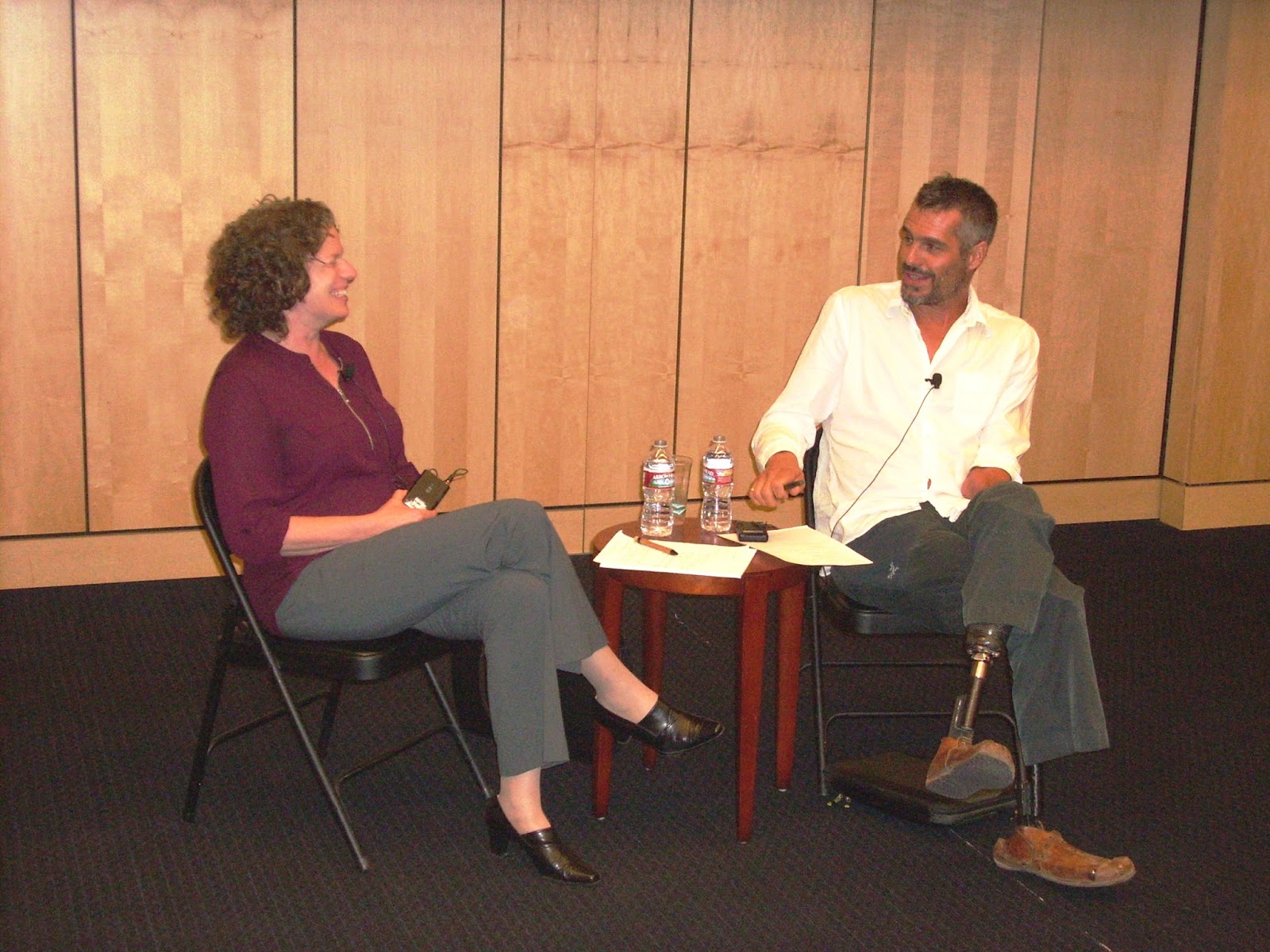
Legal Assistance to the Elderly (LAE) housing attorney Tom Drohan (bearded man in photo above; also appeared as rock star bassist in earlier blog post) presented on Reasonable Accommodations in Housing for People With Psychiatric and/or Developmental Disabilities, a public awareness seminar hosted by People With Disabilities Foundation at Koret Auditorium.  Tom mentioned how LAE provides accommodations to meet clients where they are, including making home visits, providing communication access, and collaborating with support services.
San Francisco’s 40-member Long-Term Care Coordinating Council (LTCCC) celebrated its 10th anniversary, Party With a Purpose: Making San Francisco a More Aging and Disability Friendly City!    
We were treated to performances by Dance Generators, an intergenerational dance company based out of University of San Francisco (USF).  Members on stage ranged from ages 21 to 84, using improvisation to build choreography. 
MC Mary Twomey said they were not able to get Tony Bennett and the pianist was delayed, so she gave us Rat Packer Sammy Davis, Jr. singing a cappella with the audience: “San Francisco so much to give, treat us with dignity.” 
Family Service Agency’s Senior Services Director Cathy Spensley talked about friendly San Francisco joining the WHO Network of Age-Friendly Cities and AARP’s Livable Communities last year.
Keynote speaker John Feather, CEO of Grantmakers in Aging, pointed out that the aging of America is permanent because Millennials (those born after 1985) are now the largest generation in U.S. history, and “about the time Boomers end, Millennials start to turn 65.” Quick calculation: that’s 2050, when “Boomers end” at age 84?!

When he said he liked slide photo of a person hunched over in wheelchair using a long-handled cultivator on dirt ground, Joanna Fraguli of Mayor’s Office on Disability took exception to this “one size fits all” and suggested raised-bed garden + paved pathway might be more accessible to wheelchair users.  Combating ageism + ableism are necessary to making San Francisco more aging + disability-friendly!

Next, audience broke out into small groups to Imagine an Aging and Disability Friendly San Francisco in the following areas: Technology, Social Participation, Housing, and Health & Long Term Supports.  I chose housing, which is so essential to aging in place.  My action idea to improve housing was to offer tax incentives for developers to build healthy homes free of harmful chemicals, based on Ecology House model (mentioned in my blog post last month). 
Still fresh in my mind was the prior evening’s panel discussion on Chemicals Without Harm by Ken Geiser.  As part of Breast Cancer Awareness Month, Campaign for Safe Cosmetics launched its latest campaign, Anti-Aging Secrets Exposed: Chemical Linked to Breast Cancer Found in Skin Care, which reports three anti-aging creams from household name brands contain PFOA, a toxic chemical linked to cancer.  In this case, anti-aging = anti-health.  The proposed Federal Personal Care Products Safety Act (S. 1014) would expand FDA authority over cosmetics.
Community Living Campaign Director Marie Jobling talked about bridging the digital divide to reduce isolation through SF Connected initiative providing free computer classes and Internet Essentials Senior Pilot Program providing low-cost internet ($9.99 per month) + low-cost computer ($149.99) for seniors at least 62 years old who receive state and/or federal assistance. 
Mary continued to engage us with Rap Along!: “LTCCC making San Francisco better for me, LTCCC for elders and adults with disabilities!” 
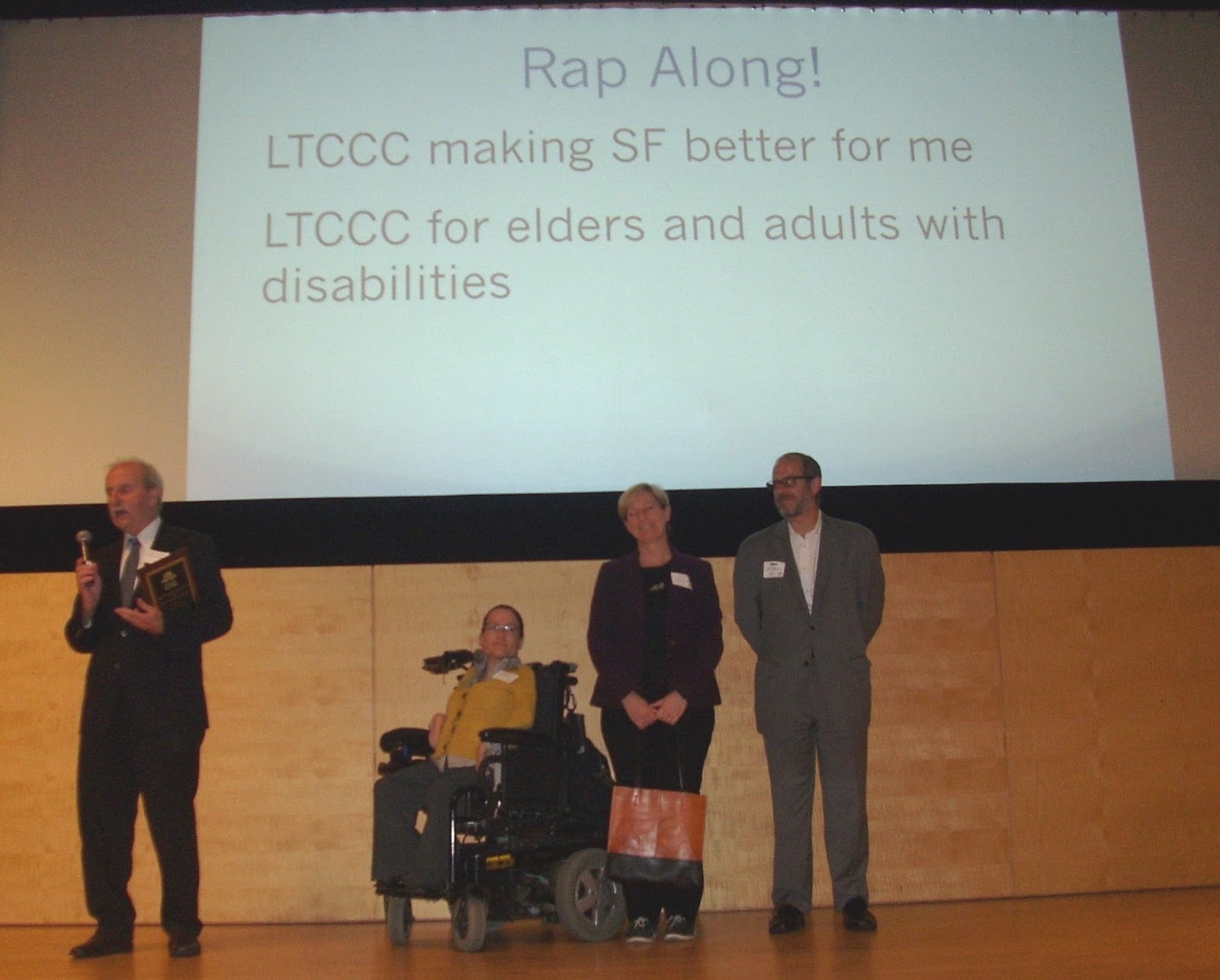
On behalf of San Francisco Municipal Transportation Authority, Board Chairman Tom Nolan accepted Friendly SF Champion Award for establishing Free Muni for low and moderate-income seniors and people with disabilities!

In SF Examiner's Being older in a youthful San Francisco”, Boomer Sally Stephens wrote about how San Francisco is being planned by millennials for people in their 20s and 30s, without taking a long-range view for older San Franciscans in areas like restricting cars in favor of bikes, consolidating bus stops for faster transit – and I would add this is done without looking out for persons with disabilities with similar concerns about getting around. 

San Francisco Sheriff’s Department presented Senior Summit to address the unique health and social needs of San Francisco’s older adult population who are part of the criminal justice system.  Sheriff Ross Mirkarimi moderated a lively panel discussion:
  • Dr. Brie Williams, UCSF geriatrician and founding Director of UC Criminal Justice & Health Consortium, talked about her recent visit to Norway where motivational interviewing is used to improve offenders’ re-entry into the community as “better neighbors.”  She also suggested a “therapeutic environment” for prisoners, like the humane prisons of Scandinavia
  • Frank Williams, Director of the Senior Ex-Offender Program (SEOP) at Bayview Hunters Point Multipurpose Senior Services, Inc., explained that SEOP concept in 2002 came from Elderly Ex-Offender Program developed by late George Davis while he was working on his dissertation at SFSU, but “Elderly” replaced with “Senior” denoting a “higher rank.”
  • Tanya Mera, LCSW, Director of Jail Behavioral Health and Reentry Services (JBHRS), talked about need to improve system of care for geriatric inmates.
  • Jeffrey Washington, 57-year-old (considered “elderly” at age 55 because age-related health problems occur early in life for prisoners), shared his experience of being released from SF County Jail and linked to case management with SEOP, which led him to employment at Goodwill and studying to be an alcohol and drug counselor at City College of San Francisco.
  • Steve Good, Executive Director of Five Keys Charter School, noted learning disabilities are ten times higher for inmate population compared to the community, where 3-5% have learning disabilities.  Five Keys was originally established by the SF Sheriff’s Department in 2003 as the first charter school in the nation to operate inside a county jail.  Based on principles of social and restorative justice, it provides inmates the opportunity to restart their education with a focus on Five Keys: education, employment, recovery, family and community. 
Prisoners of Age at Alcatraz exhibition: “You see the frailty, the forgetfullness, the universal problems of old age."

Back to school

SFSU Gerontology Celebration honored Professor Brian De Vries, who will begin FERP (Faculty Early Retirement Program), phased retirement that allows him to continue teaching part-time. Center for Age-Friendly Excellence (CfAFE) Program Director and Professor Anabel Pelham, who began her FERP two years ago, got everyone chuckling when she recalled someone suggesting that she marry Brian to help resolve his problems with immigrating from Canada so he could start teaching at SFSU!  

 
In appreciation, Brian got a standing ovation and chocolate cake! I actually had to stand in line to personally thank him for inspiring me with his scholarship and commitment to social justice, plus chocolates in his office! While Brian’s position as policy advisor to AARP is drawing to a close after 5 years, he recently joined a committee of the American Association of Medical Colleges working to ensure inclusion of sexual minorities in medical school curriculum.

USF School of Nursing and Health Director Kathy Raffel moderated a discussion on Improving Care at Home: Challenges and Opportunities at Fromm Institute of Lifelong Learning. 
  • Family Caregiver Alliance Executive Director Kathy Kelly talked about expectations of unpaid caregivers are greater now and growing due to increased life expectancy, increased complexity in health care and costs (now done in home), more women in workforce, and decreased number and sizes of families. 
  • San Francisco IHSS Public Authority Executive Director Kelly Dearman talked about independent living movement’s influence in starting consumer-directed IHSS in 1973.  Today 22,014 low-income seniors and adults with disabilities in San Francisco are served by IHSS workers (majority family and friends) who earn $12.25 per hour minimum wage, with overtime under FLSA effective November 12, 2015.  Starting January 2016, SF IHSS Public Authority will require 48 hours of basic training for caregivers through Homebridge.

Wednesday, September 30, 2015

Aging + disability: equal opportunities

Americans with Disabilities Act (ADA) and Older Americans Act (OAA) are equal opportunity laws that support full participation in community living. Americans also have equal opportunities to become Americans with disabilities and older Americans.
                                             
Aging with disability

Americans, including those with disabilities, are living longer.  As Eli Gottlieb wrote in The New York Times opinion piece, “Adult, Autistic and Ignored,” parents of dependent children with disabilities fear: What will happen to them when I’m gone?  After his mother died, Eli became guardian of his older brother Joshua who has autism and lives in an institution.  Like his mother, Eli became an advocate critical of the disability cliff when children with disabilities age-out of “special education” and the need for more attention to elderly autistic people like Joshua.  
At 5th Annual Legacy Film Festival on Aging (LFFoA), LFFoA Director Sheila Malkind facilitated Caring program discussion with Dr. Toni Miles and Mimi and Dona documentary filmmaker Sophie Sartain. 

Sophie began filming her documentary in Dallas six years ago when 92-year-old Mimi (Sophie’s maternal grandmother) was no longer able to care for her 64-year-old daughter Dona (Sophie’s aunt) who was diagnosed with “mental retardation” in the 1950s (though Sophie suspects undiagnosed autism).  When Dona was asked to leave public school after 2nd grade, Mimi sheltered Dona at home instead of the prevailing practice of sending her “retarded” child to a mental institution. 

Mimi makes the difficult decision to place Dona into Denton State-Supported Assisted Living Center, a long-term care facility that serves people with intellectual and developmental disabilities.  While Mimi thrives as she continues to live at home in the community, Dona deteriorates precipitously in the institution.  Spoiler alert: Dona’s condition improves, but she is also diagnosed with early Alzheimer’s; documentary ends with death of one.  Save this date: On November 23, Mimi and Dona will have its Independent Lens premiere on PBS. 

Family caregiving theme is constant: Sophie’s mother provided care for Sophie’s father who had multiple sclerosis during the last 20 years of his life; Sophie’s brother has a son with autism (“you need to live forever or outlive your kid”); and back in Los Angeles, Sophie learns that her own son is diagnosed with autism.  The main difference between Dona’s generation and today’s children with autism are disability civil rights laws, such as Individuals with Disabilities Education Act (IDEA) ensuring that children with disabilities have an opportunity to receive free appropriate public education in the least restrictive environment.

Now there is greater public awareness of disabilities that survive into old age. In The New York Times article, "Is It Old Age, or A.D.H.D.?", Judith Berck reported on the dearth of research on older adults with A.D.H.D. and the challenge of treating them with the same drugs given to children.
At 19th Annual Golden Gate Self-Advocacy Conference: Give It to Me Straight! Current Happenings in Our Developmental Disability Community, keynote speaker Santi Rogers, Director of California Department of Developmental Services, holds up Lanterman Act, California law passed in 1977, that gives people with developmental disabilities the right to services and supports to enable independent living.  He previously announced decision to close the remaining state-run developmental centers in California and transition participants into community living. 

More ADA celebrations! Doing disability justice

Steve and Lillian Gonzalez Brown, co-founders of Institute on Disability Culturegreeted me at Disability Rights Education and Defense Fund (DREDF)’s 36th Anniversary Celebration Honoring the 25th Year of ADA & Charting the Next 25 Years of Disability Rights at Ed Roberts Campus. 
Thanks to DREDF Director of Development Ingrid Tischer, I was able to attend the Celebration fundraiser as volunteer. 
Caramelized chocolate ganache with sea salt bars welcomed guests to tables. DREDF Senior Policy Analyst Marilyn Golden urged us to sign cards (on tables) opposing HR 2646 because “it would take away legal representation for people with mental illness, reduce privacy rights, and promote institutionalization.” 
Celebration co-sponsor Google Impact Challenge: Disability hosted Bay Area Makeathon weekend to design a more accessible world. 
Google also unveiled portraits and videos of disability rights leaders like Ed Roberts. 
ACLU attorney and DREDF Board of Directors President Claudia Center called for donations, suggesting $25 in honor of 25th anniversary of ADA; she said her personal donation formula was doubling 25, for her birthday this year, times ten! 
Evening’s program capped with intergenerational discussion about ADA’s impact 25 years after its passage, and advances we want in next 25 years, particularly on issues affecting people who live with invisible disabilities and intersectional effects of race, gender and disability. Christina Mills, Deputy Director of California Foundation for Independent Living Centers, moderated the discussion among all-women panelists: Maddy Ruvolo of Marin Center for Independent Living; Yomi Wrong of Palo Alto Medical Foundation/Mills-Peninsula Health Services; Nubyaan Scott, DREDF 2015 Summer Intern; and Mary Lou Breslin, DREDF Co-Founder/Senior Policy Advisor.


Yomi discussed her concerns about aging with disability, long-term care and still being in charge of her life, who will care for her as she has no plan to "go quietly to an institution, but if I do, what will it look like?" She noted ADA's influence on the built environment, yet need to reduce health disparities, adding that “death with dignity is such crap because if people have better choices, they don’t think to kill themselves.”
Disability Organizing Network (DOnetwork) presented California#ADA25 Conference: Access, Availability, Advocacy and Civil Rights! at UC Hastings College of Law.  This multigenerational view of disability justice covered:
  • access: equal opportunity to participate in all aspects of everyday life;
  • availability: options and choices which increase independence and freedom; 
  • advocacy: our history and courageous actions of leaders that lead to today's inclusion; and
  • civil rights: our just claim to equal citizenship
The conference's lunch program featured video clips of Alice Wong’s Disability Visibility Project: “Recording disability history, one story at a time.”   
ADA: Reflections on Success panel moderated by Yomi Wrong:
·         Arlene Mayerson, DREDF Directing Attorney, was a principal architect of ADA 25 years ago.  In order to have equal opportunities for people with disabilities (PWD), they had to have accommodations which meant they have to be treated differently. After ADA, PWD no longer asked for charity or favors, but for accommodation as a matter of right.
·         Paul Grossman, education civil rights attorney talked about Lau v. Nichols (1974 U.S. Supreme Court case finding that lack of language appropriate accommodation denied Chinese students equal educational opportunities because same treatment is not equal opportunity) and the 504 sit-in laying the groundwork for ADA.  He added that the second most exciting moment in disability rights has been since ADA Amendments Act of 2008 expanded the definition of disability (medication and other interventions that deal with effects of disability cannot be factors in determining whether individual is disabled), so disability-based discrimination cases can be heard on their merits.
·         Jim Patterson talked about “associational discrimination”: being pushed out of foreign service career because his employer viewed his daughter’s disability as a liability.  After The New York Times published an article, “Whose disability is it anyway?” he returned to work as a full member of the diplomatic corps and became an advocate for employment equality.
Do You Know Your Disability Civil Rights History? HolLynn D’Lil, author of Becoming Real in 24 Days: One Participant's Story of the 1977 504 Demonstrations, took over 350 black and white photos chronicling the takeover of the San Francisco Federal Building to demand that President Carter's administration implement regulations to Section 504 of the Rehabilitation Act, the first federal civil rights law for people with disabilities. At the time, Congressman Phil Burton said, "To have to demonstrate during a Democratic administration to fulfill a Republican promise is a painful irony."
Ted "can I get an accommodation?" Jackson, Community Organizing Director at California Foundation for Independent Living Centers (CFILC), moderated discussion during Breakfast with the Author Tony Coelho, who entered politics as his ministry after he was denied from pursuing Catholic priesthood based on his epilepsy. While serving in U.S. House of Representatives, he was principal author of ADA, which got bipartisan support due to supporters' personal relationships with PWD.  He noted 52 countries now have disability laws based on ADA.
Indigo Mind features artists celebrating the work of neurologist Dr. Oliver Sacks.  
Connie Barker founded Environmental Health Network (EHN), which provides support, advocacy and information to the chemically and electrically injured: “If it’s not healthy, it’s not green.” In addition to her own site http://ehnca.org/, she offered the following resources:
Access Kids perform on entertainment stage

Aging + disability-friendly communities 

Under disability laws, the person with disabilities has the burden to disclose his/her disability and ask, "can I get an accommodation?"  Sometimes, people with "invisible disabilities"--like chemical sensitivities--might resist disclosure to avoid stigma ("it's all in your head").  As a more proactive approach to move beyond individual accommodations, universal design creates inclusive environments for everyone by placing the burden for accessibility on architecture. 
ADA Conference workshop included Homesick Living with Multiple Chemical Sensitivities: Finding Accessible, Available, Affordable Housing, presented by Connie Barker of EHN.  Connie talked about 11-room Ecology House, the nation’s first HUD-funded housing for people with multiple chemical sensitivities (MCS) that was built over 20 years ago in San Rafael, and then showed documentary, Homesick (2013) about director Susan Abod’s road trip to discover how people with MCS find safe housing and cope with their disability. 
Ed Roberts Campus was ideal to host At Home With Growing Old (AHWGO) program, Dementia-Enabling Spaces: Bodies, Networks, Environments.  Panelists were:
  • Susan Stadler, architect and AHWGO co-founder, substituted for Clare Cooper Marcus and discussed gardens for people with dementia like Portland Memory Garden 
  • Dr. Mehrdad Ayati, geriatrician and author of Paths to Healthy Aging (2014), prescribed social interactions (“live like an Italian: engage brain in conversation, talk with hands”), value and respect elderly because “You cannot replace experience with knowledge (internet),” more geriatric training (completed by only 3% of U.S. medical students) and interdisciplinary teams in geriatrics 
  • Debora Tingley and Patricia Ris discussed Memory Care Café, a weekly social club for people with forgetfulness and their care partners.
The shift from the medical model of aging and disability continues to end-of-life: life and death are natural v. medical events.  UCSF Osher Center for Integrative Medicine hosted a screening of the PBS Frontline documentary, Being Mortal, followed by a discussion on end-of-life planning with Shelly Adler, PhD, Osher Director of Education, and BJ Miller, MD, palliative care physician and Director of Zen Hospice Project.  They discussed when cure is not possible at the end of life, we can reduce suffering for a “better death.”  BJ said a doctor can tell the truth in a supportive way that does not rob hope, but informs. In BJ’s TED talk, What Really Matters At the End of Life in March, he talked about patient meaning one who suffers, so we are all patients, and how most people fear, not death but, suffering; yet suffering unites us when we share this experience.

Sunday, August 30, 2015

Building a caring community

Theme of this month’s Senior & Disability Action (SDA) General Meeting was 2015 Election: The Fight for Affordable Housing with panelists discussing Propositions A ($310 million bond for affordable housing), D (Mission Rock Development to include 40% affordable housing), F (regulate and enforce short-term rentals), I (Mission District market rate development pause and neighborhood stabilization plan to prioritize affordable housing) and K (securing public lands for new affordable housing).  SDA recommended YES! YES! YES! YES! and YES!  

Affordable housing remains a hot issue in San Francisco, where seniors and persons with disabilities continue to be targeted for eviction from their long-term tenancies.  This has become common when older, long-term landlords--often content receiving monthly rental income stream from stable, hassle-free tenants--transfer property to new landlords who view housing as a commodity to make quick profits and ignore community.  

News headlines like "City Sues San Francisco Landlord Accused of Bullying Elderly and Disabled Tenants” and S.F. landlord evicting seniors who helped her ailing auntare disturbing.  

One would expect better behavior from landlord Annlia Paganini-Hill, a UC Irvine investigator of The 90+ Study to determine factors associated with longevity--"Because little is known about people who achieve this milestone, the remarkable increase in the number of the oldest-old presents a public health challenge to promote the quality as well as the quantity of life."  After Paganini-Hill inherited San Francisco property from her aunt, she evicted the tenants (including SDA housing organizer Theresa Flandrich), seniors who had cared for her ailing aunt when she was in her 90s.  Paganini-Hill's eviction actions did not contribute to quality/quantity of life, with one 78-year-old tenant who died while fighting her Ellis Act eviction.  Maintaining a sense of caring and community appears to be a public health challenge. 
At the same SDA meeting, Joyce and David invited all to join celebration of Social Security Act’s 80th Anniversary at visibility events in San Francisco. 
On August 14, members of California Alliance for Retired Americans (CARA) held up Happy 80th Birthday Social Security: Protect, Improve and Pass It On banner and passed out information flyers to passersby on Market Street.  One CARA member asked, “Do you want to be stuck caring for your parents?” I don’t like being “stuck” but like to keep moving and sure, I want to be caring for my parents! 

Social welfare entitlement programs, like Social Security and Medicare, have shifted income and health care support from filial obligation to societal responsibility.  Yet, aside from Medicaid for low-income persons, long-term care remains a family responsibility. 

Growing up in a multi-generational household, generational interdependence and caring for all family members was reciprocal.  For example, my grandparents cared for me and my siblings when we were very young (while we provided priceless entertainment :-)) and my parents worked outside of the home (earning money for our basic needs and wants); then as my grandparents developed dementia issues later in life, my siblings and I looked after them (while my grandparents provided amusement) and we took turns working for our parents who ran several businesses.  Caring was an expression of filial piety and love, so we never viewed caring as a burden or sacrifice. 

Oddly, bullying is rampant in “caring” professions like health care, education and public service/government, according to a 2013 Workplace Bullying Institute (WBI) study.  At last month’s LaborFest, Workplace Bullying Labor Educational Conference: What It Is and How to Stop It! featured Derek Kerr, MD, vindicated whistleblower who received a $750,000 settlement and plaque recognizing his 20+ years of distinguished service, including founding the hospice care unit at Laguna Honda Hospital (subject of Geriatric Nursing study, “A model long-term care hospice unit: care, community, and compassion).  Dr. Kerr and Dr. Maria Rivero, who were both terminated in retaliation for exposing wrongdoing by Laguna Honda administrators, write a Watchdog column in the monthly Westside Observer, while the corrupt bullies remain at Laguna Honda.  (Ten years ago, Dr. Rivero had questioned whether San Francisco's Director of Public Health was changing Laguna Honda's commitment to elderly patients after noticing a sharp increase in younger patients who were taking up beds needed by the elderly.) 

Dr. Kerr talked about growing recognition of workplace bullying as psychological violence.  WBI defines bullying as repeated, malicious, health harming mistreatment that interferes with work performance—different than incivility and discourtesy.  One-third of workers experience bullying at some point in their career; 60% inflicted by supervisors, 30% by peers, 10% by subordinates.  Since workplace bullying results in symptoms of PTSD and major depression, Dr. Kerr said it is extremely debilitating, an occupational health hazard.
Carrie Clark and Michelle Smith talked about their work with California Healthy Workplace Advocates to “Raise Public Awareness and Compel our State to Correct and Prevent Abusive Work Environment Through Legislation”  based on Healthy Workplace Bill drafted by Suffolk Law Professor David Yamada

Elderly bullying can be a form of emotional/psychological/mental abuse, which is a non-mandated report in California.  A 90+ year-old woman told me she was bullied by her senior son, who repeatedly taunted her about moving out of the home which she transferred to him, yet the APS worker said she could not make the son “be nice” to her. 

National Long-Term Care Ombudsman Resource Center (NORC) hosted an excellent webinar last month on Identifying, Preventing, and Responding to Bullying in Long-Term Care Facilities presented by Robin Bonifas, PhD, MSW of Arizona State University’s School of Social Work.  Bullying is defined as intentional, repetitive, aggressive behavior involving an imbalance of power or strength; among older adults, relational aggression is a common form of bullying intended to damage peer relationships and social connections.  Dr. Bonifas noted that because engaging in bullying requires a level of cognitive and social skills, senior environments with higher functioning residents or participants tend to have more problems with bullying.  Bullies seek to control others, have difficulty tolerating individual differences and lack empathy; among older adults, older bullies may be seeking control at a time in their life when they may feel powerless over losing independence, so they act out by dominating others.
Dr. Bonifas also distinguished bullying from behaviors related to dementia and mental illness like verbal or physical aggression linked to decreased impulse control or frustration with inability to express needs.  
Dr. Bonifas recommended a three-tiered intervention model to prevent and minimize bullying behavior: 
1) organization’s goal is to create caring communities requiring a culture of respect (zero tolerance for bullying), accountability for behaviors, willingness to stand up for what is right (bully has to be confronted often and clearly, even called out publicly since no one self-identifies as bully), civility training (pay attention, listen, be inclusive, don’t gossip, show respect, be agreeable, apologize, give constructive criticism, and take responsibility);
2) intervention for bullies (consistently set limits on bullying behavior; offer appropriate outlet to vent frustrations; identify alternative methods for bullies to feel in control, learn positive communication skills like making “I" statements, develop empathy by modeling, help expand social network, and address feeling of loss); and
3) intervention for victim/target (assertiveness training to stand up for one’s rights, use direct communication strategies, manage feelings of anger, and setting boundaries).


“The world is a dangerous place, not because of those who do evil,
but because of those who look on and do nothing.”
—Albert Einstein

At last month’s NAMI convention in San Francisco, neuroscientist Jill Bolte Taylor, PhD , author of My Stroke of Insight: A Brain Scientist’s Personal Journey (2006), presented an insightful talk about Our Beautiful BrainWhen Dr. Taylor suffered a stroke almost 20 years ago, she lost function on the left hemisphere of her brain and her mental processes shifted to her right hemisphere.  In this shift from the doing-consciousness of her left brain to the being-consciousness of her right brain, she experienced Nirvana—a sense of being fluid, at one with the universe and in the flow, tuned in to energy dynamics and body language, feeling deep inner peace and calm. 
Dr. Taylor said the brain’s judgmental left hemisphere would rather be right than happy, whereas its open-minded right side would rather be happy than right. 

  • We care about “Me” (not we)
  • Focus on personal gain (not community)
  • Care about profits (not people)
  • Strive for authority (not equality)
  • Seek differences (not similarities)
  • Competitive (not compassionate)
  • Judgmental (not forgiving)
According to Dr. Taylor, our left brain dominant society is eroding our self value when we are rewarded for what we do, rather than who we are.  We are in pain, which results in a mental health crisis: pain is masked in various forms of addiction to substances like drugs and alcohol. 
Dr. Taylor explained that information received into our brain is organized by the limbic (emotional) system and then sent for cognitive thinking, thus we are FEELING creatures who THINK.  Our limbic system cells never mature, which is probably why people can react like a two-year-old when emotional “buttons” are triggered.  Yet it takes only 90 seconds for our body to rid itself of the rush of adrenalin caused by an explosion of anger.  If people stay angry longer than 90 seconds, it's because they have chosen to have a thought in their brain that makes them angry—so every time they think that thought, they run the same circuitry in their brain that keeps them angry. 
Response-ability: Dr. Taylor said if we use our limbic system in the proper way (and we own the power to choose how we perceive and respond to experience), it will dissolve barriers between us and the world, allowing us to see ourselves as a member of the human family, showing compassion to one another in one big caring community!