Showing posts with label hearing loss. Show all posts

Saturday, June 30, 2018

Lifelong learning

Regarding people as having lives of equal worth means recognizing each as having a common core of humanity. Without being open to their humanity, it is impossible to provide good care to people…To see their humanity, you must put yourself in their shoes. That requires a willingness to ask people what it’s like in those shoes. It requires curiosity about others and the world beyond…
We are in a dangerous moment because every kind of curiosity is under attack…This is what happens when the abiding emotions have become anger and fear. Underneath that anger and fear are often legitimate feelings of being ignored and unheard—a sense, for many, that others don’t care what it’s like in their shoes. So why offer curiosity to anyone else?
Once we lose the desire to understand—to be surprised, to listen and bear witness—we lose our humanity. Among the most important capacities that you take with you today is your curiosity. You must guard it, for curiosity is the beginning of empathy. When others say that someone is evil or crazy, or even a hero or an angel, they are usually trying to shut off curiosity. Don’t let them. We are all capable of heroic and of evil things. No one and nothing that you encounter in your life and career will be simply heroic or evil. Virtue is a capacity. It can always be lost or gained. That potential is why all of our lives are of equal worth…”
Atul Gawande, MD, MPH, “Curiosity and What Equality Really Means,” The New Yorker (June 2, 2018) 

In this month’s National Resource Center for Engaging Older Adults webinar, 
engAGED: Increasing Social Engagement through Lifelong Learning, National Resource Center for Osher Lifelong Learning Institutes (OLLI) presented OLLI members' top interest topics, in this order: history, fine arts, current affairs, literature, religion and philosophy, and health and wellness.  With my insatiable curiosity (like Albert Einstein, who said, “I have no special talent. I am only passionately curious”), my idea of recreation is leisurely lifelong learning. As I go about my existence as a lifelong learner-gerontologist, I am always scouting for activity programming ideas to bring to older adults at their residential community or scheduled outings. 

Fine arts

Sixty Plus—OLLI at SFSU’s Theater Showcase previewed upcoming productions from local theater companies:
·       Golden Thread Productions: Founding Artistic Director and SFSU alumna Torange Yaghiazarian introduced Melis Aker’s Field, Awakening with its main character reuniting with friends from high school on the eve of the 2016 attempted military coup in Turkey.  Liked line, “You get to do what you wake up for,” but trigger alert for lot of “f-ck” word in script. 
·       San Francisco Playhouse: Patron Services Manager Tiiu Rebane sang title song from Stephen Sondheim’s Saturday in the Park with George and “Maybe this Time” from Cabaret.  She likened theater participation to an “empathy gym” to practice compassion.
·       Bay Area Musicals: Founder and Artistic Director Matthew McCoy discussed the role of theater to make us think, reflect and feel.  Juan Castro and Loreigna Sinclair sang “In a Place of Miracles” and “God Help the Outcasts” from Disney’s Hunchback of Notre Dame, exploring themes of disability, immigration, and discrimination.

(SFSU’s College of Extended Learning offers Elder College for people age 50+ who pay $55 per semester to sit in any regular university course on a space available basis with instructor approval.  City College of San Francisco's Older Adults Program offers free, non-credit courses designed for people age 55+, which are open to all; its Free City Program recently received funding for two years to offer free summer courses.)
Outing to 42nd Annual SF Free Folk Festival’s Jug Band Jam, with Christopher Richard, Miller Wise and Wayne Hagen, inviting folks of all ages to bring their own instruments to join in on jug-band classics, with songbooks provided.  
Director/Choreographer Bruce Bierman and Musical Director Ellen Robinson brought along Stagebridge participants to older adult communities for live performances of A Chorus Line. 
In this adaptation of A Chorus Line, Stagebridge participants audition by introducing themselves, sharing events that shaped their lives and decisions to become dancers.  Of the ten in this ensemble, only one was male.

History/Literature
Laura Bock, author of Red Diaper Daughter: Three Generations of Rebels and Revolutionaries (2017), and friend Sally Goldin, at this lively book reading/discussion party. As an only child, Laura wanted to pass on her family legacy by publishing her memoir at age 70, sharing stories of her “red” grandparents who sought to overthrow the Russian czar before immigrating to the U.S., her anarchist/communist parents who were labor organizers, and her own life as “red diaper daughter” carrying the tradition of activism (as she left for college, her parents advised her, “Now, make sure you get arrested for something political, and not just for drunkenness!”) through the 1960s civil rights and anti-war movements, 1970s women’s liberation and disability rights, 1980s fat and LGBT liberation, etc.  A self-described "groupie," Laura has been a model for community building and interdependence—running a bed and breakfast business in her family home; co-founding Fat Lip Readers Theater; joining/starting support groups for fat women, coming-out, disabled lesbian, Jewish women’s study, hard-of-hearing, old lesbian grief and loss, break-up, etc. Red Diaper Daughter is accessible via Bookshare for people to read with eyes, ears or fingers.

Health & wellness
Brain fitness

June is Alzheimer’s and Brain Awareness Month, and Jewish Community Center of SF (JCCSF) hosted its 2nd Annual Brain Fitness Forum.  Some highlights:

Serggio Lanata, MD, of UCSF presented Alzheimer’s Disease Prevention: What’s the Evidence. 
Caitlin Moore, PhD, founder of California Brain Health Center, presented Lifestyle and Brain Aging: A Multimodal Approach for Optimal Brain Health.
·       Exercise: anything better than nothing; recommend 30 minutes moderate intensity 5x/week (can’t sing, but can comfortably talk, during activity)
·       Diet: Mediterranean (fruits, green veg, healthy fats—nuts, seeds, avocado, dairy and poultry once/week, wine in moderation), DASH (more grains, few times meat, fewer fats); best diet is one can stick to, fit into lifestyle (drink greens “quick way to choke down,” whole fruits as dessert, healthy fats like nuts and olive oil, whole grains, limit sugar intake, stay hydrated throughout day)
·       Sleep: 6-8 hours, but more is not better; schedule bed time and wake time; no digital screen 30 minutes before bedtime to give brain break from stimulation; if not sleep within 20 minutes, do something mindless; address issues that interfere with sleep—mood/worry, frequent bathroom breaks, pain (treat perception, avoid “PM” meds)
·       Habits: quit smoking; control heart risk factors
·       Hearing loss:  tied to memory loss, as part of brain responsible for hearing next to hippocampus (memory), tend to isolate due to frustration in social situations; Medicare covers hearing evaluation; wear hearing aids
·       Stay engaged: participate in mentally and socially stimulating activities to maintain cognitive reserve (amount of brain damage before show symptoms, influenced by high education/IQ/complex occupation use brain), find activities that bring passion involving emotion/spirit—don’t do crosswords if you hate to; challenge real life—walk dog, memoir writing, gardening, volunteering, find purpose; avoid loneliness by being proactive like organize outings
·       Compensatory strategies for memory and attention: minimize distractions, organize/clear clutter; buy pillbox to avoid risk of missing medication dose; use calendar to immediately record appointments, prioritize and check off to-do list, store frequently used items like eyeglasses and keys in memory table; keep positive mindset; seek help from family, friends, therapist to treat anxiety and depressed mood
·       Subjective memory loss:  talk to PCP about concerns; early diagnosis is opportunity to treat symptoms with medication and lifestyle modification, decide what to do with remaining years
·       Marijuana: causes memory problems, especially avoid after age 60  
JCCSF Lifelong Learning Programs Manager Shiva Schulz introduced Just Do It: Exercising Your Way to Brain Health presenters Larriana Williams, CCC-SLP from ONR, Inc. and Christine Roppo Soares, LCSW from San Francisco Campus for Jewish Living.     
·       Plasticity: brain’s ability to change in response to experience continues throughout lifespan, remap brain circuits especially after stroke (use non-dominant to create new pathways)
·       Enriched environments
·       Power naps help consolidate new information
·       Focused concentration most important, attention equivalent to endurance
·       Multi-tasking is myth: tasks are done sequentially, not concurrently
·       Cognitive reserve: challenge brain to learn new
·       Puzzles and games may improve working memory, not improve brain function
·       Aerobic activity increases blood flow, oxygenation, neural pathways
·       Just do it: mindful movement (meditation, prayer), breathe, engage, relax, keep healthy brain vision statement
Meet the Author Francine Toder signing her book The Vintage Years (2013), with husband Joe at her side, as she chats with psychologist Beth Krackov. 
Game room featured tables with Scrabble (70 years old!), Scattergories, Taboo, and jigsaw puzzle.
Video Center included Citizen Brain: The Empathy Circuit with Josh Kornbluth 
about how empathy works in the brain with the potential to save the world because empathy allows us to get along with one another.  Empathy is when you imagine what it might feel like to be in someone else’s shoes.  UCSF researcher Virginia Sturm, PhD, called empathy “the most important thing.”  UCSF neuroscientist Bruce Miller, MD, discovered that people with frontotemporal dementia (FTD) lose their empathy, so they are often alone and isolated.  When empathy circuit is broken, we connect less especially with people outside our group; due to divisions, we cannot work to solve problems.  In contrast, people who care about and connect to others can unite humanity.  Our empathy circuits can be strengthened—take a deep breath, imagine why and how the other person is feeling … 
Forum concluded with a screening of the 95-minute documentary, In Search of Memory: The Neuroscientist Eric Kandel (2009).  Austrian-born American neuroscientist Kandel’s trauma as an Austrian Jew who fled from the Nazis at age nine contributed to his curiosity about the contradictions of human behavior and research that won the 2000 Nobel Prize in Medicine for discovering the central role of synapses in memory and learning.  
The film also showed Passover Seder with his family discussing Nobel Prize-winning physicist Isidore Isaac Rabi: when asked why he became a scientist, he replied, “My mother made me a scientist without ever knowing it. Every other child would come back from school and be asked, ‘What did you learn today?’ But my mother used to say, ‘Izzy, did you ask a good question today?’ That made the difference. Asking good questions made me into a scientist.” 

Shout out to the many awesome experts who meet older adults where they are (in their residential communities) to engage in the lively exchange of ideas and information to promote health and well-being.
Serggio Lanata, MD, of UCSF Memory and Aging Center, presented on Brain Health, including ways to reduce risk of Alzheimer’s disease and related dementias:
·       Modifiable medical factors:  hypertension, hyperlipidemia, type 2 diabetes, smoking, untreated depression.
·       Modifiable lifestyle factors: cognitive stimulation (diversify mental activities by exposure to new/different stimuli; engage different regions of brain—e.g., occipital lobe in back of brain processes visual information, so engage it by looking at things that are stimulating like art; temporal lobes at ear level associated with memory and hearing interpretation, so music stimulates emotion and better if you can play instrument or sing); physical activity (older adults who maintain physically active lifestyles reduce their risk of serious illness by up to 50%, compared to sedentary older adults; chart shows muscle mass and strength peak at age 30, and how an active person can minimize muscle loss and remain above disability threshold into old age); nutrition (check vitamin B12 and D levels); social engagement (lessen loneliness by connecting with other people, empathy helps); and adequate sleep. 
Dr. Lanata gave way more than the usual 15-minute doctor visit, ably answering questions based on his training in biological sciences, food science and nutrition, physiology, complementary and alternative medicine, and neurology.

Hearing
Jessie Johnson, Clinical Practice Manager from Hearing and Speech Center, presented on Cognition and Hearing: Hearing loss, if untreated, puts people at risk for dementia and social isolation.  Hearing aids and aural rehabilitation are evidence-based treatment options for improving hearing (sense) and listening (skill).  
Jessie also presented on Assistive Listening Devices and Hearing Related Apps (tinnitus, sound level meter, aural rehab, communication). 
California Phones Outreach Specialist Casey Kho, MSW, presented demonstration of specialized phones to make it easier to hear, dial and call.  These phones, as well as cellphone amplifiers, are available at no cost through California Telephone Access Program, to California residents who have difficulty using a standard telephone. 


End-of-life (EOL) starring medical doctors

Is the brain, which stores memory, overrated? According to Dr. Kandel, “Memory is everything. Without it we are nothing.” A related view holds that “brain death means really dead” because without brain function, the body eventually shuts down unless there is medical intervention. 

This month I attended two short Netflix documentary screenings about EOL care focused on palliative care doctors in San Francisco Bay Area, and attended a presentation on advance care planning by a local patient advocate MD. 


JFCS’ Seniors At Home's Palliative Care Program hosted a screening of Extremis (2016), the Oscar and Emmy-nominated short (24 minutes) documentary about end-of-life decision making in an intensive care unit (ICU) at Highland Hospital in Oakland.  Extremis features Jessica Zitter, MD, MPH, who practices ICU and palliative care medicine, treating patients with no hope of getting better.  She told us that she got into medicine wanting to save lives, her medical training taught her to see patients as a collection of organs like fixing broken machines, and hospital hierarchy was like the military lacking reflection and humanism.  As a result, the default is to prolong life, without considering quality of that life. She discussed need to change this culture, after she learned to be reflective, collaborative and supportive from a nurse, chaplain and social worker in the palliative care consult team.  She said humility and courage is needed to say what will happen to patients and families, providing realistic information including breaking bad news compassionately and discussing option to “pass naturally” when medicine has no cure.  Dr. Zitter is also author of Extreme Measures: Finding a Better Path to the End of Life (2017).


Ungerleider Palliative Care Lecture Series at California Pacific Medical Center (CPMC) hosted a screening of End Game (2018), a short (40 minutes) documentary film starring UCSF palliative care doctors, Steven Pantilat, MD, and BJ Miller, MD (also former Executive Director of Zen Hospice Project’s six-bed Guest House, which recently closed).  My favorite soundbites:

“It’s healthy people who think about how they want to die, and sick people who think about how they want to live.” – Dr. Pantilat

“There is nothing inherently medical about dying. It’s much larger than medicine.  It’s purely human.”—Dr. Miller

This screening was followed by a CPMC bioethicist moderating a panel discussion with Dr. Pantilat (Founding Director of UCSF Palliative Care), Bridget Sumser (UCSF palliative care clinical social worker), and Shoshana Ungerleider, MD (CPMC hospice and palliative care physician who also produced End Game and funded Extremis).  As Dr. Zitter discovered, there is more to medicine than performing procedures to prolong life; palliative care is the art and science of healing that integrates the medical and social models of care, so honest conversations can take place enabling patients (or their proxies) to make informed decisions about their EOL care. (Check out, “Is hospice on your bucket list?” by Kimberly Baumgarten, RN, FCN.) In a nutshell, know what matters in your life and communicate with your loved ones and doctor. 


At North Beach Library, NEXT Village SF hosted a presentation on Patient Advocacy, Difficult Medical Decisions, Advance Care Planning with Jennifer Brokaw, MD.  Dr. Brokaw worked with NEXT Village co-founder Jonee Levy during her 1-1/2 year struggle with stage 4 lung cancer through Jonee’s death in her home in February.  

During nearly 15 years of practicing emergency medicine, Dr. Brokaw noticed patients were older and sicker yet she was asked to “do everything” because patients did not understand the course of their disease.  With Lael Duncan, MD (now Medical Director at Coalition for Compassionate Care), Dr. Brokaw started Good Medicine Consult & Advocacy Services in 2008--“5-1/2 years ahead of time,” before Medicare created billing code for EOL discussions. 

Dr. Brokaw led an exercise to create our own advance care plan on 3” x 5” index card.
Side 1: 
·       Appoint health care agent (HCA) who knows you, are in touch frequently       with open line of communication, knows and honors your values and beliefs,   ideal if live nearby, and comfortable in medical setting to ask difficult   questions.
·       Goals: address how you want to be until you die
·       Values: priorities
·       Beliefs: spiritual statement that give survivors comfort

Side 2
·       Finances: assets to pay for LTC
·       Fears: what experience that you do not want to repeat
·       Funeral: memorial, donate body to UCSF

Next steps:  You and 2 witnesses sign card.  Call HCA to talk about your wishes.  Notify Primary Care Physician: Medicare/Medicaid will pay for advance health care discussions ($170 for 1st discussion, $80 for 2nd discussion with HCA)

Other documents: 
·     POLST/MOLST: medical orders that specify interventions, signed by MD; seek national registry
·     Living will: not medical order, but expresses preferences for EOL care; co-opted by attorneys, not practical, few are actionable, “doctors get hives from attorneys”  


Why the relatively low interest in health and wellness?

In my experience, it has been easier to promote health education programs among healthy older adults in independent living than frail, older adults in assisted living where staff take control over many of their activities of daily living (preparing meals, managing medications, bathing, etc.).  When assisted living residents tell me they’ve had enough health education from doctors’ visits (and one centenarian resident walked out half-way through Extremis documentary, complaining that it was repetitive), I have to examine programming to ensure it’s not presenting just the medical model (defining aging like a host of diseases to be cured), but also addressing the bigger picture of non-medical needs that matter for a meaningful life such as purpose, truth, beauty, empathy, creativity, generativity, etc.--long live the humanities in lifelong learning!

Monday, November 30, 2015

Aging as a Lifelong Process at GSA

“Zeke Emanuel, keynote at GSA, seriously?”
–Thomas Perls’ email message to GSA Executive Director James Appleby
 
Seriously, oncologist/bioethicist Ezekiel (Zeke) Emanuel, who wrote last year’s The Atlantic article, “Why I Hope to Die at 75and then presented a related webinar, “Why I Expect to be Alive at 75” about his personal views on rejecting life-prolonging treatment (“The American Immortal” in favor of focusing on a high-quality, meaningful life), was the keynote speaker at the President’s Opening Plenary Session in this year’s Gerontological Society of America (GSA) Annual Scientific Meeting
 
Zeke told us that he was not happy to be in Orlando.  Our meeting site was Walt Disney World Swan and Dolphin Hotel in Lake Buena Vista, a city controlled by Walt Disney Company with a permanent residential population of ten people.  With so many stimulating sessions to attend, I was okay being stuck onsite though dining options were limited.  As usual, I avoided lodging at the official meeting hotel, which cost $202 per night, in favor of low-budget Roomba room in nearby Kissimmee for $39.99 per night, with fourth night free plus breakfast and watch! I commuted to meeting site via $2 Lynx bus #56 to free Disney Transportation Center, where I took monorail/ferry to Magic Mountain for hotel shuttle bus direct to Swan and Dolphin.  
Spry 58-year-old Zeke did not talk about why he hoped to die at age 75, but chose to talk about the impact of Affordable Care Act (ACA) and future of health care, particularly VIP care for chronically and mentally ill (10% of Americans use up two-thirds of health care spending) via tertiary prevention (coordinating care to keep them healthy and out of hospitals), moving care out of hospitals (Presbyterian Healthcare Services’ Hospital @ Home in Albuquerque, CMS’ Independence at Home Demonstration), long-term care (LTC) financing, and end-of-life care (not death panels).  
Former ballet dancer Zeke was in constant motion on stage.  At left of stage, Zeke discussed ACA’s successes: decrease in uninsured Americans, improved quality (fewer preventable hospital based errors and conditions), slowdown in cost growth in health spending, and job growth.  Yet, he said there is huge waste in health care system, driven by unnecessary and inefficiently delivered services – so moving care out of hospital is key. 
Returning to the podium on stage, Zeke discussed failure of CLASS (Community Living Assistance Services and Supports) Act, a voluntary LTC insurance funded by payroll deductions that was enacted as part of ACA in 2010 but repealed in 2013 because it could not be certified as revenue-neutral.  Zeke noted the challenge to enroll younger, healthy persons without a mandate, whether for health insurance or LTC, so he didn’t think Congress would pass mandate for LTC. (On the day of Zeke's talk, The Wall Street Journal reported that public exchange plans have a hard time attracting healthy consumers, and the nation’s largest health insurer might pull out of the exchanges after 2016.) 

For end-of-life care, Zeke said palliative care should be default regardless of advance health care directive.  After his presentation, he autographed copies of his book, Reinventing American Health Care: How the Affordable Care Act will Improve our Terribly Complex, Blatantly Unjust, Outrageously Expensive, Grossly Inefficient, Error Prone System (2014).
New Interdisciplinary Track

Founded in 1945, GSA is the nation’s oldest and largest interdisciplinary organization devoted to research, education and practice in the field of aging.  When I joined GSA three years ago, I declared my affiliation with Social Research, Policy & Practice (SRPP).  Yet, as a well-rounded, liberal arts graduate, I also enjoy the other three sections, Biological Sciences (BS), Behavioral & Social Sciences (BSS), and Health Sciences (HS). 
This year’s GSA program introduced a new Interdisciplinary (ID) track, and a related online, open-access journal.  Now based on my attendance at sessions identified with this newest track, I might change my affiliation to ID…

In The Limits of Life: When Have I Lived Long Enough? (ID) Harry (Rick) Moody moderated a lively discussion with panelists responding to Zeke’s “Hope to Die at 75.” 
·         Thomas Perls, founding director of New England Centenarian Study and author of online "Living to 100 Life Expectancy Calculator" (just 25 years beyond Zeke’s Hope), said he was concerned Zeke’s view might have unintended consequences (let “nature take its course” and not invest in health care for older adults).  He reminded us that variation in how people age depends on events throughout their life course, so “instead of avoiding aging, build an aging-friendly world:  we must move from a disease-based cure model to a life-course prevention model and facilitative model.”    
·      Eileen Crimmins, AARP Professor of Gerontology at USC, was referenced in Zeke’s article: “over the past 50 years, health care hasn’t slowed the aging process so much as it has slowed the dying process.”  She noted that the length of incapacity is about the same if one dies at 65, 75 or 85.  Zeke implied that well-being and meaning in life decline with age; however, there are no differences in life satisfaction between the old (70-79) and oldest-old (80-104)—what reduces life satisfaction is having disability, having disease, and being lonely.  She concluded that “the greatest challenge of this century is to deal with the consequences of our success in extending life expectancy: reducing time with diseases and disability and providing meaningful lives should be our aim in order to increase the relative length of healthy life and well-being among the old.”
·         Wendy Lustbader, gerontological social worker and author of Life Gets Better: The Unexpected Pleasures of Growing Older (2011), noted that most of us do not fear aging and dying as much as illness and frailty.  She recalled Maggie Kuhn’s remark, “interdependence is the truth of our lives” and added three propositions for living a long life: 1) important opportunities for growth when we become vulnerable at a time of life when we count on kindness (refer to Wendy’s 1993 book, Counting on Kindness: The Dilemmas of Dependency) and care of others; 2)  approach illness, disability and death as time of deep transformation; and 3) opportunities to make sense of past, make peace and settle affairs in a desire to become complete.  She read excerpts from her book, What’s Worth Knowing (2004).
GSA Executive Director James Appleby highlighted the past year’s initiative of 8 Leaders of Aging Organizations, including GSA, to combat ageism and improve public understanding of older adults by partnering with FrameWorks Institute to Reframe Aging. This project has 3 phases: 1) research to map gaps between public opinions/prejudice and facts from experts, 2) describe media discourse, and 3) develop and test language and metaphors to talk about aging that is more appropriately aligned with reality.
 
Reframing Aging: Why Is It So Hard to Get Traction On Policies Important to Older Adults? (ID) Project Manager Laura Robbins introduced FrameWorks CEO Nat Kendall-Taylor, who recommended that aging as individual responsibility needs to be reframed with context (social determinants) and focus on systemic solutions.  During this session, American Society on Aging President Bob Stein made available print copies of Fall 2015 issue of Generations on Ageism in America: Reframing the Issues and Impacts.
Emerging Theory on Aging as Lifelong Process (ID):  Authors of the 2016 edition of Handbook of Theories of Aging.  

“…the search for solutions without regard to theory can lead to several problems, including unchecked assumptions, a lack of evaluative criteria, and the inability to build upon previous efforts. Students and new professionals in gerontology are often motivated to identify the problems of aging and help devise appropriate ways of dealing with them. This assumes that aging is inherently problematic… Without theory, how can gerontologists decide which problems are caused by aging itself, which are age-related phenomena, and which are not due to age at all?” 
-- Are Theories of Aging Important? Models and Explanations in Gerontology at the Turn of the Century by Vern L. Bengtson, Cara J. Rice, Malcolm L. Johnson 
Aging Policies 
GSA President Rita Effros, UCLA Professor of Pathology, presented 2015 Kent Award to social security advocate Eric Kingson of Syracuse University School of Social Work.  Kathy Sykes passed out bookmarks, Send a Gerontologist to Congress - Kingson for New York’s 24th Congressional District

Presidential Symposium: Future Policy Directions to Promote Aging as a Lifelong Process (ID) featured following:
  • Robyn Stone, Executive Director of Leading Age, discussed the importance of affordable senior housing linked to health and support services for low-income seniors to age in place and community, noting that the elderly are the fastest growing group of homeless. 
  • Adriana Perez of University of Pennsylvania’s Nursing discussed environmental policies to promote health aging across diverse populations: walkability and community engagement in health, recreation, housing and economic development, transportation, and Age-Friendly Business District with senior discounts in walk route.
Discussant Toni Miles brought all perspectives together in spectrum of older adults. 
Technology Solutions in an Aging Society: Federal Policy Opportunities moderated by David Lindeman, Director of Center for Technology and Aging at UC Berkeley.  Dr. Christine Cassel, author of Medicare Matters: What Geriatric Medicine Can Teach American Health Care (2005) and Co-Chair of President’s Council of Advisors on Science and Technology (PCAST), joined via telephone conference call to discuss last month’s report, Aging America & Hearing Loss: Imperative of Improved Hearing Technologies.  This report noted that untreated, age-related hearing loss is a significant national problem: a quarter of adults between 60 and 69 years, more than half of adults between 70 and 79 years, and almost 80 percent of those older than 80 years have difficulty hearing.  To address barriers to adoption of hearing technologies by older adults with mild to moderate hearing loss, PCAST recommended improving access by encouraging competition/innovation to lower cost (average $2,300 per hearing aid, not covered by Medicare):
  • Federal Trade Commission (FTC) should allow hearing-aid prescription process that is consumer-driven with opportunity to shop around (similar to eyeglasses)
  • Food and Drug Administration (FDA) should create new category for basic hearing aids and testing for sale over-the-counter; and
  • FDA should withdraw draft guidance on Personal Sound Amplification Products (PSAP) and allow for truthful claims about capabilities in noisy environments.
Margaret Campbell, senior scientist at National Institute on Disability, Independent Living, and Rehabilitation Research (NIDILRR), viewed technology as a bridge for people aging with and into disability, with an emphasis on usability and accessibility in health care technologies; she suggested opportunities in reframing issue of hearing loss as normative process of aging to reduce stigma, and research (last month’s NIH funding of Collaborative Aging in Place Research using Technology and Canada’s Aging Gracefully across Environments using Technology to Support Wellness, Engagement and Long Life, AGE-WELL


International Perspectives
Rashmi Gupta founded Aging in Asia Interest Group, which has grown and spun-off more specialized Chinese Gerontology Studies Interest Group.

Positive Effects of Traditional Chinese Culture on Aging (ID): China’s 5,000 year old history developed a tradition of healthy aging, especially through tai chi chuan (mind-body exercise), Chinese calligraphy, tea drinking (pu’er, green) and Taoism (living in harmony with nature).

Presidential Symposium: International Perspectives on Aging Well/Successful Aging (ID)

  • Dr. John (Jack) W. Rowe, Chair of MacArthur Foundation’s Research Network on an Aging Society, presented Successful Aging 2.0 for 21st Century.  Rowe and Kahn’s Successful Aging model (1987) has been alternatively welcomed and criticized. Jack Rowe made no apologies because Successful Aging reframed aging from disengagement and loss to active participation and growth.  Successful Aging 2.0 is adapted to the societal level to facilitate Successful Aging at the individual level with goals to be productive (paid labor, volunteer engagement), cohesive (intergenerational family safety net), equitable (minimize gaps in opportunities) and resilient.
  • Dr. Bilkish Cassim, Geriatrics Professor at University of KwaZulu-Natal, presented an African Perspective on Successful Aging, noting studies showing one’s subjective assessment of successful aging as higher than objective assessment based on Rowe and Kahn’s criteria.  After discussing the challenges of aging in Africa (life expectancy at birth only 57.8 years, older adults comprise 4.8% of total population or 46.4 million age 60+; universal access to health care in only handful of African countries, overwhelming poverty), she concluded with the South African philosophy of ubuntu (“I am because of who we all are”) that considers caring and social networks.
  • Dr. John Beard, Director of Ageing and Life Course at the WHO, presented Healthy Ageing, defined as the process of developing and maintaining functional ability that enables well-being in older age.  The World report on ageing and health calls for a life course approach to healthy ageing that considers interaction with environments that provide resources or barriers on healthy behaviors.
Behavioral & Social Sciences
Making the Case for Reducing Ageist Attitudes (BSS) After presentations by Hannah Swift (self-fulfilling prophecy conforms to stereotypes), Becca Levy (positive implicit-age stereotype intervention can improve physical function), Sibila Marques (navigating “threatening” environment can activate negative stereotypes), and Hannah Giasson (attributing everyday discrimination experiences to self-perceived ageism), discussant James Goodwin of Age UK called ageism the “last bastion of prejudice” and suggested interventions like age-friendly paradigm and getting older adults to believe in themselves (“love later life”).  
Age Discrimination Examined Through a Life-Course Perspective: Insights From Interdisciplinary Research (BSS) featured presentations by Elisabeth Burgess (researched media reporting of elder abuse, finding that language reinforced and perpetuated ageism with victim described in references to cognitive and physical vulnerability, and prior employment/vocation, but no mention of future orientation and resilience), Tracey Gendron (analyzed tweets for ageist language, finding students used them with intent of conveying positive messages from interactions with older adults), Ernest Gonzales (developed Workplace Age Discrimination Scale) and discussant Jennifer Sasser, who asked, "when does age matter?"  
After these back-to-back sessions, I met Bobbie Sackman, Director of Public Policy at LiveOn NY, the lead advocacy organization of over 100 NY-based member organizations that provide over 600 community-based programs serving 3 million older New Yorkers.  According to LiveOn NY, age matters because growing older presents unique challenges like living on fixed income, seeking age-appropriate healthcare, the shame of ageism that makes older adults invisible, which can cause them to retreat into social isolation. LiveOn NY's mission is to ensure that no New Yorker is alone in facing these challenges. Its website has excellent materials on advocacy, including a thoughtful blog post, “What are HUD 202 Parking Lots and Why Are They Critical to Affordable Senior Housing in NYC?, which proposes to eliminate unnecessary parking requirements, where car ownership is low in transit-served areas, in order to build more affordable housing.  (In San Francisco Bay Area’s year-round growing seasons, edible gardens in place of unneeded parking to provide access to nature and fresh food would be so awesome!)

Aging in Film
Film’s Role in Preserving Personhood Throughout the Life Course (SRPP): Rick Scheidt of Kansas State University considered ageism as a life course illness, with children acquiring ageist notions at age 4.  Though films can have a role in the creation and activation of ageism that can erode personhood, he also saw a “curative role” for documentary film (refer to last year’s Aggregate Survey on True/False Filmmakers on measuring the social impact of documentary films) to counter ageist messages (refer to Leni Marshall’s “Thinking Differently About Aging: Changing Attitudes Through the Humanities,” published in The Gerontologist last year, about using video screening and follow-up discussions as an intervention to reduce ageist ideation).  Examples of these documentaries that match message content to attitude functions for change outcomes: 
 
Helen Kivnick, Social Work Professor at University of Minnesota, discussed Vital Involvement model —a person’s meaningful relationship to environment, or engagement in meaningful activity like arts participation by people with Alzheimer’s and their care partners in Giving Voice Chorus)--to understand personhood throughout the life course.  James Vanden Bosch, Founder/Executive Director of Terra Nova Films and film reviewer for The Gerontologist, discussed aging through the lens of the young and the devaluation of persons living with dementia and old age.  We viewed documentary film clips of Whispering Hope: Unmasking the Mystery of Alzheimer’sGiving Voice ChorusThe Forgetting: A Portrait of Alzheimers, Mum and Me, and Choice & Challenge: Caring for Aggressive Older Adults Across Levels of Care.

Nebraska: Exploring Age Through the Lens of Film Studies, Age Studies and Gerontology (BSS), a Humanities and the Arts Film Symposium chaired by narrative gerontologist Kate de Medeiros.
  • Neal King, Virginia Tech Sociology Professor, saw Nebraska (2013 drama) as a road trip movie, old man hooking up with a younger man, in the tradition of About Schmidt (2002, also by Alexander Payne); marginalized old man with no social support who finds salvation via intergenerational connection; marginalized old woman not on screen or ignored. 
  • Rick Scheidt, an environmental gerontologist who studies aging in rural place, found Nebraska “harmful, condescending and cruel” to small towns that have emptied out and where elderly are trying to hang on to what they have, possibly the last generation to live in a small town—the end of an American way of life.  He also had trouble understanding protagonist Woody, a drunk with incipient Alzheimer’s disease and lack of introspection; his psychologically stuck son David; and gritty black-and-white film reflecting death of small towns in Midwest
  • Helen Kivnick was kinder in her response to watching Nebraska, preferring not to judge, but to understand the complexity from the perspective of life cycle and vital involvement.  She noted that it’s hard to understand Woody, who is a man of few words, slow cognitive process; is he displaying positivity effect, or naïve belief that he won sweepstakes, that gives him purpose for living? She likened Woody character to Dr. Borg of Wild Strawberries (1957 film by Ingmar Bergman) as they undergo life review to enable them to accomplish their psychosocial work and renew age-appropriate themes (intimacy v. isolation, generativity v. self-absorption, integrity v. despair) to resolution.
  Lectures by Awardees
2014 Maxwell A. Pollack Award for Productive Aging recipient Andrew Scharlach of UC Berkeley School of Welfare presented a lecture, Aging in Context: Individual and Environmental Pathways, discussing the giants who influenced his career—Louis Lowy (social work), Albert Bandura (social learning), Paul Baltes (life-span developmental psychology), Vern Bengtson (family systems), Rudolf Moos (social ecology) and M. Powell Lawton (environmental gerontology); perspectives on individual healthy aging (only 10.9% of people age 65+ in U.S. meet “successful aging” definition); 6 C’s of integrated development (continuity, compensation, control, connection, contribution, challenge); and age-friendly environment (older adults want to remain in homes/neighborhoods; see friends/social networks; get to shopping/healthcare; be safe, healthy and involved in community).

Marie Bernard, Deputy Director of National Institute on Aging at the National Institutes on Health and last year’s Kent Award recipient, delivered her lecture on A Gerontologist’s View of Wonderland: The Impact of Scientific Imagination, covering "what's most fascinating": extending life/healthspan (caloric restriction, resveratol, rapamycin, heterochronic parabiosis), preventing/treating Alzheimer's, behavior meaningfully modified (Advanced Cognitive Training for Independent and Vital Elderly, or ACTIVE), clinical findings (prevent mobility disability via Lifestyle Interventions and Independence For Elders, or LIFE) and intersection of man and nature (Precision Medicine Initiative, Brain Research through Advancing Innovative Neurotechnologies Initiative or BRAIN).

Laura Carstensen, Director of Stanford Center on Longevity and last year’s Kleemeier Award recipient, delivered her lecture on Taking Time Seriously in Life-Span Development.  She reviewed her socioemotional selective theory: as time horizons shrink, as when we age, people become increasingly selective, investing greater resources in emotionally meaningful goals and activities—“With age, people strive to live in the moment, know what’s important, invest in sure things, deepen relationships, and savor life”—often this results in a positivity effect, or preference for positive over negative information in attention and memory. 

 
Contrary to the stereotype of aging’s decline, economist Andrew Oswald’s U-curve shows psychological well-being or life satisfaction is high when young, then starts to decline in the early 30s, reaching a nadir in mid-life before rising again to levels even higher than young adulthood. 

(University of Bradford’s Dr. Helena Chui arrived at different findings, based on her research of older Australians living in the Adelaide area:  “It’s the first study to tell us depressive symptoms continue to increase throughout old age. We are in a period of unprecedented success in terms of people living longer than ever and in greater numbers and we should be celebrating this but it seems that we are finding it hard to cope…It seems that we need to look carefully at the provision of adequate services to match these needs, particularly in the area of mental health support and pain management. Social policies and aging-friendly support structures, such as the provision of public transport and access to health care services are needed to target the ‘oldest-old’ adults as a whole.”)


The Personal as Professional


The Personal as Professional (SRPP) session featured Anne Wyatt, Helen Kivnick and Wendy Lustbader sharing how they have aged into the people they serve in their professional gerontological work.  Wendy shared how she “became old when young” at age 26 when she received a scholarship to work in a nursing home and geriatric hospital.  This work with older adults had the effect of aging her internally as they taught her philosophical lessons about “how to live, how to die, what’s important in life and not.”  As a result, she gained an old soul — in the 70s when she was in her 30s, then the 80s when in her 40s, and “now close to 100 years old!”  People would remark, “there’s something odd about you…because you know things you ought to know,” or the “deepest things elders taught.”
The Insiders as Outsiders: Professionals Caring for an Aging Parent by Dr. Robert Kaiser and his sister Susan shared their experience of how they leveraged their professional expertise, geriatrician and geriatric social worker respectively, as caregivers with personal knowledge of their widowed mother’s circumstances in a fragmented health care system that often treated them as outsiders.  At every setting of care—emergency room, hospital intensive care unit, rehabilitation unit—there were the same problems of medication errors, poor communication, understaffing, delays in diagnosis/treatment/transfers, ignorance about special needs of older adults.  Their concluding observations included need for better training of health care professionals about how to approach clinical problems of older patients, need to incorporate caregivers as active members of care team, and need for caregivers to serve as vigilant patient advocates at every setting.

Becoming a Gerontologist: Lessons from WIGL (Women In Gerontology Legacy) Project (BSS) panel featured student interviewers Akiv Dawson (Georgia Southern) and Colleen Bennett (University of Maryland), and social gerontology faculty researchers Adrienne Cohen (Georgia Southern) and Pamela Pitman Brown (Winston-Salem State).  Between November 2014 and July 2015, 26 students interviewed 46 older women gerontologists about their life course trajectories, including when they embraced “gerontologist” as their professional identity.  Some respondents who trained in another field did not identify as gerontologists, which they thought was reserved for professionals formally trained with MA or PhD in gerontology.  WIGL Research Team will present a workshop, Collaborative Research with Professors and Graduate Students: Stories from WIGL Project, at AGHE annual meeting in March 2016.
Fielding Graduate University Professor Connie Corley convened Hartford Change AGEnts' Stories for Change Action Committee meeting.


Aging in Community

Living in Community, Aging in Place (HS)
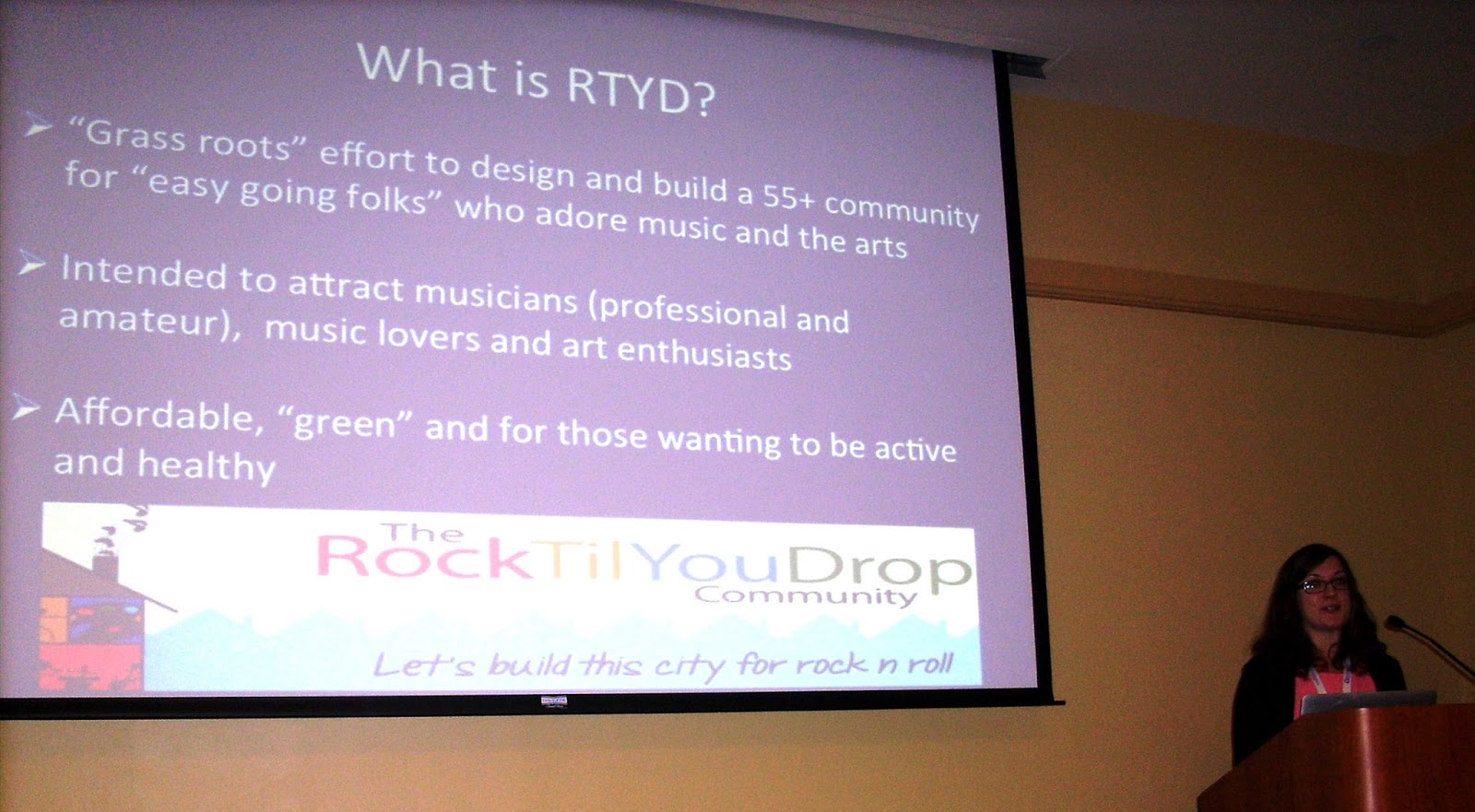
Lydia Manning, Gerontology Professor at Concordia University, presented We Are Building This City on Rock and Roll: Exploring How Music-Enthusiast Baby Boomers Create a Retirement Community.  She is researching how software developer Jerry Myroup and like-minded, easy-going folks age 55+ are designing their own retirement community, called RockTilYouDrop (RTYD), based on music—particularly Little Feat band (“Old Folks Boogie”)—as a common denominator since boomers were “very fortunate to grow up when some of the best music was being created” in the 1960s and 1970s.  Some features of this planned RTYD retirement community:
  • small senior co-housing that is affordable for starving artists
  • “garages” built throughout the community for musicians to practice and for jam sessions
  • eco-friendly building design to conserve energy
  • amenities to include walking paths, bike trails, fitness centers, greenhouses, gardens, multi-purpose clubhouse and buildings dedicated to music and art
  • “travel” units where owners/renters have option of swapping residences with folks in other RTYD communities, all within one hour drive to international airport
  • near hospitals/medical facilities, cultural establishments, college campuses
  • marijuana tolerant—just like in ol’ hippie communes
 
Kathy Black, University of South Florida Social Work Professor and Age-Friendly Sarasota researcher, presented on Aging in Place With Dignity and Independence 
Cynthia Jacelon, University of Massachusetts at Amherst Nursing Professor on The Gardener: A Life Well Lived in Rural Vermont, her case study of Bea Ward from ages 87 to 101.

Networking Receptions
As usual, GSA meeting was packed with events that ran from 6 am until midnight (USC Leonard Davis and Ethel Percy Andrus Gerontology Reception)!
President’s Welcome Reception – taco bar 
Doris Schwartz Gerontological Nursing Research Award Reception came before Presentation and Lecture 
Minority Issues in Gerontology Award Reception hosted by Senior Service America, Inc. (SSAI) 
SSAI Director Tony Sarmiento chatted with Bobbie Yee and David Chiriboga (GSA power couple) and Rashmi Gupta. 
Maxwell A. Pollack Reception 
Technology & Aging Networking Reception 
Association for Gerontology Education in Social Work (AGESW) Reception 
Emerging Scholar and Professional Organization (ESPO) Awards Reception 
USC School of Social Work Reception recognized Vern Bengtson, recipient of 2015 Richard Kalish Innovative Publication Award for his 17th book, Families and Faith: Generations and the Transmission of Religion (2013).  Carroll Estes of UCSF received Bengtson book for being the person in the room with the most grandchildren (2)! 
At USC reception, Bobbie and David mingle with Peggye Dilworth-Anderson and Rebecca Redmond (both involved in WIGL Project).


SFSU presence
Gerontology Professor Brian De Vries was discussant at symposium on Health Disparities in Diverse Older Adult Populations: Policy and Program Implications (SRPP). 
Gerontology Professor Darlene Yee-Melichar was 2015 Program Committee Co-Chair 
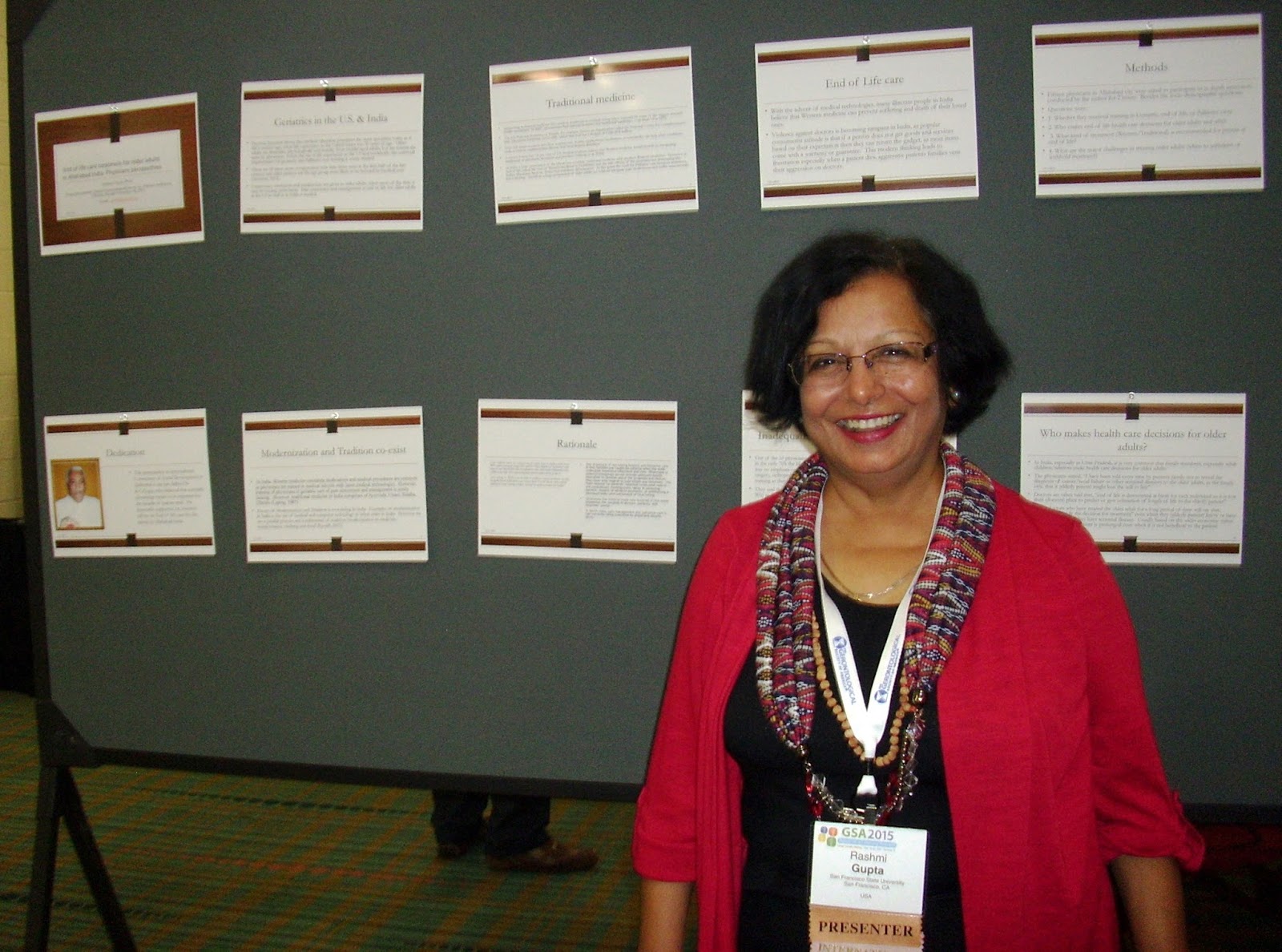
Social Work Professor Rashmi Gupta presented poster, End-of-life-care Treatment for Older Adults in Allahabad, India: Physicians’ Perspectives, which she dedicated to her father, Dr. R.C. Gupta, who supported her research. 
J.F. Oberlin University (Tokyo) Psychogerontology Professor Hisao Osado and SFSU gerontology graduate Sumi Brennan presented poster, Impact of Life Enrichment Services on Quality of Life: A Cross-Cultural Study.


Poster sessions
Ryan Shanley, graduate student at Miami University’s Scripps Gerontology Center, presented Catch Me Before I Fall: Predicting Risk of Falls in Older Adults, finding age, functional dependence, self-assessed risk of falling and fear of falling were significantly associated with Timed Up and Go task that indicates risk of falling. 
Rodlescia Sneed, postdoctoral scholar at University of Pittsburgh, presented Grandparent Caregiving, Race and Cognitive Function: A Prospective Study, finding that grandparent caregivers who provided at least 500 hours of care in the two years prior to baseline demonstrated better cognitive function in 4-year follow-up than non-caregiving grandparents – though this was observed among White caregivers, but not among African-American caregivers.
  
Sheryl Elliott, researcher at Portland State University, presented Culturally Diverse Congregate Meal Sites: Are They Meeting the Needs of Older Adults with Significant Social and Economic Limitations? Recommendations included suggestions about ways to recognize and honor language and culture, increase access by providing affordable means to travel to and from sites, facilitate participation, utilize person-centered approach, and empower clients to seek supports, thereby reducing isolation and enhancing well-being.

At Exhibit Hall Opening, Rick Moody strummed his guitar and sang Jimmy Buffett’s Margaritaville. 
Save these dates for next year's GSA meeting: November 16-20, 2016!


My lifelong process
Since I missed last year’s GSA meeting because I chose to use my limited time-off from work to attend the biennial HPGS conference instead, it was really great to be back soaking up all the latest gerontological research, re-connecting with kindred spirits and just savoring every moment of this year's 5-day GSA meeting …until next year’s meeting, I can re-visit this blog post J.  
The day after the GSA meeting ended, I started a new job working with older adults in senior housing and one of the managers advised me, “remember, seniors are just like children.”  Ouch! This remark reminded me how much gerontologists are needed to educate uninformed people about the realities of aging, including the unique developmental needs of older adults.

Like Laura Carstensen said about people past middle age enjoy life more as our time horizons grow shorter and we see our priorities most clearly,… “we savor life, we are more appreciative, more open to reconciliation, we invest in more emotionally important parts of life, and life gets better … but that same shift in perspective leads us to have less tolerance than ever for injustice.” As it is painful to witness older adults being unjustly patronized by people who hold ageist attitudes, I find myself more understanding when older adults prefer to be in age-segregated settings where there is presumably power in numbers.  Yet I am more appreciative of my upbringing in a three-generation household where my grandparents, models of healthy aging, definitely rocked and ruled … in an ideal world, RockTilYouDrop!