To advocate for aging
services, Coalition of Agencies Serving the Elderly (CASE) urged members
to attend monthly meetings of San Francisco
Commission on Aging, which oversees the budget for Department of Aging and Adult Services (DAAS). CASE represents 37 agencies and their 20,000+
elderly constituents in San Francisco.
At February 4 Commission meeting, seated from left to right,
in photo above, are Commissioners Samer Itani (dentist), Katie Loo, President
Edna James (nurse/health educator/gerontologist and nonprofit OMI Community
Action Organization President), Kaushik Roy (nonprofit Shanti
Project Executive
Director), Neil Sims (executive search firm partner), and DAAS Executive Director Anne Hinton.
Public comment by CASE
Secretary Valorie Villela (also 30th
Street Senior Center Director),
a tree hugger who suggested less printing of agenda which is sent out to
regular attendees.
Anne and Edna congratulated DAAS Employee of Month, who received a desk clock in appreciation.
Municipal
Transportation Agency Board member (and DAAS Manager) Tom Nolan reported last month’s approval of free Muni for low-and moderate-income (up to $67,950
for single person) seniors (age 65+) and persons with disabilities (PWD),
effective March 1, 2015...thanks to grassroots advocacy! Tom reported 20,000 seniors and PWD had already applied,
and anticipated 25,000 to sign-up. He said Muni is for everyone, but
especially those who need it most.

CASE Co-Chair Michelle
Alcedo (also Openhouse Programs Director) presented CASE advocacy platform requesting funding to: 1) increase staffing for community services, 2) increase staffing for Aging and Disability Resource Centers (ADRC, which has
lacked Tagalog speaking staff since July 2014 though Tagalog has been certified as third language for City communications),
and 3) pay more “equitable” salaries for case
management positions because nonprofit agencies struggle to recruit and retain talent
when County salaries are “much higher.” In addition, CASE seeks
to extend free Muni to include group van
and ADA
transportation and 4% cost of doing
business increase for FY 2015-16.
DAAS
Program Support Analyst Monte Cimino requested authorization for additional funds to Mental Health Association of San
Francisco (MHASF) for expanding hoarding support services to non-English speakers. Commissioners responded with ayes.
DAAS Nutritionist Linda Lau had longest presentation requesting authorization of $5
million in add-backs for nutrition, including three new meal sites and expansion of Choosing Healthy and Appetizing Meal Plan
Solutions for Seniors (CHAMPSS,
which is healthier than CalFresh Fast Food Restaurant Meals Program).
“Good end-of-life”
Katy Butler, journalist and author
of Knocking on Heaven’s Door: The Path to
a Better Way of Death (2013), was
speaker at this month’s meeting of San
Francisco Bay Area Network for End-of-Life Care (SFEOL), co-chaired by Nate Hinerman. Now a Dean at Golden Gate
University,
Nate was my former SFSU Professor who taught Death and Dying in Contemporary Society.
Katy discussed the
contrasting experiences of her parents’ final years: medical technology interventions
to keep her dying father alive for “five terrible years,” and her mother’s determination for a better
death so she decided to stop eating and drinking after a second heart attack
brought her to a hospice wing. (The legal status of such "voluntarily stopping eating and drinking" by advance directive is untested.) She said
it takes moral courage to say it’s the end-of-life, which she recognized in her
father’s “benchmark” statements:
- “I don’t know who I am anymore” (lost
capacities)
- “I am not going to get better” (progressive
illness)
- “I’m living too long”
According to Katy, “bad (painful) deaths” are so common because doctors don’t know how to talk to us, insurance pays for
the wrong things (cure v. care), and treatments don’t stop until someone just
says no (because medicine’s default is to offer all reimbursable treatments).
Katy recommended Dr. Angelo
Volandes’ The Conversation: A Revolutionary Plan for End-of-Life Care (2015), for patients, family members and doctors to honestly discuss the following:
·
What kinds of things are important to you in your life?
·
If you were not able to do the activities you enjoy, are there any
medical treatments that would be too much?
·
What fears do you have about getting sick or medical care?
·
Do you have any spiritual, religious, philosophical, or cultural
beliefs that guide you when you make medical decisions?
Katy’s
presentation reminded me of The New
York Times' recent Opinionator piece, “Dying Shouldn’t Be So Brutal,” in which Dr. Ira Byock proposed Safe Dying Act
with these components: 1) train “young” (new?)
doctors to assess and treat pain, listen to patients’ concerns and collaborate
with patients and families in making treatment decisions, 2) require nursing
home companies to double staffing of nurses and aides, and hours of care for
each resident, 3) set minimum standards for palliative care teams within every
hospital, 4) routinely publish meaningful quality ratings for hospitals,
nursing homes, assisted living, home health and hospice programs for people to
use in choosing care, and 5) repeal the Medicare statute that forces incurably
ill people to forgo disease treatments in order to receive hospice care.
Also on my reading list is Atul Gawande’s Being Mortal: Medicine and What Matters in the End (2014), which
was excerpted in Slate and featured in this month’s PBS Frontline.
Community of Voices
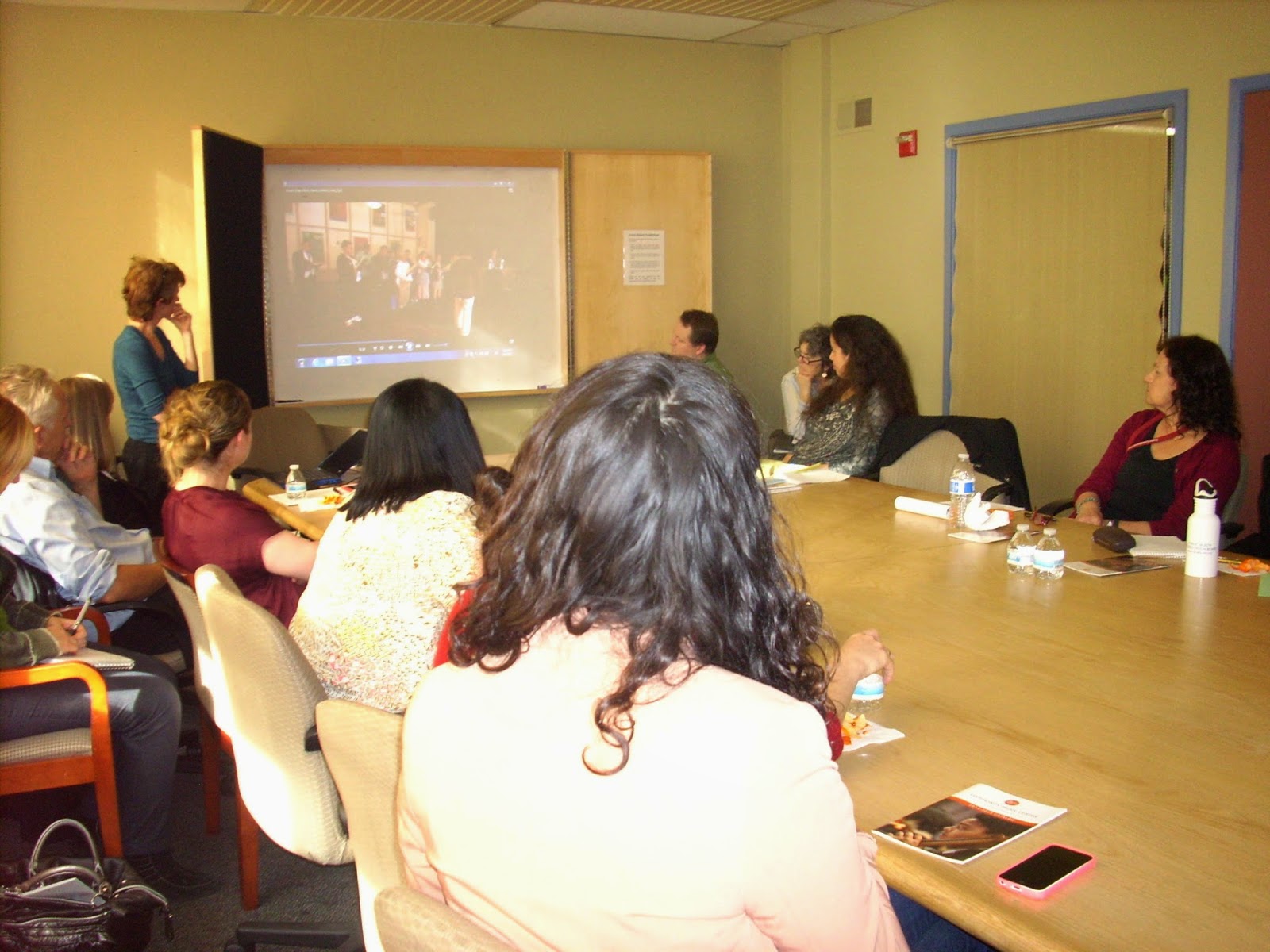
At this month's CASE meeting held at Project Open Hand, Community Music Center (CMC) Program Director Sylvia Sherman spoke about her organization’s partnership with UCSF School of Nursing’s
Institute for Health and Aging and DAAS, to form Community of Voices research involving a dozen senior choirs throughout San Francisco. Funded by a five-year grant from National
Institute on Aging, this study is in its third year to demonstrate health
benefits (lung capacity, balance, coordination, memory, moods) on seniors (age
60+) who participate in a community choir.
Check out video, Can Singing in a Choir Improve the Health of Older Adults?
Caregiving
Another
reason to thumbs-up “like” Kevin Winge even more: he’s got his priorities in
order, resigning as Project Open Hand (POH) Executive Director to return to
his home state of Minnesota
to provide care to his sisters who are critically ill. I liked Kevin’s memoir, Never Give Up: Vignettes from Sub-Saharan Africa in the Age of AIDS
(2006, reminded me of my own experience as Global Service Corps volunteer in Tanzania), his monumental decision to remove the soda vending machine (ostensibly to cut
unnecessary electricity costs), expansion of POH meals to include
clients with ten additional diseases (beyond traditionally served clients with
HIV/AIDS and cancer), Food=Medicine Pilot Study with UCSF,
expansion of senior congregate meal sites, etc. Kevin will be missed more than the in-house production of peanut butter and beloved macaroni and cheese, which he also removed from POH menu.

Let’s
Kick ASS (AIDS Survivor Syndrome) hosted Who Is Going to Care For Us As We Age? A Discussion on Options for Long-Term Care, at
LGBT Conference Center with elder law attorney Daniel Redman and NEXT Village
Director Jacqueline Zimmer (JZ) Jones. Daniel provided an overview of the continuum of care (in-home, assisted living, continuing care retirement communities, skilled nursing) from low-income (SSI/Medi-Cal/IHSS) to private pay options, and San Francisco's proposed LGBT Long-Term Care Facility Residents' Bill of Rights. JZ shared the benefits of joining NEXT Village, which serves residents in San Francisco's north east, and tips for LGBT community to start a village of neighbors helping one another so all can successfully age in community.
Dementia care

Alzheimer’s
Association Director of Diversity Edie Yau moderated panel discussion on Sharing
Lessons Learned: Integrating Cultural Values, Beliefs and Practices into
Dementia Care of LGBT Older Adults, with Geoffrey Kerchner (Alzheimer's researcher), Lou Bordisso (retired therapist with early-onset Alzheimer's),
and two caregivers. LGBT seniors may fear disclosing their sexual orientation/gender identity and not access services out of fear of discrimination, and few providers have received training to celebrate (not just tolerate) LGBT. Alzheimer’s Association has LGBT Caregiver Concerns brochure and Family Caregiver Alliance has LGBT Caregiving: FAQs.
At
AgeSong Guru Project’s Biomedical Convention, psychiatrist and Pacific
Institute board member Richard Patel welcomed psychologist (retired) Richard
Taylor and geriatrician Allen Power for a discussion about wisdom in
changes associated with aging and forgetting.
Richard Taylor,
author of Alzheimer’s From the Inside Out (2006), has been sharing his experience since receiving his diagnosis of
dementia ten years ago. He described the
disengagement process, and finding the “disease” answers in the medical model
do not help. Rather than being defined by deficits to be fixed, it takes time to find out what he can do and
the brain is always trying to figure out, Who am I? What’s going on? Why am I
here? He repeats because he wants answers that he can’t hold in his short-term
memory. To understand “problem behavior” (negative label) is to understand who the person is, including unique ways of expression, rather than project needs to quiet behavior
with psychotropic drugs. Richard's call to action is: "Stand up! Speak up! Do not victimize yourself with your own silence. How will anyone really know what it's like to live with dementia?" He encouraged us to sign-up for his newsletter at http://www.richardtaylorphd.com/. (Another resource is Dementia Alliance International, established in 2014 and the first international group of, by and for the people with dementia engaged in advocacy to eradicate stigma, isolation and discrimination.)
Singalong at AgeSong’s
Forget Me Not Café: music + cognition.
SFSU gerontology classmate
Brittany plays flute at AgeSong’s University campus during Guru Launch Gala.
Psychotherapist
Nader Shabahangi, founder of AgeSong and Pacific Institute,
moderated discussion of the AgeSong Guru Project,
a one-year initiative to “focus on comprehensive care
partnerships with elders to understand need-driven behaviors and minimize risky
use of psychotropic medication.”
AgeSong
Care Planning Liaison and Pacific Institute Clinical Psychology Ph.D. student Stephanie
Rothman’s interest in “what matters in life” led to working with elders, whom
she finds more authentic. She described
her disillusionment while attending last year’s Alzheimer’s Association
International Conference in Copenhagen
that was akin to a pharmaceutical convention. Instead of drug treatment to make persons with dementia more like us inside, Stephanie seeks
depathologizing dementia and psychosocial treatment to see the real person from his/her perspective: we learn from feistiness because we are better off when needs are expressed and supported.
Richard
said humanity increases with
dementia because you become more of who you are when pretense fades away and
you get in touch with your needs for esteem, love and belonging, which you are
more willing to express as you get older; forgetfulness gets you closer to
humanity because you stay in the present
moment to understand now instead of past; instead of looking back at "who I was," now time is spent working on "who I am." Allen echoed those thoughts about getting to the essence when one is
more honest and transparent with fewer agendas, and advocated for an abling perspective so people feel allowed to be.
Hospital discharge
At
Hospital to Home: A Community Forum on
Hospital Discharge, held at 30th Street Senior Center's dining room, DAAS Director Anne Hinton provided an overview of San
Francisco’s Long-Term Care Integration Strategic Plan.
Senior
and Disability Action (SDA) Executive Director Sarah Lehman moderated the panel
of speakers:
- Carrie Wong, DAAS Director of Care Transition
Operations, explained San Francisco Transitional Care Program (SFTCP) provides services (transportation including medication pick-up, 14 days of
meals, 6 hours of homecare) for 4 to 6 weeks, at no cost to eligible San Francisco residents
with Medicare Parts A and B who are referred by one of eight partnering hospitals to
prevent unnecessary readmissions.
- Donna Willmott, SDA Consumer Advocate,
reminded us that Medicare covers the first 20 days in an approved skilled
nursing facility, only if one first has at least
three full days of "inpatient" Part A hospital care. However, hospitals are placing
more patients under “observation status” to protect themselves against new
policies that penalize hospitals for unnecessary admissions. Therefore, Medicare patients should ask
whether they are considered inpatients or outpatients each day they are in
the hospital as status can change.
More tips in SDA’s June 2013 newsletter.
- Marcia Peterzell, Community Living Campaign
Connector, discussed Connections for Healthy Aging workshop that covers hospital stay and advocacy. She distributed Vial of Life kits for us to complete personal identifying information, medical history and
information, and emergency contact.
- Ken Hornby shared his personal experience and
the need for self-advocacy to make sure one is heard to get the help
needed. Medicare has Discharge Planning Checklist.
One attendee shared her
experience of having her service dog stay in the hospital with her. (Some institutions recognize doctor’s orders
for pet visits.) There were more providers than consumers at this event, which was scheduled at the same time as Ai-Jen Poo's book tour talk on Women, Leadership, and the Future of Care.
“Old is gold”: telephone community
After
taking online classes like Coursera’s Living with Dementia: Impact on
Individuals, Caregivers, Communities and Societies, conveniently accessible 24/7 with power point presentations, taking classes via telephone seems so
quaint. But a recent Telegraph article, “Why low-tech living is back” declared, “old is gold” with the popularity of printed books, vinyl records,
typewriters, retro-phones, and Polaroid instant photo cameras.
Staying Engaged for a Lifetime gerontologist
Hope Levy introduced Susan Lee Lindeman, Program Manager of Senior Center Without Walls,
a “statewide telephone community” serving about 300 older adults age 60+ in California. SFSU gerontology alum Terry Englehart founded
this award-winning nonprofit in 2004 to connect homebound, isolated seniors via
telephone in activities such as bingo, improvisation, armchair travel,
singalongs, health presentations, book clubs, support groups, etc. To participate or volunteer, call
877-797-7299.

 Sociology
Professor Becky Yang Hsu discussed
her upcoming book, Happiness in China:
Family, Fate, and the Good Death, at the University of San Francisco. She
explained that death can be “happy” in China because it is a social event which
strengthens existing relationships:
Sociology
Professor Becky Yang Hsu discussed
her upcoming book, Happiness in China:
Family, Fate, and the Good Death, at the University of San Francisco. She
explained that death can be “happy” in China because it is a social event which
strengthens existing relationships: