Showing posts with label People With Disabilities Foundation. Show all posts

Friday, July 31, 2015

Beautiful Acts: Americans with Disabilities & Older Americans

“I want future generations to know that we are a people who see our differences as a great gift, that we are a people who value the dignity and worth of every citizen – man and woman, young and old, black and white, Latino and Asian, immigrant and Native American, gay and straight, Americans with mental illness or physical disability.”
-- U.S. President Barack Obama, January 20, 2015 State of the Union Address
This month’s 25th anniversary of Americans with Disabilities Act (ADA), at least in San Francisco Bay Area, seemed to upstage the 50th anniversaries of Older Americans Act (OAA) and Medicare.  While OAA tends to promote age segregation by funding programs for age 60+ (with few intergenerational provisions that could be strengthened), I prefer ADA’s provisions for reasonable accommodation to promote integration into community living for all ages and abilities.  Ideally, integration creates inclusive communities where everyone can be accepted for who they are.

In Andy Imparato’s blog post, The ADA and Claiming Disability, I thought about inserting “old age” for “disabilities”:  
“Rather than buying into the larger societal narrative that disabilities are inherently limiting, we have an opportunity to recognize that personal experience with disability can lead to greater personal strength, creative problem-solving, and a stronger connection to other populations who face discrimination at work, at school and in the community.”

From ugly to beautiful law

In 1867, the first “ugly law,” making it illegal for persons with disabilities to appear in public, was enacted in San Francisco.  In 1977, San Francisco helped set the stage for passage of ADA, when more than 150 people of all types of disabilities took part in the longest occupation of a federal building, in the San Francisco regional office of the Department of Health, Education and Welfare (HEW), to demand implementation of regulations to Section 504 of the Rehabilitation Act of 1973.  
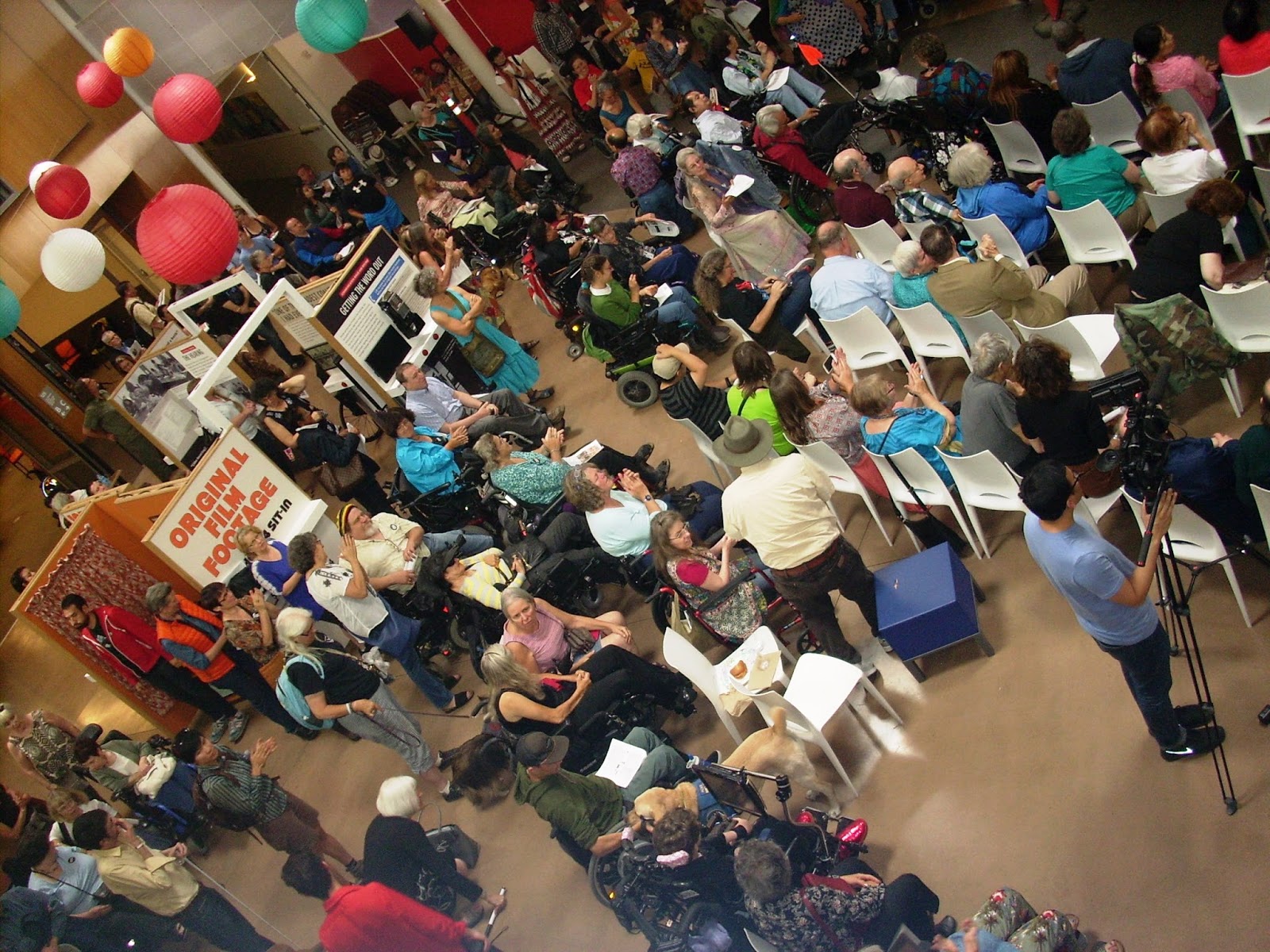
Carla Johnson of San Francisco Mayor’s Office on Disability (MOD) and Community Alliance for Disability Advocates (AIDS Legal Referral Panel, Senior and Disability Action, San Francisco IHSS Public Authority, The Arc of San Francisco, LightHouse for the Blind, Independent Living Resource Center of San Francisco, Paul K. Longmore Institute on Disability, Community Living Campaign, Toolworks, Bakeworks) hosted ADA Month Kick Off Celebration on July 1st inside City Hall (which celebrated its own centennial last month).   
Mayor Ed Lee greeted the audience of “beautiful people” and praised ADA for promoting independence, inclusion and community, consistent with making San Francisco for the 100%.  During last month’s U.S. Conference of Mayors meeting in San Francisco, he introduced a resolution that was adopted nationwide to recommit cities to the goals and ideals of ADA.  He then proclaimed July as ADA Month in San Francisco. 
District 1 Supervisor Eric Mar honored grassroots organizations like ILRC and co-sponsors for organizing California #ADA25 Conference on September 25-26, in San Francisco.  He said it was Disability Empowerment Month when supervisors would introduce legislation, led by people with disabilities and supported by allies, and spoke about need for Dignity Fund. 
Kathy Martinez, a former ten-year-old actress in Lassie TV show, recalled being age 17 during 1977 sit-in that was an “invitation to fight for our civil rights.”  As former Assistant Secretary in Office of Disability Employment Policy at U.S. Department of Labor, she advocated hiring people with disabilities to achieve financial independence.  
Former Assemblymember Tom Ammiano recalled being a school teacher who brought his hungry students to the 504 rally, so when asked, “What do we want?” they replied, “French toast,” instead of “civil rights!”  On a more serious note, he reminded us that we all get old, when accommodations are welcome then, but awareness is needed beforehand to prepare.  He said to look for the 2016 ballot measure for Dignity Fund, which would allocate real estate taxes for seniors and persons with disabilities. 
Access SFUSD appeared on stage twice: to speak on disability perspectives (“because of ADA …”) and to show their dance moves to a medley of songs from 1990.
San Francisco MOD squad, established in 1998 as the City's overall ADA Coordinator, and banner reminded us that celebrating 25 years of ADA doesn't stop here:  the struggle continues to eliminate attitudinal, communication, transportation, policy and physical barriers in order to achieve full integration of people with disabilities in our society. 
Ms. Wheelchair California at Patient No More panel, a preview of larger exhibit at Ed Roberts Campus in Berkeley.
Bryan Bashin of LightHouse and Catherine Kudlick of Longmore Institute. Catherine explained double meaning of Patient No More: people with disabilities have lives beyond medicine, and they should not have to wait.   

Universal design 
Panelists discussed ADA’s impact on design with architect Michael Chambers as moderator at SmithGroupJJR in San Francisco:
·      Architect Chris Downey of Architecture for the Blind: ADA means opportunity, access to life; no handicap unless barrier is put in the way, which is done (or not done) by an architect in the built world; one has a disability, but not disabled; access is not just code, but a civil right
·      Disability Rights Advocates attorney Zoe Chernicoff: ADA is not just about physical access but covers more; for example, solitary confinement discriminates against people with mental disabilities
·      Architect and gerontologist Alexis Denton: ADA provides minimum standards, should aspire to go beyond with universal design for everyone and create great experience by designing with empathy
·      Architect Gilda Puente-Peters: ADA model has been used internationally by other countries to develop their own access standards, but ADA enforcement is weak
·      Center for Independent Living’s work and benefits counselor Alana TheriaultADA, which does not cover airplanes (but Air Carrier Access Act does), could be improved to provide more expansive definition of access.

Chris and Alana mentioned Berkeley’s Ed Roberts Campus as an example of accessible design.                   
Ed Roberts Campus housed the equally accessible exhibit, Patient No More! People with Disabilities Securing Civil Rights, which held its grand opening on ADA’s 25th anniversary on July 26. 
Spiral ramp inside Ed Roberts Campus 
Quiet area outdoors to get away from sensory overload 
Disability Mural (2000-Present) is the first community artwork about the everyday experiences of living with a disability, created by people with and without disabilities. 
Mural tile reads: "One day many people will learn to sign, and we all be seeing voices...when all the world speaks with its hands!"
Room for improvement on one size fits all

Rosemarie Garland-Thomson has noted that disability is the body's response over time to its environment.  Temporarily abled people who acquire a disability later in life experience disability differently (like learning a foreign language later in life), than people who have a congenital disability and already have adapted to “fit in” the built environment or changed the inaccessible environment to accommodate their individual differences (latter often benefits our broader society).  People with a congenital disability do not experience loss over not being able to do “normal” activities because they never did, so this self-acceptance reframes “the problem is the solution.” 
  
Celebrating disability civil rights 
Cathy Kudlick, who developed Patient No More exhibit with her team at Longmore Institute, welcomed attendees at grand opening. 
Jeff Moyer, songwriter and 504 participant, led 504 protest song, Hold On:
        “Civil Rights were knocking at our door,
        But Carter wouldn’t stand on 504…
        After four years of delay,
        We came to claim the ground we’d gained…
        Well, for 28 days unafraid
        150 people with disabilities they stayed.
        They had their eye on the prize.  They held on.
        Hold on. Hold on.
        Keep our eyes on the prize. Hold on…”  
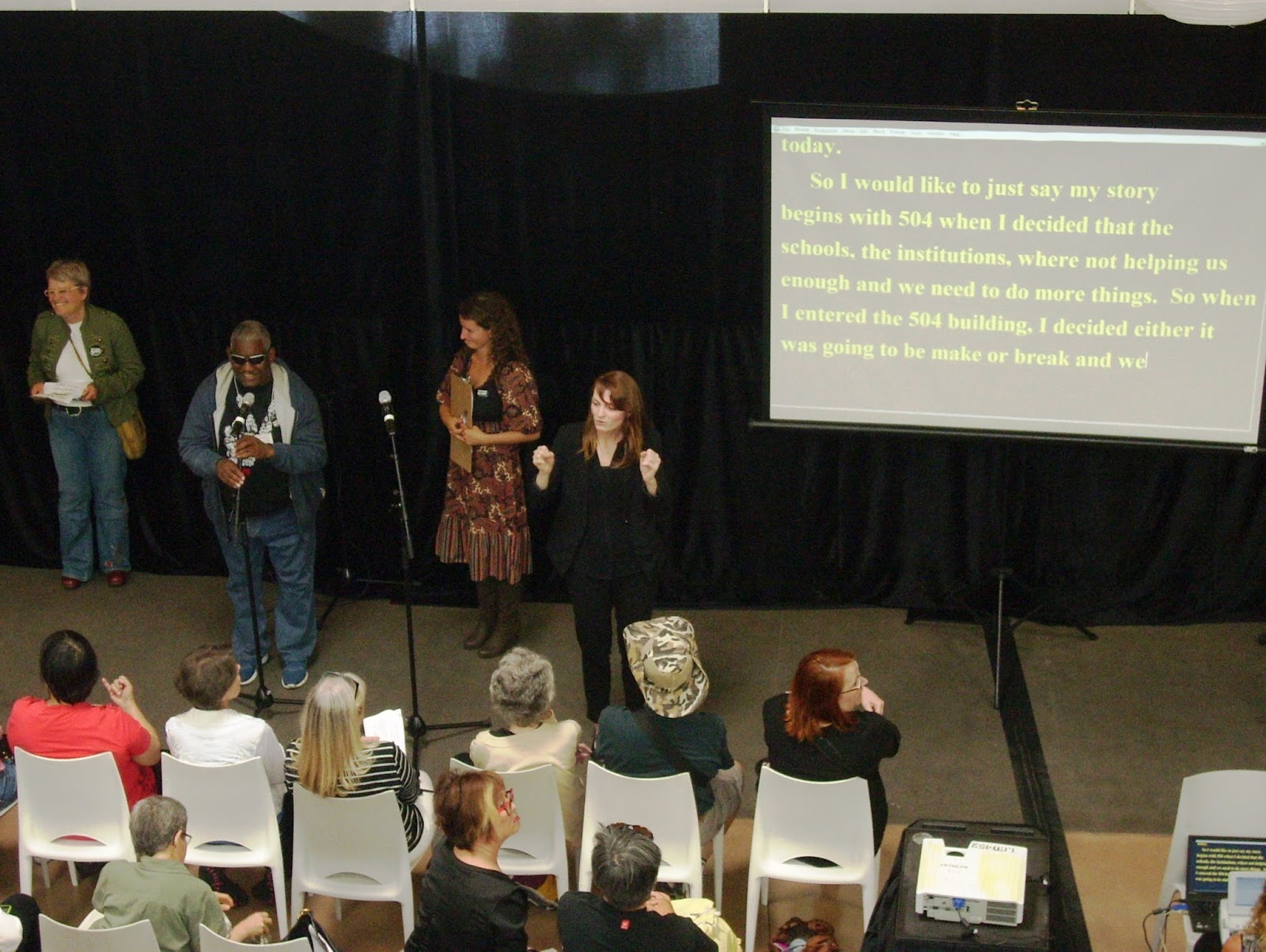
Dennis Billups, 504 Chief Morale Officer, led chant, “1-2-5-0-4. Kickin’ in the bathroom door …We’re rolling in victory now.” 
Interactive exhibit, with poster of Billups during 504 demonstration, invited visitors to respond, What makes you “patient no more”?  
Bruce Oka, 504 participant and former SFMTA Director, said he was "patient no more" because he was tired of being excluded, and talked about need to be included. 
Corbett O’Toole said she was "patient no more" because there are only two lawyers in the nation available to represent parents with disabilities losing custody of their children. 
Persons with disabilities nationwide occupied the regional offices of HEW in April 1977, but only San Francisco held out until April 28, 1977 when HEW Secretary finally signed regulations implementing Section 504. 
·      504 protests and ADA legislation grouped people with many different disabilities together, so there would be one big ADA instead of mini-ADAs for each impairment group
·      504 resulted in a national disability rights movement and national disability organizations that could promote and defend ADA
·      504 defined disability flexibly and took prejudice into account, so ADA could be about civil rights rather than medical diagnoses
Section 504 served as a template for the more comprehensive ADA passed in 1990, showing that disability rights could benefit many without adding a huge burden on society.  


disability = diversity


Invisible disabilities

At this month’s Mayor’s Disability Council meeting, attendees presented on “what ADA means to me” with several mentioning “invisible” disabilities (like learning differences and psychiatric disorders), how physical and mental disabilities influence another, and the financial impacts.  The majority of disabilities are non-apparent, and until ADA Amendments Act of 2008, the U.S. Supreme Court did not consider persons with diabetes and mental illness as disabled, and thus not entitled to protection against discrimination.  In fact, neuropsychiatric disorders represent the largest category of disability in the U.S. The landmark Olmstead case, in which the U.S. Supreme Court ruled that persons with disabilities must be enabled by states to live in the “most integrated setting appropriate” to their needs and that “unjustified isolation” is discrimination based on disability under Title II of ADA, involved persons with “invisible disabilities” (mental illness and developmental disabilities).
People With Disabilities Foundation (PWDF), a non-profit that aims to “provide total integration of people with mental disabilities into the whole of society,” hosted a delegation of disability advocates from 20 countries, at the invitation of U.S. Department of State’s International Visitor Leadership Program (IVLP), Access for All: Enhancing the Lives of People with Disabilities. Founded 15 years ago in San Francisco, PWDF won the nation’s first court case requiring a federal agency to accommodate the needs of persons with mental disabilities, who were denied equal access to Social Security disability programs, in violation of Section 504 of the Rehab Act of 1973, because they could not understand the complex eligibility rules. PWDF’s Parity in Advocacy initiative works to provide equal access to legal representation for those with mental disabilities (advocacy version of Mental Health Parity).

With the passage of ADA 25 years ago, the U.S. became the first country in the world to adopt national civil rights legislation banning discrimination against persons with disabilities.  ADA was the model for the Convention on the Rights of Persons with Disabilities (CRPD), which U.S. President Barack Obama signed in 2009, but its ratification voted down by the Senate.  

                                                                  
The 50th anniversary of Older Americans Act (OAA) on July 14 was a non-event in the Bay Area.  The decennial White House Conference on Aging (WHCoA) took place the day before with at least one watch party of the live stream in San Francisco.  Congress didn't fund WHCoA so its executive director Nora Super had to get non-government sponsors to help organize this event.  At least on July 16, the Senate passed the bill reauthorizing OAA, which expired 2011, and now goes to the House for consideration. 

I was not aware of any delegations visiting from other countries to learn about OAA as a model . . . 
Senior and Disability Action’s monthly meeting celebrated ADA rather than OAA.
Model garden at 30th Street Senior Center is a beautiful act of nature

Sunday, August 31, 2014

Listening

The Doobie Brothers gave good advice when they sang, Listen to the Music, written by Tom Johnston:

Wo, we got to let the music play 
What the people need
Is a way to make 'em smile
It ain't so hard to do if you know how
Gotta get a message
Get it on through
Oh now mama's goin' to after awhile
Wo, oh, oh, listen to the music
All the time 

Like executing advance health care directives, those who can listen to music should document our favorite music while we still have capacity.  
At San Francisco’s Opera Plaza Cinema, filmmaker Michael Rossato-Bennett showed Alive Inside, a documentary about the transformative power of “personally meaningful” music to “re-awaken” memories of persons with dementia. (Screen shows nursing home resident Henry becoming animated while listening to his favorite music, in photo above.)  It follows New York social worker Dan Cohen dispensing iPods first at a nursing home and seeing the benefits (regain self-expression, memory recall, physical movement) as residents listen to their favorite music, then he brings iPods to a private residence in the community with similar effect.  Neurologist Oliver Sacks, author of Musicophilia:Tales of Music and the Brain, reminds us that Kant called music the “quickening art” because of its ability to bring listeners immediately to life.  For persons with dementia, this is possible because musical memories activate more parts of the brain last touched by Alzheimer’s, the most common form of dementia.  Alive Inside provides these facts:

5 million Americans have dementia
10 million care for them
1 million in nursing homes lose their connection to life

In Alive Inside, Dr. Bill Thomas discussed how music creates spontaneity in contrast to the regimented world of nursing homes (total institutions), where residents lose independence, dignity and control over meds that sedate them; as they struggle to adapt, they end up withdrawing inside as "living dead" people.  However, he notes that a $1,000 anti-depressant is “real business” (reimburseable under health insurance system), while a $40 music system does not count as a medical intervention; Western medicine views the body as a machine, while music touches the heart and soul of the patient. 

Twenty years ago, Dr. Thomas published The Eden Alternative: Nature, Hope and Nursing Homes, critiquing the prevailing nursing homes modeled after hospitals. Based on this medical model of treatment focused on disease, disability and decline (body system failures), residents are overtreated with psychotropic drugs, unnecessarily restrictive diets that take pleasure out of eating, endless activities programs to meet needs of regulators (rather than true needs of residents), and a therapeutic mentality that remakes ordinary life activities (e.g., pleasure of animal companionship, enjoyment of children, music, art, movement and touch) into treatments rendered by certified therapists.

In its place, Dr. Thomas proposed his holistic Eden Alternative model of personalized care that promotes growth in an enlivened human habitat so residents have “close and continuing contact” with a harmonized diversity of plants, animals and children to combat the “three neglected plagues of nursing homes”—loneliness, helplessness and boredom (social system failures that can be addressed by providing companionship, usefulness and variety).  Instead of scheduled visits for pet therapy, pets would live with residents.  Dr. Thomas acknowledged the role of music when he stated “few human hearts are immune to the uplifting effect of a bird’s song” and suggested parakeets—though imprisoned in bird cages, while dogs and cats roam freely. 


I had many questions, but I was reluctant to ask during the 15-minute Q&A with both filmmaker Michael and social worker Dan after the screening because the audience seemed so enamored with the idea of bringing iPods to nursing home residents with dementia.  During this Q&A, Dan mentioned that a resident listening to just one hour of music in the morning is “good for the day.”  He also reminded us that long-term memory is retained longer and hearing is the last sense to go when one dies.  I wondered if this suggested that one-hour of personalized music alone for the hearing was sufficient to combat loneliness, helplessness and boredom—without adding Eden Alternative elements like plants, animals and children?

My critical mind wondered why the woman living at home in the community was deprived of music until social worker Dan got her an iPod playing her favorite music? Did she stop listening to her favorite oldies music when her 8-track became obsolete, and did not transition to cassette tape or compact disc? Is the takeaway message for us to avoid music (nature) deficit disorder so we should “listen to the music all the time” and be alive to experience every moment of life as a gift, prayer or sacrament like e.e. cummings' the gladdest thing?

Why select so many happy-dance songs? For example, the film featured Bobby McFerrin of Don’t Worry, Be Happy (1989 Grammy Award Song of the Year):
In every life, we have some trouble
When you worry, you make it double
Don’t worry, be happy . . .
The landlord say your rent is late
He may have to litigate
Don’t worry, be happy

In light of the increasing rates of evictions when renters can lose their home within three weeks for failure to pay rent and the fact that 90% of tenants in eviction cases go without legal representation, listening to this song is creepy . . . though last month San Francisco approved funding $1 million for eviction legal defense services.

How about listening to songs that arouse other emotions like anger (Pat Benatar’s Hell is for Children), sadness (Rolling Stones’ Angie), grief (Tracy Chapman’s Behind the Wall), pensiveness (Beatles’ Revolution), etc. to fully express the range of emotions instead of simply joy? How about songs about social justice (Shane Philips’ Rise Up) to inspire change? All honest emotions that flow through (unstuck) can engage us with life.
Like Dr. Thomas’ The Eden Alternative, a non-profit organization that offers culture change training to de-institutionalize long-term care environments and membership in Eden Registry for $3,300, Dan Cohen’s opportunistic Music & Memory is a non-profit that provides training and certification for $1,600. When Music & Memory asks, "Can an iPod change a life?" I wondered whether it has any financial interest in Apple company stock for marketing its products? Also, I wondered about potential hearing loss from use of headphones/earphones? 
In the audience, I spotted California Advocates for Nursing Home Reform (CANHR) Senior Attorney Prescott Cole, who was guest lecturer in my Ethical and Legal Issues in Aging and Social Services course.  He also wrote and composed Shady Manor, a 22-song musical about “a nursing home run by an ambitious and corrupt administrator trying to make Shady Manor show a profit so he can get promoted by his corporate higher-ups.  To make a profit he cuts corners on supplies and under-staffs, causing misery for the residents.”  Shady Manor was performed last year as a fundraiser for University Mound Ladies Home, a non-profit assisted living that was ultimately “saved” from closure when acquired by for-profit AgeSong this month. 

 
At the San Francisco Main Library, People With Disabilities Foundation hosted a seminar, Abuse Against People with Mental and/or Developmental Disabilities: Physical, Sexual and Verbal Abuse in Institutional or Community Settings, to address the potential causes, ramifications, and preventive measures related to the abuse of people with mental and/or developmental disabilities.  Dr. Clarissa Kripke (seated 2nd to left behind table, in photo above), UCSF Clinical Professor of Family and Community Medicine, provided 10 tips for improved communication between professionals and people with psychiatric and developmental disabilities:
  1. Speak directly to patients.  Figure out how people communicate best and support it.
  2. Presume competence.  Give access information and education as well as support for people to make their own decisions.
  3. Give people the tools to communicate about mistreatment, boundaries and choices.
  4. Teach people to set boundaries and protest to help people maximize their potential and to participate fully. Compliance training is a set up for abuse.
  5. Train families and professionals how to listen and respond. Communication is a twoway street. Put people with disabilities in charge of developing the curriculum.
  6. Take all complaints about mistreatment seriously. Investigate them, and protect people from the accused during that process. 
  7. Give people opportunities to try and fail when the stakes are low, so that people have experience with natural consequences when the stakes are higher.
  8. Get a history of baseline function. In people with communication challenges, illness presents as a change in behavior or function. 
  9. Respect personal boundaries. Offer assistance, but wait for a response and instructions before acting. Treat assistive devices such as wheelchairs and communication devices as personal space. 
  10. Give people access to their chosen advocates and supporters. Many people need support to communicate and to make decisions, especially when they need it the most such as when they are in crisis or transition.
Dr. Kripke, who received the Chancellor Award for Disability Service and has a son with autism, noted Autistic Self Advocacy Network (ASAN) drafted model state legislation to enable Persons with Disabilities a trusted person to help communicate with doctors, understand health care information, make informed decisions about health care, and/or carry out daily health-related activities. This would be like a power of attorney for health care, except there would be no transfer of decision-making to another person. 
CANHR Staff Attorney Tony Chicotel said chemical restraints have been the primary treatment for behavioral expressions related to dementia, such as memory loss, confusion and loss of ability to communicate.  He asked, “what do you do with a crying baby? A. Give them drugs, or B. Tend to their needs and comfort them?”  Instead of drugs, the focus should be the least medicating approach recognizing behavior is communication, knowing care recipient, and meeting them where they are (versus correcting mistakes); and comfort-focused care involving culture change components (liberalized diet, personalized sleeping and showering schedule); active observation, notation and collaboration; and comfort as the goal of every experience.  Tony suggested we reframe the language: for example, viewing the person with dementia resisting care v. exercising self-protection; or wandering v. expressing underlying boredom or lack of physical activity. 

This reminded me of Dr. Thomas saying, “If only we could care for nursing home residents as we care for children. After all, we expect children to grow and we do everything we can to nurture that growth.”  I wondered how can we support growth when caring for persons with dementia (particularly in its progressive and degenerative form like Alzheimer's disease) who grow more dependent as they lose capacity for decision-making? 

I did a lot of listening and learning at Discover You: A Day of Connections, Information and Possibilities! an all-day seminar presented by National Federation of the Blind of California and LightHouse for the Blind.  The main message was set high expectations to do what you want, focus on your strengths, talk about your disability and figure out how to do things and ask for accommodation if needed.  GK Callahan’s The Beaded Quilt (2011, photo above) mural represents the colorfulness and diversity of the Bay Area blindness community who assembled it from almost 150,000 colored beads, and over a year in the making.
Architect Chris Downey, Attorney Shannon Dillon, and CEO Kevan Worley (also Executive Director of National Association of Blind Merchants) participated in breakout session, Discovering Employment Opportunities.  Chris related how soon after he lost his vision in mid-life, a social worker began talking to him about career alternatives.  As an architect, Chris said his work is about trying different points of view and problem-solving, so he ignored the social worker’s advice and found adaptations to continue working as architect while carving out a niche in designing for the blind!  Because architects are obsessed about the world around them, he rediscovered the world without the visual—paying more attention to space and sound—so it was like being a kid again. 
Deborah Kendrick, author of Jobs To Be Proud of and Jobs That Matter from AFB Press, is also columnist for Columbus Dispatch with her latest article, How much do you know about disabilities?