Showing posts with label Older Americans Act. Show all posts

Saturday, April 30, 2016

Normalization

In No Pity: People with Disabilities Forging a New Civil Rights Movement (1993), Joseph P. Shapiro noted that deinstitutionalization and the community living movement in the 1960s was driven by the rise of the concept of normalization.  This sociological (as opposed to medical) approach to disability has application to all who wish to age in place by normalizing aging and dying:  ask the elderly what matters in the end. Nothing about us without us!

“The normalization principle means making available to all people with disabilities patterns of life and conditions of everyday living which are as close as possible to the regular circumstances and ways of life or society.”
Bengt Nirje on Normalization, which laid the groundwork for social inclusion and self-determination for people with disabilities

“Normalization demands …an entire spectrum of community living arrangements to serve all ages and age appropriate behavior levels, to address progress, integration and independence appropriate to a person's age and competencies.” – William G. Bronston, MD, on Concepts and Theory of Normalization 

Normalization means giving people with disabilities (including older adults) the same opportunities in life that others have.  The person is not the one being forced to be normal, but the environment is changed to give this person a chance to experience what is considered "normal." 

Senior & Disability Action staff presented Disability & Ableism Training, including skit on how to communicate and interact effectively with people with disabilities.

Nourishing the whole person

Normally eating can be a pleasurable activity, but can be challenging to those with dental problems (missing teeth, adjusting to dentures) or medical conditions (dry mouth, fatigue).  In my work with seniors, I routinely assess for nutritional risk asking, “Do you have tooth or mouth problems that make it hard for you to eat or chew?” When a client responds in the affirmative, my follow-up question is, “Would you like to change to a mechanical soft diet?”  Initially clients resist saying that they “don’t want any pureed baby food.”  Then I explain a mechanical soft diet includes a spectrum of different textures and consistencies (soft, liquid, blended, chopped, ground or minced) so it’s easier to chew and swallow.  The following are sample foods prepared by Meals On Wheels of San Francisco—so you see, these meals are age-appropriate for senior clients! 
Mechanical soft pork loin in sesame with peas & curried lentils: looks similar to kitfo (Ethiopian minced meat) or moo-shu (Chinese ground pork) moistened with sauce/gravy! 
Salisbury steak in mushroom sauce with broccoli, cauliflower & carrots


Dementia = Being present (tense)

At SFSU Counseling Student Association’s 5th Annual Counseling Symposium, Nader Shabahangi and Sally Gelardin of AgeSong presented on 17 Things I Would Want, If I Get Forgetful (adapted from Rachel Wonderlin’s 16 Things I Would Want, If I Get Dementia).  Nader’s introduction raised the issue of labeling that separates humanity; for example, “disabilities” suggests being outside of the mainstream, rather than different functional abilities giving rise to possibilities.  Another example is “dementia” meaning “out of one’s mind” (from Latin), and this could suggest emptying the mind as in Zen enlightenment.  

Instead of the scientific view of dementia with its emphasis on cure, Nader talked about adopting an attitudinal shift towards a humanistic view of forgetfulness with an emphasis on care.  He noted that forgetfulness has a purpose to “let the mind go” of memories causing pain or embarrassment, to slowly work one’s way through death.  “If we view elders as our teachers, then forgetfulness as our teachers” that push us to learn wisdom and qualities like being present. 
  
Contemporary Jewish Museum’s Access Program hosted The Power of Art and Music: In the Lives of Those Living with Alzheimer’s seminar exploring research on creativity and the brain, and how arts and cultural experiences can enrich the lives of people living with Alzheimer’s or dementia.  The panelists included:

  • Zachary Miller, MD Assistant Professor of Neurology, UCSF Memory and Aging CenterNeuroscience of Visual Art: lefty doc noted greater number of left handers in mental asylums & artistic behavior among mentally ill
  • Lola  Fraknoi, founder of Ruth’s Table and Art Time Programs for a Creative Life  - Prompting to Make Art kit to release creativity in persons with moderate dementia
  • Andrea Korsunsky, Coordinator for Center for Dementia Care, Seniors at Home, a program of Jewish Family and Children’s Services (JFCS) - Communication Strategies: use nonverbal body language to listen & be present, avoid word “remember”, ask for help & support in community
  • Rachel Main, Family Support Coordinator, Ray Dolby Brain Health Center, Alzheimer’s Association – Why is Music and Art Important in Daily Life for People with Dementia? Engage both sides of brain to reduce 4 A’s (agitation, anxiety, apathy, aggression) & replace antipsychotics, focus on strengths that remain. 


Lola's examples of Prompting to Make Art: 1st slide (top left) shows beginning sketch of open image as visual cue for persons with Alzheimer’s to “think outside the box” and continue the drawing. 

Other resources:
·         TimeSlips 
·         Alzheimer’s Poetry Project 
·         NCCA Creative Caregiving 


Care giving/taking

At Ed Roberts Campus, UC Davis Alzheimer’s Disease Center and Alzheimer’s Association presented the 8th Annual African-American Caregiving and Wellness Forum: Focusing on Brain Health and Disease Management, which included a discussion moderated by Miranda Wilson of Smooth Jazz 98.1 FM:
·         Rita Hargrave, MD, geriatric psychiatrist at Veterans Administration
·         Yaisa Andrews-Zilling, PhD, who also presented on Recent Developments in Alzheimer’s Research: prevent and reduce risk by paying attention to heart health, exercise (African-Americans at highest risk of ethnic groups due to higher rates of cardiovascular disease, obesity & diabetes), brain stimulation/education/novelty, nutrition, social and emotional well-being
·         LoWanda Moore, MSW, who also presented on Taking Care of the Caregiver, demonstrated relaxation techniques like deep breathing and guided imagery

Elena Portacolone, PhD, of UCSF Institute for Health & Aging, is recruiting older adults age 65+ who are living alone with either Alzheimer’s disease or mild cognitive impairment for a research project, supported by National Institute on Aging and Alzheimer’s Association (which offers Dementia Capable Services & Supports, a free program to assist people living alone with dementia in San Mateo).  
Alzheimer’s Association Community Outreach Specialist Debbie Williams quit her job (supported by husband Lenny of Tower of Power) to care for her mother who was diagnosed with Alzheimer’s.  Though anyone with a brain is at risk, she emphasized that African-Americans are typically diagnosed in later stages of disease when they are more cognitively and physically impaired, needing more medical care yet less opportunity for input in long-term care and financial plans.


Treating Sickness & Death = Palliative & Hospice Care

Nearly half of all people with Alzheimer’s and other dementias are in hospice care at the time of their death, yet fewer than half of surveyed nursing homes have some sort of palliative care program.  Palliative Care and Hospice Education and Training Act (PCHETA) would increase palliative care and hospice training for health care professionals, launch a national campaign to inform patients and families about the benefits of palliative care, and enhance research on improving the delivery of palliative care. 
JFCS Seniors At Home launched a new Palliative Care Lecture Series, "Let's Keep Talking About..."  Psychotherapist Sylvia Boorstein and JFCS Director of Palliative Care Program Redwing Keyssar began the community conversation with “Let's Keep Talking About Old Age, Sickness, and Death - Liberating the Hard Questions from the Shadows.”

  • Old Age:  Sylvia embraces old age by disclosing that she is 80 years old
  • Sickness & Death:  Sylvia said if one gets cancer, one who thinks why me? suffers a lot; but one who thinks why not me? does not suffer so much.  Accept that death happens so don’t struggle with what can’t change.  Redwing expressed her disappointment reading Dr. Paul Kalanithi’s memoir, When Breath Becomes Air (2016), because the doctor dying of cancer only mentioned palliative care at the end, no mention of spiritual care but only medical treatment.
Redwing shared palliative care physician Ira Byock’s The Four Things That Matter Most: A Book About Living (2004) -- “Please forgive me,” “I forgive you,” “Thank you,” and “I love you”the role of forgiveness as an opportunity to let go. 
At Books Inc., Pamela Skjolsvik read excerpts from her memoir Death Becomes Us (2015) about overcoming social anxiety disorder and fear of mortality.  Her use of humor to normalize death is similar to mortician Caitlin Doughty, author of Smoke Gets in Your Eyes & Other Lessons from the Crematory (2014) and founder of Order of the Good Death.


Aging policies

At Home With Growing Older hosted Brooke Hollister, Assistant Professor of Sociology in the Institute for Health & Aging at the University of California, San Francisco, for a discussion on Communicating Aging Issues At The Policy Level.

Congress finally passed legislation to reauthorize Older Americans Act (OAA), which President Obama signed into law this month—nearly five years after it expired  -- a symbolic act as funding remains flat for OAA programs like Meals On Wheels.  For example, government funding provides only 40% of the operating budget for Meals On Wheels of San Francisco (MOWSF), which fundraises the remainder; this month's MOWSF Star Chefs & Vintners Gala raised $3.3 million or 25% of its annual budget.  In contrast, Medicare expenditures doubled between 2005 and 2015, suggesting that unmet social needs are "medicalized" and delivered in higher-cost settings.
Booksmith hosted panel discussion on Marijuana in the Haight: From the 1967 Grateful Dead Bust to Legalization in 2016 with these movers and shakers: 
  • Andy Clark, Assistant District Attorney
  • Dennis McNally, The Grateful Dead’s publicist and historian
  • Michael Stepanian, who formed the Haight-Ashbury Legal Organization (HALO) to defend the Grateful Dead who were busted for marijuana in 1967
  • Marsha Rosenbaum, who made available free copies of Safety First release by Drug Policy Alliance
  • Steven Heilig, San Francisco Medical Society and member of Lt. Governor Gavin Newsom’s Blue Ribbon Commission on Marijuana
  • David Talbot, founder of Salon and author of Season of the Witch, a cultural history of San Francisco
  • David Smith founded Haight Ashbury Free Clinic (HAFC) to care for young drug users and Rock Medicine to provide medical services at Bill Graham concerts.
Is medical marijuana as effective as opiates in treating pain?  Timely topic, especially following 57-year-old artist Prince’s death of possible opioid overdose.  In contrast to the epidemic of deaths from opioid overdose, the death rate from marijuana overdose remains zero.  And legalization of marijuana could generate tax revenue to fund senior services!

The New York Times' article, “U.S. Suicide Rate Surges to a 30-Year High,” (April 22, 2016) reported that from 1999 to 2014, suicide rates in the United States rose among most age groups:
  • Men and women from 45 to 64 had a sharp increase
  • Though suicide rates for older adults fell over the period of the study, men over 75 still have the highest suicide rate of any age group — 38.8 per 100,000 in 2014, compared with just 4 per 100,000 for their female counterparts.
Does Death With Dignity normalize suicide?
Stefano Bini, MD, UCSF Professor of Clinical Orthopaedics, highlights “Age is not a problem” during his presentation on Total Hip and Knee Replacement as a Treatment for Arthritis and New Developments.

DAAS Benefits & Resources Hub Grand Opening

San Francisco Department of Aging & Adult Services (DAAS) opened its Benefits and Resources Hub as a one-stop shop for the public to access in-person intake services (Adult Protective Services, In-Home Support Services & Home Care, Nutrition, Case Management, Information & Referral to Community Services), benefits (CalFresh, Medi-Cal), and Veterans Services.
Entrance to 2 Gough Street
Signs in English, Chinese, Spanish
Check-in with Greeter (gatekeeper) who asks for name & purpose of visit
Service counter
Waiting area

Friday, July 31, 2015

Beautiful Acts: Americans with Disabilities & Older Americans

“I want future generations to know that we are a people who see our differences as a great gift, that we are a people who value the dignity and worth of every citizen – man and woman, young and old, black and white, Latino and Asian, immigrant and Native American, gay and straight, Americans with mental illness or physical disability.”
-- U.S. President Barack Obama, January 20, 2015 State of the Union Address
This month’s 25th anniversary of Americans with Disabilities Act (ADA), at least in San Francisco Bay Area, seemed to upstage the 50th anniversaries of Older Americans Act (OAA) and Medicare.  While OAA tends to promote age segregation by funding programs for age 60+ (with few intergenerational provisions that could be strengthened), I prefer ADA’s provisions for reasonable accommodation to promote integration into community living for all ages and abilities.  Ideally, integration creates inclusive communities where everyone can be accepted for who they are.

In Andy Imparato’s blog post, The ADA and Claiming Disability, I thought about inserting “old age” for “disabilities”:  
“Rather than buying into the larger societal narrative that disabilities are inherently limiting, we have an opportunity to recognize that personal experience with disability can lead to greater personal strength, creative problem-solving, and a stronger connection to other populations who face discrimination at work, at school and in the community.”

From ugly to beautiful law

In 1867, the first “ugly law,” making it illegal for persons with disabilities to appear in public, was enacted in San Francisco.  In 1977, San Francisco helped set the stage for passage of ADA, when more than 150 people of all types of disabilities took part in the longest occupation of a federal building, in the San Francisco regional office of the Department of Health, Education and Welfare (HEW), to demand implementation of regulations to Section 504 of the Rehabilitation Act of 1973.  
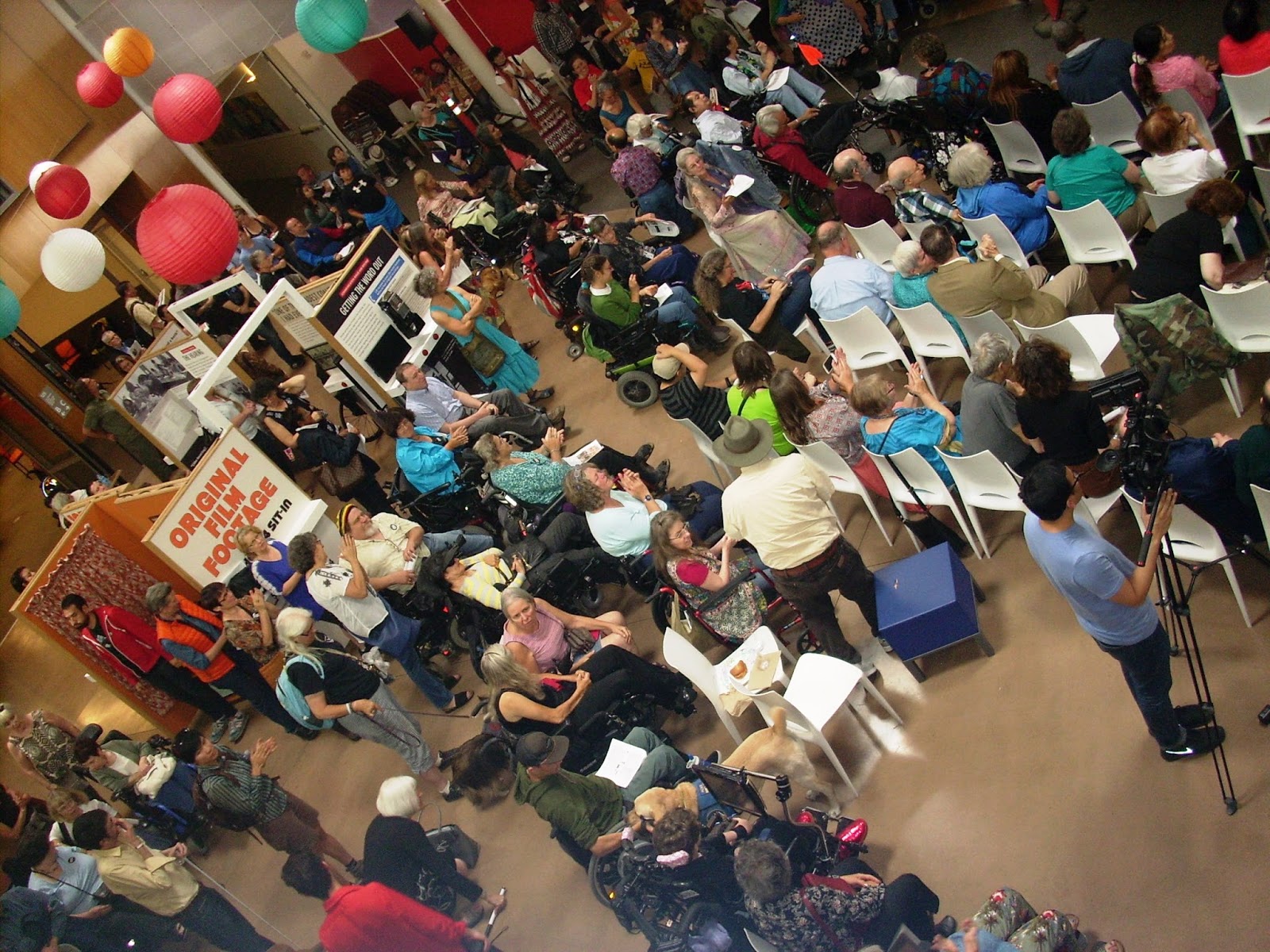
Carla Johnson of San Francisco Mayor’s Office on Disability (MOD) and Community Alliance for Disability Advocates (AIDS Legal Referral Panel, Senior and Disability Action, San Francisco IHSS Public Authority, The Arc of San Francisco, LightHouse for the Blind, Independent Living Resource Center of San Francisco, Paul K. Longmore Institute on Disability, Community Living Campaign, Toolworks, Bakeworks) hosted ADA Month Kick Off Celebration on July 1st inside City Hall (which celebrated its own centennial last month).   
Mayor Ed Lee greeted the audience of “beautiful people” and praised ADA for promoting independence, inclusion and community, consistent with making San Francisco for the 100%.  During last month’s U.S. Conference of Mayors meeting in San Francisco, he introduced a resolution that was adopted nationwide to recommit cities to the goals and ideals of ADA.  He then proclaimed July as ADA Month in San Francisco. 
District 1 Supervisor Eric Mar honored grassroots organizations like ILRC and co-sponsors for organizing California #ADA25 Conference on September 25-26, in San Francisco.  He said it was Disability Empowerment Month when supervisors would introduce legislation, led by people with disabilities and supported by allies, and spoke about need for Dignity Fund. 
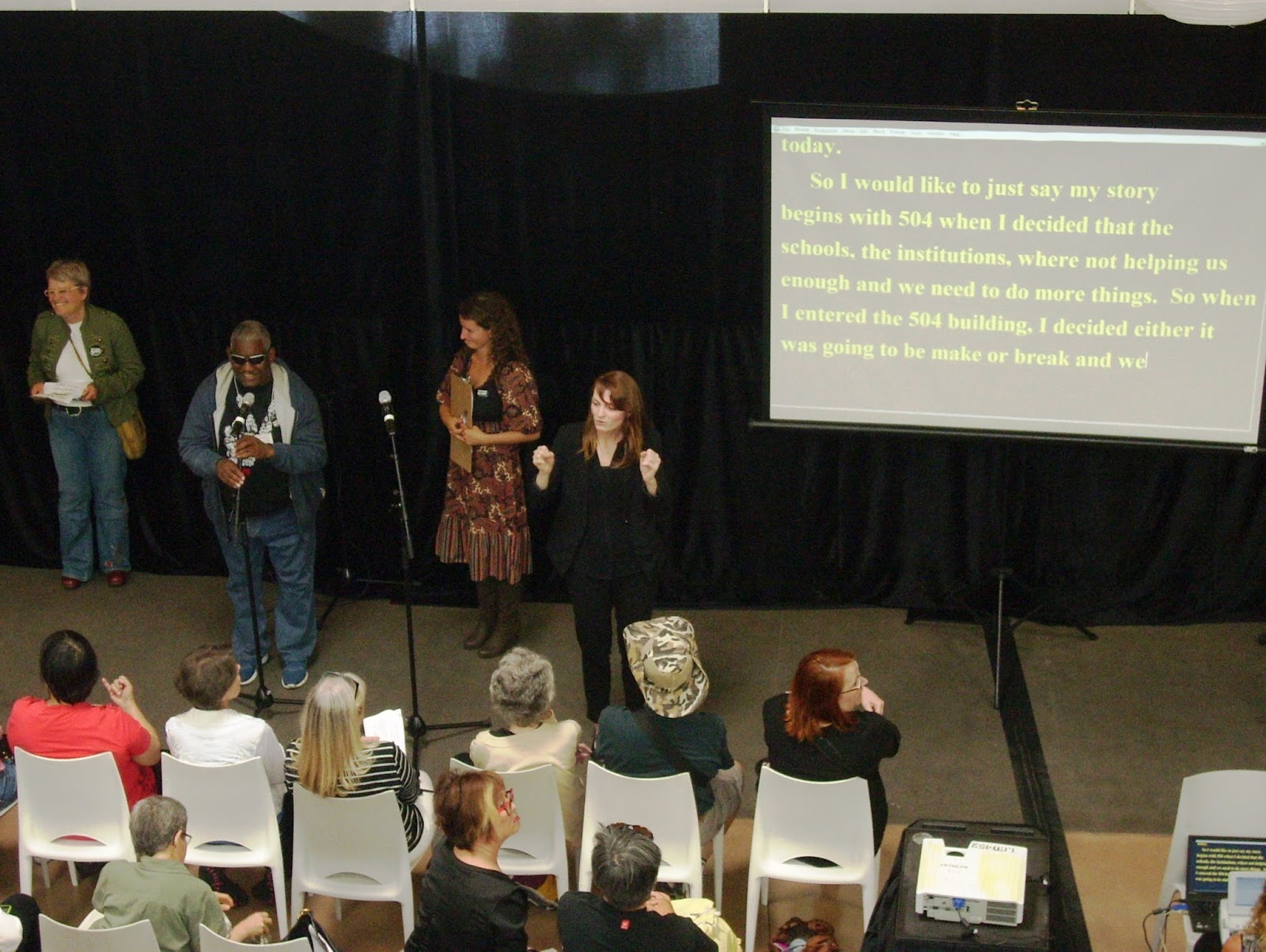
Kathy Martinez, a former ten-year-old actress in Lassie TV show, recalled being age 17 during 1977 sit-in that was an “invitation to fight for our civil rights.”  As former Assistant Secretary in Office of Disability Employment Policy at U.S. Department of Labor, she advocated hiring people with disabilities to achieve financial independence.  
Former Assemblymember Tom Ammiano recalled being a school teacher who brought his hungry students to the 504 rally, so when asked, “What do we want?” they replied, “French toast,” instead of “civil rights!”  On a more serious note, he reminded us that we all get old, when accommodations are welcome then, but awareness is needed beforehand to prepare.  He said to look for the 2016 ballot measure for Dignity Fund, which would allocate real estate taxes for seniors and persons with disabilities. 
Access SFUSD appeared on stage twice: to speak on disability perspectives (“because of ADA …”) and to show their dance moves to a medley of songs from 1990.
San Francisco MOD squad, established in 1998 as the City's overall ADA Coordinator, and banner reminded us that celebrating 25 years of ADA doesn't stop here:  the struggle continues to eliminate attitudinal, communication, transportation, policy and physical barriers in order to achieve full integration of people with disabilities in our society. 
Ms. Wheelchair California at Patient No More panel, a preview of larger exhibit at Ed Roberts Campus in Berkeley.
Bryan Bashin of LightHouse and Catherine Kudlick of Longmore Institute. Catherine explained double meaning of Patient No More: people with disabilities have lives beyond medicine, and they should not have to wait.   

Universal design 
Panelists discussed ADA’s impact on design with architect Michael Chambers as moderator at SmithGroupJJR in San Francisco:
·      Architect Chris Downey of Architecture for the Blind: ADA means opportunity, access to life; no handicap unless barrier is put in the way, which is done (or not done) by an architect in the built world; one has a disability, but not disabled; access is not just code, but a civil right
·      Disability Rights Advocates attorney Zoe Chernicoff: ADA is not just about physical access but covers more; for example, solitary confinement discriminates against people with mental disabilities
·      Architect and gerontologist Alexis Denton: ADA provides minimum standards, should aspire to go beyond with universal design for everyone and create great experience by designing with empathy
·      Architect Gilda Puente-Peters: ADA model has been used internationally by other countries to develop their own access standards, but ADA enforcement is weak
·      Center for Independent Living’s work and benefits counselor Alana TheriaultADA, which does not cover airplanes (but Air Carrier Access Act does), could be improved to provide more expansive definition of access.

Chris and Alana mentioned Berkeley’s Ed Roberts Campus as an example of accessible design.                   
Ed Roberts Campus housed the equally accessible exhibit, Patient No More! People with Disabilities Securing Civil Rights, which held its grand opening on ADA’s 25th anniversary on July 26. 
Spiral ramp inside Ed Roberts Campus 
Quiet area outdoors to get away from sensory overload 
Disability Mural (2000-Present) is the first community artwork about the everyday experiences of living with a disability, created by people with and without disabilities. 
Mural tile reads: "One day many people will learn to sign, and we all be seeing voices...when all the world speaks with its hands!"
Room for improvement on one size fits all

Rosemarie Garland-Thomson has noted that disability is the body's response over time to its environment.  Temporarily abled people who acquire a disability later in life experience disability differently (like learning a foreign language later in life), than people who have a congenital disability and already have adapted to “fit in” the built environment or changed the inaccessible environment to accommodate their individual differences (latter often benefits our broader society).  People with a congenital disability do not experience loss over not being able to do “normal” activities because they never did, so this self-acceptance reframes “the problem is the solution.” 
  
Celebrating disability civil rights 
Cathy Kudlick, who developed Patient No More exhibit with her team at Longmore Institute, welcomed attendees at grand opening. 
Jeff Moyer, songwriter and 504 participant, led 504 protest song, Hold On:
        “Civil Rights were knocking at our door,
        But Carter wouldn’t stand on 504…
        After four years of delay,
        We came to claim the ground we’d gained…
        Well, for 28 days unafraid
        150 people with disabilities they stayed.
        They had their eye on the prize.  They held on.
        Hold on. Hold on.
        Keep our eyes on the prize. Hold on…”  
Dennis Billups, 504 Chief Morale Officer, led chant, “1-2-5-0-4. Kickin’ in the bathroom door …We’re rolling in victory now.” 
Interactive exhibit, with poster of Billups during 504 demonstration, invited visitors to respond, What makes you “patient no more”?  
Bruce Oka, 504 participant and former SFMTA Director, said he was "patient no more" because he was tired of being excluded, and talked about need to be included. 
Corbett O’Toole said she was "patient no more" because there are only two lawyers in the nation available to represent parents with disabilities losing custody of their children. 
Persons with disabilities nationwide occupied the regional offices of HEW in April 1977, but only San Francisco held out until April 28, 1977 when HEW Secretary finally signed regulations implementing Section 504. 
·      504 protests and ADA legislation grouped people with many different disabilities together, so there would be one big ADA instead of mini-ADAs for each impairment group
·      504 resulted in a national disability rights movement and national disability organizations that could promote and defend ADA
·      504 defined disability flexibly and took prejudice into account, so ADA could be about civil rights rather than medical diagnoses
Section 504 served as a template for the more comprehensive ADA passed in 1990, showing that disability rights could benefit many without adding a huge burden on society.  


disability = diversity


Invisible disabilities

At this month’s Mayor’s Disability Council meeting, attendees presented on “what ADA means to me” with several mentioning “invisible” disabilities (like learning differences and psychiatric disorders), how physical and mental disabilities influence another, and the financial impacts.  The majority of disabilities are non-apparent, and until ADA Amendments Act of 2008, the U.S. Supreme Court did not consider persons with diabetes and mental illness as disabled, and thus not entitled to protection against discrimination.  In fact, neuropsychiatric disorders represent the largest category of disability in the U.S. The landmark Olmstead case, in which the U.S. Supreme Court ruled that persons with disabilities must be enabled by states to live in the “most integrated setting appropriate” to their needs and that “unjustified isolation” is discrimination based on disability under Title II of ADA, involved persons with “invisible disabilities” (mental illness and developmental disabilities).
People With Disabilities Foundation (PWDF), a non-profit that aims to “provide total integration of people with mental disabilities into the whole of society,” hosted a delegation of disability advocates from 20 countries, at the invitation of U.S. Department of State’s International Visitor Leadership Program (IVLP), Access for All: Enhancing the Lives of People with Disabilities. Founded 15 years ago in San Francisco, PWDF won the nation’s first court case requiring a federal agency to accommodate the needs of persons with mental disabilities, who were denied equal access to Social Security disability programs, in violation of Section 504 of the Rehab Act of 1973, because they could not understand the complex eligibility rules. PWDF’s Parity in Advocacy initiative works to provide equal access to legal representation for those with mental disabilities (advocacy version of Mental Health Parity).

With the passage of ADA 25 years ago, the U.S. became the first country in the world to adopt national civil rights legislation banning discrimination against persons with disabilities.  ADA was the model for the Convention on the Rights of Persons with Disabilities (CRPD), which U.S. President Barack Obama signed in 2009, but its ratification voted down by the Senate.  

                                                                  
The 50th anniversary of Older Americans Act (OAA) on July 14 was a non-event in the Bay Area.  The decennial White House Conference on Aging (WHCoA) took place the day before with at least one watch party of the live stream in San Francisco.  Congress didn't fund WHCoA so its executive director Nora Super had to get non-government sponsors to help organize this event.  At least on July 16, the Senate passed the bill reauthorizing OAA, which expired 2011, and now goes to the House for consideration. 

I was not aware of any delegations visiting from other countries to learn about OAA as a model . . . 
Senior and Disability Action’s monthly meeting celebrated ADA rather than OAA.
Model garden at 30th Street Senior Center is a beautiful act of nature