Showing posts with label civil rights. Show all posts

Friday, July 31, 2015

Beautiful Acts: Americans with Disabilities & Older Americans

“I want future generations to know that we are a people who see our differences as a great gift, that we are a people who value the dignity and worth of every citizen – man and woman, young and old, black and white, Latino and Asian, immigrant and Native American, gay and straight, Americans with mental illness or physical disability.”
-- U.S. President Barack Obama, January 20, 2015 State of the Union Address
This month’s 25th anniversary of Americans with Disabilities Act (ADA), at least in San Francisco Bay Area, seemed to upstage the 50th anniversaries of Older Americans Act (OAA) and Medicare.  While OAA tends to promote age segregation by funding programs for age 60+ (with few intergenerational provisions that could be strengthened), I prefer ADA’s provisions for reasonable accommodation to promote integration into community living for all ages and abilities.  Ideally, integration creates inclusive communities where everyone can be accepted for who they are.

In Andy Imparato’s blog post, The ADA and Claiming Disability, I thought about inserting “old age” for “disabilities”:  
“Rather than buying into the larger societal narrative that disabilities are inherently limiting, we have an opportunity to recognize that personal experience with disability can lead to greater personal strength, creative problem-solving, and a stronger connection to other populations who face discrimination at work, at school and in the community.”

From ugly to beautiful law

In 1867, the first “ugly law,” making it illegal for persons with disabilities to appear in public, was enacted in San Francisco.  In 1977, San Francisco helped set the stage for passage of ADA, when more than 150 people of all types of disabilities took part in the longest occupation of a federal building, in the San Francisco regional office of the Department of Health, Education and Welfare (HEW), to demand implementation of regulations to Section 504 of the Rehabilitation Act of 1973.  
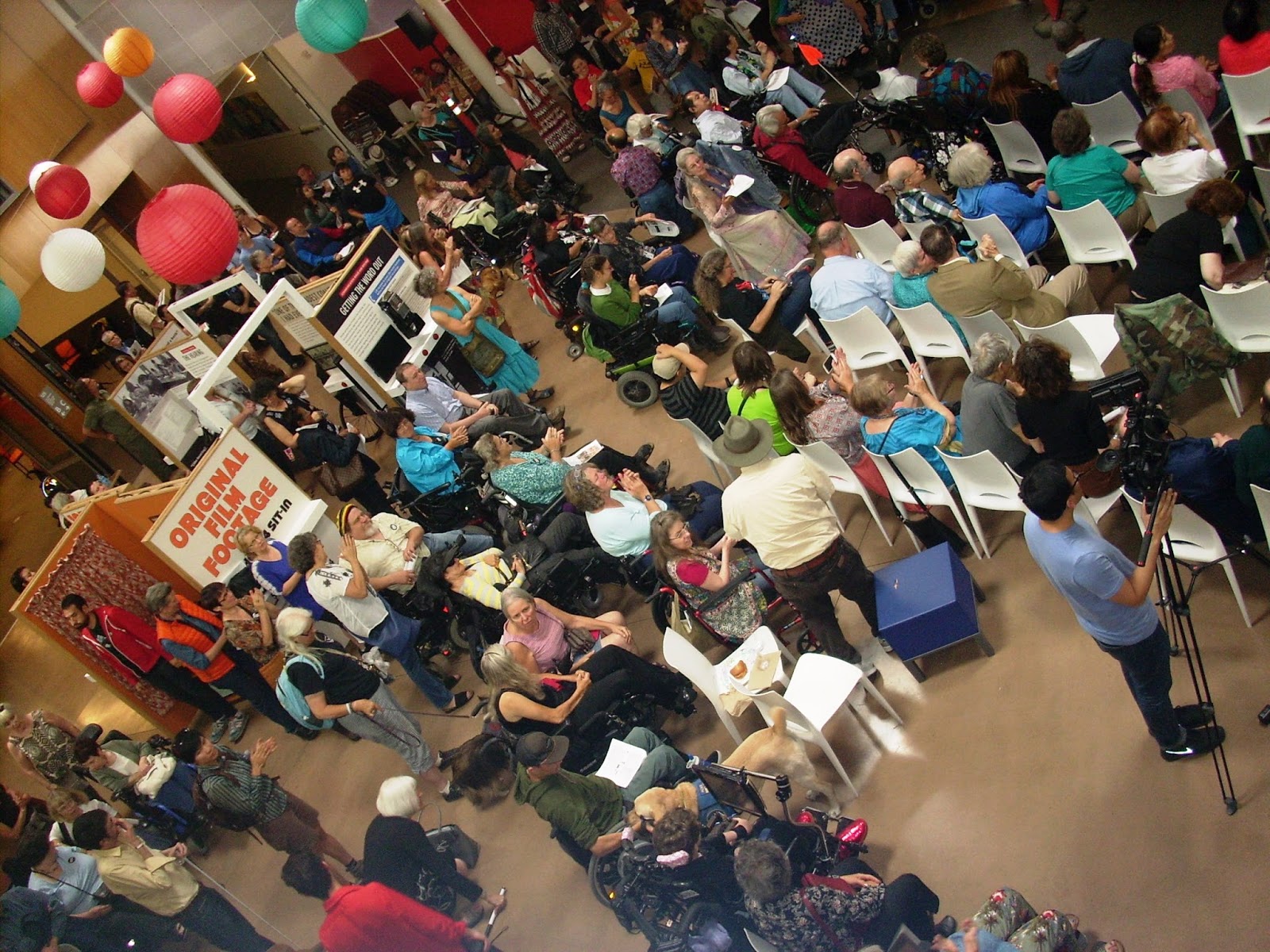
Carla Johnson of San Francisco Mayor’s Office on Disability (MOD) and Community Alliance for Disability Advocates (AIDS Legal Referral Panel, Senior and Disability Action, San Francisco IHSS Public Authority, The Arc of San Francisco, LightHouse for the Blind, Independent Living Resource Center of San Francisco, Paul K. Longmore Institute on Disability, Community Living Campaign, Toolworks, Bakeworks) hosted ADA Month Kick Off Celebration on July 1st inside City Hall (which celebrated its own centennial last month).   
Mayor Ed Lee greeted the audience of “beautiful people” and praised ADA for promoting independence, inclusion and community, consistent with making San Francisco for the 100%.  During last month’s U.S. Conference of Mayors meeting in San Francisco, he introduced a resolution that was adopted nationwide to recommit cities to the goals and ideals of ADA.  He then proclaimed July as ADA Month in San Francisco. 
District 1 Supervisor Eric Mar honored grassroots organizations like ILRC and co-sponsors for organizing California #ADA25 Conference on September 25-26, in San Francisco.  He said it was Disability Empowerment Month when supervisors would introduce legislation, led by people with disabilities and supported by allies, and spoke about need for Dignity Fund. 
Kathy Martinez, a former ten-year-old actress in Lassie TV show, recalled being age 17 during 1977 sit-in that was an “invitation to fight for our civil rights.”  As former Assistant Secretary in Office of Disability Employment Policy at U.S. Department of Labor, she advocated hiring people with disabilities to achieve financial independence.  
Former Assemblymember Tom Ammiano recalled being a school teacher who brought his hungry students to the 504 rally, so when asked, “What do we want?” they replied, “French toast,” instead of “civil rights!”  On a more serious note, he reminded us that we all get old, when accommodations are welcome then, but awareness is needed beforehand to prepare.  He said to look for the 2016 ballot measure for Dignity Fund, which would allocate real estate taxes for seniors and persons with disabilities. 
Access SFUSD appeared on stage twice: to speak on disability perspectives (“because of ADA …”) and to show their dance moves to a medley of songs from 1990.
San Francisco MOD squad, established in 1998 as the City's overall ADA Coordinator, and banner reminded us that celebrating 25 years of ADA doesn't stop here:  the struggle continues to eliminate attitudinal, communication, transportation, policy and physical barriers in order to achieve full integration of people with disabilities in our society. 
Ms. Wheelchair California at Patient No More panel, a preview of larger exhibit at Ed Roberts Campus in Berkeley.
Bryan Bashin of LightHouse and Catherine Kudlick of Longmore Institute. Catherine explained double meaning of Patient No More: people with disabilities have lives beyond medicine, and they should not have to wait.   

Universal design 
Panelists discussed ADA’s impact on design with architect Michael Chambers as moderator at SmithGroupJJR in San Francisco:
·      Architect Chris Downey of Architecture for the Blind: ADA means opportunity, access to life; no handicap unless barrier is put in the way, which is done (or not done) by an architect in the built world; one has a disability, but not disabled; access is not just code, but a civil right
·      Disability Rights Advocates attorney Zoe Chernicoff: ADA is not just about physical access but covers more; for example, solitary confinement discriminates against people with mental disabilities
·      Architect and gerontologist Alexis Denton: ADA provides minimum standards, should aspire to go beyond with universal design for everyone and create great experience by designing with empathy
·      Architect Gilda Puente-Peters: ADA model has been used internationally by other countries to develop their own access standards, but ADA enforcement is weak
·      Center for Independent Living’s work and benefits counselor Alana Theriault:  ADA, which does not cover airplanes (but Air Carrier Access Act does), could be improved to provide more expansive definition of access.

Chris and Alana mentioned Berkeley’s Ed Roberts Campus as an example of accessible design.                   
Ed Roberts Campus housed the equally accessible exhibit, Patient No More! People with Disabilities Securing Civil Rights, which held its grand opening on ADA’s 25th anniversary on July 26. 
Spiral ramp inside Ed Roberts Campus 
Quiet area outdoors to get away from sensory overload 
Disability Mural (2000-Present) is the first community artwork about the everyday experiences of living with a disability, created by people with and without disabilities. 
Mural tile reads: "One day many people will learn to sign, and we all be seeing voices...when all the world speaks with its hands!"
Room for improvement on one size fits all

Rosemarie Garland-Thomson has noted that disability is the body's response over time to its environment.  Temporarily abled people who acquire a disability later in life experience disability differently (like learning a foreign language later in life), than people who have a congenital disability and already have adapted to “fit in” the built environment or changed the inaccessible environment to accommodate their individual differences (latter often benefits our broader society).  People with a congenital disability do not experience loss over not being able to do “normal” activities because they never did, so this self-acceptance reframes “the problem is the solution.” 
  
Celebrating disability civil rights 
Cathy Kudlick, who developed Patient No More exhibit with her team at Longmore Institute, welcomed attendees at grand opening. 
Jeff Moyer, songwriter and 504 participant, led 504 protest song, Hold On:
        “Civil Rights were knocking at our door,
        But Carter wouldn’t stand on 504…
        After four years of delay,
        We came to claim the ground we’d gained…
        Well, for 28 days unafraid
        150 people with disabilities they stayed.
        They had their eye on the prize.  They held on.
        Hold on. Hold on.
        Keep our eyes on the prize. Hold on…”  
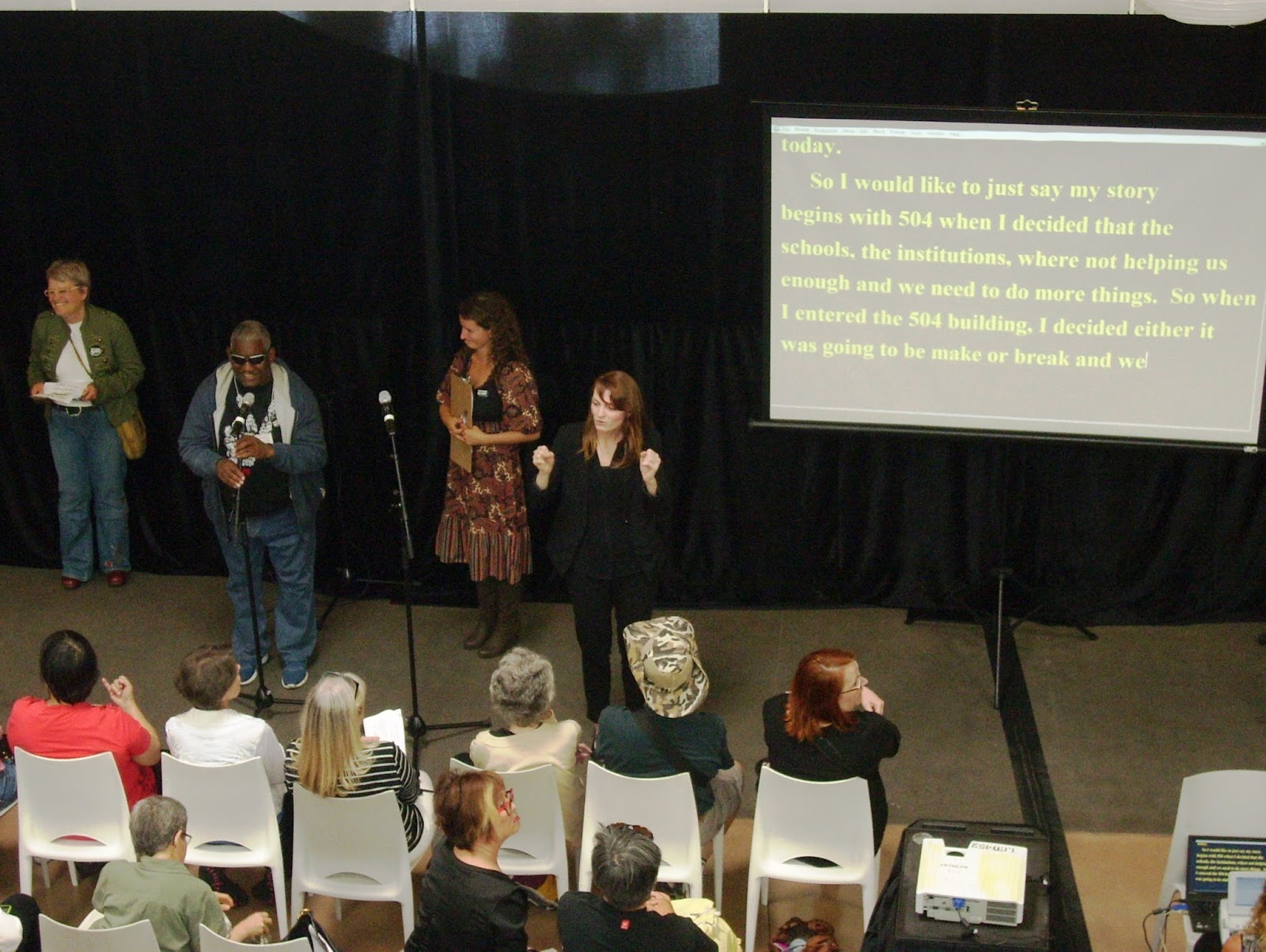
Dennis Billups, 504 Chief Morale Officer, led chant, “1-2-5-0-4. Kickin’ in the bathroom door …We’re rolling in victory now.” 
Interactive exhibit, with poster of Billups during 504 demonstration, invited visitors to respond, What makes you “patient no more”?  
Bruce Oka, 504 participant and former SFMTA Director, said he was "patient no more" because he was tired of being excluded, and talked about need to be included. 
Corbett O’Toole said she was "patient no more" because there are only two lawyers in the nation available to represent parents with disabilities losing custody of their children. 
Persons with disabilities nationwide occupied the regional offices of HEW in April 1977, but only San Francisco held out until April 28, 1977 when HEW Secretary finally signed regulations implementing Section 504. 
·      504 protests and ADA legislation grouped people with many different disabilities together, so there would be one big ADA instead of mini-ADAs for each impairment group
·      504 resulted in a national disability rights movement and national disability organizations that could promote and defend ADA
·      504 defined disability flexibly and took prejudice into account, so ADA could be about civil rights rather than medical diagnoses
Section 504 served as a template for the more comprehensive ADA passed in 1990, showing that disability rights could benefit many without adding a huge burden on society.  


disability = diversity


Invisible disabilities

At this month’s Mayor’s Disability Council meeting, attendees presented on “what ADA means to me” with several mentioning “invisible” disabilities (like learning differences and psychiatric disorders), how physical and mental disabilities influence another, and the financial impacts.  The majority of disabilities are non-apparent, and until ADA Amendments Act of 2008, the U.S. Supreme Court did not consider persons with diabetes and mental illness as disabled, and thus not entitled to protection against discrimination.  In fact, neuropsychiatric disorders represent the largest category of disability in the U.S. The landmark Olmstead case, in which the U.S. Supreme Court ruled that persons with disabilities must be enabled by states to live in the “most integrated setting appropriate” to their needs and that “unjustified isolation” is discrimination based on disability under Title II of ADA, involved persons with “invisible disabilities” (mental illness and developmental disabilities).
People With Disabilities Foundation (PWDF), a non-profit that aims to “provide total integration of people with mental disabilities into the whole of society,” hosted a delegation of disability advocates from 20 countries, at the invitation of U.S. Department of State’s International Visitor Leadership Program (IVLP), Access for All: Enhancing the Lives of People with Disabilities. Founded 15 years ago in San Francisco, PWDF won the nation’s first court case requiring a federal agency to accommodate the needs of persons with mental disabilities, who were denied equal access to Social Security disability programs, in violation of Section 504 of the Rehab Act of 1973, because they could not understand the complex eligibility rules. PWDF’s Parity in Advocacy initiative works to provide equal access to legal representation for those with mental disabilities (advocacy version of Mental Health Parity).

With the passage of ADA 25 years ago, the U.S. became the first country in the world to adopt national civil rights legislation banning discrimination against persons with disabilities.  ADA was the model for the Convention on the Rights of Persons with Disabilities (CRPD), which U.S. President Barack Obama signed in 2009, but its ratification voted down by the Senate.  

                                                                  
The 50th anniversary of Older Americans Act (OAA) on July 14 was a non-event in the Bay Area.  The decennial White House Conference on Aging (WHCoA) took place the day before with at least one watch party of the live stream in San Francisco.  Congress didn't fund WHCoA so its executive director Nora Super had to get non-government sponsors to help organize this event.  At least on July 16, the Senate passed the bill reauthorizing OAA, which expired 2011, and now goes to the House for consideration. 

I was not aware of any delegations visiting from other countries to learn about OAA as a model . . . 
Senior and Disability Action’s monthly meeting celebrated ADA rather than OAA.
Model garden at 30th Street Senior Center is a beautiful act of nature
Sunday, June 29, 2014

Justice, not just us

In The Boston Globe's June 20 op-ed piece, “Aging isn’t the challenge; building an equitable society is," gerontologists Laura L. Carstensen and John W. Rowe wrote: 
“Aging too often plays out much differently among less advantaged people. Instead of deepening expertise and well-being, the cumulative effects of poverty, harsh working conditions, and persistent stress leave an alarming proportion of people with little in the way of personal resources. A fifth of married couples and half of unmarried people rely on Social Security alone for at least 90 percent of their income.”

The New York Times today published its last article, “Inequality Is Not Inevitable,” in The Great Divide series, moderated by American economist Joseph E. Stiglitz, who wrote:
“Justice has become a commodity, affordable to only a few. . . .More than a half-century ago, America led the way in advocating for the Universal Declaration of Human Rights, adopted by the United Nations in 1948. Today, access to health care is among the most universally accepted rights, at least in the advanced countries. America, despite the implementation of the Affordable Care Act, is the exception. It has become a country with great divides in access to health care, life expectancy and health status.” 
Americans make up 5% of the world’s population yet consume 25% of its resources, and comprise 25% of the world’s prisoners.  And 99% of Americans are subject to the wealthiest 1%, who control more than 40% of the nation's wealth.
STOP BEING POOR (The Art Show) at Incline Gallery in San Francisco's Mission District: “. . . inspired by the sentiment that many politicians and media correspondents have reverberated: If you’re poor, stop being poor.  . . . With skyrocketing rents and massive neighborhood takeovers, our home, the Bay Area, has become a difficult place in which to live. We invite everyone to come see, but also, purchase art. Can you help us? We need to stop being poor.”

According to the Brookings Institution, the gap between the rich and poor in San Francisco is growing faster than any other city in the nation, and San Francisco’s income inequality is on par with developing countries in Central America and sub-Saharan Africa.  San Francisco risks losing its diversity, especially seniors and persons with disabilities who can no longer afford to live in an increasingly expensive city.

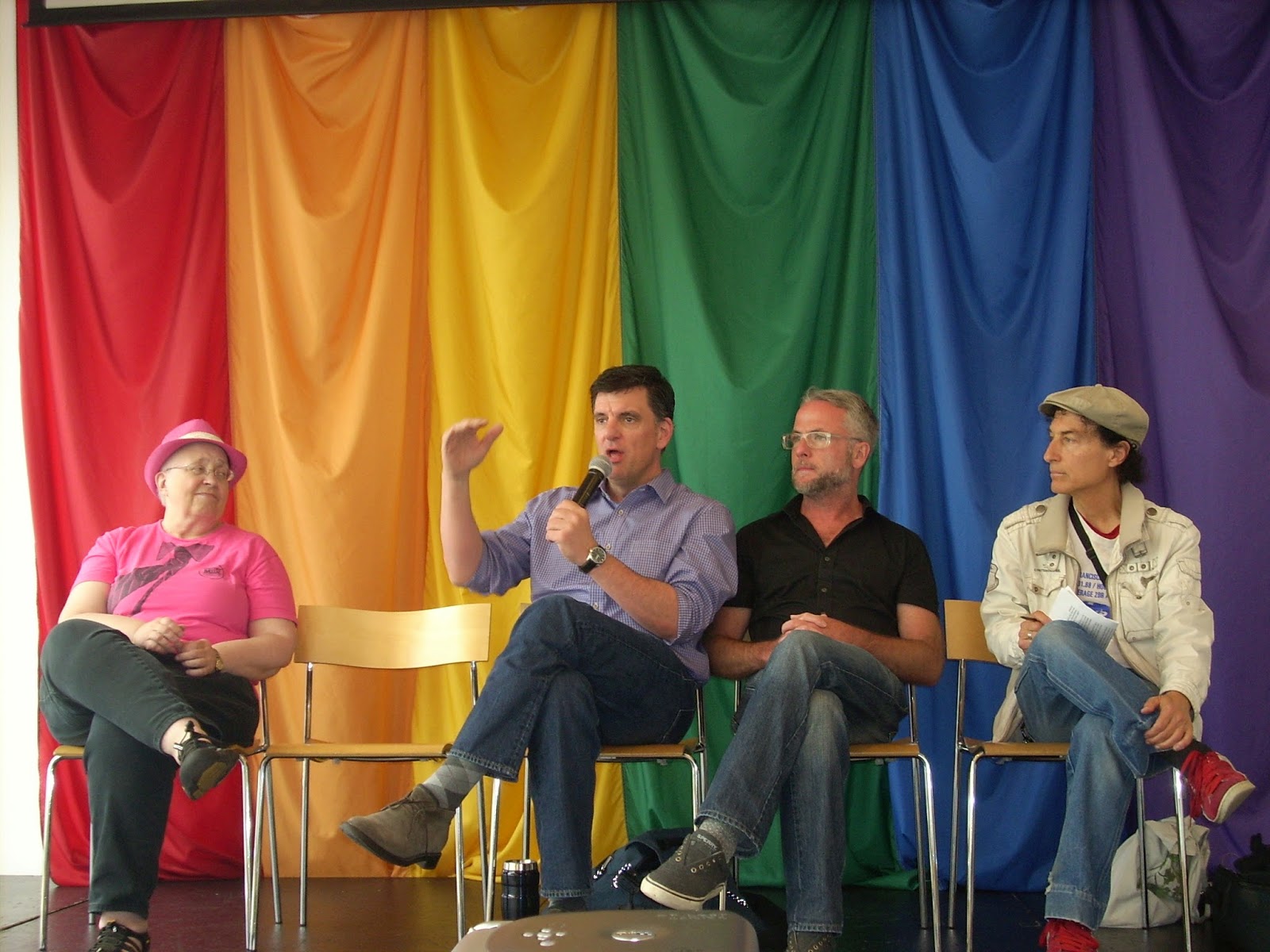
While there is much work to overcome rising inequality and barriers to justice, let's remember people power with this summer’s commemoration of the 15th anniversary of Olmstead case (June 22, 1999 U.S. Supreme Court ruling that under the Americans with Disabilities Act, individuals with mental disabilities have a right to live in the community rather than institutions) and 50th anniversary of Civil Rights Act (CRA enacted July 2, 1964 outlawed discrimination based on race, color, religion, sex, or national origin). Knowledge of existing rights and resources can help identify gaps or areas for improvement; for example, CRA has been supplemented with Age Discrimination in Employment Act of 1967 and Americans with Disabilities Act of 1990 (July 26).

Elder justice
 
San Francisco Department of Aging and Adult Services (DAAS) sponsored World Elder Abuse Awareness Day (WEAAD, June 15) Symposium at Born Auditorium in the Human Services Agency building. 
Jill Nielsen, Adult Protective Service (APS) Program Director at DAAS, rattled off the following statistics:
  • 5 million, or 1 in 10, older adults in the U.S. are victims of elder abuse, neglect or exploitation
  • For every case reported, as many as 23.5 cases go unreported (according to New York prevalence study)
  • San Francisco APS received over 6,500 reports of abuse last year, and 580 reports in May 2014 alone
Elizabeth Aguilar Tarchi, San Francisco Assistant District Attorney (DA) for the past 27 years, explained her office’s no drop policy (DA can aggressively hold perpetrators accountable based on evidence, even if victim does not want to pursue action) and vertical prosecution (victim is assigned DA to follow through from charge of crime, rather than have victim re-live experience when dealing with different DAs).  The DA’s Office handles elder abuse cases involving physical and financial crimes.
Any known/suspected abuse should be reported to APS (24-hour hotline at 415.355.6700 or statewide at 800.814.0009) or the Police Department; if immediate harm, call 911.  (If abuse/neglect occurs to a resident in a long-term care facility, call Long-TermCare Ombudsman at 415.751.9788.) 
Mary Twomey, Co-Director at Center of Excellence on Elder Abuse and Neglect based in University of California at Irvine, reminded us that elder abuse is a public health and human rights issue. She performed rap with audience joining her refrain:
I am old, and I am positive
I have wisdom, I’m gonna tell it like it is
I may be disabled, but I’m not obtuse
There’s no excuse for elder abuse! 

At the federal level, Congress has appropriated nothing to implement Elder Justice Act of 2010.  At the state level, California Elder Justice Coalition requested increased funding for statewide training of APS staff and state-level coordinator for county APS.  Mary invited us to wear aqua-colored UNITED AGAINST ELDER ABUSE bracelets, speak up and get involved with her organization, Ageless Alliance. 

Shawna Reeves, Director of Elder Abuse Prevention at Institute on Aging (IOA), discussed the following trends in elder financial abuse with greater coverage: PBS Frontline program on Residential Care Facilities For the Elderly (RCFE) and Castro Valley RCFE abandonment case; California has 12 bills addressing RCFE abuse; and even a TV show dedicated to hoarding.  She described popular scams like the grandparent scam (phone call from perpetrator who claims to be grandchild requesting emergency funds), sales presentations at senior centers, tax prospecting by insurance agents, pension advance loans, etc.  IOA’s Access to Justice Project details San Francisco civil legal resources specializing in remedies for elder financial abuse.


Housing & health justice 
Third Annual Howard Grayson Elder Life Conference: Housing & Health for All! at LGBT Center opened with performance by Stonestown YMCA Senior Taiko Drummers! 
Moderator Sue Englander with housing panelists Seth Kilbourn, Openhouse Executive Director; Brian Basinger, AIDS Housing Alliance Director; and Tommi Avicolli Mecca, Housing Rights Committee Director of Counseling Programs.

Tommi presented the following facts:
  • 29% of San Francisco’s homeless identify as LGBT, and 3% as transgender
  • District 8 (including Castro, which he says is being “de-gayed”) has been hardest hit by evictions, with 2,000 units affected since 1997 during the first dot-com boom
  • Two-thirds of seniors live in fear that their building will be sold by a speculator who will evict them and flip rentals for profit
Tommi called for the following 11-point plan of action:
  1. eviction defense: demonstrate against speculators (Ellis Act evictions are elder abuse)
  2. public relations to denounce evictions: organize, stand and block doors to Sheriff
  3. affordable housing advocacy: Community Land Trust alternative
  4. develop abandoned property: 300 buildings could be used for housing; only 150 Otis housing (for low-income homeless veterans) was developed in past 12 years
  5. moratorium on market rate housing: this is unconstitutional, but so was same-sex marriage
  6. rental assistance fund: LGBT Aging Task Force recommended Mayor build 30,000 units; first 8,000 to homeless to get off streets, and fill remaining with low-income
  7. stronger eviction protection: relocation for no-fault, Ellis, owner move-in
  8. repeal Ellis Act: Costa Hawkins Bill not allow vacancy rent control; need to extend rent control beyond pre-1979 constructed buildings 
  9. anti-speculation tax: on November ballot would limit 5-year re-sale of building
  10. City shelters need to be LGBT-friendly
  11. campaign to reduce LGBT homeless by 50% in 5 years
During the Q&A, Tommi said they could declare a state of emergency to impose vacancy control and roll back rents because the system is broken so we need a revolution to build systems to address the problem, a PR gimmick to “make headlines like Newsom” and “bring outrage to the planet,” while adding “it’s all about theatrics.”

Brian said that activism and advocacy work: once the fringe challenges the status quo, they win because the fringe makes it safe to get what you ask for, and there is opportunity in crisis.  He proposed the following:
  • resurrect last legislation that late Supervisor Harvey Milk worked on, two days prior to his murder: tax 100% profits of residential building that is bought and sold within two years, which takes away economic incentive driving evictions.  This anti-speculation tax will be on November ballot.
  • introduce legislation to require developers to adopt anti-discrimination protections based on sexual/gender orientation; ask and dialogue to have impact
  • organize homeless to develop policy, join budget advocacy, link arms and stand together to force issue and get fair share
He also mentioned the need to elect the right people who are willing to fight and move forward to support the poor, versus moderates who will not rock boats, like former Mayor DiFi who opposed vacancy control and anti-speculation tax.
 
Seth discussed Openhouse’s partnership with Mercy Housing to develop 55 Laguna, 110 units of affordable senior (age 55+) housing that is “LGBT-welcoming” with construction beginning this October, and the next development of additional 70 units, which he hopes to get HUD rent subsidy. Applications for 55 Laguna housing will be available in mid-2015, and then selection will be made by lottery.  He noted this new housing is just a “drop in the bucket” so it’s important to keep people in their homes.  Policy change solution is critical to dis-incentivize speculators from kicking out seniors and to strengthen anti-eviction.    
Snack table and resource fair included Openhouse, CARA, Gray Panthers, SDA and DAAS.


Host Denise D’Anne, former co-president of Harvey Milk LGBT Democratic Club, introduced health care panelists Miss Major, Transgender, Gender Variant & Intersex Justice Project (TGIJP) Director; Susan Pfeifer, Organizing for Action; Celia Chung, Transgender Law Center; and Barry Hermanson, Green Party candidate.  Panelists acknowledged Affordable Care Act (ACA) is not perfect but huge first step for universal coverage by requiring citizens to purchase insurance or face penalty (greater of $95 or 1% of income); ultimate solution is Medicare for All: “the best universal single payer health care system in the world.”  
After screening of 2005 Emmy-winning documentary for historical/cultural program, Screaming Queens:The Riot at Gene Compton’s Cafeteria, Q&A with Felicia Flames and director Victor Silverman. Three years prior to the June 28, 1969 Stonewall riots in New York, transgender community members in San Francisco’s Tenderloin District fought back to protest police harassment which resulted in improved police community relations and support services through Department of Public Health’s Center for Special Problems, including issuance of ID cards with their new gender.  Felicia, a screaming queen who said she will be 68 next month, is also a Vietnam veteran and 27-year survivor of AIDS.

Administration for Community Living (ACL) released an online learning tool, Building Respect for LGBT Older Adults, which is designed to increase awareness of issues faced by LGBT individuals living in long-term care facilities.  

Access to income

Positive Resource Center (PRC) and Senator Mark Leno sponsored Thriving in 2014: A Day Long Institute on Access to Income and Healthcare for People Living with HIV/AIDS at Milton Marks Conference Center in the State Office Building. 
Access to Income panel included:
  • Amy Orgain, Staff Attorney at AIDS Legal Referral Panel: private long-term disability insurance may pay 60-70% of income, but only up to age 65 or Social Security retirement age
  • Joe Ramirez-Forcier, Employment Services Managing Director at PRC: individuals with HIV may face discrimination based on age rather than HIV status because the average person with HIV in San Francisco is age 50, when there is more turnover in job market so skill refreshment needed  
  • Jerry McIntyre, Directing Attorney at National Senior Citizens Law Center: last year’s Windsor decision (providing for equal treatment of same sex marriage) means Social Security spousal benefit available to same-sex married and domestic partners; however, being recognized as married couple is no advantage for SSI benefits due to combining resources and income of spouses, and SSI does not consider spouse if civil union/domestic partner
  • Fernando Aguayo-Garcia, Senior Bilingual Benefits Advocate at PRC: non-citizens, who are not eligible for SSI, might be eligible for Cash Assistance Program for Immigrants (CAPI); HIV itself is not disabling, but combined with mental health or diabetes symptoms to make disability
Budget justice

Budget Justice Coalition held a press conference on the steps of San Francisco City Hall an hour before the packed budget hearing. 
San Francisco Public Defender Jeff Adachi called for increased funding for eviction legal defense because only 10% of tenants had lawyers to defend them in eviction suits brought by landlords, of which 90% had lawyers.
 
Colleen Rivecca of St. Anthony’s Foundation and San Francisco Food Security Task Force called for additional $10 million for home-delivered meals to serve vulnerable seniors and persons with disabilities (PWD) so they can remain in their homes. 
Marie Jobling, on behalf of San Francisco Long-Term Care Coordinating Council, requested additional $3 million funding for Community Living Fund, created in 2006 with initial funding of $3 million, to help re-establish Laguna Honda patients into the community. 
At budget hearing, seniors and PWD spoke first. SDA Executive Director Jessica Lehman requested funding to fix broken elevators in SRO hotels.
 
In the overflow room in City Hall’s North Light Court, Project Open Hand (POH) Operations Director Simon Pitchford and Executive Director Kevin Winge (seated second row) watch budget hearing on screen.  POH provides “meals with love” at 18 congregate meal sites for seniors and PWD in San Francisco.  In 1998, DAAS selected POH to replace The Salvation Army, which lost its senior congregate meals contract when it failed to comply with a 1997 ordinance requiring anyone who did business with the City to provide nondiscriminatory domestic partners benefits. 
 
At Potrero Hill Health Fair, POH Associate Director of Senior Services Noah Lopez (FOOD=LOVE) and Senior Sites Manager Darin Raffaelli (MEALS with LOVE) model fashion-forward POH T-shirts.  

Long-term care

Basics of Medicare and Medi-Cal presentation, hosted by On Lok Lifeways, addressed long-term care needs. 
Shibin Tharayil of San Francisco Health Insurance Counseling and Advocacy Program (HICAP) explained that after a 2-night hospital stay, the hospital should (and one should make sure the hospital does) admit one as an inpatient versus “observation” status —an important distinction because one must spend at least 3 full days in the hospital as an admitted patient to receive Medicare coverage for first 20 days in a skilled nursing facility. 
 
On Lok Medi-Cal Eligibility Specialist Daniel Sullivan covered Medi-Cal Basics.  In California, Medi-Cal Managed Care (such as On Lok Lifeways) is available to low-income, undocumented persons with PRUCOL (Permanent Residence Under Color of Law) status, or persons who are not lawfully residing in U.S., but the immigration agency does not intend to pursue deportation. 
 
On Lok Outreach and Enrollment Specialist John Lam provided an overview of Lifeways’ consolidated model of long-term care for adults age 55+ who are certified by the state as meeting the need for nursing home level of care, and funded by Medicare and Medi-Cal waivers.  John also organized Gray Pride community space (rest area, water, snacks, private ADA-accessible bathroom) for seniors at LGBT PRIDE Festival.
  
Civil rights

Born after the Civil Rights Act of 1964, I view this landmark legislation as history that comes alive when I hear older adults share their reminiscences of those dark ages when “discrimination with a smile” was the norm.  The San Francisco Federal Building hosted Celebrating & Collaborating: The 50th Anniversary of the Civil Rights Act of 1964. 
Steven Anthony Jones, Artistic Director of Lorraine Hansberry Theatre and artistic collaborator of Civil Rights at 50, asked the audience to interject “and women” whenever he said "men" as in “we hold these truths to be self-evident, that all men. . . and women!"  According to some reports, Rep. Howard Smith, a segregationist from Virginia who was against civil rights, included sex-based discrimination so the civil rights bill would be too controversial to pass, but it did pass! 
In this panel discussing the accomplishments and impact of the CRA, Senior U.S. District Judge Thelton Henderson was the token senior at 80 years old.  As a 1962 graduate of UC Berkeley’s Boalt Hall School of Law, he was the first African-American lawyer in the Justice Department’s Civil Rights Division and recalled being sent to the South to monitor local law enforcement for civil rights abuses, including investigation of the 1963 16th Street Baptist Church bombing that killed four black girls. (Other panelists were Zoe Polk, Director of Policy & Social Justice at San Francisco Human Rights Commission, and Reuel Schiller, Professor of Law at Hastings College of Law.)

Closing digital divide 
At yesterday’s Older Women's League (OWL) meeting, Community Living Campaign (CLC) Director Marie Jobling presented on 10 Things to Love (and 5 Things to Hate) about Technology.  When technical difficulties delayed her showing of the trailer for Cyber Seniors documentary, Marie quipped, "Computers teach you patience." 

First, Marie's top 10 loves about technology:
  1. connects us: skype, google, twitter, blogger, youtube, linkedin, facebook
  2. facilitates lifelong learning 24/7 in every language (google translate, Duolingo), every subject
  3. levels playing field to break down barriers for PWD, limited English: assistive technology, large print, more disability access built-in
  4. language and disability access
  5. pathway to employment & volunteer opportunities
  6. convenient shopping
  7. helps us take control of our health & well-being: research, connect with health providers, fitness apps
  8. we can make & promote our own “news”: blogs, digital photo sharing, customize what you read (google alerts)
  9. keeps mind & memory sharp: learn new things, brain fitness games, genealogy
  10. fun: online entertainment
 
Then, Marie's 5 things to hate about technology:
  1. discourage connections in-person: lack basic courtesies, create new class of haves & have-nots, don’t know when to put screen down
  2. not available to all: limited affordable access
  3. problem with p@ssW0rds: hard to remember all, complex to be secure
  4. privacy: keep info secure, know how to be safe, what to share
  5. things change too fast: hard to keep up, too expensive
CLC, which organized the 2012 Aging & Disability Technology Summit at City Hall, provides technology training through SF Connected program. CLC Connector LaNay Eastman demonstrated technology tools for persons with vision and/or hearing disabilities.  Independent Living Resource Center of San Francisco (ILRCSF) is the local assistive technology network, where one can "try before you buy."