Showing posts with label health care. Show all posts

Tuesday, November 30, 2021

National Family Caregivers Month

According to Recognize, Assist, Include, Support, Engage (RAISE) Act Family Caregiving Advisory Council’s Initial Report to Congress (Sep. 2021): 

·       In USA, 1 in 7 people is a caregiver and more than 2/3 of people will need assistance with daily tasks as they age.

·       In USA, more than 53 million family caregivers provide approximately $470 billion in unpaid support annually for their loved ones to be able to live in their communities.

·       Family caregivers often provide support without a formal assessment of their needs or of the person receiving support; learn “on the job,” taking on complex medical, administrative and care coordination activities.

·       Lost income due to family caregiving is estimated at $522 billion each year.

Rosalynn Carter Institute for Caregivers’ Working While Caring: A National Survey of Caregiver Stress in the U.S. Workforce (Sep. 28, 2021) found that 1 in 5 full-time workers care for a family member with a serious illness/disability; nearly 20% of them quit a job to care for a relative, while 44% switched to part-time work. Rosalynn Carter has advocated for establishment of a new Office of Caregiver Health, within the U.S. Department of Health & Human Services, intended to improve coordination within the bureaucracy. 

My Administration is committed to strengthening American families and easing the burdens of caregiving.  That is why my American Rescue Plan provided an additional $145 million in funding for the National Family Caregiver Support Program,…also provided States with additional Medicaid funding to strengthen and enhance their home- and community-based services (HCBS) program.  My Administration’s Build Back Better agenda will build on this down payment by continuing to invest in the caregiving infrastructure for HCBS and increasing pay and benefits to address the direct care workforce crisis.  I will also fight to expand paid family and medical leave nationwide.  Each of these elements is critical to better supporting family caregivers.

--Joseph R. Biden, Jr., A Proclamation on National Family Caregivers Month (Oct. 29, 2021) 

It takes a village + infrastructure, like job-protected leave and healthcare coverage, to support family care partners.

·       Effective Jan. 1, 2022, California Family Rights Act (AB 1033) expanded to grant eligible employees up to 12 weeks of job-protected leave to care for parent-in-law with a serious medical condition. 

·       Effective Jan. 1, 2023, Parent Health Care Act (AB 570) will allow adult children to add their parents/step parents (who are not eligible for Medicare) as dependents to their individual health insurance coverage. 
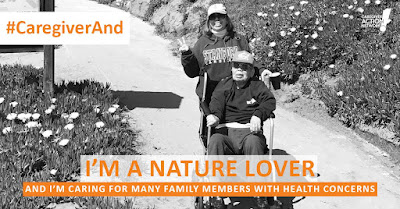
https://twitter.com/CaregiverAction/status/1457888929127014402 

This year’s NFCM theme is #CaregiverAnd, which encourages family caregivers to “celebrate the passions and interests that enrich their lives.” 

During the COVID-19 pandemic lockdowns, many family caregivers were on their own without the usual respite supports from other relatives/neighbors/friends (as people formed their own pods/bubbles) and formal supports like home health/adult day centers/congregate care settings. Compared to non-caregivers during this pandemic, research found that family caregivers experienced higher rates of anxiety, depression and disturbed sleep; and reported less social interaction, more worries about finances and food, even after controlling for income and employment. Caregivers who fared the worst were female, young, lower-income, and providing care for people with cognitive disabilities (dementia) or behavioral/emotional problems. 

According to UCLA study, Who Is Caring for the Caregivers? The Financial, Physical, and Mental Health Costs of Caregiving in California (Nov. 29, 2021): 

·       In 2020, 1 in 4 California caregivers provided 20+ hours of care to a family member/friend in a typical week, yet only 1 in 11 received payment for any of the hours spent providing care

·       Majority of caregivers in California are women (57.7%), middle age or ages 26-64 (67.5%) and provide care to mainly older adults ages 65+(64.7%).

·       Nearly half (44.4%) of California’s estimated 6.7 million adult caregivers reported experiencing some level of financial stress in 2020 due to their role.

·       About 1 in 5 (20.9%) caregivers reported that caring for their relative/friend was somewhat to extremely financially stressful.

·       1 in 7 caregivers (13.5%) reported a physical or mental health problem within the past 12 months due to caregiving.

Aging boomers in later life have fewer family members to rely on for caregiving (due to never married, divorce, no kids, etc.). (China has recognized tradition of family caregiversand “Confronted By Aging Population China Allows Couples To Have Three Children.”) 

“I’m a single woman, so I say mom has me, but I don’t have a me.”—Lily Liu, who took “gap year” from her job to set-up infrastructure of care for her mom, featured in AARP documentary, Caregiving: The Circle of Love (2016) 


AARP hosted Beyond the Burnout: A Morning Forum for Caregivers. Lily Liu, former AARP archivist/historian, has been caregiver for her 90-year-old mother diagnosed with Parkinson’s disease for past 40 years and more recently dementia; she decided not to bring home care aides during pandemic due to risk of infection. Lily talked about her nuclear family’s immigration from China to USA (her parents came for graduate studies when she was a child), thanks to 1965 Immigration Act. As a 1.5 immigrant family caregiver, Lily was imbued with Chinese cultural norm of filial piety (“even if I didn’t read Confucius, there was an expectation to care for elders in the family”) and challenges like having no extended family members to help out (but “family by choice”—someone acting like “big sister” as “accountability coach” before she reached burnout), linguistic barriers (terms like “MRI, UTI, and ADL are hardly understandable in English” and interpreting in another language), shift in power dynamic when providing care (“almost become a parent of your parent”), exploring trauma for Chinese immigrant parents who lived during 20th century wars and civil strife, etc. 

(See Mission Local’s “For Mao survivors, the pandemic has been a cakewalk.” In 2015, Administration for Community Living awarded its first grant to develop “person-centered, trauma-informed” care for Holocaust survivors.) 
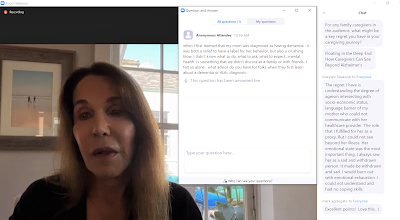
Patti Davis wrote her handbook + memoir, Floating in the Deep End: How Caregivers Can See Beyond Alzheimer’s (2021), based on her caregiver support group, Beyond Alzheimer’s (started in 2011) and caring for her father Ronald Reagan who died in 2004. After her attempt to license Beyond Alzheimer's into “AA of caregiver support” fell through, she decided to write her book to share lessons, like addressing grief (“you’re well-served to inhabit and surrender to grief early on…grief is not biodegradable, it will wait and come find you…”), looking beyond disease to essence of person (“Alzheimer’s is stripping away of façade… my father was sweet, gentle person so it was easier”), educating about disease and acceptance to take on challenges like taking away car keys (avoid 86-year-old George Weller’s 20-second drive through farmer’s market in Santa Monica killing 10 people, and injuring many others.) She broadly viewed a caregiver as someone who shows up to provide support; her father received homecare from paid caregivers when he was “bedridden” during last three years of his 10-year illness.

Kupuna edge”

“When you’re a caregiver … you’re the nurse, you’re the physician, you’re the lawyer, you’re the chauffeur, you’re the accountant. You play all of these different roles that most people go to school and get a degree for, and you are expected as the caregiver to become all of that overnight and as the disease progresses.”— Poki‘i Balaz, geriatric NP, “Our Kūpuna, Our Kuleana: Senior Care Crisis in Hawaiʻi,” Hawai’i Business (Feb. 4, 2020) 

Growing up with kupuna (grandparents) in the same household, family caregiving was reciprocal: my grandparents cared for me and my siblings (while my parents worked outside of our home) until we became more independent, and then we reciprocated as my grandparents with dementia became more dependent on us for activities of daily living. This caregiver experience was more like something we grew into as needs arose, rather than “overnight.” And I suppose it helped that my grandparents had more than a single caregiver playing different roles, and benefited from many family caregivers with specialized roles including physician (though trained in OB-GYN; my cousin didn’t become a geriatrician until after grandparents died), lawyer, accountant, and we were all (non-degreed, but licensed) chauffeurs!

Last month, Hawaii Business magazine covered the role of kupuna in caring for grand keiki in a series of articles about Hawaii’s so-called kupuna edge:

·       "Grandparents Help Hawai‘i Parents Get the Job Done: Grandmothers and grandfathers are storytellers, sources of wisdom, keepers of family legacies and teachers. But perhaps their most important role in Hawai‘i is to help working parents raise their keiki.” 

·       "Do’s and Don’ts of Using Grandparents for Child Care: Lessons learned from both grandparents and parents about navigating these relationships.” 

·       "Grandparents Are Great, But They Can’t Solve All of Hawai‘i’s Child Care Needs: Hawai‘i’s high cost of living often drives the need for grandparent-provided child care. But many grandparents can’t provide care because they are still working or live on the Mainland. Here’s what else is needed.” This article noted that grandparents who are the primary caregivers for their grandchildren tend to experience worse physical and mental health than those who provide occasional or no child care at all. 

Kupuna might wish to exchange worse health for a stipend while serving in foster grandparent program and more low wage opportunities await them in proposed Caring Corps for older adults in charge of universal early childhood education?! 

This month, the Advisory Council to Support Grandparents Raising Grandchildren (SGRC) released its Initial Report to Congress. Highlights:

·       In USA, 2.7 million children are being raised in the homes of grandparents.

·       The child welfare system increasingly relies on kin or grandfamilies to provide care for children, yet they are less likely than non-related foster families to receive needed supports and services.

This report also provides recommendations that will inform development of the National Family Caregiving Strategy.

As COVID-19 pandemic seemed to accelerate hospital discharge preference of patients to go home rather than receive rehabilitation care from a skilled nursing facility (SNF), some exciting Home- and Community-Based Services (HCBS) policy proposals: 

·       Choose Home Care Act of 2021 (S.2562/H.R. 5541) would increase access to health services at home by giving eligible Medicare beneficiaries the option to choose home-based extended care as an alternative to SNF care after being discharged from the hospital. 

·       Justice in Aging is advocating for change in federal Medicaid law to apply retroactive coverage of HCBS services after hospital discharge, just as Medicaid allows services to be covered up to 3 months for SNF. 

Advance care planning

Geriatricians are expert at managing syndromes that are associated with age (e.g., dementia)… are good at deprescribing, looking at list of medications and possibility of interactions…eliminating what’s not necessary… really useful if multiple chronic illnesses… key to good care as we get older is constant, ongoing communication with your doctor… about what you want, how aggressive you want, that trade-off between things that might possibly prolong life versus side-effects and quality of life.

--Jay Luxenberg, MD, On Lok Chief Medical Officer, “Do We Need New Doctors As We Age?” Not Born Yesterday podcast (Oct. 15, 2021) 

UCSF geriatrician Dr. Anna Chodos presented on Advance Care Planning (ACP): how to make decisions based on context (emotions, needs, resources), personality, values, and experiences.

ACP includes medical and financial/legal considerations.

Wonder how many people attended this webinar? I asked all 4 questions! Answers:

·       Even if elder orphan is unable to name a surrogate, it is appropriate to document that person’s preferences—even if “terrible system” for people who are not going to have an advocate, POLST may or may not be useful.

·       “Many of us deal with people who are really complex and seem to have a lot of wishes for what life is like now that don’t match up with what are some stated long-term goals like living forever, getting better…it’s a process we continue to revisit…most people do not like thinking about the hard stuff…Most people don’t get the point, they don’t understand what the heck we’re asking them to do…completing advance directive takes at least a half hour, if not an hour.” 

·       “Assuming they have a program where you can live forever,…what most religions promise people. No, I haven’t started referring people to Jehovah’s Witness programs, but I hope that was like a cheeky question…they’re plenty of religions that have very specific requirements for how people get healthcare.” 

According to AARP, Hawaii has 157,000 family caregivers providing $2.1 billion value of u(n)paid care! AARP HI Pre-Crisis Planning for Dementia featured elder law attorney Laurie Adamshick, who shared her family caregiving experience. 

For solo agers (“elder orphan” without family caregiver), she advised hiring a professional fiduciary. 

Chinese American Coalition for Compassionate Care (CACCC) and AACI hosted Chinese American Cultural Challenges at End of Life (EOL) presented by Esther Luo, MD, Kaiser Permanente palliative care specialist. According to Pew Research, Asians are the fastest growing racial/ethnic group in USA, and Chinese are the largest Asian origin group making up 24% of this group.

According to California Health Care Foundation’s Help Wanted: Californians’ Views and Experiences of Serious Illness and End-of-Life Care (2019), majority of Californians at EOL do not want to “burden” family, want to die at home, prefer “natural death” and do not want to suffer pain.  

Compared to whites, Chinese Americans receive more aggressive EOL care including invasive mechanical ventilation when hospitalized and deaths in ICU so fewer die at home.

Few Chinese Americans enroll in hospice due to cultural challenges, including finding providers with cultural sensitivity (honor family-based v. individual decision-making) and language fluency. About 25% of Chinese Americans live in traditional multigenerational household; modern Chinese family structure is more like the family depicted in The Farewell (2019) film: adult children live separately from aging parents, varying acculturation (immigrant with limited English so gaps in communication with USA-born children/grandchildren), working adult children may have limited time for direct care, so more common to hire or place elder in care home.

Traditional filial duties might include nondisclosure to protect psychological well-being of elderly parent; advocate for aggressive treatment to prolong life; pressure to perform duties to avoid disapproval of community (save “face”); provision of food at EOL as cultural obligation to demonstrate love and care. 

“New” approach to filial piety involves ACP with parents initiating discussion and decision-making in context of not being burden to family, and reframing love/care by honoring elders’ wishes. 

Good death is part of 5 blessings, along with love of virtue, longevity, wealth, health. To traditional Chinese, components of good death are defined by one’s accomplishments of familial responsibility; “natural death” in old age; minimal suffering and free from pain; and maintaining good family relationships. 
 
Dr. Luo recommended indirect communication preferred when discussing EOL: use another person’s EOL experience; frame discussion as standard question and  part of routine care; acknowledge cultural taboos and ask for permission (e.g., some may fear invoking “bad luck” if they discuss death, or talking about death might invite death to come sooner); use provider’s own experience as example. 

Last month, I completed mandatory First Aid/CPR/AED training. During COVID-19 pandemic to prevent contamination, rescuers place material over the victim’s mouth and nose. This mannequin did not look like Resusci Anne

During COVID-19 pandemic, call 911 and stick to compression-only CPR: check for response, check for breathing (look; careful about exposure if you listen and feel), then start chest compressions 100-120 beats per minute to the rhythm of BeeGees’ Stayin’ Alive! Use AED defibrillator. 


SF DPH COVID-19 data before Thanksgiving/National Day of Mourning gatherings.

Ageism in healthcare

Kaiser Health News’ Navigating Aging columnist Judy Graham moderated stimulating 90-minute panel discussion, Confronting Ageism in Healthcare: A Conversation for Patients, Caregivers and Clinicians. What we can do:

·       Louise Aronson, MD, UCSF geriatrician and author of Elderhood: suggested how to communicate with provider to get your needs met—e.g., “I feel that I’m not getting attention my symptoms warrant (use “I” statement), and I came to you because of your reputation as a good doctor” (compliment!). And she incited us to “make a ton of noise and don’t shut up until things change…that’s how other social change movements succeed, own it, be noisy. Let’s do it!” She added Essential Caregiver Bill (HR 3733) in Zoom chat box

·       Michael Wasserman, MD, geriatrician and immediate past president of California Association of Long-Term Care Medicine (CALTCM): encouraged us to “speak truth to power”; called out federal government spending $10 billion a year subsidizing graduate medical education, but failing to train doctors to care for Medicare beneficiaries; the failure to develop policies focused on older adults due to the lack of geriatric expertise among policymakers (notably, failure of Biden administration to appoint gerontology expert to COVID-19 task force)—“honestly, the federal government didn’t listen, and now we have over half a million deaths amongst older adults from COVID and close to 200,000 of them from nursing homes…honestly, the policymakers don’t seem to care.” (The lack of gerontology expertise proved fatal in nursing homes that cut off family visits since March 2020 through Nov. 12, 2021 when finally CMS lifted visitor restrictions in nursing homes.)  

·       Rebecca Elon, MD, geriatrician and family caregiver (see “Aiding Her Dying Husband, a Geriatrician Learns the Emotional and Physical Toll of Caregiving”): recommended starting local and with groups for a louder voice!

·       Javette Orgain, MD, family physician and medical director for Longevity Health Plan of Illinois: called for intergenerational living, closing technology gap, increased funding of home-based care and improving nursing homes!

·       Jesse Mauer, JD, Executive Director of Maine Council on Aging, which promotes Anti-Ageism Pledge: advocated to include age in every DEI (diversity, equity, inclusion) conversation to “help us move collectively together”! (Check out recorded 2021 Wisdom Summit: Embracing a New Normal, Bouncing Forward to Build an Age-Positive Maine.) 

Despite anti-ageism guide to language tip, “do not use ‘elderly’ as a reference to a group,” transcript showed use of “elderly” in reference to a group almost interchangeable with “older adults” in same sentence:

·       Dr. Orgain said she “began care for older adults prior to becoming a physician, so I had some experience there that fostered my love for the care of the elderly.”

·       Judy Graham asked Dr. Orgain about “the lack of resources and what that says about how we approach our elderly population and what it means for those older adults.”

Maine’s Anti-Ageism Pledge includes “call attention to ageist language,” which depends foremost on what “the person wants to be described” as an equity consideration, and otherwise “refer to people over 60 as older people instead of seniors or the elderly.”

[Similarly, University of Iowa researchers Clarissa A. Shaw, PhD and Jean K. Gordon, PhD, advocate for an individualized, person-centered approach to communication accommodation based on person’s preferences and needs, not stereotypes of aging; for example, not all older adults find “elderspeak” (which arises when caregivers take on parental role) to be patronizing, particularly when it facilitates comprehension (e.g., slow speech, simplified sentence, long pause, loud voice, repetition, etc.). Otherwise, elderspeak is harmful!] 

Judy Graham summarized efforts to address ageism in healthcare: remove old age as a cause and symptom of disease; identify ageist beliefs and language (Frameworks Institute); tackle ageism at grassroots level (Changing the Narrative); require geriatrics education for medical students; include older adults in clinical trials; bring in geriatrics expertise; build age-friendly health system. 
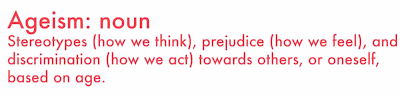
Joined screening of 16-minute video premiere of Changing the Narrative’s Antidotes for Ageism: A Brief Guide to Creating Inclusive Care in an Ageist Society, followed by discussion with talking heads from video. Take-aways:

·       Our age does not define us (so stop attributing everything to “growing older”); instead, age-inclusive healthcare starts with caring for people as individuals because “every person is living a unique human experience.” 

·       “If you are receiving care: Talk to your provider. Ask questions. Your goals shape the course of your healthcare. Clarify what you value to avoid under- or over-treatment. Advocate beyond conversations with healthcare providers.  Seek care providers that truly listen to you, and support your vision for your health.” (Can this be done in typical 15- to 20-minute visit?!)

·       “If you are a healthcare professional: Active listening and letting patients guide care.” 

Geriatrician Jeff Wallace, MD, advised: “Get to know the patient, whether they’re age 20 or age 80, and get the background, and that’s the fun part in many ways, to learn about your patient to start…the therapeutic relationship with a patient starts with respect. You have to respect them, and they have to respect you…doctors should be interrupted more often…it’s okay to say, ‘let’s just timeout, and I really want you to focus on this.’”

Consultant Carolyn Love said she understood that doctors and nurses are medical experts, but patients are experts of their own body so providers need to listen.

Gilliane Lee, recent graduate of occupational therapy (OT), talked about shift to focus on safety as well as quality of life for older adults, and responded to following Q&A:

Q: What are some things that can be done to encourage more people to work with older adults?

A: “Bring them to assisted living facilities (ALF) and getting that exposure so that they can understand that there is such a need for providing care.”

Oy vey, will exposure to ALF for understanding “need for providing care” translate to encouraging more people to work with older adults? Possible to deter people from working in ALF setting like Brookdale, the nation’s largest senior living provider and target of federal lawsuit on behalf of 83 families alleging elder neglect and financial abuse, as well as lawsuit by California Attorney General?! As a graduate gerontology student, I watched Life and Death in Assisted Living (2013), PBS Frontline documentary that featured my instructor Pat McGinnis, founder and Executive Director of California Advocates for Nursing Home Reform; that horror show convinced me to stay away from for-profit ALF!  

“Too many assisted living centers, care centers, and nursing homes are places I would never allow a loved one to enter. Most wouldn’t either if they knew what the facilities were really like. However, families who schedule facility tours and interviews when considering placing a parent or grandparent, do not see that side…Families must learn to get behind the scenes in order to see the truth.” --Linda L. Schlenker, OTR, author of Aging in America: A Wake-Up Call and Call to Action for Seniors and Those Who Love and Serve Them (2008), calling out non-profit Mayo Clinic and St. Anne’s Home, Little Sisters of the Poor (SF) as exceptional

Been there, done that with my own stint working in ALF (non-profit, of course)! People who get behind the scenes by working in ALF see truth of “need for providing care”: understaffing, lack of staff trained in gerontology and experienced in working with older adults, low morale, high turnover, etc. Residents who wait too long for assistance end up trying to manage on their own, resulting in falls, bedsores, medication errors, other neglect.

Exposure to older adults segregated in ALF seems to reinforce warehousing people based on old age/disability. More encouraging to meet older people where they are in a variety of settings, listen and let their complexity grow on you until you decide this could be an interesting way to earn a living 😉!

Ageism in media

Ageism isn’t even recognized in Pew Research’s list of 15 biggest problems facing the nation; in contrast, racism and sexism make the list. 

November 2021 issue of The Journal of Gerontology: Social Sciences featured several articles about media coverage of aging and ageism.

In Aging Narratives Over 210 Years (1810-2019), Reuben Ng, PhD, found aging narratives in newspapers, magazines and nonfiction books have become more “negative” over 210 years, from “uplifting narratives of heroism and kinship” in the 1800s to “darker tones of illness, death, and burden” in the 1900s as older adults came to be viewed as dominant occupants of almshouses and described as deserted by their children and too infirm to work. Contributing to this ageism were the diminishing status of older adults, loss of warmth, loss of competence, social ostracism, and medicalization of aging. Defying this trend was fiction, which provided “positive” portrayals of older adults through romantic courtship and war heroism.

In Ageism in COVID-Related Newspaper Coverage: The First Month of the Pandemic, researchers analyzed 287 articles concerning older adults and COVID-19, published between March 11 and April 10, 2020, in four major U.S. newspapers (USA Today, The NY Times, LA Times, The WaPo), the term “ageism” appeared only five times and only in The NY Times opinion pieces, suggesting that journalists were not calling out ageism. 

This failure to call out or name ageism seems to normalize ageism so it’s not viewed as the problem it is with harmful impacts. 

Journalists continue to confuse assisted living and nursing home, needing to issue corrections like “This story has been corrected to refer to Brookdale as an assisted living and memory care center instead of a nursing home.”  In “The Forgotten Nursing Home Tragedy” (NY Times, Nov. 4, 2021), journalist stated “Nurses were routinely working at several elder-care facilities at once”—more likely the reality is lower-paid certified nursing assistants (CNA) who have closer hands-on contact with residents (assisting with toileting, bathing, dressing, feeding, etc.) work at multiple nursing homes? Important to understand differences: ALF v. SNF, CNA v. nurse.

Wish more journalists would follow reporter Laura Wenus’ advice to consult someone with expertise in the field because “elder care and nursing care is a complex industry” so it helps to turn to a second pair of eyes to ensure “using the right terms and describing the relevant systems correctly.” 

SF Dept. of Disability & Aging Services (DAS) hosted SF Dignity Fund Community Needs Forum (“What do older adults & adults with disabilities living in San Francisco need?). This took place on day after holiday weekend, 39 showed up on Zoom, mostly DAS staff; service providers who participated talked about workforce challenges like finding social workers who are Cantonese bilingual and who are familiar with African American culture. 
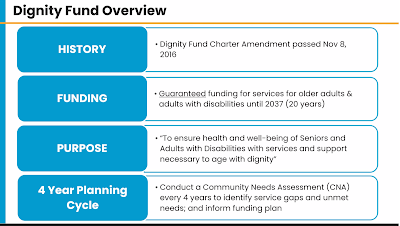
I completed 36-item SF Dignity Fund Community Needs Assessment survey, commenting on need for gerontology training in workforce development to better serve diverse older adults, like designing a more age-friendly survey! Wonder how many older adults/people with disabilities had stamina to actually answer all survey items: e.g., 5-item Likert scales for #6 Please rate your agreement with the following (19) statements about your needs; #17 Please rate your agreement with the following (15) statements about any barriers you have experienced when trying to participate in services. By the time I got to survey's demographic information section, I just wanted to get over ordeal so quickly selected "Decline to answer"! 

Friday, March 31, 2017

Aging in America 2017 conference highlights

Welcome mural at Hostelling International in Chicago, which offered $34 per night rate for my student/non-profit worker budget!  For the third time in five years, American Society on Aging (ASA) held its Aging in America (AiA) conference at the Hyatt Regency Chicago ($239 per night).  I volunteered again for a behind-the-scenes experience, working with ASA staff like Patricia Morazan (volunteer coordinator and fundraiser extraordinaire for homeless Petaluma senior after 15 agencies declined to help) and Steve Moore (poster coordinator and popular webinar host).
Hostel advice: forget the maps ...follow your instincts
During my daily mile-long walk from hostel to conference site, I approached Trump International Hotel and Tower (tallest reinforced concrete building in the world) as a reminder of who’s President … and the March 16, 2017 release of his “skinny budget,” which proposed a 17.9% cut in the Department of Health and Human Services (HHS), impacting discretionary programs “that are duplicative or have limited impact on public health and well-being.”  Trump’s budget director Mick Mulvaney defended cuts to the Community Development and Community Services Block Grant programs, which fund Meals on Wheels (MOW) in some communities, suggesting that MOW is ineffective. In response, the media quickly came to the defense of MOW.  Linda Qiu of The New York Times provided this fact check

“Meals on Wheels helps 2.4 million people each year, including 500,000 veterans and 226,000 older citizens in the three states Mr. Mulvaney specified. And a body of research shows that it does work.  Evaluation of the home-meal delivery program found that participating helped reduce feelings of loneliness and the risk of falls while improving nutrition and food security, and even decreasing government spending.
‘If you can provide these lower-cost programs and keep seniors out of nursing homes, that in essence will save money,’ said Kali S. Thomas, a professor of health services at Brown UniversityDr. Thomas’s research showed that Medicaid spending could be reduced by $109 million if all states were to increase the population of people who received home-delivered meals by 1 percent.”
SF Examiner featured Riding Along with MOW driver Viena as she delivered meals + safety checks to homebound seniors in San Francisco’s Bayview district! 
Since military spending appears to be Trump’s priority (America First: A Budget Blueprint to Make America Great Again proposed increases in the Departments of Defense, Homeland Security, and Veterans Affairs), The Daily Show proposed militarizing MOW to trick Trump into funding the home-delivered meal program for frail, homebound seniors. 

At this year’s AiA conference, almost every session included reference to MOW...since I work with homebound seniors who rely on MOW, it was very touching to hear such overwhelming support! ASA Board Chair Bob Blancato, also Executive Director at National Association of Nutrition and Aging Services Programs, issued this forceful statement

“While details are still emerging, it is hard to see how key programs that provide vital nutrition services to older adults, like the Older Americans Act and the Social Services Block Grant (SSBG), are not reduced. These programs now operate on the edge in terms of funding and any reductions will mean service disruptions and waiting lists for needy older adults. We intend to work individually and collectively with other aging organizations to keep this budget from ever passing.”
When I overheard Douglas (architect) and Ellen (gerontologist) Gallow’s conversation about MOW, I chimed in and learned their Ohio-based Lifespan Design Studio consulted on George W. Davis Senior Residence and Senior Center in San Francisco, one of the educational trip offerings at this summer’s IAGG Congress!

Advocacy
ASA President Bob Stein shared stage with ASA Hall of Fame Awardee Percil Stanford, who was instrumental in founding the Department of Gerontology at San Diego State University.  Stanford, a 2016 Influencer in Aging, advocated for all ages:

As our society ages, it is strategically smart to fully utilize all human assets regardless of age…Instead of embracing policies that separate ages, allocate more time toward understanding how limited resources can serve multiple age groups. Food, shelter, clothing and health care are essentials for everyone.”
During the general session, ASA Board Chair Bob Blancato told us our meeting was “not a 3,000 person group therapy session,” rather an opportunity for advocacy “to do right” because “silence is complicity.”  As a follow-up to last month’s National Call-In Day to Congress against repeal of the Affordable Care Act (ACA), Bob urged us to call Congress to Vote No on the American Health Care Act, which would cut over $800 billion from Medicaid. #itsNOTokay.
Later on Day 4 (or March 23, the 7th anniversary of ACA), we learned that Republicans cancelled vote on Trumpcare largely due to support for Medicaid.
ASA and NCOA United: A Stronger Voice for Advocacy was standing room only.  A larger venue would have been more appropriate for the announcement that ASA, which has focused on professional education and publications, joined National Council On Aging (NCOA) to advocate for low-income older adults.  While both organizations remain nonpartisan, there was discussion about the disconnect between aging advocates and seniors who "voted against their interests" by supporting Trump (who appealed to their “nostalgia, fear of danger and anxiety about social change,” according to "Trump's Graying Army" by Molly Ball of The Atlantic, yet scorned as “basket of deplorables” by candidate Hillary Clinton).
On platform: Kevin Prindiville, ASA Director; Bob Blancato, ASA Board Chair and NCOA Director; Carol Zernial, NCOA Board Chair; Howard Bedlin, VP Public Policy and Advocacy at NCOA; Richard Browdie, ASA Director and NCOA Past Chair; Josefina Carbonell, NCOA Director and former Assistant Secretary for Aging in George H.W. Bush Administration (self-described as the “token Republican”); Bill Benson, ASA Director (reminded us that advocacy is centerpiece of Older Americans Act).  When an audience member expressed disagreement with focus on low-income seniors, Howard acknowledged that modest-income white Americans might perceive low-income seniors get more benefits than deserved, e.g., better health insurance, but everyone hurts when our safety net is threatened. Next step is joint webinars to build capacity.
In Beltway Insiders Round-Up: What You Need to Know About Aging Policy Now, Amy Gotwals, Chief of Public Policy and External Affairs at National Association of Area Agencies on Aging (n4a) moderated discussion with panelists Bob Blancato, Howard Bedlin, Jennifer Dexter, and Tony Sarmiento.  They were uniformly opposed to American Health Care Act (aka "the more you need, the less you get") and Trump’s “skinny budget” proposals:
·         HHS programs (18% cut):  Low Income Energy Assistance Program, Community Development & Community Services Block Grants (include funding for MOW)
·         Elimination of Corporation for National and Community Service, which provides funding for RSVP, Senior Companion and Foster Grandparent programs

·         Elimination of Legal Services Corporation, which provides legal assistance to low-income people including seniors
·         Labor program (21% cut): Elimination of Senior Community Service Employment Program (SCSEP), only federal program to employ low-income older adults.  Tony corrected the “alternative facts” about his organization, Senior Service America Inc. (includes SCSEP), based on Evaluation of SCSEP Process and Outcomes Study Final Report (2012), by Social Policy Research Associates and Mathematica Policy Research, Inc. and Charter Oak Group SCSEP Surveys.
SFSU Gerontology Professor Brian de Vries expressed concern over the disdain for facts in reframing to advance agenda, which is so contrary to fact-checking that he requires of students (--like yours truly).  Afterwards, I mentioned to Brian that disdain for facts in this era of Post-Truth Politics seems to have started comically with Stephen Colbert’s truthiness, in which people who “know with their heart” trump people who think with their head (latter perceived as elitist).

Reframing Aging
Coming of Age in Aging America: Documentary and Discussion.  After screening the one-hour documentary Coming of Age in Aging America, Vital Pictures President and film producer Christine Herbes-Sommers moderated a panel discussion addressing the challenges and opportunities of our changing demographic:
The documentary will be broadcast on PBS stations in April and May, and a companion toolkit is in the works. [Check out video clip, Thinking Out Loud: Learning To Be Old and Interdependency, featuring late geriatrician Dennis McCullough, author of My Mother Your Mother: Embracing Slow Medicine (2008).] Christine mentioned that at age 68, with both parents deceased and after 45 years of documentary filmmaking, Coming of Age in Aging America is her last film because she will enroll in MFA in Classical Realist Painting and Drawing!

Poverty & Health Outcomes
Lisa Marsh Ryerson, President of AARP Foundation, which focuses on creating opportunities for low-income older Americans, delivered the opening general session talk, Out of the Shadows: Poverty and Other Social Determinants of Health.  She discussed 5 building blocks to eradicate poverty from a systemic view (v. individual failure):
1.     adopt integrated perspective
2.     strengthen social connections via Connect2Affect because isolation and loneliness is as bad as smoking 15 cigarettes 
3.     active listening to resist assumptions about motivation, wants and needs; instead, listen with intention to guide sustainable solutions
4.     use opportunities to collaborate and connect to services
5.     get out of silos to join others for collective impact
I was seated to right of Justice in Aging’s Kevin Prindiville who was tweeting,
as panelists spoke:
  • Candace Baldwin, Director of Strategy, Aging in Community at Capital Impact Partners, a nonprofit Community Development Financial Institution, has partnered with AARP Foundation for Age Strong initiative to invest in projects and organizations that benefit older adults
  • Bill Rivera, SVP Litigation at AARP Foundation, mentioned studying social welfare policy in Sweden, which has low poverty rate   
  • Fernando Torres-Gil, Director of the Center for Policy Research on Aging, reminded us that as we get older, we are more at risk of falling into poverty/insecurity, so we need to rebuild our social welfare safety net.
This discussion made me think about The New York Times' op-ed piece, “To Fix Health, Help the Poor” (December 9, 2011), by Elizabeth H. Bradley and Lauren A. Taylor

“It is Americans’ prerogative to continually vote down the encroachment of government programs on our free-market ideology, but recognizing the health effects of our disdain for comprehensive safety nets may well be the key to unraveling the “spend more, get less” paradox. Before we spend even more money, we should consider allocating it differently.”
They later published The American Health Care Paradox: Why Spending More Is Getting Us Less (2013), critiquing the “medicalization”—or treatment of social determinants of health as medical problems:

“Rather than relying almost solely on medicine to improve health outcomes, we could look at alternative interventions: adequate housing for people who seek shelter in emergency departments, better nutrition for those suffering from diabetes, transportation services for older adults who can no longer drive to their medical appointments safely. In some cases, such interventions might help obviate the need for additional medical care entirely, while in others they might make certain treatments more successful and efficient.” –Elizabeth H. Bradley and Lauren A. Taylor, “American Health Care: Too Much, Too Late?” The New Yorker (November 13, 2013) 
Partnering with Municipalities: Building Sustainable Bridges Between Community and Clinic:  Executive Director Lynnzy McIntosh and Implementation Director Maripat Gallas from Consortium of Older Adult Wellness (COAW) in Lakewood, CO, talked about improved health outcomes in evidence-based disease self-management and fall prevention programs by using referrals from health partners, a peer coach to support participants, $50 incentive for program completion, etc.
Introducing the National Center on Law and Elder Rights (NCLER) was presented by Directing Attorney Jennifer Goldberg (filling in for Faye Gordon, NCLER Project Director who is on maternity leave) and Executive Director Kevin Prindiville of Justice in Aging—Fighting Senior Poverty Through Law.  Starting September 2016, ACL awarded a 5-year contract to Justice in Aging to launch NCLER, a legal support center providing training (basic and advanced webinars twice a month, but no CLE credit), case consultation (email ncler@justiceinaging.org) and technical assistance to aging & disability and legal networks on topics relating to public benefits, consumer rights, housing, advance directives, etc.
Mental Health     
New Strategies for Engaging Older Adults in Behavioral Health Services: Oregon’s Tri-County Region of specialists (Shannon Baggerman and Kim Jackson of Washington County, Stephanie Barnett-Herro of Clackamas County, and Lauren Fontanarosa of Multnomah County) introduced Older Adult Behavioral Health Initiative (OABHI). The OABHI team conducted over 100 stakeholder interviews to identify challenges older adults face when attempting to access behavioral health services (both system and individual levels), service gaps, programs experiencing success, ideas for system integration and partnerships, etc.  In response to findings, the OABHI team developed the following strategies:
  • Workforce development: system navigation and clinical training (Portland State University’s training modules to increase knowledge of behavioral health issues of older adults); Behavioral Health Resource Guide for ADRC toolkit and decision flowchart to facilitate appropriate help at right time and level of care; normalize getting help (“some people find it helpful to talk to someone, would you be interested…?”); Wraparound for Older Adults with complex needs (medical, behavioral and aging)
  • Community engagement: senior center projects to incorporate talking about mental health, warmline (suicide prevention & loneliness, challenge is sustainable funding); community events (May is Older Americans and Mental Health Month, focus on strength-based resiliency, resource fairs, community night out with police, etc.)
  • Program implementation: peer support (similar to Senior Companions, but hiring challenges), PEARLS (Program to Encourage Active Rewarding Lives for Seniors)  for culturally specific providers (8 sessions delivered in-home, one-on-one, focused on problem-solving to reduce depression); Substance Abuse Relapse Prevention for Older Adults: Group Treatment Approach (2005 SAMHSA curriculum,16 group sessions to start in July, using cognitive behavioral therapy and self-management) 
  • Cross-system collaboration: suicide prevention (Suicide Prevention Council’s Get Trained To HelpZero Suicide Initiative), Dementia Task Force (Mobile Crisis Team, Mental Health Response Team, Collaborative Older Adults Solutions Team (COAST))
Mental Health and Aging Policy in the New Administration: Brian Altman, Division of Policy Innovation Director at Substance Abuse and Mental Health Services Administration (SAMHSA) providing an update:
·         increasing trend in opioid misuse among adults age 50+ appears largely driven by adults age 50-64 (baby boom generation more likely to use psychoactive drugs compared to earlier cohorts)
·         about 95% of opioid misusers age 50+ used prescription pain relievers nonmedically without using heroin
·         opioid misuse also more prevalent among Hispanic, living in poverty, fair or poor health, with past year major depressive episode, and past year alcohol use disorder
·         protective factors include: appropriate assessment and care for physical and behavioral health issues; social connectedness; sense of purpose/meaning; resilience around change

He shared the following SAMHSA toolkits:
Trump’s “skinny budget” proposed funding SAMHSA substance abuse treatment activities, with $500 million increase to expand opioid misuse prevention, treatment and recovery services.
Edwin Walker, Acting Assistant Secretary for Aging at U.S. Administration for Community Living (ACL), shared resources from ACL’s Behavioral Health homepage and the following evidence-based programs:
  • PEARLS 
  • Healthy IDEAS (Identifying Depression, Empowering Activities for Seniors)
  • IMPACT (Improving Mood Promoting Access to Collaborative Treatment) 
  • Florida BRITE (BRief Intervention and Treatment for Elders) identify non-dependent substance use/prescription medication issues and provide strategies prior to need for more extensive/specialized substance abuse treatment
  • HomeMeds medication safety program
ACL and SAMHSA have partnered with NCOA to present Older Americans Behavioral Health Series of issue briefs and webinars.  Another resource is National Coalition on Mental Health and Aging (NCMHA).


Trauma and Resilience: Understanding and Using Trauma-Informed Services with Older Adults featured panelists:


Brian Sims, psychiatrist and Senior Medical Director/Behavioral Health at National Association of State Mental Health Program Directors (NASMHPD), said ACE (Adverse Childhood Experiences) have long-lasting effects on health and well-being (health-risk behaviors as coping mechanisms, chronic disease, early death); holding on to traumas eventually explode, and recommended reading The Body Keeps Score: Brain, Mind and Body in the Healing of Trauma (2014).  He said introducing medication will put out fire, but not cure; trauma-informed care considers following:

  • Ask underlying question, “what happened to you?” because experiences shape who you are
  • Symptoms = adaptation to traumatic events (abuse, loss, chronic stressors)
  • Healing happens in relationships with the power of empathy

Dr. Sims mentioned he was survivor of POT=Post-Obama Trauma 😀.


Laura Gilman, Care Management Team Manager at Jewish Family Services of Greater Kansas City, talked about Trauma Informed Care: Through Lens of Caring for Our Holocaust Survivor Community. She provided examples of triggers, particularly with institutionalization/hospitalization (medical interventions were lethal/experimental; bright lights, small confined spaces, showers; mistrust related to receiving care from unknown person) and PTSD (neurotoxicity results in cognitive/mental health challenges). She noted the impact of dementia on brain function that might worsen a trauma survivor’s response to triggers: increased potential for survivor to be living in trauma period due to short-term memory loss, and reduced ability for language expression of needs and wants. 


Tobi Abramson, Director of Geriatric Mental Health at New York City Department for the Aging, talked about Resilience and Growth After Trauma.  She shared tips to build resiliency, or transform trauma from pathology to growth:

  • encourage supportive relationships
  • create narratives to boost sense of identity and control
  • develop resilience skills to be flexible and take risks
  • practice mindfulness techniques like focus on breathing when hurt
  • understand there is no answer to “why me?” instead ask “what steps can I take to deal effectively with situation?”
  • view setbacks as experience to learn from, not to be defeated

She noted value of rumination to help reframe trauma with different outcome.  For people who cannot use language, she suggested arts (dance, music, painting, etc.) to create engagement and referred to National Center for Creative Aging.

In Embracing a Trauma-Informed Service Approach, Sue Dichter and Megan Mariner of Northern California Presbyterian Homes & Services (NCPHS) shared their experiences of working with residents during building renovation and relocation, which seemed to trigger past trauma or losses as they refused to leave or confronted hoarding problems.  Resident services coordinators devised opportunities to mitigate stress and build community, starting with safe activities like community meals (including monthly cooking classes), resident storytelling (Inviting Wolf In: Thinking About Difficult Stories, by Loren Niemer and Elizabeth Ellis), and bingo games with cleaning supplies as prizes (hint to hoarders).
 
Creative Expression 
Using Music and Technology to Drastically Improve Our Lives as We Age: Ginna Baik, Senior Care Business Strategist at CDW, partnered with  Andy Tubman, MT-BC, co-founder of Musical Health Technologies/Sing-Fit, to deliver a music health technology kit to actively engage participants in music therapy incorporating movement (beyond passively listening to music, like Music & Memory) for a multi-sensory experience in a group setting.  He inspired us to “Let’s exercise those neurons!” to the tune of Bill Withers’ “Lean on Me”:
·         listening to the lyrics (“Sometimes in our lives we all have pain, We all have sorrow But if we are wise, We know that there's always tomorrow…”)
·         clapping side by side (“Lean on me, when you're not strong, And I'll be your friend I'll help you carry on, For it won't be long 'Til I'm gonna need Somebody to lean on…”)
Andy explained how structured singing is a catalyst for biochemical and neurological change: full brain workout, neurochemical release (oxytocin, dopamine, endorphins, serotonin), respiratory benefits (increase lung capacity), immunity fortitude, and socialization.  He also reminded us that former Arizona congresswoman Gabby Giffords, who was shot in the head, credited music therapy to her speech recovery.
Before a general session, Gold Coast Encore Chorale sang the Beatles’ “When I’m 64” with choir members holding up signs with ages higher than 64 in finale!
Group Drumming for Wellness by Rachelle Norman, MT-BC, Founder of Soundscaping Source LLC, provided 10 reasons to learn an instrument as an adult.

General Sessions: Drugs and Pets
Benjamin Rose Institute on Aging President and CEO Richard Browdie moderated Ensuring Access to Affordable Treatments, sponsored by AARP (co-founded by Leonard Davis to sell insurance products) and PhRMA (trade group representing pharmaceutical industry).
  • Leigh Purvis, AARP Director of Health Services Research, discussed why older adults are particularly vulnerable to high drug costs (Medicare beneficiaries have high utilization of average 4.5 prescriptions/month; modest incomes or median income less than $25,000; limited financial resources).  
  • Lori Reilly, PhRMA EVP for Policy, Research and Membership, explained cost to develop new medicine more than doubled over past decade (on average, it takes more than 10 years and $2.6B to research and develop a new medicine, while just 12% of drug candidates that enter clinical testing are approved for use by patients).  She offered following solutions: modernize drug discovery and development process; promote value-driven healthcare; and ensure patients directly benefit from manufacturer rebates.
General session offered no opportunity for audience Q&A. On stage, there was no mention of AARP’s support of Medicare Prescription Drug, Improvement, and Modernization Act of 2003, which prohibited the federal government from negotiating discounts with drug companies.  Trump favors the idea of Medicare negotiating drug prices to ensure affordability for all Americans.  (See Consumer Reports' "Is There a Cure for High Drug Prices?")
Exhibit hall vendor Journeyworks displayed publications of common substances (ab)used by my clients. 
Better Together: Healthy Aging for Pets and People was moderated by Steve Dale and co-sponsored by dog food company:
  • Zara Boland discussed the power of pets in our lives, assisting in the retention of independence and quality of life, providing benefits for better physical health (pet owners have 21% fewer doctor visits, get out and about more), social connection (pet is often catalyst to start conversation, promoting civic engagement and community), and emotional well-being.
  • Steven Hannah discussed molecular nutrition to optimize longevity of dogs to address concerns of senior dog owners (less interaction, lower engagement, more loner)
  • Gerardo Perez-Camorgo talked about life stages of cats, who are considered geriatric at age 11+
  • Matt Kaeberlein’s Dog Aging Project aims to increase healthy life span of pet dogs
While I recognize the value of pets to my homebound clients, there have been times when I felt like calling ASPCA after home visits with dogs and cats confined to small indoor spaces and bouncing off the walls, ready to follow me out the door to escape outside. 
Aging in Community

Housing Older Adults: Advocating for Expanded and Appropriate Options featured the following speakers: 
Stephanie Firestone, Senior Strategic Policy Advisor at AARP Office of International Affairs discussed Diverse Housing Options: housing cost burdens rise with age, especially for renters and owners with mortgages; projected increase in senior homelessness; oldest households drive growth in single-person households through 2035; increase supply of affordable, accessible housing via incentives for builders and more effective utilization of existing housing (Accessory Dwelling Units, like Fonzi’s bachelor pad above the Cunningham’s family home garage in Happy Days TV show; or homesharing like Golden Girls).

Cindy Campbell, Director of International & Philanthropic Innovation, Office of Policy Development & Research, at U.S. Housing & Urban Development (HUD), discussed Supportive Services & Housing:
  • Section 202 Supportive Housing for the Elderly: only 1 in 4 eligible low-income elderly households receive this assistance
  • Service Coordinators in Multifamily Housing: 2014 study noted that seniors in buildings with supportive services less likely to enter costly nursing homes and hospitals
  • Supportive Services Demonstration for Elderly Households in HUD-Assisted  Multifamily Housing: include full-time enhanced service coordinator (duties beyond information and referral) + half-time wellness nurse (to monitor health conditions and encourage self-care), subject to 4-year evaluation to measure Medicare claims to assess impacts
  • Veterans Affairs Supportive Housing (VASH) assisted over 110,000 veterans, and reduced veteran homelessness by 36% between 2010 and 2015
  • Shared housing in Germany (grant to owner to make home “age-appropriate” + grant to senior to live in shared housing) and Netherlands (college student lives rent-free if provides 30 hours of care to senior at home)
Trump’s skinny budget proposed 13% cut for HUD. (Notably, on his first day as HUD secretary, 65-year-old neurosurgeon Dr. Ben Carson joked that he likes operating on younger people more than an "old geezer" because latter could "die in 5 years or something else.") 
Jayna Lynott, Senior Strategic Policy Advisor at AARP Public Policy Institute, presented on Age-Friendly Housing Policies, showing winner of last month’s Future of Housing: ReDefine Home Design challenge  and sharing several AARP studies:
Kathy Sykes, Senior Advisor for Aging and Public Health at U.S. Environmental Protection Agency (EPA) presented on Housing and Environmental Health:
 Trump’s skinny budget proposed 31% cut for EPA.
  
Receptions

2016 Rosalinde Gilbert Innovations in Alzheimer’s Disease Caregiving Legacy Awards 


AARP hosted reception for Next Avenue’s 2016 Influencers in Aging 

 Not forgotten

AiA17’s weeklong conference in Chicago, with attendees from all 50 states and other countries, was an awesome opportunity to get beyond the San Francisco bubble.  At AiA17, particularly in light of Trump’s proposed “skinny budget,” there seemed to be greater emphasis on protecting the safety net for the most vulnerable seniors living in poverty. It was good to hear from other attendees expressing concern about the forgotten, anxious middle-class who are losing ground yet who are “trying to get along without public relief” and perhaps not income-eligible for subsidized housing, SSI, Medicaid, IHSS, SNAP, and other safety net programs.  Trump appealed to “The forgotten man and woman will never be forgotten again—his supporters were mostly white, native-born working class.

Yet, as The Washington Post columnist Ruth Marcus observed in her March 17, 2017 opinion piece, “Trump wants the forgotten men and women to stay forgotten”: 

“The Republican health-care plan that Trump endorsed and the budget he just submitted cater more to the interests of the billionaires Trump chose for his Cabinet than to the lower-income, rural and older voters who formed the backbone of his electoral support. …
The new system would hurt the oldest consumers. Insurers would be free to charge those between 50 and 64 five times as much as younger enrollees; under Obamacare, that differential is limited to three times as much.” 

Rising income polarization has gutted the middle-class.  Growing income inequality seems related to growing political polarization, with like-minded people clustering themselves and rarely engaging with people of different political persuasions.

At AiA17, San Francisco presenters included Brian de Vries (LGBT Aging), Carroll Estes (Social Security), Anne Hinton (SF Tech Council), Kate Hoepke (Village Movement), Brooke Hollister (Dementia), Susan Poor (Village Movement), and Cathy Spensley (Age-Friendly Communities).  While they do awesome work, I decided to skip their sessions to learn what is happening outside of our San Francisco bubble.  I also attended the most sessions on Mental Health and Aging, which is the focus of my studies and client home visits.

Fortunately, ASA posted power point presentations on its website for conference registrants so I could access some missed sessions.  Since March is National Nutrition Month, there were several sessions on Food Insecurity and Malnutrition; some resources:
Save the date: next year’s ASA conference in San Francisco on March 26-29, 2018!

Chicago: Year of Public Art