Saturday, September 27, 2014

Aging in place: home and community

The ability to live in our own home and community is a prerequisite to aging in place.  Yet lack of affordability and accessibility are challenges to staying in home and community as long as one can in the later years. 

Home-less

This month Flyaway Productions presented Multiple Mary and Invisible Jane, a 30-minute aerial dance performance about the struggles of older homeless women.  As part of a trilogy about urban poverty, this work was based on local investigative journalist Rose Aguilar’s article, “Old, Female and Homeless,” published in The Nation last year.  Set against an 80-foot wall of the YMCA in San Francisco’s Tenderloin District, dancers are suspended by rope around their waist, with no safety net below.  They are strong but vulnerable in this environment and circumstance as we learn the oral histories of the older homeless women whom they represent. 
Sleeping in chairs: “You couldn’t lie down, you had to sit up.”
 
Carrying your stuff: “It’s so hard to push pride aside to tell someone I was homeless . . . but people notice it.” 
Living on the streets is dangerous, with homeless women experiencing high rates of physical, sexual and emotional violence.  A recent UCSF study found much of the violence on homeless and unstably housed women was inflicted by acquaintances and strangers.  In this context, researchers found that social isolation protected them from experiencing violence. 
Multiple Mary (Poppins) umbrellas represent shelter.  The increase in homeless older women is related to the rising cost of living and evictions.
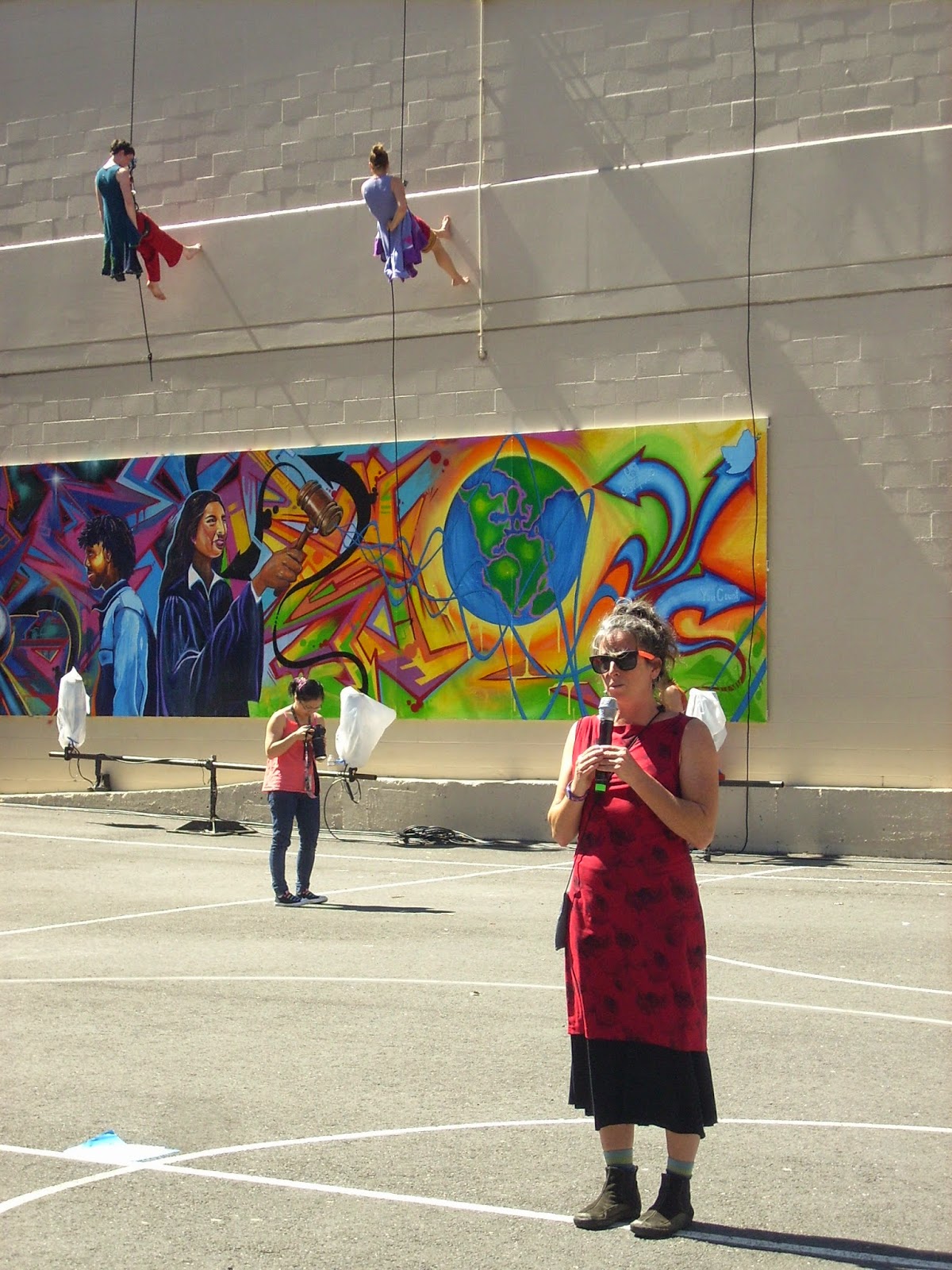


After the performance, Flyaway Productions Artistic Director Jo Kreiter and dancers touch ground for Q & A session.  Their goal is to give light and inspire compassion to the plight of the growing numbers of older women living on the streets of San Francisco.  

Single Room Occupancy (SRO)

Chinese Historical Society of America (CHSA)’s exhibit, “Living in Chinatown: SRO,” featured artist Frank Wong’s miniature diorama and a life-size version of a Chinatown Single-Room Occupancy (SRO), and a panel discussion on affordable housing.
This Frank Wong miniature was inspired by a SRO containing all the possessions of a bachelor resident of the International Hotel at the edge of Chinatown.  SRO housing, originally intended for low-income, immigrant workers, are typically rooms measuring 8 by 10 feet with a communal bathroom down the hall.  San Francisco has over 500 SRO buildings with more than 19,000 units located mainly in the Tenderloin, Chinatown, Mission and SoMa districts.  About 8,000 seniors and persons with disabilities live in San Francisco SROs, which are regarded as important housing stock to support their independence to age in place.  In addition, more than 450 families live in SROs, most built right after the 1906 earthquake and intended for bachelor living.  Many seniors move in with families living in Chinatown SROs. 


Life-size SRO contains bed, sink, and rice cooker.  A 2010 survey found that more than half of SROs in San Francisco had no access to a kitchen in the building.  In SROs, crowded conditions mean 40 people sharing a kitchen, toilet fights, and electrical problems.

Tenants in SROs are being evicted to create vacancies for tourist rentals, so it was disturbing to hear District Supervisor David Chiu talk about investing in SROs and legalizing “in-law units as variations of SROs” to address affordable housing crisis because he has introduced legislation to legalize and regulate short-term rentals through online social networking platforms like Airbnb, which has the effect of removing SRO units intended for lower-income residents, while flagrantly violating existing leases, local rent control laws and prohibitions against converting residential units in buildings with four or more units to tourist or transient use, and failing to pay the City’s 14% transient occupancy or hotel tax.  Further, these laws have not been enforced, including the failure to collect an estimated $25 million in back hotel taxes. 
CHSA hosted a timely affordable housing discussion with CHSA Executive Director and former San Francisco Planning Commission President Sue Lee, Chinatown Community Development Center (CCDC) Executive Director Norman Fong, and San Francisco Planning Commission President and CCDC Community Planning Manager Cindy Wu.  Cindy talked about families crammed into SROs for affordability with an average stay of 7 to 10 years until they have saved enough to move to Visitacion Valley or Excelsior. 
SRO residents work as peer organizers through Chinese Progressive Association to improve living conditions in SROs.  The recent college graduate said last year's Ellis Act eviction of Lee family (elderly couple with disabled adult daughter) from their low-rent apartment of 34 years empowered her to fight for “just and fair living.” While some people consider SROs as transitional housing, they are permanent housing for others and thus worth taking action to improve habitability.


Affordable housing initiatives

Last month, California Housing Partnership Corporation released its report, How San Francisco County’s Housing Market is Failing to Meet the Needs of Low-Income Families.  It found more than 50% of extremely low-income households are elderly or disabled, and San Francisco is short about 40,845 housing units affordable to the poorest, which means a third of household income; in response, the Mayor’s Office of Housing said it was committed to supplying 10,000 units at below market rate, or just a third of the 30,000 housing units that the Mayor has promised to build or rehabilitate by 2020.

At the top of San Francisco Planning and Urban Research (SPUR)’s 8 Ways to Make San Francisco Affordable Again is protect the existing rent controlled housing stock.  San Francisco is about two-thirds renters and has about 172,000 units of rent controlled housing.  As housing prices go up, owners have an incentive to Ellis Act evict tenants (often seniors and persons with disabilities) and get out of the landlord business so they can sell. About 60% of Ellis Act evictions in 2013 were issued by property owners who had owned for less than one year.
Eviction Free San Francisco (EFSF), a direct action group for housing justice, has organized public protests against the displacement of long-time San Franciscan seniors by serial evictors.  This rally and press conference outside San Francisco Superior Courthouse took place before the hearing that quashed the attempted Ellis Act eviction of seniors Patricia Kerman and Tom Rapp based on improper service of their eviction notice by their landlord Kaushik Dattani, who has used Ellis Act on 24 households in the Mission District.  
Demonstrators carried signs, “ELLIS ACT IS ELDER ABUSE” and “STOP EVICTING SENIORS.”  Earlier this month, the Ellis Act eviction of 63-year-old teacher Benito Santiago was rescinded after protests by anti-eviction activists.

Senior and Disability Action (SDA), winner of this year’s n4a Aging Innovations Award for advocacy, kept busy advocating for affordable housing.   
At SDA’s July meeting on Housing, longtime community activist Calvin Welch and Housing Rights Committee Community Organizer Fred Sherburn-Zimmer discussed housing balance and anti-speculation tax legislation. 
Angelica Cabande, Organizing Director of SOMCAN (South Of Market Community Action Network) presented Healthy SoMa (South of Market) about the impact of the 1990s dot-com resulting in gentrification and displacement of mostly seniors, veterans, homeless, low-income residents and Filipino community.  Now this second tech boom is impacting not just SoMa and Mission Districts but the entire City of San Francisco.  Between 2012 and 2013, evictions went up by 115%! Angelica discussed the need for Housing Balance between market rate and affordable housing, with public participation, in order to increase the City’s accountability for meeting its housing goals.
 
SDA University Organizer Pi Ra and Housing Organizer Tony Robles provided advocacy training on Protect Affordable Housing: Stop the Flipping Speculators at the International Hotel Manilatown Center. Tony’s uncle Al Robles was a poet-activist involved in the almost decade-long fight against eviction of the original I-Hotel Manilatown tenants to preserve low-income housing and their community. 
Fred talked about support for anti-speculation tax (Proposition G), which is an additional transfer tax on certain multi-unit residential properties that are sold within 5 years of purchase:  up to 24% then scaling down to 14% on the fifth year.  
Calvin explained that San Francisco has a shortage of land available to build housing:  of its 46.7 square miles, 23 square miles is developable (not beach, parks) and only 13 square miles zoned for housing.  He also provided a history of San Francisco development, blaming today’s housing crisis on ill-conceived land use policies for the past 30 years that favored office buildings over housing, assuming workers would live in suburbs. But most people want to live in San Francisco, including tech workers in Silicon Valley.  In fact, San Francisco’s population has grown to an all-time high of 837,442 in 2013.  To address affordable housing, he favors policies designed to control housing costs and conversions, and investment in public and subsidized housing.  
April Veneracion was former SOMCAN Director before becoming District 6 Supervisor Jane Kim’s legislative aide to focus on land use and redevelopment.  April worked on the initial Housing Balance proposal that included mandated conditional use approval for developments if construction of units fall below the 30% below-market-rate unit threshold.  However, the Mayor’s Office believed this would slow development so the "compromise" measure resulted in a housing policy statement (Proposition K) that sets a goal of providing 33% below-market-rate units and annually reporting on the cumulative ratio between below-market-rate and market-rate housing.


Building home and community through design
 
The 2014 Architecture and the City festival theme, Home: My San Francisco, included panel discussions about affordable housing beyond shelter and our relationship with the built environment.
At the San Francisco Chapter office of American Institute of Architects (AIA), Home Matters convened a panel for a conversation about The Future of Affordable Housing: How Do We Create Affordable Housing Beyond Just Shelter? Panelists included Russell Krummow of Opportunity Nation, Susan Neufeld of non-profit BRIDGE Housing, architect Lisa Gelfand, and neuroscientist Pireeni Sundaralingam.  Defining home as beyond shelter, it provides a sense of place and relationships to feel connected and engaged as part of a community.  Designing home with a view of the individual as part of an ecosystem provides opportunities for interaction with the natural environment (daylight, fresh air, healthy materials, spaciousness) and access to resources like transportation and social capital to enhance emotional well-being and health benefits.
Mapping the home: The roles of subjective and objective in the design process panel of architects and UCSF neurologist Zachary Miller repeated theme of our brains responding to the built environment, nature as healing and creating spaces that feel good to reduce stress.  However, hospitals (nursing homes) may not be healing environments when the wrong science causes problems like sick building syndrome, with sealed windows intended for infection control, but trapping indoor air pollution that is worse than outdoor pollution from operable windows that allow natural ventilation.


Community engagement

Aging in place is about growing old in one’s own home, as opposed to nursing home placement, and facilitating this process by making home safety modifications.  However, this focus makes aging in place limited to physical and safety needs.

Aging in community is a more holistic approach that considers our need for connection.  San Francisco’s compactness, relative walkability and extensive public transit system facilitate connections with others face-to-face. 

Because loneliness is independently associated with functional decline and risk of nursing home placement that jeopardizes aging in place, it’s important to identify loneliness and interventions.  Patrick Arbore, Director and Founder of Center for Elderly Suicide Prevention and Grief Related Services at Institute on Aging, presented a talk about loneliness in gerontologist Hope Levy’s Staying Engaged for a Lifetime, offered through City College of San Francisco at our Main Library. 

According to the U.S. Census Bureau, the number of Americans living alone in 2010 was 29 million – a 30% increase since 1980.  However, Dr. Arbore mentioned that introverts, like himself, prefer solitude so we should not assume that living alone means loneliness.  Instead, loneliness is a feeling of longing and emptiness that is caused by the lack of emotional attachment and/or social ties – and thus a subjective experience. Loneliness expert Louise Hawkley proposed loneliness has three dimensions: isolation, connectedness and belongingness.  Ageism contributes to feelings of being invisible and ignored.

Loneliness interventions include:
  • ask about loneliness
  • spend time with the person, in silence or in conversation
  • assist the person in keeping contact with people important to them
  • explore the nature of loneliness with the person
  • develop community support for the person 
Practice Oprah’s Just Say Hello! Dr. Arbore urged us to be more welcoming and less suspicious in our fear-based culture:
  • connect with people
  • be as present as possible with people who are lonely
  • empathize with people’s losses and suffering
  • EASE our way to social connection: 
Extend yourself to others
Action plan
Selection – solution is quality, not quantity, of relationships
Expect the best – we have more control over our thoughts than we think

San Francisco’s diversity offers many opportunities to find community and dialogue. This year's Legacy Film Festival on Aging (LFFOA) and Aging While Black events took place on the same weekend, yet I couldn't be at two places at the same time so . . .
I didn't buy an all-fest pass to this month’s 4th annual LFFOA, but I attended Friday's Opening Night and Sunday's afternoon screening. With its mission to inspire, educate (including CEUs for MFTs and LCSWs) and entertain intergenerational audiences about the issues surrounding aging, LFFOA builds community.  Opening Night featured Three Perspectives on Aging:  Burn the Clock (UK drama short about septuagenarians who smoke, drink and have sex), Beauty Before Age (documentary about fear of aging in gay male community that values youth/beauty; one older interviewee mentioned that he used physical attractiveness to compensate for his emptiness because he was really seeking validation and connection) and Fabulous Fashionistas (UK documentary about 6 women, whose average age is 80 who show us that style and attitude is not just clothes but knowing what you want like “live in color, don’t wear beige—it might kill you,” being comfortable in “faithful clogs—Crocs,” and making the most of whatever time is left including self-care and being interested).  
Afterwards, LFFOA Executive Director Sheila Malkind moderated a Q &A with Beauty Before Age director Johnny Symons and Dazie Rustin Grego, 19-year-old who said “life is over after age 26” in 1997 documentary.  Now a 37-year-old performance artist, Dazie said he is more thoughtful, less about “look-ism, pretty doll image” and he was just telling his truth at age 19 though this offended some people.  
LFFOA’s Opening Night was also a celebration of Sheila turning age 76! In her interview with KALW’s Your Call host Rose Aguilar about What does it mean to be an elder today, Sheila said she wishes women would stop worrying about aging and stating their age because we should be proud to get to that stage and do wonderful things.  Sheila is a fabulous fashionista herself by embracing aging -- “no botox, plastic surgery” plus no hair dye! 


Sunday afternoon screening of Forget Me Not (Vergiss Mein Nicht), a documentary by German filmmaker David Sieveking about the home care of his mother who had Alzheimer’s disease, showed his use of music, travel, and reading his mother’s diaries (revealing his professor father’s infidelity, which reminded me of the drama Away From Her) to maintain personal connection.  At times, his mother simply wants to retreat in response to attempts to engage her in activities—scenes that resonated with me because I can relate to just wanting down time at home.  After all, home should be a place of retreat—a break from the programmed activities of an institution like a senior center, assisted living, nursing home, cruise ship, etc.  

In Wendy Lustbader’s It All Depends on What You Mean by Home, her study of elders who did not feel at home after moving to continuing care retirement communities (CCRC) to receive supportive services, she found that discontented elders sought: 1) access to dignity, privacy and choice inherent in normal life (versus reminders to “keep busy” through a program of activities like staying at a perpetual resort), 2) the capacity to form significant relationships (versus age segregation that leaves one disconnected from the outside world), and 3) the means to contribute to other people’s lives (reciprocity versus being served all the time).

Community Living Campaign (CLC) uses the power of relationships to build connections of support that we need to age in community.  CLC’s Aging While Black Forum returned to Pilgrim Community Church (panel) and IT Bookman Center (reception).  IT Bookman Director Jackie Wright is seated with panelists Dr. Raymond Tompkins (Aging in a Toxic Environment), Lorenzo Dill (Aging as an African American Veteran) and Anne Warren (Aging with Bills and Legislation).
 
Senior Assembly Member E. Anne Warren represents Older Californians in San Francisco County at California Senior Legislature (CSL).  During CSL's 2013-2014 Session, Legislative Committee Chair Warren introduced Assembly Proposal 43 for a tax credit under personal income tax law for family members providing long-term care.
Pilgrim Community Church Pastor Harold Pierre recognized CLC Community Connector Deloris McGee for founding annual Aging While Black Forum and her community connecting work to support healthy aging in place.  Deloris is retiring and leaving San Francisco to return to her hometown in Mississippi.  I'll always be grateful to Deloris for her inspiration and letting me tag along to learn first-hand about her grassroots community organizing work for my public health classes.  San Francisco will not be the same without Deloris, but she has left a tremendous legacy with her achievements in helping us to age in community by founding OMI Food Network, Breast Cancer Support Group, Fog Walkers, Aging While Black Forum, etc.  

Sunday, August 31, 2014

Listening

The Doobie Brothers gave good advice when they sang, Listen to the Music, written by Tom Johnston:

Wo, we got to let the music play 
What the people need
Is a way to make 'em smile
It ain't so hard to do if you know how
Gotta get a message
Get it on through
Oh now mama's goin' to after awhile
Wo, oh, oh, listen to the music
All the time 

Like executing advance health care directives, those who can listen to music should document our favorite music while we still have capacity.  
At San Francisco’s Opera Plaza Cinema, filmmaker Michael Rossato-Bennett showed Alive Inside, a documentary about the transformative power of “personally meaningful” music to “re-awaken” memories of persons with dementia. (Screen shows nursing home resident Henry becoming animated while listening to his favorite music, in photo above.)  It follows New York social worker Dan Cohen dispensing iPods first at a nursing home and seeing the benefits (regain self-expression, memory recall, physical movement) as residents listen to their favorite music, then he brings iPods to a private residence in the community with similar effect.  Neurologist Oliver Sacks, author of Musicophilia:Tales of Music and the Brain, reminds us that Kant called music the “quickening art” because of its ability to bring listeners immediately to life.  For persons with dementia, this is possible because musical memories activate more parts of the brain last touched by Alzheimer’s, the most common form of dementia.  Alive Inside provides these facts:

5 million Americans have dementia
10 million care for them
1 million in nursing homes lose their connection to life

In Alive Inside, Dr. Bill Thomas discussed how music creates spontaneity in contrast to the regimented world of nursing homes (total institutions), where residents lose independence, dignity and control over meds that sedate them; as they struggle to adapt, they end up withdrawing inside as "living dead" people.  However, he notes that a $1,000 anti-depressant is “real business” (reimburseable under health insurance system), while a $40 music system does not count as a medical intervention; Western medicine views the body as a machine, while music touches the heart and soul of the patient. 

Twenty years ago, Dr. Thomas published The Eden Alternative: Nature, Hope and Nursing Homes, critiquing the prevailing nursing homes modeled after hospitals. Based on this medical model of treatment focused on disease, disability and decline (body system failures), residents are overtreated with psychotropic drugs, unnecessarily restrictive diets that take pleasure out of eating, endless activities programs to meet needs of regulators (rather than true needs of residents), and a therapeutic mentality that remakes ordinary life activities (e.g., pleasure of animal companionship, enjoyment of children, music, art, movement and touch) into treatments rendered by certified therapists.

In its place, Dr. Thomas proposed his holistic Eden Alternative model of personalized care that promotes growth in an enlivened human habitat so residents have “close and continuing contact” with a harmonized diversity of plants, animals and children to combat the “three neglected plagues of nursing homes”—loneliness, helplessness and boredom (social system failures that can be addressed by providing companionship, usefulness and variety).  Instead of scheduled visits for pet therapy, pets would live with residents.  Dr. Thomas acknowledged the role of music when he stated “few human hearts are immune to the uplifting effect of a bird’s song” and suggested parakeets—though imprisoned in bird cages, while dogs and cats roam freely. 


I had many questions, but I was reluctant to ask during the 15-minute Q&A with both filmmaker Michael and social worker Dan after the screening because the audience seemed so enamored with the idea of bringing iPods to nursing home residents with dementia.  During this Q&A, Dan mentioned that a resident listening to just one hour of music in the morning is “good for the day.”  He also reminded us that long-term memory is retained longer and hearing is the last sense to go when one dies.  I wondered if this suggested that one-hour of personalized music alone for the hearing was sufficient to combat loneliness, helplessness and boredom—without adding Eden Alternative elements like plants, animals and children?

My critical mind wondered why the woman living at home in the community was deprived of music until social worker Dan got her an iPod playing her favorite music? Did she stop listening to her favorite oldies music when her 8-track became obsolete, and did not transition to cassette tape or compact disc? Is the takeaway message for us to avoid music (nature) deficit disorder so we should “listen to the music all the time” and be alive to experience every moment of life as a gift, prayer or sacrament like e.e. cummings' the gladdest thing?

Why select so many happy-dance songs? For example, the film featured Bobby McFerrin of Don’t Worry, Be Happy (1989 Grammy Award Song of the Year):
In every life, we have some trouble
When you worry, you make it double
Don’t worry, be happy . . .
The landlord say your rent is late
He may have to litigate
Don’t worry, be happy

In light of the increasing rates of evictions when renters can lose their home within three weeks for failure to pay rent and the fact that 90% of tenants in eviction cases go without legal representation, listening to this song is creepy . . . though last month San Francisco approved funding $1 million for eviction legal defense services.

How about listening to songs that arouse other emotions like anger (Pat Benatar’s Hell is for Children), sadness (Rolling Stones’ Angie), grief (Tracy Chapman’s Behind the Wall), pensiveness (Beatles’ Revolution), etc. to fully express the range of emotions instead of simply joy? How about songs about social justice (Shane Philips’ Rise Up) to inspire change? All honest emotions that flow through (unstuck) can engage us with life.
Like Dr. Thomas’ The Eden Alternative, a non-profit organization that offers culture change training to de-institutionalize long-term care environments and membership in Eden Registry for $3,300, Dan Cohen’s opportunistic Music & Memory is a non-profit that provides training and certification for $1,600. When Music & Memory asks, "Can an iPod change a life?" I wondered whether it has any financial interest in Apple company stock for marketing its products? Also, I wondered about potential hearing loss from use of headphones/earphones? 
In the audience, I spotted California Advocates for Nursing Home Reform (CANHR) Senior Attorney Prescott Cole, who was guest lecturer in my Ethical and Legal Issues in Aging and Social Services course.  He also wrote and composed Shady Manor, a 22-song musical about “a nursing home run by an ambitious and corrupt administrator trying to make Shady Manor show a profit so he can get promoted by his corporate higher-ups.  To make a profit he cuts corners on supplies and under-staffs, causing misery for the residents.”  Shady Manor was performed last year as a fundraiser for University Mound Ladies Home, a non-profit assisted living that was ultimately “saved” from closure when acquired by for-profit AgeSong this month. 

 
At the San Francisco Main Library, People With Disabilities Foundation hosted a seminar, Abuse Against People with Mental and/or Developmental Disabilities: Physical, Sexual and Verbal Abuse in Institutional or Community Settings, to address the potential causes, ramifications, and preventive measures related to the abuse of people with mental and/or developmental disabilities.  Dr. Clarissa Kripke (seated 2nd to left behind table, in photo above), UCSF Clinical Professor of Family and Community Medicine, provided 10 tips for improved communication between professionals and people with psychiatric and developmental disabilities:
  1. Speak directly to patients.  Figure out how people communicate best and support it.
  2. Presume competence.  Give access information and education as well as support for people to make their own decisions.
  3. Give people the tools to communicate about mistreatment, boundaries and choices.
  4. Teach people to set boundaries and protest to help people maximize their potential and to participate fully. Compliance training is a set up for abuse.
  5. Train families and professionals how to listen and respond. Communication is a two‐way street. Put people with disabilities in charge of developing the curriculum.
  6. Take all complaints about mistreatment seriously. Investigate them, and protect people from the accused during that process. 
  7. Give people opportunities to try and fail when the stakes are low, so that people have experience with natural consequences when the stakes are higher.
  8. Get a history of baseline function. In people with communication challenges, illness presents as a change in behavior or function. 
  9. Respect personal boundaries. Offer assistance, but wait for a response and instructions before acting. Treat assistive devices such as wheelchairs and communication devices as personal space. 
  10. Give people access to their chosen advocates and supporters. Many people need support to communicate and to make decisions, especially when they need it the most such as when they are in crisis or transition.
Dr. Kripke, who received the Chancellor Award for Disability Service and has a son with autism, noted Autistic Self Advocacy Network (ASAN) drafted model state legislation to enable Persons with Disabilities a trusted person to help communicate with doctors, understand health care information, make informed decisions about health care, and/or carry out daily health-related activities. This would be like a power of attorney for health care, except there would be no transfer of decision-making to another person. 
CANHR Staff Attorney Tony Chicotel said chemical restraints have been the primary treatment for behavioral expressions related to dementia, such as memory loss, confusion and loss of ability to communicate.  He asked, “what do you do with a crying baby? A. Give them drugs, or B. Tend to their needs and comfort them?”  Instead of drugs, the focus should be the least medicating approach recognizing behavior is communication, knowing care recipient, and meeting them where they are (versus correcting mistakes); and comfort-focused care involving culture change components (liberalized diet, personalized sleeping and showering schedule); active observation, notation and collaboration; and comfort as the goal of every experience.  Tony suggested we reframe the language: for example, viewing the person with dementia resisting care v. exercising self-protection; or wandering v. expressing underlying boredom or lack of physical activity. 

This reminded me of Dr. Thomas saying, “If only we could care for nursing home residents as we care for children. After all, we expect children to grow and we do everything we can to nurture that growth.”  I wondered how can we support growth when caring for persons with dementia (particularly in its progressive and degenerative form like Alzheimer's disease) who grow more dependent as they lose capacity for decision-making? 

I did a lot of listening and learning at Discover You: A Day of Connections, Information and Possibilities! an all-day seminar presented by National Federation of the Blind of California and LightHouse for the Blind.  The main message was set high expectations to do what you want, focus on your strengths, talk about your disability and figure out how to do things and ask for accommodation if needed.  GK Callahan’s The Beaded Quilt (2011, photo above) mural represents the colorfulness and diversity of the Bay Area blindness community who assembled it from almost 150,000 colored beads, and over a year in the making.
Architect Chris Downey, Attorney Shannon Dillon, and CEO Kevan Worley (also Executive Director of National Association of Blind Merchants) participated in breakout session, Discovering Employment Opportunities.  Chris related how soon after he lost his vision in mid-life, a social worker began talking to him about career alternatives.  As an architect, Chris said his work is about trying different points of view and problem-solving, so he ignored the social worker’s advice and found adaptations to continue working as architect while carving out a niche in designing for the blind!  Because architects are obsessed about the world around them, he rediscovered the world without the visual—paying more attention to space and sound—so it was like being a kid again. 
Deborah Kendrick, author of Jobs To Be Proud of and Jobs That Matter from AFB Press, is also columnist for Columbus Dispatch with her latest article, How much do you know about disabilities?

Thursday, July 31, 2014

Wandering

Wandering became a favorite activity of my grandparents, especially my grandfather as he aged in our family home.  When we noticed my grandfather missing and couldn’t find him nearby, we would make a missing person report to the local police, who eventually found him wandering – sometimes almost a mile away from our home! At the time, we thought our wandering grandfather was “senile” and forgot his way home.  Nowadays with helicopter parenting, we probably would be accused of elder neglect but my grandparents were fiercely independent so we gave them free rein to come and go as they pleased.

Earlier this month, I participated in a caregiver focus group, hosted by Aging 2.0 meetup, to provide feedback on a wristwatch that also operates like a fashionable sensor/surveillance/medical alert system to detect falls within the home or wandering from the home.  I didn’t think the watch would have worked for my grandparents, who liberated themselves from wearing watches in favor of being present and especially after developing dementia.  And they would have been terribly upset if they learned about any monitoring that might trigger a traumatic association with Communist informants in China, which they had escaped so they could enjoy freedom and privacy, rights protected under U.S. law. 

Is the problem (dementia) the solution (being present all the time)? Since dementia symptoms include memory loss that seems to keep people present in time, it almost seems like dementia as prolonged meditation (being present all the time) might keep them living longer.  Nobel Prize-winning UCSF biochemist Elizabeth Blackburn is studying how meditation might boost telomeres and telomerase (associated with longevity), possibly via stress reduction.  I often wonder whether my grandparents, who experienced so much trauma and loss in their lives, remained physically fit well into their 90s because dementia was a coping mechanism to forget their painful past and to remain present? Depression, which adds stress to the brain, may be an independent risk factor for dementia, and treating depression includes practices like meditation and getting more sleep to calm brain activity. 
Are you there God? (prayer is my favorite form of meditation) It’s me Wandering (in Antelope Canyon, photo above).  Like my grandparents, wandering is one of my favorite activities—sometimes to prove that I could be like them and adapt to living anyplace in the world.  After completing my professional education (which included studying abroad in China), I made career choices based on travel opportunities.  Then after an employer denied my bereavement leave request to attend my grandmother’s funeral based on their view that "grandparents are not close enough family members to qualify," I quit my job to travel around the world using frequent flier miles.  From my wandering experiences to well over a hundred countries, I value cultural diversity and view dementia as a cultural experience to navigate.

When my grandparents were alive with dementia, I knew little about dementia and regarded them with a mixture of admiration (for their gutsy determination to start over again after losing almost everything in Old China) and amusement (for their frugality).  My grandparents never became invisible as they were surrounded by extended family members who reminded them who they were.  (In the absence of an adequate pool of family caregivers, see Caregiver Corps Act of 2014.)

In a recent Memory Care presentation, Christina Irving, LCSW at Family Caregiver Alliance said that the most effective intervention is our interaction and communication with someone with dementia, focusing on the relationship or personal connection based on emotions rather than content (just like my favorite Maya Angelou quote about “people will never forget how you made them feel”): 
·         Reassure by being present and doing things together based on what is retained (e.g., music, muscle memory)
·         Remain calm
·         Don’t disagree (directly) or try to reason
·         Give compliments
·         Respond to feelings
·         Use distractions
·         Avoid short-term memory questions
·         Break down all tasks
·         Respond calmly to anger, don’t contradict

Wandering in place

This month I was summoned for jury service, which involved a lot of waiting in the courthouse so I enjoyed some napping and summer armchair travel.  I read two funny books by cerebral Jewish authors who are 20 years apart, and write about aging and how we are linked to one another via underwear :-)  
Ladies first, or beauty before age J.  Pink granny panties grace the cover of comedienne Annabelle Gurwitch’s latest book, I See You Made an Effort: Compliments, Indignities and Survival Stories from the Edge of 50, a collection of essays about being sandwiched between raising a teen and helping elderly parents move to assisted living, taking inventory of her life’s regrets (“I’m Meditating as Fast as I Can”), putting health problems in perspective as she copes with her own rheumatoid arthritis at age 49 after a close friend dies of pancreatic cancer, etc.  Her book’s title refers to letting go of perfectionism (like pesky to-do lists in favor of a single item list No. 1: Free yourself from any and all Things You Should Know Lists) and the panties made headlines in her 2007 Los Angeles Times Op-Ed piece, Flee the Fire, Pack the Panties, or her lesson on what to take with her in the event of an emergency evacuation.  After reading Effort, I wanted to read more of Annabelle’s mid-life adventures; as a career changer, I especially liked her essay about reinventing herself with a new career at age 51, after deciding that writing could get lonely so she tried politics until she found herself longing for “the solitude of my writing desk. The words of a Dostoevsky character pop into my mind: ‘The more I love humanity in general, the less I love man in particular.’ I am not as much of a people person as I’d thought. Politics is not for me.” 
Political pundit Neal Milner’s The Gift of Underpants: Stories Across Generations and Place is his memoir about growing up Jewish with his Old Country grandparents in the same household in Wisconsin, living as a haole for the past 40 years in Hawaii where “being Jewish adds zest, recognition and mystery,” and visiting his in-laws in a Florida retirement community. In Jerry Seinfeld’s Florida and My Hawaii (p. 90), he writes: “My main defense against rotting away – the single item in my (I hate the term) bucket list is:  Keep life complicated.  Continue to embrace complexity.  Don’t narrow your gaze. Never give up your search for oddity and irony.” 

In Planning for the Past, he writes about his immigrant ancestors quitting work (simple) while his generation has the privilege of planning for retirement (existential).  As political science professor at the University of Hawaii for 40 years, he was already a storyteller, actor and playwright in the classroom – though his book says “none of these was ever his day job.”  (I still have the November 2000 issue of Honolulu magazine, which originally published his short story, The Gift of Underpants, about his family's tradition of gifting underpants as the "comfort food of gifts.")  Like Word Babcock in The Whore of Mensa, Woody Allen’s short story, I sought out Professor Milner for intellectual stimulation and he remains my favorite tourist attraction when I visit Hawaii -- thoughtful, funny, very easy on the eyes (worthy of red chili pepper in ratemyprofessors.com J)! He always encouraged my curiosity and idealism, and sometimes gave career advice, which I respected but mainly ignored because as a child of Chinese immigrant parents, I was steered to practical professions . . .until I decided on my latest career change, which has most people asking me, “What is gerontology?"


Wandering with the blind leading

On July 26, the 24th anniversary of the Americans with Disabilities Act (ADA), I attended programs at Lighthouse for the Blind and Independent Living Resource Center (ILRC).  
At the Lighthouse event, we met Belo Cipriani, the official spokesperson for Guide Dogs for the Blind (GDB), and his 80-pound guide dog Oslo.  (GDB was a former client so I worked at its spacious San Rafael headquarters, 20 miles north of San Francisco, and was impressed by its ability to provide services free from private funding as it receives no government funding).  Two-thirds of the legally blind population are seniors who lost vision as a result of age-related eye diseases.  Belo became totally blind at age 26 when he suffered retinal detachment after he was beaten up by former childhood friends seven years ago.  During rehabilitation, he studied writing and authored a book, Blind: A Memoir.  A technical recruiter before he lost his sight, he is now a full-time writer, including columnist for SFGate’s Get to Work and Seeing in the Dark.

Belo discussed the value of interdependence, making friends in the community (as only another blind person can understand), learning to anticipate or plan ahead for accommodations (call in advance for Braille), navigating with a white cane (lots of memorizing and counting steps so mobility becomes a chore, people are more courteous) versus guide dog (which become the eyes and social life of the handler, bringing more public attention and engagement), applying for a dog to match his lifestyle (Oslo was pre-screened for travel to rabies-free Hawaii), his GDB training and the only guide dog school with graduate support services, bonding with guide dog to trust with your life (“what they do for love” though service dogs are not trained to protect handlers), different types of service dogs (blind, diabetic, deaf, cane companion, etc.), ADA protection for service dogs (which wear harness uniform on duty to signify no petting), calling police when his dog was denied access by a restaurant that ended up fined $2,500 for ADA violation, retiring service dogs (his first service dog Madge retired after eight years, which is equivalent to 60 human years, when she didn’t want to board a plane, indicating she was tired and didn’t want to work anymore, so she was adopted by his sister to retain health benefits), and being a volunteer puppyraiser. 

Blind leading the blind at ILRC, which celebrated the grand opening of its new street level space designed by 51-year-old architect Chris Downey, who lost his vision four years ago days after surgery to remove a brain tumor.     
ILRC Executive Director Jessie Lorenz, in appreciation, presented wine bottles to Chris, who designed building using Braille blueprint, and his wife Rosa, who picked colors.  Check out Chris’ TED talk, Design with the Blind in Mind:

“if you design a city with the blind in mind, you'll have a rich, walkable network of sidewalks with a dense array of options and choices all available at the street level. If you design a city with the blind in mind, sidewalks will be predictable and will be generous. The space between buildings will be well-balanced between people and cars. In fact, cars, who needs them? If you're blind, you don't drive. (Laughter) They don't like it when you drive. (Laughter) If you design a city with the blind in mind, you design a city with a robust, accessible, well-connected mass transit system that connects all parts of the city and the region all around. If you design a city with the blind in mind, there'll be jobs, lots of jobs. Blind people want to work too. They want to earn a living.”

And YOU can promote accessible paths of travel on all public sidewalks in San Francisco by letting Department of Public Works know where YOU need a curb ramp through its Curb Ramp Program or call 311.

Wandering into the future
This week’s White House blog announced the leader, future website and potential topics for the White House Conference on Aging in 2015, which also marks the 50th anniversaries of the Older Americans Act (July 14), Medicare and Medicaid (July 30), as well as the 80th anniversary of Social Security (August 14).  Potential topics include: retirement security, long-term services and supports, healthy aging, and elder abuse prevention.  (The Employee Retirement Income Security Act celebrates its 40th this year on September 2!)