Saturday, February 28, 2015

Advocacy

To advocate for aging services, Coalition of Agencies Serving the Elderly (CASE) urged members to attend monthly meetings of San Francisco Commission on Aging, which oversees the budget for Department of Aging and Adult Services (DAAS).  CASE represents 37 agencies and their 20,000+ elderly constituents in San Francisco 
At February 4 Commission meeting, seated from left to right, in photo above, are Commissioners Samer Itani (dentist), Katie Loo, President Edna James (nurse/health educator/gerontologist and nonprofit OMI Community Action Organization President), Kaushik Roy (nonprofit Shanti Project Executive Director), Neil Sims (executive search firm partner), and DAAS Executive Director Anne Hinton. 
Public comment by CASE Secretary Valorie Villela (also 30th Street Senior Center Director), a tree hugger who suggested less printing of agenda which is sent out to regular attendees. 
Anne and Edna congratulated DAAS Employee of Month, who received a desk clock in appreciation.  
Municipal Transportation Agency Board member (and DAAS Manager) Tom Nolan reported last month’s approval of free Muni for low-and moderate-income (up to $67,950 for single person) seniors (age 65+) and persons with disabilities (PWD), effective March 1, 2015...thanks to grassroots advocacyTom reported 20,000 seniors and PWD had already applied, and anticipated 25,000 to sign-up.  He said Muni is for everyone, but especially those who need it most.   
Marie Jobling reported Community Living Campaign launched Tech Council (public-private partnership to expand technology access) the previous day, and Long-Term Care Coordinating Council will hold tenth year celebration this year. 
CASE Co-Chair Michelle Alcedo (also Openhouse Programs Director) presented CASE advocacy platform requesting funding to: 1) increase staffing for community services, 2) increase staffing for Aging and Disability Resource Centers (ADRC, which has lacked Tagalog speaking staff since July 2014 though Tagalog has been certified as third language for City communications), and 3) pay more “equitable” salaries for case management positions because nonprofit agencies struggle to recruit and retain talent when County salaries are “much higher.”  In addition, CASE seeks to extend free Muni to include group van and ADA transportation and 4% cost of doing business increase for FY 2015-16. 
DAAS Program Support Analyst Monte Cimino requested authorization for additional funds to Mental Health Association of San Francisco (MHASF) for expanding hoarding support services to non-English speakers. Commissioners responded with ayes.
DAAS Nutritionist Linda Lau had longest presentation requesting authorization of $5 million in add-backs for nutrition, including three new meal sites and expansion of Choosing Healthy and Appetizing Meal Plan Solutions for Seniors (CHAMPSS, which is healthier than CalFresh Fast Food Restaurant Meals Program).
  
“Good end-of-life”
 
Katy Butler, journalist and author of Knocking on Heaven’s Door: The Path to a Better Way of Death (2013), was speaker at this month’s meeting of San Francisco Bay Area Network for End-of-Life Care (SFEOL), co-chaired by Nate Hinerman. Now a Dean at Golden Gate University, Nate was my former SFSU Professor who taught Death and Dying in Contemporary Society.

Katy discussed the contrasting experiences of her parents’ final years: medical technology interventions to keep her dying father alive for “five terrible years,” and her mother’s determination for a better death so she decided to stop eating and drinking after a second heart attack brought her to a hospice wing. (The legal status of such "voluntarily stopping eating and drinking" by advance directive is untested.) She said it takes moral courage to say it’s the end-of-life, which she recognized in her father’s “benchmark” statements:
  • “I don’t know who I am anymore” (lost capacities)
  • “I am not going to get better” (progressive illness)
  • “I’m living too long”
According to Katy, “bad (painful) deaths” are so common because doctors don’t know how to talk to us, insurance pays for the wrong things (cure v. care), and treatments don’t stop until someone just says no (because medicine’s default is to offer all reimbursable treatments). 
Katy recommended Dr. Angelo Volandes’ The Conversation: A Revolutionary Plan for End-of-Life Care (2015), for patients, family members and doctors to honestly discuss the following:
·         What kinds of things are important to you in your life?
·         If you were not able to do the activities you enjoy, are there any medical treatments that would be too much?
·         What fears do you have about getting sick or medical care?
·         Do you have any spiritual, religious, philosophical, or cultural beliefs that guide you when you make medical decisions?

Katy’s presentation reminded me of The New York Times' recent Opinionator piece, “Dying Shouldn’t Be So Brutal,” in which Dr. Ira Byock proposed Safe Dying Act with these components: 1) train “young” (new?) doctors to assess and treat pain, listen to patients’ concerns and collaborate with patients and families in making treatment decisions, 2) require nursing home companies to double staffing of nurses and aides, and hours of care for each resident, 3) set minimum standards for palliative care teams within every hospital, 4) routinely publish meaningful quality ratings for hospitals, nursing homes, assisted living, home health and hospice programs for people to use in choosing care, and 5) repeal the Medicare statute that forces incurably ill people to forgo disease treatments in order to receive hospice care.

Also on my reading list is Atul Gawande’s Being Mortal: Medicine and What Matters in the End (2014), which was excerpted in Slate and featured in this month’s PBS Frontline

Community of Voices
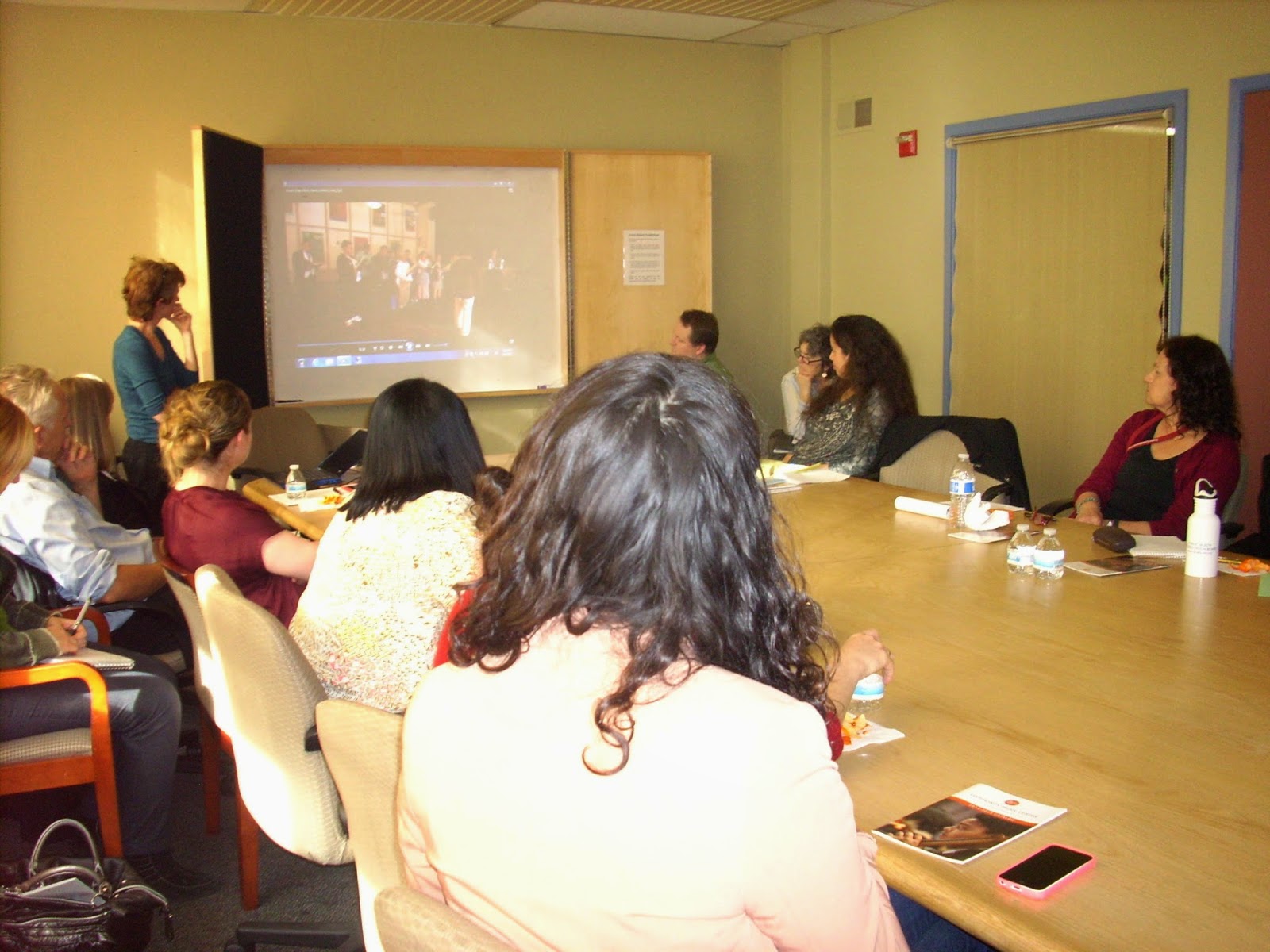
At this month's CASE meeting held at Project Open Hand, Community Music Center (CMC) Program Director Sylvia Sherman spoke about her organization’s partnership with UCSF School of Nursing’s Institute for Health and Aging and DAAS, to form Community of Voices research involving a dozen senior choirs throughout San Francisco.  Funded by a five-year grant from National Institute on Aging, this study is in its third year to demonstrate health benefits (lung capacity, balance, coordination, memory, moods) on seniors (age 60+) who participate in a community choir.  Check out video, Can Singing in a Choir Improve the Health of Older Adults? 
  
Caregiving
Another reason to thumbs-up “like” Kevin Winge even more: he’s got his priorities in order, resigning as Project Open Hand (POH) Executive Director to return to his home state of Minnesota to provide care to his sisters who are critically ill.  I liked Kevin’s memoir, Never Give Up: Vignettes from Sub-Saharan Africa in the Age of AIDS (2006, reminded me of my own experience as Global Service Corps volunteer in Tanzania), his monumental decision to remove the soda vending machine (ostensibly to cut unnecessary electricity costs), expansion of POH meals to include clients with ten additional diseases (beyond traditionally served clients with HIV/AIDS and cancer), Food=Medicine Pilot Study with UCSF, expansion of senior congregate meal sites, etc. Kevin will be missed more than the in-house production of peanut butter and beloved macaroni and cheese, which he also removed from POH menu.

Let’s Kick ASS (AIDS Survivor Syndrome) hosted Who Is Going to Care For Us As We Age? A Discussion on Options for Long-Term Care, at LGBT Conference Center with elder law attorney Daniel Redman and NEXT Village Director Jacqueline Zimmer (JZ) Jones.  Daniel provided an overview of the continuum of care (in-home, assisted living, continuing care retirement communities, skilled nursing) from low-income (SSI/Medi-Cal/IHSS) to private pay options, and San Francisco's proposed LGBT Long-Term Care Facility Residents' Bill of Rights. JZ shared the benefits of joining NEXT Village, which serves residents in San Francisco's north east, and tips for LGBT community to start a village of neighbors helping one another so all can successfully age in community.  

Dementia care
 
Preparing for the Changing Horizon: Dementia Awareness and Caregiving for LGBT Older Adults from Diverse Communities included roundtable discussion with keynote presenters David Coon and Karen Fredriksen-Goldsen (author of The Aging and Health Report: Disparities and Resilience among LGBT Older Adults), two caregivers and Michelle Alcedo of Openhouse.  LGBT older adults are more likely to live alone and depend on “families of choice” for caregiving, yet such friends or non-families of origin as caregivers lack legal recognition by the health care system.    
Alzheimer’s Association Director of Diversity Edie Yau moderated panel discussion on Sharing Lessons Learned: Integrating Cultural Values, Beliefs and Practices into Dementia Care of LGBT Older Adults, with Geoffrey Kerchner (Alzheimer's researcher), Lou Bordisso (retired therapist with early-onset Alzheimer's), and two caregivers.  LGBT seniors may fear disclosing their sexual orientation/gender identity and not access services out of fear of discrimination, and few providers have received training to celebrate (not just tolerate) LGBT. Alzheimer’s Association has LGBT Caregiver Concerns brochure and Family Caregiver Alliance has LGBT Caregiving: FAQs.

At AgeSong Guru Project’s Biomedical Convention, psychiatrist and Pacific Institute board member Richard Patel welcomed psychologist (retired) Richard Taylor and geriatrician Allen Power for a discussion about wisdom in changes associated with aging and forgetting.

Richard Taylor, author of Alzheimer’s From the Inside Out (2006), has been sharing his experience since receiving his diagnosis of dementia ten years ago.  He described the disengagement process, and finding the “disease” answers in the medical model do not help.  Rather than being defined by deficits to be fixed, it takes time to find out what he can do and the brain is always trying to figure out, Who am I? What’s going on? Why am I here? He repeats because he wants answers that he can’t hold in his short-term memory.  To understand “problem behavior” (negative label) is to understand who the person is, including unique ways of expression, rather than project needs to quiet behavior with psychotropic drugs.  Richard's call to action is: "Stand up! Speak up! Do not victimize yourself with your own silence.  How will anyone really know what it's like to live with dementia?"  He encouraged us to sign-up for his newsletter at http://www.richardtaylorphd.com/. (Another resource is Dementia Alliance International, established in 2014 and the first international group of, by and for the people with dementia engaged in advocacy to eradicate stigma, isolation and discrimination.) 

Allen Power, author of Dementia Beyond Disease: Enhancing Well-Being (2014), discussed 7 domains of well-being: 1) identity, 2) connections, 3) security, 4) autonomy, 5) meaning, 6) growth and 7) joy.  He cautioned that if you view someone as less than a complete person, then you give less care; and that too much focus is on finding a cure for dementia rather than promoting well-being.
 
Singalong at AgeSong’s Forget Me Not CafĂ©: music + cognition.
SFSU gerontology classmate Brittany plays flute at AgeSong’s University campus during Guru Launch Gala.
Psychotherapist Nader Shabahangi, founder of AgeSong and Pacific Institute, moderated discussion of the AgeSong Guru Project, a one-year initiative to “focus on comprehensive care partnerships with elders to understand need-driven behaviors and minimize risky use of psychotropic medication.” 

AgeSong Care Planning Liaison and Pacific Institute Clinical Psychology Ph.D. student Stephanie Rothman’s interest in “what matters in life” led to working with elders, whom she finds more authentic.  She described her disillusionment while attending last year’s Alzheimer’s Association International Conference in Copenhagen that was akin to a pharmaceutical convention.  Instead of drug treatment to make persons with dementia more like us inside, Stephanie seeks depathologizing dementia and psychosocial treatment to see the real person from his/her perspective: we learn from feistiness because we are better off when needs are expressed and supported.

Richard said humanity increases with dementia because you become more of who you are when pretense fades away and you get in touch with your needs for esteem, love and belonging, which you are more willing to express as you get older; forgetfulness gets you closer to humanity because you stay in the present moment to understand now instead of past; instead of looking back at "who I was," now time is spent working on "who I am."  Allen echoed those thoughts about getting to the essence when one is more honest and transparent with fewer agendas, and advocated for an abling perspective so people feel allowed to be.

After the panel discussion, I met Eveline Wu, GCFP, who co-authored the UCSF study on Preventing Loss of Independence through Exercise (PLIE) for Older Adults with Dementia, a non-drug intervention that focuses on training procedural memory for basic functional movements, while increasing mindful body awareness and facilitating social connection.

Hospital discharge
 
At Hospital to Home: A Community Forum on Hospital Discharge, held at 30th Street Senior Center's dining room, DAAS Director Anne Hinton provided an overview of San Francisco’s Long-Term Care Integration Strategic Plan.
 
Senior and Disability Action (SDA) Executive Director Sarah Lehman moderated the panel of speakers:
  • Carrie Wong, DAAS Director of Care Transition Operations, explained San Francisco Transitional Care Program (SFTCP) provides services (transportation including medication pick-up, 14 days of meals, 6 hours of homecare) for 4 to 6 weeks, at no cost to eligible San Francisco residents with Medicare Parts A and B who are referred by one of eight partnering hospitals to prevent unnecessary readmissions.  
  • Donna Willmott, SDA Consumer Advocate, reminded us that Medicare covers the first 20 days in an approved skilled nursing facility, only if one first has at least three full days of "inpatient" Part A hospital care. However, hospitals are placing more patients under “observation status” to protect themselves against new policies that penalize hospitals for unnecessary admissions.  Therefore, Medicare patients should ask whether they are considered inpatients or outpatients each day they are in the hospital as status can change.  More tips in SDA’s June 2013 newsletter
  • Marcia Peterzell, Community Living Campaign Connector, discussed Connections for Healthy Aging workshop that covers hospital stay and advocacy.  She distributed Vial of Life kits for us to complete personal identifying information, medical history and information, and emergency contact. 
  • Ken Hornby shared his personal experience and the need for self-advocacy to make sure one is heard to get the help needed.  Medicare has Discharge Planning Checklist.
One attendee shared her experience of having her service dog stay in the hospital with her.  (Some institutions recognize doctor’s orders for pet visits.) There were more providers than consumers at this event, which was scheduled at the same time as Ai-Jen Poo's book tour talk on Women, Leadership, and the Future of Care.

“Old is gold”: telephone community

After taking online classes like Coursera’s Living with Dementia: Impact on Individuals, Caregivers, Communities and Societies, conveniently accessible 24/7 with power point presentations, taking classes via telephone seems so quaint.  But a recent Telegraph article, “Why low-tech living is back” declared, “old is gold” with the popularity of printed books, vinyl records, typewriters, retro-phones, and Polaroid instant photo cameras.
 
Staying Engaged for a Lifetime gerontologist Hope Levy introduced Susan Lee Lindeman, Program Manager of Senior Center Without Walls, a “statewide telephone community” serving about 300 older adults age 60+ in California.  SFSU gerontology alum Terry Englehart founded this award-winning nonprofit in 2004 to connect homebound, isolated seniors via telephone in activities such as bingo, improvisation, armchair travel, singalongs, health presentations, book clubs, support groups, etc.  To participate or volunteer, call 877-797-7299.

Saturday, January 31, 2015

Caring

San Francisco In-Home Supportive Services (IHSS) Public Authority  held an information meeting to discuss IHSS program changes.  As a result of IHSS workers’ successful fight against Governor Brown’s proposal to cap IHSS worker hours to 40 hours per week to avoid paying overtime, the State Budget included pay for IHSS overtime, travel time and wait time starting January 1, 2015.   In addition, Governor Brown’s proposed budget includes restoration of the 7% cut to IHSS hours effective July 1, 2015.  However, at this January 21 meeting, it was announced that California IHSS Program will not pay overtime, travel, or wait time due to recent U.S. District Court decisions. . . and after it printed six million new timesheets!

On September 17, 2013, the U.S. Department of Labor (DOL) announced a final rule extending the Fair Labor Standards Act (FLSA)'s minimum wage and overtime protections to most workers who provide home care assistance to elderly people and people with illnesses, injuries or disabilities.  Set to take effect January 1, 2015, DOL’s proposed changes would have extended FLSA protections to more than two million home care workers by 1) eliminating the companionship exemption for home care workers employed by third-party agencies, and 2) limiting the definition of “companionship” to providing fellowship and protection, with “care” services limited to no more than 20% of hours worked per week. 

With a Little Help From My Friends:  On a sunny Saturday morning, joined Beatles Choir led by Christie Chew of City Church San Francisco for the past five years to provide monthly musical companionship to residents at Laguna Honda Hospital and Rehabilitation Center.  We met in the lobby to introduce ourselves, receive Beatles Choir Lyrics booklets and rehearse for our tour of three “neighborhoods” (home to maximum 60 residents each who live in four 15-person “households”).

We practice choreography for Here Comes the Sun: raise hands for “sun, sun, sun, here it comes“ and then lower bodies for “I see the ice is slowly melting.”

However, two U.S. District Court rulings on December 22, 2014 and January 14, 2015 vacated DOL’s Home Care Rule, finding DOL was “trying to do through regulation what must be done through legislation.”  While home care agencies challenged DOL’s rule to maintain the affordability of home care services, DOL disagreed with the Court’s orders, stating: “We believe the Rule is legally sound and is the right policy—both for those employees, whose demanding work merits these fundamental wage guarantees, and for recipients of services, who deserve a stable and professional workforce allowing them to remain in their homes and communities.”  DOL is considering “legal options” including appeal.

With this recent setback for IHSS workers, I decided to re-visit a gerontology class paper I wrote two years ago about the campaign for Domestic Worker Bill of Rights, which California Governor Brown signed into law (though it does not cover IHSS workers) just nine days after DOL announced its Home Care Rule.  


Ob-la-di, Ob-la-da got a bird sing-ing-a-long “life goes on, brah!”


Domestic Worker Rights and Implications for Aging in Place
Most people wish to remain in their own homes (“age in place”), and view nursing home placement as a last resort option.  In the absence of informal care by family and friends, domestic workers provide formal in-home care to seniors who need assistance with activities of daily living so they can age in place. 
I Wanna Hold Your Hand (with permission):  “And when I touch you, I feel happy inside”

Government Policies Relating to Formal In-home Care

As supplements or substitutes for informal caregivers, domestic workers make possible middle-class women’s “liberation” from unpaid housework and caregiving, which are often outsourced to racial minority and immigrant women in mostly low-paying in-home care jobs.  Due to its historical roots in slavery and association with women’s unpaid labor, domestic work is undervalued and underpaid.  Further, domestic workers are marginalized by deliberate government policies, often criticized as rooted in gender and race discrimination, which exclude them from labor protections that apply to other occupations and workplaces.
Yellow Submarine:  “As we live a life of ease, Every one of us has all we need, 
Sky of blue, and sea of green, in our yellow submarine”

Since colonial times in the United States, domestic work was performed by enslaved, indentured and semi-free female laborers.  Since the 19th century, domestic work offered opportunities for paid work by Black and new immigrant women.  “Visiting homemakers” emerged in the Great Depression as work relief for unemployed Black women who previously worked as domestic servants and as an alternative to fiscally strained public hospitals.  As such, they were ignored as an occupation: the New Deal Congress (Southern politicians seeking to maintain an inexpensive supply of Black labor) excluded domestic workers from coverage for Social Security (until 1951), collective bargaining (National Labor Relations Act of 1936), minimum wages and other labor standards.  In 1974, the Fair Labor Standards Act of 1938 was amended to include domestic workers, but exempted companionship from coverage (U.S. Supreme Court affirmed this exclusion in 2007 for workers who provided home companionship services through a third party) and live-in workers from overtime provisions.

The Occupational Safety and Health Act specifically excludes domestic workers.  Other federal laws exclude most domestic workers on a de facto basis, because they only apply to employers with multiple employees:
  • Title VII of Civil Rights Act of 1964 and Americans with Disabilities Act: at least 15 employees
  • Age Discrimination in Employment Act: at least 20 employees
  • Family and Medical Leave Act: at least 50 employees
Policymakers have been reluctant to extend labor protections to domestic workers for performing care work, based on the presumption that women would always be willing to provide care and companionship for loved ones.  Caregivers may develop emotional attachment to those they care for, which reduces their bargaining power, as the lack of boundaries leads to working around the clock beyond paid hours.

Hey Jude:  “Take a sad song and make it better!”

“Care Crisis”:  Growing Demand for yet Shortage of Domestic Workers
         
Demand for home care is expected to rise faster than institution-based care.  The unprecedented increase in our older population, as the baby boom generation ages with chronic conditions and prefers to age in place, has translated into an increased demand for domestic workers.  Long-term care policies focused primarily on protecting the consumer, but paying little attention on protecting domestic workers, have not helped the recruitment and retention of these workers. 

All You Need is Love is affirming: “There's nothing you can do that can't be done”

Instead, the low pay, poor working conditions and challenges of caring for clients, who are increasingly more sick and disabled, have contributed to a “care crisis” due to high turnover and vacancy rates among domestic workers.  Men, in particular, are not attracted to domestic work because of the low wages paid and cultural stereotypes of women’s work.  About 25% of home aides make less than the federal minimum wage, and about 40% rely on public assistance, such as Medicaid and food stamps. 
         
A survey of domestic workers in the San Francisco Bay Area 
revealed the following work conditions: the majority work to provide support for their families, yet their wages are not sufficient to meet family living expenses; 90% of workers did not receive overtime pay when they worked overtime; over 80% did not receive paid rest and meal breaks; and the majority are exposed to health and safety hazards (exposure to toxic cleaning chemicals, risk of injury).

As the demand for in-home care rises in response to our growing older population that wishes to age in place, policy change is needed to improve the recruitment and retention of domestic workers.  The wages and working conditions of domestic workers are directly related to the quality and availability of care.  Problems with attracting and retaining domestic workers may translate to disruptions in continuity of care, and overworked and frustrated workers may be more likely to physically or emotionally abuse home care clients or become victims of abuse from underserved clients.   

Art with Elders, a program of Elder Givers Connecting the Generations
Do you hear me, me, me, me painting
  
Proposed Solutions

Advocates propose interventions to address power imbalances and discriminatory policies.  One model is California’s consumer-directed home care services.  Created in 1973, In-Home Supportive Services (IHSS) developed out of previous attendant and homemaker programs that often employed those on welfare to care for others on public assistance.  A coalition of labor, seniors and disability advocates got state legislation authorizing counties to create public authorities to run the state’s IHSS program as employers of record for homecare workers, while consumers retained power to hire, fire and supervise them.  Next, they passed local ordinances to set up public authorities in each county that paved the way for union recognition and collective bargaining.  In 1995, the San Francisco Public Authority was created, and IHSS workers unionized (Service Employees International Union) to get better pay and working conditions, which helped get better qualified and more reliable caregivers devoted to the elderly and persons with disabilities who share similar low-income class, and often the same gender and race as many hire their own relatives.

Yet, working conditions for domestic workers cannot be improved by merely shifting their location from the private market to the public sector, but we need to challenge policies that sustain low wages and poor working conditions.  Assemblyman Tom Ammiano advocated for a California Domestic Worker Bill of Rights to address discriminatory policies that have sustained low wages and poor working conditions for domestic workers.


Visited Laguna Honda’s farm animals after completing Free Memory Screening based on Brief Alzheimer Screen Test, which included naming as many animals in 30 seconds time:  pig, turkey, duck, goat, sheep, goat, rabbit, etc.

California Domestic Worker Bill of Rights

In 2012, California Governor Jerry Brown vetoed California Domestic Worker Bill of Rights (Assembly Bill 889), based on paternalistic concerns that requiring overtime and rest/meal breaks to domestic workers might result in 1) increased costs beyond the financial capacity of the elderly and disabled to the point of “forcing people out of their homes and into licensed institutions,” and 2) fewer jobs, less hours and flexibility for domestic workers. 

In 2013, Assemblyman Tom Ammiano introduced a revised California Domestic Worker Bill of Rights (Assembly Bill 241), with the following six provisions for improving work conditions to promote the welfare of both domestic workers (except IHSS workers) and those under their care:  1) overtime pay, 2) meal and rest breaks, 3) workers compensation, 4) uninterrupted sleep provisions (live-in), 5) use of kitchen facilities, and 6) paid days of rest.  On September 26, 2013, Governor Brown signed this Bill into law, which became effective January 1, 2014.

Gerald Heffernon’s sculpture, Rabbinoid on Cell Phone, at Laguna Honda

Ethical Principles

Magnificent Magnolias bloom inside 75-year-old San Francisco Botanical Garden
which has the most significant collection of magnolias outside of China

The ethical principles driving Domestic Worker Bill of Rights are beneficence, nonmaleficence and justice.  Beneficence comes into play because the bill attempts to do what is good for domestic workers and care recipients.  San Francisco Department of Public Health conducted a Health Impact Assessment of AB 889, finding that both domestic workers and care recipients would benefit from giving 24-hour or live-in caregivers the right to protected time to rest and recover.  Sufficient sleep would reduce risk of premature death, chronic disease and depression for caregivers, and ensure that caregivers are more alert and attentive to their client’s needs.  

Without this protection, sleep-deprived workers may be more prone to mistakes and accidents, potentially jeopardizing themselves and those under their care as well.  In addition, overtime pay provides a disincentive to employers scheduling workers for more than 8 hours a day or 40 hours a week, because long work hours are associated with increased stress, depression, high blood pressure and cardiovascular disease.  Thus, a related principle is nonmaleficence.  Justice also comes into play because it seems only fair to extend labor law protections already enjoyed by other California workers to cover over 200,000 domestic workers in California, who are 93% female, majority are women of color, 40% are immigrants and 22% are undocumented, earning just over the minimum wage and averaging less than $20,000 per year. 


Quality of care is affected when domestic workers do not reflect most of their older clients who are white.  One study noted that beneficial close relationships, akin to nurturing familial relationships, between domestic workers and older adults in their care are possible when they are the same gender and race, and relationships have continued for at least one year.  As status and power differentials are reduced, clients are satisfied with work performed, and workers feel valued as persons.

Power dynamics in domestic worker-older client relationships that resemble master-servant roles make workers less able to negotiate work conditions in private homes, where they are often isolated and invisible to the public, and thus vulnerable to exploitation in an unregulated industry.  When underpaid and overworked, they suffer burnout and lose commitment to remain in their jobs to the detriment of their older clients who need continuity of quality care.

Conclusion: Call to Action

To attract and retain a more stable and diverse group of domestic workers to provide continuity of care and gender/race preferences for our growing older population, we need policy change to recognize domestic workers worthy of labor protections enjoyed by other workers.  To date, only three states have adopted Domestic Worker Bill of Rights: New York (2010), Hawaii (2013) and California (2014). 

Domestic workers are the front-line caregivers who ensure that our growing elderly population with chronic conditions can continue to age in place at home.  Thus, there is an urgent need to address how we value both our elderly population and domestic workers. 

Ai-Jen Poo, lead organizer in New York’s Domestic Worker Bill of Rights campaign, co-director of Caring Across Generations and author of The Age of Dignity: Preparing for the Elder Boom in a Changing America, said, “It’s about respect and dignity, not for one group or another but for all of us as humans.” 

 Docent Joe Barbaccia holds magnolia sprengeri & stands in front of white zen magnolia

Wednesday, December 31, 2014

Power to the Elderly

Power = Legal assistance

“The most important thing a lawyer can do is become an advocate of powerless citizens. . . Lawyers should represent systems of justice.
-- Ralph Nader, public interest lawyer (attorney)

This month’s Legal Assistance to the Elderly (LAE) fundraiser was attended mostly by lawyers.  In California, the July bar exam results are released just before Thanksgiving; the pass rate was 69% for first-time takers from ABA-accredited law schools.  But how many of these new admittees will practice elder law in public interest settings or empower older adults to exercise their legal rights to income, employment, health care, housing, etc.?

Ageism takes away power from older adults, who may protest that they’re not heard so they seek “magical attorney letters” on law office letterhead to get attention, or sue oppressors to regain control over their lives – whether it’s potential loss of respect (elder abuse), home (evictions, habitability), standard of living (public benefits), independence (service dogs as reasonable accommodation), etc.  As Gray Panthers founder Maggie Kuhn noted, people go through more psychological changes in the last 20 years of their life than they do in the first 60:  “Older persons experience the traumas of retirement; death of friends, spouse, children; lack of income, health, mobility.”  (Maggie Kuhn on Aging, 1977, p. 98)  
San Francisco Main Library’s exhibit, HEAL! Veterans and Their Service Dogs, is a photographic series about veterans with post-war disabilities and their service dogs for hearing, psychiatric service, mobility and medical alert provided through Operation Freedom Paws

According to David Solie, physician assistant and author of How to Say It to Seniors: Closing the Communication Gap with Our Elders (2004), the “secret mission” of older adults is to maintain control over their lives in face of almost daily losses (physical strength, health, peer group, consultative authority, identity, physical space, financial independence) and simultaneously to discover their legacy.  In trying to resolve this conflict (need for control v. reflection to discover legacy), elderly will wander from subject to subject, repeat stories we’ve heard, postpone decisions, go off on tangents, or describe something in endless detail. 

Solie argues that older adults’ communication style is not a problem, but an attempt at problem-solving based on developmental psychology to fulfill needs like self-esteem (associated with autonomy that is threatened by loss of control) and legacy (a larger issue for consideration if one is not consumed by focus on control).  In the elderly, attempts to resolve this developmental crisis propel them backward (v. forward) to reflect on what their lives have meant.  If this crisis is not resolved in favor of generativity (creating legacy), then they experience stagnation. 

Further, Solie theorizes that what appears to be diminished capacity in the majority of older adults is “slowing down” due to awareness of their different developmental mission, which results in refocusing life’s priorities from the goal-oriented productivity of middle-age years to reflective activity.  He explains that an aging brain’s physiology changes to promote an older person’s need for reflection and insight at the end of life: the prefrontal cortex (platform for working memory capacity, processing information) takes longer to process multiple points of information, so the external world may begin to fade, distraction sets in and focus is compromised – but this lag time allows for wisdom to surface.  
LAE Director Howard Levy greets arriving guests at fundraiser.  Donations to LAE always welcome at http://laesf.org/#/donate/

“You teach yourselves the law, but I train your minds.  You come in here with a skull full of mush; and if you survive, you leave thinking like a lawyer.”
-- The Paper Chase’s Law Professor Charles W. Kingsfield, Jr.

While working with the elderly seeking legal assistance in eviction cases based on nuisance claims, I considered Solie’s ideas and wondered if any allegations of hoarding and cluttering might be related to an older tenant’s need for control and legacy: in the face of overwhelming losses, this creates a need to “hang on tight” to a lifetime of collectibles (repository of memories), which may represent one's legacy? Thus, we argue that nuisance was due to client’s mental health impairment and request reasonable accommodation for additional time to clear out stuff to maintain tenancy?  Yet, some clients will not acquiesce to a defense that they find stigmatizing like a mental health disability, and might decide to pay for storage space rather than their tenancy.
 
LAE’s staff attorney/lawyer Tom Drohan plays stand-up bass with Shut-Ins, who play “Hulabilly,” a lively amalgam of hillbilly, hula, folk and country music.  Their CDs include Sing Songs of Pain and Joy and A Very Shut-Ins Xmas.  Tom also plays “Roadhouse Swing” with ChazzCats, and keeps his busy day job as housing lawyer.

“Lawyers know how to apply law to power.” – Ralph Nader

In my visits to the elderly living in SROs, what appears to be hoarding and cluttering is really a lack of adequate physical space.  Though hoarding behavior seems to be more problematic (deferred maintenance, falls, fire, pest infestation, etc.) as people age, hoarding documents is empowering evidence!  For example, in determining a tenant’s lawful rent in San Francisco, the Administrative Law Judge will evaluate each rent increase going back to the commencement of the tenancy or April 1, 1981, whichever is later. This hoarding advantage made a huge difference in the case of an elderly couple who received a three-day notice to pay (back rent) or quit: after reviewing their “hoarded” documents from 20 years of rent increase notices, rent receipts and canceled checks, we identified a pattern of improper rent increases; after computing the lawful rent, it was determined that this couple actually overpaid rent to their landlord! 
Shut-Ins' drummer is LAE’s tech guy.  As landlords seek to take advantage of rising real estate values fueled by the tech boom, low- and moderate-income tenants including nonprofits risk losing their tenancies.  Due to new building ownership, LAE and other nonprofit tenants (including Eviction Defense Collaborative) are being displaced from their office space within Twitter tax break zone (Market and 6th Streets) next year while tolerating remodeling work this past year.

Legal assistance empowers the elderly by listening and working with them to honor their needs.  In a case involving an elderly client who faced eviction because he did not trust his building's management to perform bed bug control treatment in his rental unit, I was aghast hearing an Adult Protective Services worker suggest a mental assessment for possible conservatorship or 5150 (involuntary psychiatric hold).  Fortunately, empathetic LAE staff intervened to speak on behalf of client (too frail to be present at hearing) who felt manhandled by property management team but could be persuaded to agree to pest control when approached in a more respectful manner and with his input in making arrangements.
  

“It’s hard to avoid the ‘doing for.’ Some people are hungry for attention and are quite ready to be cared for, well on the way to wrinkled babyhood.”
Maggie Kuhn On Aging (1977, p. 23)

According to Robert Butler’s Why Survive? Being Old in America (1975), there was no public or private legal program for older people until 1968 when a grant from the Office of Economic Opportunity funded Legal Research and Services for the Elderly under sponsorship of the National Council of Senior Citizens.  In 1972, National Senior Citizens Law Center (NSCLC) was formed to be a national resource to protect the rights of low-income older adults in America

In California, there are more legal aid agencies serving older adults that are doing “for”:
·         Alameda County’s Legal Assistance for Seniors was founded in 1976 by three women graduates of the Displaced Homemakers Paralegal Program at Mills College (which had Maggie Kuhn as member of the advisory board).
·         Monterey County has Legal Services for Seniors in Salinas and Seaside.
·         Sonoma County has Council on Aging Services for Seniors in Santa Rosa.
·         Yuba-Sutter County has Legal Center for Seniors in Marysville.

In contrast, San Francisco County’s Legal Assistance to the Elderly began serving elders in 1977 as a pro bono program, then hired paid staff shortly after becoming a non-profit corporation in 1979.  In 2003, LAE expanded to serve younger adults with disabilities (though this is not reflected in organization’s name).

Grammar lesson:  “For” is used to indicate on behalf (e.g., do for seniors), while “to” is used to indicate directed action (e.g., do to seniors). 

“Words are the essential tools of the law. In the study of law, language has great importance; cases turn on the meaning that judges ascribe to words, and lawyers must use the right words to effectuate the wishes of their clients. . . .”

At Books, Inc. in San Francisco, Timothy Shriver introduced his new memoir, Fully Alive: Discovering What Matters Most, about finding inspiration (overcome fear of judgment) from his aunt Rosemary Kennedy and people with intellectual disabilities he’s met as Special Olympics Chairman, collaborating with Farrelly brothers in The Ringer film, campaign not to use r-word, and his preference for using “diffabilities” (different abilities) to rethink that there are multiple intelligences.  When asked about Alzheimer's, he mentioned his late father Sargent with Alzheimer's demanded much compassion and his sister Maria's work with The Alzheimer's Project.
  
Elderly v. Seniors

“We are not ‘senior citizens’ or ‘golden agers.’ We are the elders, the experienced ones; we are maturing, growing adults responsible for the survival of our society.  We are better educated, healthier, with more at stake in this society.  We are not wrinkled babies, succumbing to trivial, purposeless waste of our years and our time.  We are a new breed of old people.  There are more of us alive today than at any other time in history.” 
Maggie Kuhn On Aging (1977, p. 14)

What do we call old people? How do we define an old person?  Should laws treat older adults as a special class “deserving” of special treatment due to ageism that makes them vulnerable to discrimination and disadvantage?          
·         In San Francisco evictions based on owner or relative move-in (under rent control), older adults age 60+ or disabled (SSI eligible) tenants with 10 or more years tenancy, or catastrophically ill tenants with 5 or more years tenancy have protected status and cannot be evicted from a building of two or more units. 
·         In San Francisco evictions based on landlord removing building from rental market (Ellis Act, under rent control), older adults age 62+ with at least one year tenancy are entitled to one-year notice (rather than 120 days notice) and additional relocation payment.  
·         California’s elder abuse law covers anyone age 65+ and “dependent adults.”
                                                       
There are challenges in representing older adults:
·         lack of capacity due to cognitive impairment from dementia, stroke, depression or other condition
·         sudden death (LAE had sad case of elderly couple with more than 5 years but less than 10 years tenancy, when catastrophically ill husband died leaving wife to fight owner move-in eviction without his protected status)
·         frailty so older adult accompanied by relative (spouse, child) who may have conflicting interests (always communicate directly to older adult as client)
  
 
In 1961, President John F. Kennedy convened the first White House Conference on Aging.  Four years later, his successor President Lyndon B. Johnson included three bills to assist older adults as part of his Great Society reforms: 
  • Older Americans Act (OAA), which established the federal Administration on Aging, to provide comprehensive services for older adults;
  • Medicare to provide basic hospital and supplemental medical insurance to older adults and younger persons with disabilities; and
  • Medicaid to provide health coverage for low-income persons of all ages and funding expansion of nursing home industry.  
These government safety net programs and Social Security have reduced the elderly poverty rate from 35% in 1960 to 9% in 2012.  There is broad public support for entitlements like Social Security and Medicare.  Yet means-tested programs like public housing, Medicaid (Medi-Cal), SSI or SNAP (CalFresh) are stigmatizing (like mental health disease) to the Greatest Generation (born 1901-1924) and Silent Generation (born 1925-1945) cohorts who are reluctant to apply for welfare though they qualify. 

OAA’s Title III programs (nutrition, community services) are not means-tested and are not permitted to charge for their services (though voluntary donations are encouraged), but expected to target services to individuals with the greatest economic or social needs (low-income minorities) and yet Congress has never appropriated sufficient funds to make them universal in practice.  In fact, OAA expired in 2011, and we’re waiting for Congress to restart the reauthorization process next year. 

Though most OAA programs are age-segregated, they end up benefiting all ages; for example, providing adult day care, meals and transportation frees mobile younger adults from providing direct care or support to their aging parents.  However, developing a coordinated long-term care system remains a public policy challenge due to partisan politics and the existing fragmentation of programs and services with different entitlements and eligibility requirements.

Organizing around common concerns for social justice (Gray Panthers’ motto is “Age and Youth in Action”) is the legacy of Maggie Kuhn, a proponent of generational interdependence (v. independence), cooperation (v. competition), intergenerational involvement (v. age segregation), public interest (v. self interest)—for more Power to the People including Elderly!

Legacies

“ . . .the day of death is better than the day of birth . . .  The heart of the wise is in the house of mourning, but the heart of the stupid is in the house of rejoicing."
-- Ecclesiastes 7:1, 4

Perhaps it’s my introverted nature, but I prefer memorial services than other occasions for reflection and inspiration.  This year I attended two services that stand out:  my 94-year-old landlord, who knew me for more than half my life; and a 61-year-old tenant advocate, who never met me. 

First, my landlord: a retired County District Attorney—a fact that he never volunteered to me (but I learned from his daughter) because he was so endearingly unassuming (one obituary described him as “homespun”). As a clueless and unemployed twentysomething recent graduate when I became his tenant, my landlord provided gentle encouragement as I searched for gainful employment that would enable me to pay rent J 

When my landlord got out of his pickup truck with toolbox, he passed as a handyman, a real do-it-yourself landlord who repaired my windows and often accompanied electricians and plumbers doing work in his multi-unit apartment building.  Even after he retired from landlording, delegating duties to a property management firm, he continued to check on the building, which I saw as an opportunity to check on him – how was he and his wife doing in their retirement community in Sacramento?  Since I knew them with their children and grandchildren, it seemed unusual to live in an age-segregated community.

After my landlord died, I attended a celebration of his life at the retirement community.  As the only tenant present, I could say he was the model landlord, embodying the fruitages of the spirit (“love, joy, peace, patience, kindness, goodness, faith, mildness, self-control” from Galatians 5:22-23) along with being fair and responsive – the same qualities consistently mentioned by his family, friends, neighbors, and colleagues.   I was inspired learning about my landlord’s legacy in representing justice in his legal career. . .and doing so with civility, which made a comeback with this year's California bar admittees who took a new oath:  “As an officer of the court, I will strive to conduct myself at all times with dignity, courtesy, and integrity.”  

Second, the tenant advocate: Ted Gullicksen, director of San Francisco Tenants Union since 1988 until his sudden death in October.  Though I never met Ted in person, I admired his advocacy work from afar so his memorial was an opportunity to learn more about his life and legacy from his associates.  
 
Just outside Mission High School auditorium was a wall papered with a collage of photos, posters and news clippings of Ted's work to fight displacement and protect rent control; a table held the tools of his trade—bolt-cutters (to get into locked abandoned buildings to occupy in his Homes Not Jails campaign), bullhorn (to shout his messages), chocolate espresso beans (for sustenance) and SFTU Tenants Rights Handbook (given to members and updated annually that often included legislation that he helped draft) among other items.
Prayer flags created by attendees and strung outside auditorium.  Ted liked donuts so one flag had a picture of a donut with message, "I donut want a San Francisco without Ted." Ted spoke out against landlords making unilateral changes to leases, like one who evicted an elderly couple who had goldfish in their unit.
 
Upon entering the auditorium, we received a 12-page booklet filled with photos and remembrances about Ted’s lifelong commitment to social justice.  Inside the auditorium, Brass Liberation Orchestra welcomed attendees: Housing is a human right! 
 
Artist Hugo Kobayashi wears his portrait of Ted and dog Falcor, who was adopted by
 
Sara Shortt of Housing Rights Committee. 
Sheriff Ross Mirkarimi in dark suit standing in back row.  Sheriff’s Office took a break from carrying out usual Wednesday evictions on Xmas Eve and New Year’s Eve this year.