Sunday, August 31, 2014

Listening

The Doobie Brothers gave good advice when they sang, Listen to the Music, written by Tom Johnston:

Wo, we got to let the music play 
What the people need
Is a way to make 'em smile
It ain't so hard to do if you know how
Gotta get a message
Get it on through
Oh now mama's goin' to after awhile
Wo, oh, oh, listen to the music
All the time 

Like executing advance health care directives, those who can listen to music should document our favorite music while we still have capacity.  
At San Francisco’s Opera Plaza Cinema, filmmaker Michael Rossato-Bennett showed Alive Inside, a documentary about the transformative power of “personally meaningful” music to “re-awaken” memories of persons with dementia. (Screen shows nursing home resident Henry becoming animated while listening to his favorite music, in photo above.)  It follows New York social worker Dan Cohen dispensing iPods first at a nursing home and seeing the benefits (regain self-expression, memory recall, physical movement) as residents listen to their favorite music, then he brings iPods to a private residence in the community with similar effect.  Neurologist Oliver Sacks, author of Musicophilia:Tales of Music and the Brain, reminds us that Kant called music the “quickening art” because of its ability to bring listeners immediately to life.  For persons with dementia, this is possible because musical memories activate more parts of the brain last touched by Alzheimer’s, the most common form of dementia.  Alive Inside provides these facts:

5 million Americans have dementia
10 million care for them
1 million in nursing homes lose their connection to life

In Alive Inside, Dr. Bill Thomas discussed how music creates spontaneity in contrast to the regimented world of nursing homes (total institutions), where residents lose independence, dignity and control over meds that sedate them; as they struggle to adapt, they end up withdrawing inside as "living dead" people.  However, he notes that a $1,000 anti-depressant is “real business” (reimburseable under health insurance system), while a $40 music system does not count as a medical intervention; Western medicine views the body as a machine, while music touches the heart and soul of the patient. 

Twenty years ago, Dr. Thomas published The Eden Alternative: Nature, Hope and Nursing Homes, critiquing the prevailing nursing homes modeled after hospitals. Based on this medical model of treatment focused on disease, disability and decline (body system failures), residents are overtreated with psychotropic drugs, unnecessarily restrictive diets that take pleasure out of eating, endless activities programs to meet needs of regulators (rather than true needs of residents), and a therapeutic mentality that remakes ordinary life activities (e.g., pleasure of animal companionship, enjoyment of children, music, art, movement and touch) into treatments rendered by certified therapists.

In its place, Dr. Thomas proposed his holistic Eden Alternative model of personalized care that promotes growth in an enlivened human habitat so residents have “close and continuing contact” with a harmonized diversity of plants, animals and children to combat the “three neglected plagues of nursing homes”—loneliness, helplessness and boredom (social system failures that can be addressed by providing companionship, usefulness and variety).  Instead of scheduled visits for pet therapy, pets would live with residents.  Dr. Thomas acknowledged the role of music when he stated “few human hearts are immune to the uplifting effect of a bird’s song” and suggested parakeets—though imprisoned in bird cages, while dogs and cats roam freely. 


I had many questions, but I was reluctant to ask during the 15-minute Q&A with both filmmaker Michael and social worker Dan after the screening because the audience seemed so enamored with the idea of bringing iPods to nursing home residents with dementia.  During this Q&A, Dan mentioned that a resident listening to just one hour of music in the morning is “good for the day.”  He also reminded us that long-term memory is retained longer and hearing is the last sense to go when one dies.  I wondered if this suggested that one-hour of personalized music alone for the hearing was sufficient to combat loneliness, helplessness and boredom—without adding Eden Alternative elements like plants, animals and children?

My critical mind wondered why the woman living at home in the community was deprived of music until social worker Dan got her an iPod playing her favorite music? Did she stop listening to her favorite oldies music when her 8-track became obsolete, and did not transition to cassette tape or compact disc? Is the takeaway message for us to avoid music (nature) deficit disorder so we should “listen to the music all the time” and be alive to experience every moment of life as a gift, prayer or sacrament like e.e. cummings' the gladdest thing?

Why select so many happy-dance songs? For example, the film featured Bobby McFerrin of Don’t Worry, Be Happy (1989 Grammy Award Song of the Year):
In every life, we have some trouble
When you worry, you make it double
Don’t worry, be happy . . .
The landlord say your rent is late
He may have to litigate
Don’t worry, be happy

In light of the increasing rates of evictions when renters can lose their home within three weeks for failure to pay rent and the fact that 90% of tenants in eviction cases go without legal representation, listening to this song is creepy . . . though last month San Francisco approved funding $1 million for eviction legal defense services.

How about listening to songs that arouse other emotions like anger (Pat Benatar’s Hell is for Children), sadness (Rolling Stones’ Angie), grief (Tracy Chapman’s Behind the Wall), pensiveness (Beatles’ Revolution), etc. to fully express the range of emotions instead of simply joy? How about songs about social justice (Shane Philips’ Rise Up) to inspire change? All honest emotions that flow through (unstuck) can engage us with life.
Like Dr. Thomas’ The Eden Alternative, a non-profit organization that offers culture change training to de-institutionalize long-term care environments and membership in Eden Registry for $3,300, Dan Cohen’s opportunistic Music & Memory is a non-profit that provides training and certification for $1,600. When Music & Memory asks, "Can an iPod change a life?" I wondered whether it has any financial interest in Apple company stock for marketing its products? Also, I wondered about potential hearing loss from use of headphones/earphones? 
In the audience, I spotted California Advocates for Nursing Home Reform (CANHR) Senior Attorney Prescott Cole, who was guest lecturer in my Ethical and Legal Issues in Aging and Social Services course.  He also wrote and composed Shady Manor, a 22-song musical about “a nursing home run by an ambitious and corrupt administrator trying to make Shady Manor show a profit so he can get promoted by his corporate higher-ups.  To make a profit he cuts corners on supplies and under-staffs, causing misery for the residents.”  Shady Manor was performed last year as a fundraiser for University Mound Ladies Home, a non-profit assisted living that was ultimately “saved” from closure when acquired by for-profit AgeSong this month. 

 
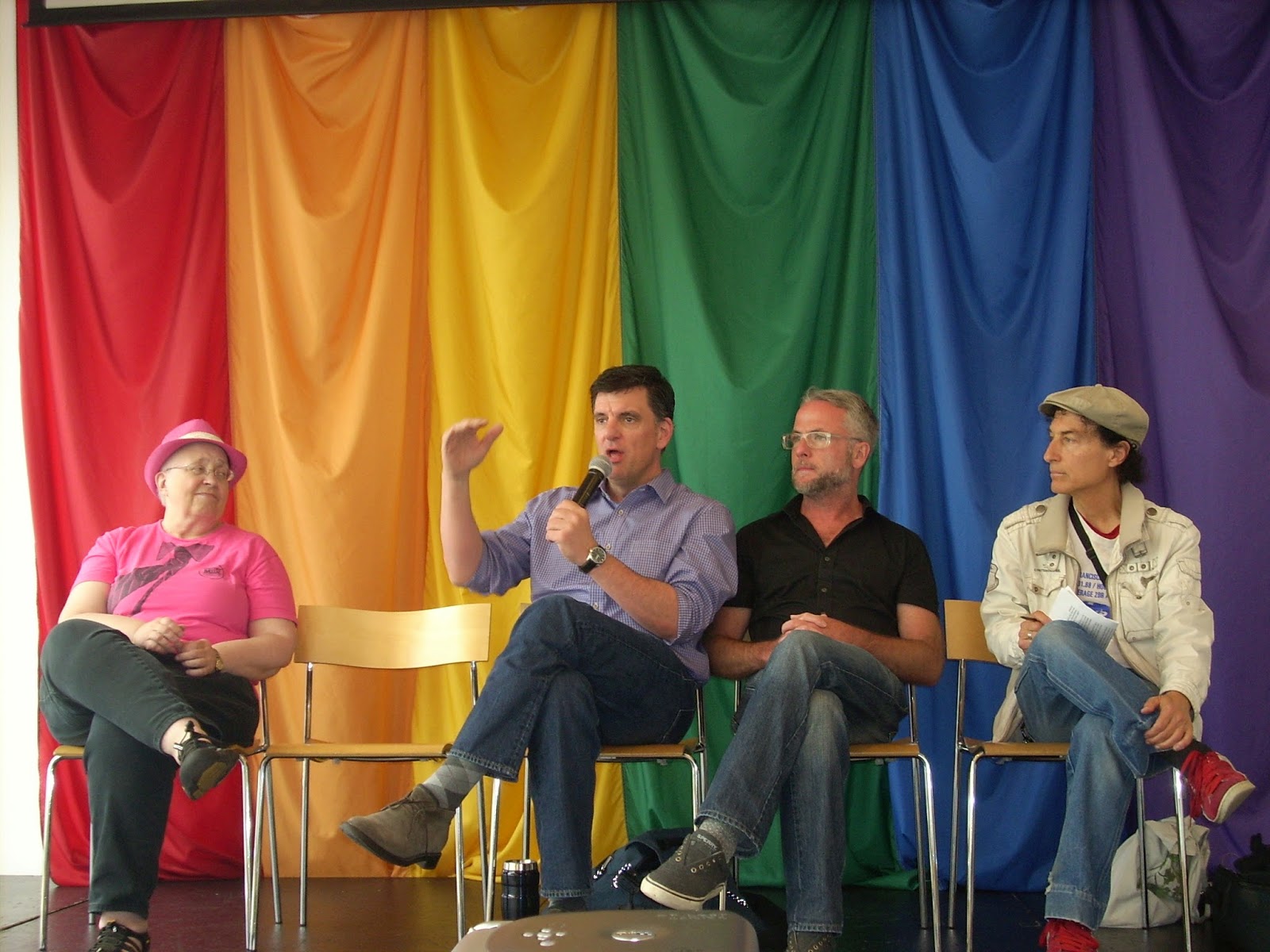
At the San Francisco Main Library, People With Disabilities Foundation hosted a seminar, Abuse Against People with Mental and/or Developmental Disabilities: Physical, Sexual and Verbal Abuse in Institutional or Community Settings, to address the potential causes, ramifications, and preventive measures related to the abuse of people with mental and/or developmental disabilities.  Dr. Clarissa Kripke (seated 2nd to left behind table, in photo above), UCSF Clinical Professor of Family and Community Medicine, provided 10 tips for improved communication between professionals and people with psychiatric and developmental disabilities:
  1. Speak directly to patients.  Figure out how people communicate best and support it.
  2. Presume competence.  Give access information and education as well as support for people to make their own decisions.
  3. Give people the tools to communicate about mistreatment, boundaries and choices.
  4. Teach people to set boundaries and protest to help people maximize their potential and to participate fully. Compliance training is a set up for abuse.
  5. Train families and professionals how to listen and respond. Communication is a twoway street. Put people with disabilities in charge of developing the curriculum.
  6. Take all complaints about mistreatment seriously. Investigate them, and protect people from the accused during that process. 
  7. Give people opportunities to try and fail when the stakes are low, so that people have experience with natural consequences when the stakes are higher.
  8. Get a history of baseline function. In people with communication challenges, illness presents as a change in behavior or function. 
  9. Respect personal boundaries. Offer assistance, but wait for a response and instructions before acting. Treat assistive devices such as wheelchairs and communication devices as personal space. 
  10. Give people access to their chosen advocates and supporters. Many people need support to communicate and to make decisions, especially when they need it the most such as when they are in crisis or transition.
Dr. Kripke, who received the Chancellor Award for Disability Service and has a son with autism, noted Autistic Self Advocacy Network (ASAN) drafted model state legislation to enable Persons with Disabilities a trusted person to help communicate with doctors, understand health care information, make informed decisions about health care, and/or carry out daily health-related activities. This would be like a power of attorney for health care, except there would be no transfer of decision-making to another person. 
CANHR Staff Attorney Tony Chicotel said chemical restraints have been the primary treatment for behavioral expressions related to dementia, such as memory loss, confusion and loss of ability to communicate.  He asked, “what do you do with a crying baby? A. Give them drugs, or B. Tend to their needs and comfort them?”  Instead of drugs, the focus should be the least medicating approach recognizing behavior is communication, knowing care recipient, and meeting them where they are (versus correcting mistakes); and comfort-focused care involving culture change components (liberalized diet, personalized sleeping and showering schedule); active observation, notation and collaboration; and comfort as the goal of every experience.  Tony suggested we reframe the language: for example, viewing the person with dementia resisting care v. exercising self-protection; or wandering v. expressing underlying boredom or lack of physical activity. 

This reminded me of Dr. Thomas saying, “If only we could care for nursing home residents as we care for children. After all, we expect children to grow and we do everything we can to nurture that growth.”  I wondered how can we support growth when caring for persons with dementia (particularly in its progressive and degenerative form like Alzheimer's disease) who grow more dependent as they lose capacity for decision-making? 

I did a lot of listening and learning at Discover You: A Day of Connections, Information and Possibilities! an all-day seminar presented by National Federation of the Blind of California and LightHouse for the Blind.  The main message was set high expectations to do what you want, focus on your strengths, talk about your disability and figure out how to do things and ask for accommodation if needed.  GK Callahan’s The Beaded Quilt (2011, photo above) mural represents the colorfulness and diversity of the Bay Area blindness community who assembled it from almost 150,000 colored beads, and over a year in the making.
Architect Chris Downey, Attorney Shannon Dillon, and CEO Kevan Worley (also Executive Director of National Association of Blind Merchants) participated in breakout session, Discovering Employment Opportunities.  Chris related how soon after he lost his vision in mid-life, a social worker began talking to him about career alternatives.  As an architect, Chris said his work is about trying different points of view and problem-solving, so he ignored the social worker’s advice and found adaptations to continue working as architect while carving out a niche in designing for the blind!  Because architects are obsessed about the world around them, he rediscovered the world without the visual—paying more attention to space and sound—so it was like being a kid again. 
Deborah Kendrick, author of Jobs To Be Proud of and Jobs That Matter from AFB Press, is also columnist for Columbus Dispatch with her latest article, How much do you know about disabilities?

Thursday, July 31, 2014

Wandering

Wandering became a favorite activity of my grandparents, especially my grandfather as he aged in our family home.  When we noticed my grandfather missing and couldn’t find him nearby, we would make a missing person report to the local police, who eventually found him wandering – sometimes almost a mile away from our home! At the time, we thought our wandering grandfather was “senile” and forgot his way home.  Nowadays with helicopter parenting, we probably would be accused of elder neglect but my grandparents were fiercely independent so we gave them free rein to come and go as they pleased.

Earlier this month, I participated in a caregiver focus group, hosted by Aging 2.0 meetup, to provide feedback on a wristwatch that also operates like a fashionable sensor/surveillance/medical alert system to detect falls within the home or wandering from the home.  I didn’t think the watch would have worked for my grandparents, who liberated themselves from wearing watches in favor of being present and especially after developing dementia.  And they would have been terribly upset if they learned about any monitoring that might trigger a traumatic association with Communist informants in China, which they had escaped so they could enjoy freedom and privacy, rights protected under U.S. law. 

Is the problem (dementia) the solution (being present all the time)? Since dementia symptoms include memory loss that seems to keep people present in time, it almost seems like dementia as prolonged meditation (being present all the time) might keep them living longer.  Nobel Prize-winning UCSF biochemist Elizabeth Blackburn is studying how meditation might boost telomeres and telomerase (associated with longevity), possibly via stress reduction.  I often wonder whether my grandparents, who experienced so much trauma and loss in their lives, remained physically fit well into their 90s because dementia was a coping mechanism to forget their painful past and to remain present? Depression, which adds stress to the brain, may be an independent risk factor for dementia, and treating depression includes practices like meditation and getting more sleep to calm brain activity. 
Are you there God? (prayer is my favorite form of meditation) It’s me Wandering (in Antelope Canyon, photo above).  Like my grandparents, wandering is one of my favorite activities—sometimes to prove that I could be like them and adapt to living anyplace in the world.  After completing my professional education (which included studying abroad in China), I made career choices based on travel opportunities.  Then after an employer denied my bereavement leave request to attend my grandmother’s funeral based on their view that "grandparents are not close enough family members to qualify," I quit my job to travel around the world using frequent flier miles.  From my wandering experiences to well over a hundred countries, I value cultural diversity and view dementia as a cultural experience to navigate.

When my grandparents were alive with dementia, I knew little about dementia and regarded them with a mixture of admiration (for their gutsy determination to start over again after losing almost everything in Old China) and amusement (for their frugality).  My grandparents never became invisible as they were surrounded by extended family members who reminded them who they were.  (In the absence of an adequate pool of family caregivers, see Caregiver Corps Act of 2014.)

In a recent Memory Care presentation, Christina Irving, LCSW at Family Caregiver Alliance said that the most effective intervention is our interaction and communication with someone with dementia, focusing on the relationship or personal connection based on emotions rather than content (just like my favorite Maya Angelou quote about “people will never forget how you made them feel”): 
·         Reassure by being present and doing things together based on what is retained (e.g., music, muscle memory)
·         Remain calm
·         Don’t disagree (directly) or try to reason
·         Give compliments
·         Respond to feelings
·         Use distractions
·         Avoid short-term memory questions
·         Break down all tasks
·         Respond calmly to anger, don’t contradict

Wandering in place

This month I was summoned for jury service, which involved a lot of waiting in the courthouse so I enjoyed some napping and summer armchair travel.  I read two funny books by cerebral Jewish authors who are 20 years apart, and write about aging and how we are linked to one another via underwear :-)  
Ladies first, or beauty before age J.  Pink granny panties grace the cover of comedienne Annabelle Gurwitch’s latest book, I See You Made an Effort: Compliments, Indignities and Survival Stories from the Edge of 50, a collection of essays about being sandwiched between raising a teen and helping elderly parents move to assisted living, taking inventory of her life’s regrets (“I’m Meditating as Fast as I Can”), putting health problems in perspective as she copes with her own rheumatoid arthritis at age 49 after a close friend dies of pancreatic cancer, etc.  Her book’s title refers to letting go of perfectionism (like pesky to-do lists in favor of a single item list No. 1: Free yourself from any and all Things You Should Know Lists) and the panties made headlines in her 2007 Los Angeles Times Op-Ed piece, Flee the Fire, Pack the Panties, or her lesson on what to take with her in the event of an emergency evacuation.  After reading Effort, I wanted to read more of Annabelle’s mid-life adventures; as a career changer, I especially liked her essay about reinventing herself with a new career at age 51, after deciding that writing could get lonely so she tried politics until she found herself longing for “the solitude of my writing desk. The words of a Dostoevsky character pop into my mind: ‘The more I love humanity in general, the less I love man in particular.’ I am not as much of a people person as I’d thought. Politics is not for me.” 
Political pundit Neal Milner’s The Gift of Underpants: Stories Across Generations and Place is his memoir about growing up Jewish with his Old Country grandparents in the same household in Wisconsin, living as a haole for the past 40 years in Hawaii where “being Jewish adds zest, recognition and mystery,” and visiting his in-laws in a Florida retirement community. In Jerry Seinfeld’s Florida and My Hawaii (p. 90), he writes: “My main defense against rotting away – the single item in my (I hate the term) bucket list is:  Keep life complicated.  Continue to embrace complexity.  Don’t narrow your gaze. Never give up your search for oddity and irony.” 

In Planning for the Past, he writes about his immigrant ancestors quitting work (simple) while his generation has the privilege of planning for retirement (existential).  As political science professor at the University of Hawaii for 40 years, he was already a storyteller, actor and playwright in the classroom – though his book says “none of these was ever his day job.”  (I still have the November 2000 issue of Honolulu magazine, which originally published his short story, The Gift of Underpants, about his family's tradition of gifting underpants as the "comfort food of gifts.")  Like Word Babcock in The Whore of MensaWoody Allen’s short story, I sought out Professor Milner for intellectual stimulation and he remains my favorite tourist attraction when I visit Hawaii -- thoughtful, funny, very easy on the eyes (worthy of red chili pepper in ratemyprofessors.com J)! He always encouraged my curiosity and idealism, and sometimes gave career advice, which I respected but mainly ignored because as a child of Chinese immigrant parents, I was steered to practical professions . . .until I decided on my latest career change, which has most people asking me, “What is gerontology?"


Wandering with the blind leading

On July 26, the 24th anniversary of the Americans with Disabilities Act (ADA), I attended programs at Lighthouse for the Blind and Independent Living Resource Center (ILRC).  
At the Lighthouse event, we met Belo Cipriani, the official spokesperson for Guide Dogs for the Blind (GDB), and his 80-pound guide dog Oslo.  (GDB was a former client so I worked at its spacious San Rafael headquarters, 20 miles north of San Francisco, and was impressed by its ability to provide services free from private funding as it receives no government funding).  Two-thirds of the legally blind population are seniors who lost vision as a result of age-related eye diseases.  Belo became totally blind at age 26 when he suffered retinal detachment after he was beaten up by former childhood friends seven years ago.  During rehabilitation, he studied writing and authored a book, Blind: A MemoirA technical recruiter before he lost his sight, he is now a full-time writer, including columnist for SFGate’s Get to Work and Seeing in the Dark.

Belo discussed the value of interdependence, making friends in the community (as only another blind person can understand), learning to anticipate or plan ahead for accommodations (call in advance for Braille), navigating with a white cane (lots of memorizing and counting steps so mobility becomes a chore, people are more courteous) versus guide dog (which become the eyes and social life of the handler, bringing more public attention and engagement), applying for a dog to match his lifestyle (Oslo was pre-screened for travel to rabies-free Hawaii), his GDB training and the only guide dog school with graduate support services, bonding with guide dog to trust with your life (“what they do for love” though service dogs are not trained to protect handlers), different types of service dogs (blind, diabetic, deaf, cane companion, etc.), ADA protection for service dogs (which wear harness uniform on duty to signify no petting), calling police when his dog was denied access by a restaurant that ended up fined $2,500 for ADA violation, retiring service dogs (his first service dog Madge retired after eight years, which is equivalent to 60 human years, when she didn’t want to board a plane, indicating she was tired and didn’t want to work anymore, so she was adopted by his sister to retain health benefits), and being a volunteer puppyraiser

Blind leading the blind at ILRC, which celebrated the grand opening of its new street level space designed by 51-year-old architect Chris Downey, who lost his vision four years ago days after surgery to remove a brain tumor.     
ILRC Executive Director Jessie Lorenz, in appreciation, presented wine bottles to Chris, who designed building using Braille blueprint, and his wife Rosa, who picked colors.  Check out Chris’ TED talk, Design with the Blind in Mind:

“if you design a city with the blind in mind, you'll have a rich, walkable network of sidewalks with a dense array of options and choices all available at the street level. If you design a city with the blind in mind, sidewalks will be predictable and will be generous. The space between buildings will be well-balanced between people and cars. In fact, cars, who needs them? If you're blind, you don't drive. (Laughter) They don't like it when you drive. (Laughter) If you design a city with the blind in mind, you design a city with a robust, accessible, well-connected mass transit system that connects all parts of the city and the region all around. If you design a city with the blind in mind, there'll be jobs, lots of jobs. Blind people want to work too. They want to earn a living.”

And YOU can promote accessible paths of travel on all public sidewalks in San Francisco by letting Department of Public Works know where YOU need a curb ramp through its Curb Ramp Program or call 311.

Wandering into the future
This week’s White House blog announced the leader, future website and potential topics for the White House Conference on Aging in 2015, which also marks the 50th anniversaries of the Older Americans Act (July 14), Medicare and Medicaid (July 30), as well as the 80th anniversary of Social Security (August 14).  Potential topics include: retirement security, long-term services and supports, healthy aging, and elder abuse prevention.  (The Employee Retirement Income Security Act celebrates its 40th this year on September 2!)

Sunday, June 29, 2014

Justice, not just us

In The Boston Globe's June 20 op-ed piece, “Aging isn’t the challenge; building an equitable society is," gerontologists Laura L. Carstensen and John W. Rowe wrote
Aging too often plays out much differently among less advantaged people. Instead of deepening expertise and well-being, the cumulative effects of poverty, harsh working conditions, and persistent stress leave an alarming proportion of people with little in the way of personal resources. A fifth of married couples and half of unmarried people rely on Social Security alone for at least 90 percent of their income.”

The New York Times today published its last article, “Inequality Is Not Inevitable,” in The Great Divide series, moderated by American economist Joseph E. Stiglitz, who wrote:
“Justice has become a commodity, affordable to only a few. . . .More than a half-century ago, America led the way in advocating for the Universal Declaration of Human Rights, adopted by the United Nations in 1948. Today, access to health care is among the most universally accepted rights, at least in the advanced countries. America, despite the implementation of the Affordable Care Act, is the exception. It has become a country with great divides in access to health care, life expectancy and health status.” 
Americans make up 5% of the world’s population yet consume 25% of its resources, and comprise 25% of the world’s prisoners.  And 99% of Americans are subject to the wealthiest 1%, who control more than 40% of the nation's wealth.
STOP BEING POOR (The Art Show) at Incline Gallery in San Francisco's Mission District: “. . . inspired by the sentiment that many politicians and media correspondents have reverberated: If you’re poor, stop being poor.  . . . With skyrocketing rents and massive neighborhood takeovers, our home, the Bay Area, has become a difficult place in which to live. We invite everyone to come see, but also, purchase art. Can you help us? We need to stop being poor.

According to the Brookings Institution, the gap between the rich and poor in San Francisco is growing faster than any other city in the nation, and San Francisco’s income inequality is on par with developing countries in Central America and sub-Saharan Africa.  San Francisco risks losing its diversity, especially seniors and persons with disabilities who can no longer afford to live in an increasingly expensive city.

While there is much work to overcome rising inequality and barriers to justice, let's remember people power with this summer’s commemoration of the 15th anniversary of Olmstead case (June 22, 1999 U.S. Supreme Court ruling that under the Americans with Disabilities Act, individuals with mental disabilities have a right to live in the community rather than institutions) and 50th anniversary of Civil Rights Act (CRA enacted July 2, 1964 outlawed discrimination based on race, color, religion, sex, or national origin). Knowledge of existing rights and resources can help identify gaps or areas for improvement; for example, CRA has been supplemented with Age Discrimination in Employment Act of 1967 and Americans with Disabilities Act of 1990 (July 26).

Elder justice
 
San Francisco Department of Aging and Adult Services (DAAS) sponsored World Elder Abuse Awareness Day (WEAAD, June 15) Symposium at Born Auditorium in the Human Services Agency building. 
Jill Nielsen, Adult Protective Service (APS) Program Director at DAAS, rattled off the following statistics:
  • 5 million, or 1 in 10, older adults in the U.S. are victims of elder abuse, neglect or exploitation
  • For every case reported, as many as 23.5 cases go unreported (according to New York prevalence study)
  • San Francisco APS received over 6,500 reports of abuse last year, and 580 reports in May 2014 alone
Elizabeth Aguilar Tarchi, San Francisco Assistant District Attorney (DA) for the past 27 years, explained her office’s no drop policy (DA can aggressively hold perpetrators accountable based on evidence, even if victim does not want to pursue action) and vertical prosecution (victim is assigned DA to follow through from charge of crime, rather than have victim re-live experience when dealing with different DAs).  The DA’s Office handles elder abuse cases involving physical and financial crimes.
Any known/suspected abuse should be reported to APS (24-hour hotline at 415.355.6700 or statewide at 800.814.0009) or the Police Department; if immediate harm, call 911.  (If abuse/neglect occurs to a resident in a long-term care facility, call Long-TermCare Ombudsman at 415.751.9788.) 
Mary Twomey, Co-Director at Center of Excellence on Elder Abuse and Neglect based in University of California at Irvine, reminded us that elder abuse is a public health and human rights issue. She performed rap with audience joining her refrain:
I am old, and I am positive
I have wisdom, I’m gonna tell it like it is
I may be disabled, but I’m not obtuse
There’s no excuse for elder abuse! 

At the federal level, Congress has appropriated nothing to implement Elder Justice Act of 2010.  At the state level, California Elder Justice Coalition requested increased funding for statewide training of APS staff and state-level coordinator for county APS.  Mary invited us to wear aqua-colored UNITED AGAINST ELDER ABUSE bracelets, speak up and get involved with her organization, Ageless Alliance

Shawna Reeves, Director of Elder Abuse Prevention at Institute on Aging (IOA), discussed the following trends in elder financial abuse with greater coverage: PBS Frontline program on Residential Care Facilities For the Elderly (RCFE) and Castro Valley RCFE abandonment case; California has 12 bills addressing RCFE abuse; and even a TV show dedicated to hoarding.  She described popular scams like the grandparent scam (phone call from perpetrator who claims to be grandchild requesting emergency funds), sales presentations at senior centers, tax prospecting by insurance agents, pension advance loans, etc.  IOA’s Access to Justice Project details San Francisco civil legal resources specializing in remedies for elder financial abuse.


Housing & health justice 
Third Annual Howard Grayson Elder Life Conference: Housing & Health for All! at LGBT Center opened with performance by Stonestown YMCA Senior Taiko Drummers! 
Moderator Sue Englander with housing panelists Seth Kilbourn, Openhouse Executive Director; Brian Basinger, AIDS Housing Alliance Director; and Tommi Avicolli Mecca, Housing Rights Committee Director of Counseling Programs.

Tommi presented the following facts:
  • 29% of San Francisco’s homeless identify as LGBT, and 3% as transgender
  • District 8 (including Castro, which he says is being “de-gayed”) has been hardest hit by evictions, with 2,000 units affected since 1997 during the first dot-com boom
  • Two-thirds of seniors live in fear that their building will be sold by a speculator who will evict them and flip rentals for profit
Tommi called for the following 11-point plan of action:
  1. eviction defense: demonstrate against speculators (Ellis Act evictions are elder abuse)
  2. public relations to denounce evictions: organize, stand and block doors to Sheriff
  3. affordable housing advocacy: Community Land Trust alternative
  4. develop abandoned property: 300 buildings could be used for housing; only 150 Otis housing (for low-income homeless veterans) was developed in past 12 years
  5. moratorium on market rate housing: this is unconstitutional, but so was same-sex marriage
  6. rental assistance fund: LGBT Aging Task Force recommended Mayor build 30,000 units; first 8,000 to homeless to get off streets, and fill remaining with low-income
  7. stronger eviction protection: relocation for no-fault, Ellis, owner move-in
  8. repeal Ellis Act: Costa Hawkins Bill not allow vacancy rent control; need to extend rent control beyond pre-1979 constructed buildings 
  9. anti-speculation tax: on November ballot would limit 5-year re-sale of building
  10. City shelters need to be LGBT-friendly
  11. campaign to reduce LGBT homeless by 50% in 5 years
During the Q&A, Tommi said they could declare a state of emergency to impose vacancy control and roll back rents because the system is broken so we need a revolution to build systems to address the problem, a PR gimmick to “make headlines like Newsom” and “bring outrage to the planet,” while adding “it’s all about theatrics.”

Brian said that activism and advocacy work: once the fringe challenges the status quo, they win because the fringe makes it safe to get what you ask for, and there is opportunity in crisis.  He proposed the following:
  • resurrect last legislation that late Supervisor Harvey Milk worked on, two days prior to his murder: tax 100% profits of residential building that is bought and sold within two years, which takes away economic incentive driving evictions.  This anti-speculation tax will be on November ballot.
  • introduce legislation to require developers to adopt anti-discrimination protections based on sexual/gender orientation; ask and dialogue to have impact
  • organize homeless to develop policy, join budget advocacy, link arms and stand together to force issue and get fair share
He also mentioned the need to elect the right people who are willing to fight and move forward to support the poor, versus moderates who will not rock boats, like former Mayor DiFi who opposed vacancy control and anti-speculation tax.
 
Seth discussed Openhouse’s partnership with Mercy Housing to develop 55 Laguna, 110 units of affordable senior (age 55+) housing that is “LGBT-welcoming” with construction beginning this October, and the next development of additional 70 units, which he hopes to get HUD rent subsidy. Applications for 55 Laguna housing will be available in mid-2015, and then selection will be made by lottery.  He noted this new housing is just a “drop in the bucket” so it’s important to keep people in their homes.  Policy change solution is critical to dis-incentivize speculators from kicking out seniors and to strengthen anti-eviction.    
Snack table and resource fair included Openhouse, CARA, Gray Panthers, SDA and DAAS.


Host Denise D’Anne, former co-president of Harvey Milk LGBT Democratic Club, introduced health care panelists Miss Major, Transgender, Gender Variant & Intersex Justice Project (TGIJP) Director; Susan Pfeifer, Organizing for Action; Celia Chung, Transgender Law Center; and Barry Hermanson, Green Party candidate.  Panelists acknowledged Affordable Care Act (ACA) is not perfect but huge first step for universal coverage by requiring citizens to purchase insurance or face penalty (greater of $95 or 1% of income); ultimate solution is Medicare for All: “the best universal single payer health care system in the world.”  
After screening of 2005 Emmy-winning documentary for historical/cultural program, Screaming Queens:The Riot at Gene Compton’s Cafeteria, Q&A with Felicia Flames and director Victor Silverman. Three years prior to the June 28, 1969 Stonewall riots in New York, transgender community members in San Francisco’s Tenderloin District fought back to protest police harassment which resulted in improved police community relations and support services through Department of Public Health’s Center for Special Problems, including issuance of ID cards with their new gender.  Felicia, a screaming queen who said she will be 68 next month, is also a Vietnam veteran and 27-year survivor of AIDS.

Administration for Community Living (ACL) released an online learning tool, Building Respect for LGBT Older Adults, which is designed to increase awareness of issues faced by LGBT individuals living in long-term care facilities.  

Access to income

Positive Resource Center (PRC) and Senator Mark Leno sponsored Thriving in 2014: A Day Long Institute on Access to Income and Healthcare for People Living with HIV/AIDS at Milton Marks Conference Center in the State Office Building. 
Access to Income panel included:
  • Amy Orgain, Staff Attorney at AIDS Legal Referral Panel: private long-term disability insurance may pay 60-70% of income, but only up to age 65 or Social Security retirement age
  • Joe Ramirez-Forcier, Employment Services Managing Director at PRC: individuals with HIV may face discrimination based on age rather than HIV status because the average person with HIV in San Francisco is age 50, when there is more turnover in job market so skill refreshment needed  
  • Jerry McIntyre, Directing Attorney at National Senior Citizens Law Center: last year’s Windsor decision (providing for equal treatment of same sex marriage) means Social Security spousal benefit available to same-sex married and domestic partners; however, being recognized as married couple is no advantage for SSI benefits due to combining resources and income of spouses, and SSI does not consider spouse if civil union/domestic partner
  • Fernando Aguayo-Garcia, Senior Bilingual Benefits Advocate at PRC: non-citizens, who are not eligible for SSI, might be eligible for Cash Assistance Program for Immigrants (CAPI); HIV itself is not disabling, but combined with mental health or diabetes symptoms to make disability
Budget justice

Budget Justice Coalition held a press conference on the steps of San Francisco City Hall an hour before the packed budget hearing. 
San Francisco Public Defender Jeff Adachi called for increased funding for eviction legal defense because only 10% of tenants had lawyers to defend them in eviction suits brought by landlords, of which 90% had lawyers.
 
Colleen Rivecca of St. Anthony’s Foundation and San Francisco Food Security Task Force called for additional $10 million for home-delivered meals to serve vulnerable seniors and persons with disabilities (PWD) so they can remain in their homes. 
Marie Jobling, on behalf of San Francisco Long-Term Care Coordinating Council, requested additional $3 million funding for Community Living Fund, created in 2006 with initial funding of $3 million, to help re-establish Laguna Honda patients into the community. 
At budget hearing, seniors and PWD spoke first. SDA Executive Director Jessica Lehman requested funding to fix broken elevators in SRO hotels.
 
In the overflow room in City Hall’s North Light Court, Project Open Hand (POH) Operations Director Simon Pitchford and Executive Director Kevin Winge (seated second row) watch budget hearing on screen.  POH provides “meals with love” at 18 congregate meal sites for seniors and PWD in San Francisco.  In 1998, DAAS selected POH to replace The Salvation Army, which lost its senior congregate meals contract when it failed to comply with a 1997 ordinance requiring anyone who did business with the City to provide nondiscriminatory domestic partners benefits. 
 
At Potrero Hill Health Fair, POH Associate Director of Senior Services Noah Lopez (FOOD=LOVE) and Senior Sites Manager Darin Raffaelli (MEALS with LOVE) model fashion-forward POH T-shirts.  

Long-term care

Basics of Medicare and Medi-Cal presentation, hosted by On Lok Lifeways, addressed long-term care needs. 
Shibin Tharayil of San Francisco Health Insurance Counseling and Advocacy Program (HICAP) explained that after a 2-night hospital stay, the hospital should (and one should make sure the hospital does) admit one as an inpatient versus “observation” status —an important distinction because one must spend at least 3 full days in the hospital as an admitted patient to receive Medicare coverage for first 20 days in a skilled nursing facility. 
 
On Lok Medi-Cal Eligibility Specialist Daniel Sullivan covered Medi-Cal Basics.  In California, Medi-Cal Managed Care (such as On Lok Lifeways) is available to low-income, undocumented persons with PRUCOL (Permanent Residence Under Color of Law) status, or persons who are not lawfully residing in U.S., but the immigration agency does not intend to pursue deportation. 
 
On Lok Outreach and Enrollment Specialist John Lam provided an overview of Lifeways’ consolidated model of long-term care for adults age 55+ who are certified by the state as meeting the need for nursing home level of care, and funded by Medicare and Medi-Cal waivers.  John also organized Gray Pride community space (rest area, water, snacks, private ADA-accessible bathroom) for seniors at LGBT PRIDE Festival.
  
Civil rights

Born after the Civil Rights Act of 1964, I view this landmark legislation as history that comes alive when I hear older adults share their reminiscences of those dark ages when “discrimination with a smile” was the norm.  The San Francisco Federal Building hosted Celebrating & Collaborating: The 50th Anniversary of the Civil Rights Act of 1964. 
Steven Anthony Jones, Artistic Director of Lorraine Hansberry Theatre and artistic collaborator of Civil Rights at 50, asked the audience to interject “and women” whenever he said "men" as in “we hold these truths to be self-evident, that all men. . . and women!"  According to some reports, Rep. Howard Smith, a segregationist from Virginia who was against civil rights, included sex-based discrimination so the civil rights bill would be too controversial to pass, but it did pass! 
In this panel discussing the accomplishments and impact of the CRA, Senior U.S. District Judge Thelton Henderson was the token senior at 80 years old.  As a 1962 graduate of UC Berkeley’s Boalt Hall School of Law, he was the first African-American lawyer in the Justice Department’s Civil Rights Division and recalled being sent to the South to monitor local law enforcement for civil rights abuses, including investigation of the 1963 16th Street Baptist Church bombing that killed four black girls. (Other panelists were Zoe Polk, Director of Policy & Social Justice at San Francisco Human Rights Commission, and Reuel Schiller, Professor of Law at Hastings College of Law.)

Closing digital divide 
At yesterday’s Older Women's League (OWL) meeting, Community Living Campaign (CLC) Director Marie Jobling presented on 10 Things to Love (and 5 Things to Hate) about Technology.  When technical difficulties delayed her showing of the trailer for Cyber Seniors documentary, Marie quipped, "Computers teach you patience." 

First, Marie's top 10 loves about technology:
  1. connects us: skype, google, twitter, blogger, youtube, linkedin, facebook
  2. facilitates lifelong learning 24/7 in every language (google translate, Duolingo), every subject
  3. levels playing field to break down barriers for PWD, limited English: assistive technology, large print, more disability access built-in
  4. language and disability access
  5. pathway to employment & volunteer opportunities
  6. convenient shopping
  7. helps us take control of our health & well-being: research, connect with health providers, fitness apps
  8. we can make & promote our own “news”: blogs, digital photo sharing, customize what you read (google alerts)
  9. keeps mind & memory sharp: learn new things, brain fitness games, genealogy
  10. fun: online entertainment
 
Then, Marie's 5 things to hate about technology:
  1. discourage connections in-person: lack basic courtesies, create new class of haves & have-nots, don’t know when to put screen down
  2. not available to all: limited affordable access
  3. problem with p@ssW0rds: hard to remember all, complex to be secure
  4. privacy: keep info secure, know how to be safe, what to share
  5. things change too fast: hard to keep up, too expensive
CLC, which organized the 2012 Aging & Disability Technology Summit at City Hall, provides technology training through SF Connected program. CLC Connector LaNay Eastman demonstrated technology tools for persons with vision and/or hearing disabilities.  Independent Living Resource Center of San Francisco (ILRCSF) is the local assistive technology network, where one can "try before you buy."