Saturday, April 30, 2016

Normalization

In No Pity: People with Disabilities Forging a New Civil Rights Movement (1993), Joseph P. Shapiro noted that deinstitutionalization and the community living movement in the 1960s was driven by the rise of the concept of normalization.  This sociological (as opposed to medical) approach to disability has application to all who wish to age in place by normalizing aging and dying:  ask the elderly what matters in the end. Nothing about us without us!

“The normalization principle means making available to all people with disabilities patterns of life and conditions of everyday living which are as close as possible to the regular circumstances and ways of life or society.”
Bengt Nirje on Normalization, which laid the groundwork for social inclusion and self-determination for people with disabilities

“Normalization demands …an entire spectrum of community living arrangements to serve all ages and age appropriate behavior levels, to address progress, integration and independence appropriate to a person's age and competencies.” – William G. Bronston, MD, on Concepts and Theory of Normalization 

Normalization means giving people with disabilities (including older adults) the same opportunities in life that others have.  The person is not the one being forced to be normal, but the environment is changed to give this person a chance to experience what is considered "normal." 

Senior & Disability Action staff presented Disability & Ableism Training, including skit on how to communicate and interact effectively with people with disabilities.

Nourishing the whole person

Normally eating can be a pleasurable activity, but can be challenging to those with dental problems (missing teeth, adjusting to dentures) or medical conditions (dry mouth, fatigue).  In my work with seniors, I routinely assess for nutritional risk asking, “Do you have tooth or mouth problems that make it hard for you to eat or chew?” When a client responds in the affirmative, my follow-up question is, “Would you like to change to a mechanical soft diet?”  Initially clients resist saying that they “don’t want any pureed baby food.”  Then I explain a mechanical soft diet includes a spectrum of different textures and consistencies (soft, liquid, blended, chopped, ground or minced) so it’s easier to chew and swallow.  The following are sample foods prepared by Meals On Wheels of San Francisco—so you see, these meals are age-appropriate for senior clients! 
Mechanical soft pork loin in sesame with peas & curried lentils: looks similar to kitfo (Ethiopian minced meat) or moo-shu (Chinese ground pork) moistened with sauce/gravy! 
Salisbury steak in mushroom sauce with broccoli, cauliflower & carrots


Dementia = Being present (tense)

At SFSU Counseling Student Association’s 5th Annual Counseling Symposium, Nader Shabahangi and Sally Gelardin of AgeSong presented on 17 Things I Would Want, If I Get Forgetful (adapted from Rachel Wonderlin’s 16 Things I Would Want, If I Get Dementia).  Nader’s introduction raised the issue of labeling that separates humanity; for example, “disabilities” suggests being outside of the mainstream, rather than different functional abilities giving rise to possibilities.  Another example is “dementia” meaning “out of one’s mind” (from Latin), and this could suggest emptying the mind as in Zen enlightenment.  

Instead of the scientific view of dementia with its emphasis on cure, Nader talked about adopting an attitudinal shift towards a humanistic view of forgetfulness with an emphasis on care.  He noted that forgetfulness has a purpose to “let the mind go” of memories causing pain or embarrassment, to slowly work one’s way through death.  “If we view elders as our teachers, then forgetfulness as our teachers” that push us to learn wisdom and qualities like being present. 
  
Contemporary Jewish Museum’s Access Program hosted The Power of Art and Music: In the Lives of Those Living with Alzheimer’s seminar exploring research on creativity and the brain, and how arts and cultural experiences can enrich the lives of people living with Alzheimer’s or dementia.  The panelists included:

  • Zachary Miller, MD Assistant Professor of Neurology, UCSF Memory and Aging CenterNeuroscience of Visual Art: lefty doc noted greater number of left handers in mental asylums & artistic behavior among mentally ill
  • Lola  Fraknoi, founder of Ruth’s Table and Art Time Programs for a Creative Life  - Prompting to Make Art kit to release creativity in persons with moderate dementia
  • Andrea Korsunsky, Coordinator for Center for Dementia Care, Seniors at Home, a program of Jewish Family and Children’s Services (JFCS) - Communication Strategies: use nonverbal body language to listen & be present, avoid word “remember”, ask for help & support in community
  • Rachel Main, Family Support Coordinator, Ray Dolby Brain Health Center, Alzheimer’s Association – Why is Music and Art Important in Daily Life for People with Dementia? Engage both sides of brain to reduce 4 A’s (agitation, anxiety, apathy, aggression) & replace antipsychotics, focus on strengths that remain. 


Lola's examples of Prompting to Make Art: 1st slide (top left) shows beginning sketch of open image as visual cue for persons with Alzheimer’s to “think outside the box” and continue the drawing. 

Other resources:
·         TimeSlips 
·         Alzheimer’s Poetry Project 
·         NCCA Creative Caregiving 


Care giving/taking

At Ed Roberts Campus, UC Davis Alzheimer’s Disease Center and Alzheimer’s Association presented the 8th Annual African-American Caregiving and Wellness Forum: Focusing on Brain Health and Disease Management, which included a discussion moderated by Miranda Wilson of Smooth Jazz 98.1 FM:
·         Rita Hargrave, MD, geriatric psychiatrist at Veterans Administration
·         Yaisa Andrews-Zilling, PhD, who also presented on Recent Developments in Alzheimer’s Research: prevent and reduce risk by paying attention to heart health, exercise (African-Americans at highest risk of ethnic groups due to higher rates of cardiovascular disease, obesity & diabetes), brain stimulation/education/novelty, nutrition, social and emotional well-being
·         LoWanda Moore, MSW, who also presented on Taking Care of the Caregiver, demonstrated relaxation techniques like deep breathing and guided imagery

Elena Portacolone, PhD, of UCSF Institute for Health & Aging, is recruiting older adults age 65+ who are living alone with either Alzheimer’s disease or mild cognitive impairment for a research project, supported by National Institute on Aging and Alzheimer’s Association (which offers Dementia Capable Services & Supports, a free program to assist people living alone with dementia in San Mateo).  
Alzheimer’s Association Community Outreach Specialist Debbie Williams quit her job (supported by husband Lenny of Tower of Power) to care for her mother who was diagnosed with Alzheimer’s.  Though anyone with a brain is at risk, she emphasized that African-Americans are typically diagnosed in later stages of disease when they are more cognitively and physically impaired, needing more medical care yet less opportunity for input in long-term care and financial plans.


Treating Sickness & Death = Palliative & Hospice Care

Nearly half of all people with Alzheimer’s and other dementias are in hospice care at the time of their death, yet fewer than half of surveyed nursing homes have some sort of palliative care program.  Palliative Care and Hospice Education and Training Act (PCHETA) would increase palliative care and hospice training for health care professionals, launch a national campaign to inform patients and families about the benefits of palliative care, and enhance research on improving the delivery of palliative care. 
JFCS Seniors At Home launched a new Palliative Care Lecture Series, "Let's Keep Talking About..."  Psychotherapist Sylvia Boorstein and JFCS Director of Palliative Care Program Redwing Keyssar began the community conversation with “Let's Keep Talking About Old Age, Sickness, and Death - Liberating the Hard Questions from the Shadows.”

  • Old Age:  Sylvia embraces old age by disclosing that she is 80 years old
  • Sickness & Death:  Sylvia said if one gets cancer, one who thinks why me? suffers a lot; but one who thinks why not me? does not suffer so much.  Accept that death happens so don’t struggle with what can’t change.  Redwing expressed her disappointment reading Dr. Paul Kalanithi’s memoir, When Breath Becomes Air (2016), because the doctor dying of cancer only mentioned palliative care at the end, no mention of spiritual care but only medical treatment.
Redwing shared palliative care physician Ira Byock’s The Four Things That Matter Most: A Book About Living (2004) -- “Please forgive me,” “I forgive you,” “Thank you,” and “I love you”the role of forgiveness as an opportunity to let go. 
At Books Inc., Pamela Skjolsvik read excerpts from her memoir Death Becomes Us (2015) about overcoming social anxiety disorder and fear of mortality.  Her use of humor to normalize death is similar to mortician Caitlin Doughty, author of Smoke Gets in Your Eyes & Other Lessons from the Crematory (2014) and founder of Order of the Good Death.


Aging policies

At Home With Growing Older hosted Brooke Hollister, Assistant Professor of Sociology in the Institute for Health & Aging at the University of California, San Francisco, for a discussion on Communicating Aging Issues At The Policy Level.

Congress finally passed legislation to reauthorize Older Americans Act (OAA), which President Obama signed into law this month—nearly five years after it expired  -- a symbolic act as funding remains flat for OAA programs like Meals On Wheels.  For example, government funding provides only 40% of the operating budget for Meals On Wheels of San Francisco (MOWSF), which fundraises the remainder; this month's MOWSF Star Chefs & Vintners Gala raised $3.3 million or 25% of its annual budget.  In contrast, Medicare expenditures doubled between 2005 and 2015, suggesting that unmet social needs are "medicalized" and delivered in higher-cost settings.
Booksmith hosted panel discussion on Marijuana in the Haight: From the 1967 Grateful Dead Bust to Legalization in 2016 with these movers and shakers: 
  • Andy Clark, Assistant District Attorney
  • Dennis McNally, The Grateful Dead’s publicist and historian
  • Michael Stepanian, who formed the Haight-Ashbury Legal Organization (HALO) to defend the Grateful Dead who were busted for marijuana in 1967
  • Marsha Rosenbaum, who made available free copies of Safety First release by Drug Policy Alliance
  • Steven Heilig, San Francisco Medical Society and member of Lt. Governor Gavin Newsom’s Blue Ribbon Commission on Marijuana
  • David Talbot, founder of Salon and author of Season of the Witch, a cultural history of San Francisco
  • David Smith founded Haight Ashbury Free Clinic (HAFC) to care for young drug users and Rock Medicine to provide medical services at Bill Graham concerts.
Is medical marijuana as effective as opiates in treating pain?  Timely topic, especially following 57-year-old artist Prince’s death of possible opioid overdose.  In contrast to the epidemic of deaths from opioid overdose, the death rate from marijuana overdose remains zero.  And legalization of marijuana could generate tax revenue to fund senior services!

The New York Times' article, “U.S. Suicide Rate Surges to a 30-Year High,” (April 22, 2016) reported that from 1999 to 2014, suicide rates in the United States rose among most age groups:
  • Men and women from 45 to 64 had a sharp increase
  • Though suicide rates for older adults fell over the period of the study, men over 75 still have the highest suicide rate of any age group — 38.8 per 100,000 in 2014, compared with just 4 per 100,000 for their female counterparts.
Does Death With Dignity normalize suicide?
Stefano Bini, MD, UCSF Professor of Clinical Orthopaedics, highlights “Age is not a problem” during his presentation on Total Hip and Knee Replacement as a Treatment for Arthritis and New Developments.

DAAS Benefits & Resources Hub Grand Opening

San Francisco Department of Aging & Adult Services (DAAS) opened its Benefits and Resources Hub as a one-stop shop for the public to access in-person intake services (Adult Protective Services, In-Home Support Services & Home Care, Nutrition, Case Management, Information & Referral to Community Services), benefits (CalFresh, Medi-Cal), and Veterans Services.
Entrance to 2 Gough Street
Signs in English, Chinese, Spanish
Check-in with Greeter (gatekeeper) who asks for name & purpose of visit
Service counter
Waiting area

Thursday, March 31, 2016

Let’s Rock and Roll

“Let’s Rock and Roll” poster at Senior & Disability Action office

“It’s shocking how age-segregated American society is …Nothing changes if we stay in our silos, and one of the really, really important things about living in society is having friends of all ages. It connects people empathetically, and that’s critically important.”
--Ashton Applewhite, author of This Chair Rocks: A Manifesto Against Ageism (2016) on why ageism is not ok
  
About a year ago after pondering the value of age-segregation, I left my job at a senior-focused organization to work in disability rights advocacy and later supportive housing.  Since the latter organizations served all ages, my intention was to bring a gerontologist’s perspective and promote intergenerational relationships. 

However, in these environments for all ages, I was disappointed that the concerns of older adults were often marginalized (in favor of investing in the future of younger ages; staff training involved chanting “Youth matters!” and ideas for after-school programs) or equated with children (so occupy their time with bingo games).  Like the late gerontologist James Birren, who found that residents in retirement “age ghetto” communities actually were more satisfied with their lives than were community residents of the same age, I learned from my senior residents that they really preferred the quiet and safety of living in senior housing (--just as I am enjoying this Spring Break week’s peaceful commute on Muni bus, without younger, often boisterous, students onboard).

Like the Parable of the Prodigal Son, I soon realized the error of my idealism for an age-less society when the real world remains ageist, and returned to the Aging Network!

At senior sites where I worked in supportive housing, homebound tenants appeared to be almost as vulnerable as nursing home residents since they must depend on and wait for others’ availability to access food, healthcare, transportation, assistance with activities of daily living, etc.  Thus, I decided to join a senior-focused organization serving seniors who are mostly homebound due to disability (including low-grade agoraphobia, but not by choice like shut-ins who use on-demand economy for convenience).

Disability rights

I learn how to be a better advocate of community living for homebound seniors when I meet disability rights advocates. 
At LightHouse for the Blind, Summer Beasley-Hoffman, an ACVREP certified Orientation & Mobility specialist at Veterans’ Administration, demonstrated two-point touch technique of tapping long white cane from left to right.  She said studies show that using white cane increased yield to pedestrians about 90%!  Good information to share with older adults who believe using a cane makes them more vulnerable because this “advertises” their disability.
 
At Ed Roberts Campus, Ralf Hotchkiss (Whirlwind Wheelchair founder), Anthony Tusler (About Disability consultant), Cathy Kudlick (Longmore Institute Director) and Corbett O’Toole (author of Fading Scars: My Queer Disability History) were panelists in celebration of Paul K. Longmore’s posthumous publication, Telethons: Spectacle, Disability, and the Business of Charity (2016).  The Jerry Lewis telethon for the Muscular Dystrophy Association (MDA) was ageist in parading cute disabled kids as poster-children needing audience’s donations to cure them, while adults who made up two-thirds of MDA’s clients were invisible. The MDA telethon ended last year after a 60-year run.  I like Andrew Pulrang's "Telethon Thoughts" from Disability Thinking: 
  
“Unless you have a disability yourself, you have to think actively and practice deliberate empathy to understand how a well-intended fundraiser can be not only distasteful, but even harmful…
I don’t really object to raising money for medical research into disabling conditions. I resent the fact that the general public is consistently more excited about supporting those efforts than they are about supporting equal rights, equal access, and the nuts-and-bolts stuff disabled people need to live decent lives with our disabilities. It’s strange, when you think about it. “Medical Research” is so abstract, and outcomes so fleeting, while building ramps and buying people speech synthesizers is entirely concrete, with immediate payoff. You would think all us practical-minded Americans would rather give to pay for things people can use, than to provide open-ended funding for fuzzy dreams.”

At SFSU Campus, Smith-Kettlewell scientist inventor Joshua Miele delivered Longmore Institute on Disability lecture on How Access Really Happens: Disability, Technology, and Design Thinking.  Dr. Miele talked about his role as scientist/scholar who is blind and member of disability community to “demand, require, cajole the world into giving what we need to do things we want.”  Dr. Miele’s work involves designing and developing technology for people with visual disabilities relating to access to information, such as tactile maps.  This might involve breaking the rules to get what we want until the rules change, and then real access happens; he said permission is less valuable than the outcome as in the case with his tactile BART station map project, which was completed two years ago without waiting for BART to provide plans, and his ongoing YouDescribe project (to add audio description to YouTube videos).  He reminded us that accessibility principles are not guidelines/standards so we need to go to users who understand what needs are.  

Seniors dominate in end-of-life issues
At SF End-of-Life Network meeting, Co-Chair Nate Hinerman introduced Roy Remer, Director of Guest House Facility and Volunteer Programs at 6-bed Zen Hospice residential care facility for chronically ill and 60-bed hospice/palliative care floor at Laguna Honda Hospital.  Zen Hospice integrates social and medical services with spirituality (Zen mindfulness) to enable the dying to live fully toward the end. Its caregiver volunteer program is rigorous, involving 43 hours of training, minimum 1 year commitment of 5 hours each week.  Outside of Zen Hospice, Roy guides wilderness rites of passage to prepare us for death and help us in the process of grief.  
At SFSU, Gerontology Professor and Interim Faculty Director at the Institute for Palliative Care Brian de Vries moderated a panel discussion with BJ Miller, MD (Zen Hospice), Rabbi Eric Weiss (Bay Area Jewish Healing Center), Redwing Keyssar, RN (Jewish Family and Children Services) and Daphne Stuart, LCSW (UCSF Symptom Management Service) on Everything You Wanted to Know About Palliative Care in San Francisco.  In a nutshell, palliative care is person-centered and multidisciplinary focused on improving quality of life, including pain and suffering relief, psychological/spiritual support for patient and family, and conversation on choice and hope.  Hospice is a form of palliative care, but most palliative care is not end-of-life care or hospice. 
Shireen McSpadden, Interim Director of San Francisco Department of Aging and Adult Services, remarked that several panelists (Miller, Keysaar, Weiss) serve on San Francisco Palliative Care Task Force, which produced its 2014 Final Report. 
At The Booksmith, Ann Neumann and Katy Butler discussed their respective books, The Good Death: An Exploration of Dying in America (2016) and Knocking on Heaven's Door: The Path to a Better Way of Death (2013).  Katy noted their commonalities (journalists who wrote books about their fathers’ deaths) and differences (20 years apart in age; Katy’s father had too much treatment prior to his death at age 80, while Ann’s father had too little treatment prior to his death at age 60).  According to Ann, who became a hospice volunteer after her father's death, there is no “good death,” but always pain, loss, disparities in health care, etc.  Katy is writing her next book, Good End-of-Life: A Practical Guide, which will include ideas like tripling payments to hospice, lengthen Medicare hospice eligibility from last 6 months of life to 1 year, and consumer lobbying.

Monday, February 29, 2016

Being seen and heard

Safety

Seniors from The Coronet participated in Arguello Boulevard Safety Community Walkthrough with San Francisco Municipal Transportation Agency staff (wearing bright yellow vests) and diverse interest groups (Walk SF, SF Bicycle Coalition, car drivers, people using canes/walkers/wheelchairs) for a lively dialogue on improving safety for all ages and abilities!  According to Walk SF, between 2005 and 2011, at least 17 people have been struck while walking along Arguello; this statistic included an 87-year-old woman who lost her life crossing Arguello and Geary, near The Coronet in 2011 when Institute on Aging opened next door.
The Coronet seniors meet-up with District Supervisor Eric Mar when Walkthrough ended at Rossi Playground near dusk time.  Some of their suggestions to improve safety: audible signaling with countdown timers at crosswalks, at least 5 more seconds for pedestrian crossing, and resting benches along Rossi Playground. 


The Coronet hosted Tai Chi for Arthritis and Fall Prevention for all abilities, with modifications like chair for arthritis and audio description for blind. 
Norman of The Coronet shared health and safety concerns during his visit to a sister senior housing site in East Oakland at Alameda Area Agency on Aging’s Needs Assessment Public Forum.  He expressed appreciation for The Coronet staff who are accessible and responsive to promote the overall well-being of senior residents. Always thoughtful, Norman presented Oakland residents with glittered red heart cutouts that he made in San Francisco!

Poverty

This month’s Senior & Disability Action (SDA) meeting focused on the California State Budget and Increasing SSI (Supplemental Security Income)/SSP (State Supplemental Payment).

Shanti Prasad (center, in photo above) of Alameda County Community Food Bank is part of Californians for SSI (CA4SSI), a statewide coalition of over 200 organizations across the aging, disability rights, housing and homeless, anti-hunger and anti-poverty sectors.  CA4SSI seeks to prioritize SSI/SSP funding in the 2016-17 budget to lift more than 1 million Californians out of poverty.  
During the 2009 recession, the annual cost-of-living-adjustment (COLA) for SSI/SSP was repealed.  In addition, the state-funded SSP was cut from $233 per month in 2009 to the federal minimum of $156 per month.  The federal SSI grant is $733 per month, for a combined $889 SSI/SSP grant per month, or just 90% of the federal poverty levelCA4SSI seeks to repeal the cuts to SSP and to restore the COLA.

SDA member Nelly Echeverria (left, in photo above) shared her experience of trying to survive on SSI/SSP when her rent, which was $600 in 2008, has increased by $120, so there is little leftover to cover costs for healthcare and healthy food (SSI recipients in California are not eligible for Supplemental Nutrition Assistance Program). (2015 MacArthur "Genius" Fellow Matthew Desmond explains how the housing market exploits the poor and keeps them in poverty in his new book, Evicted: Poverty and Profit in the American City.)

Nelly’s experience is similar to the four women featured in a Justice in Aging video about being poor in old age
·         Older women are twice as likely to live in poverty as men due to wage discrimination, low wage jobs, death of a spouse and divorce.
·         26% of Native American, 25% of black and 23% of Hispanic women over age 65 live in poverty.
·         It doesn’t add up: To meet basic needs, it costs an average $23,317 per year for a senior living alone in California; yet, $12,155 is the average yearly social security income for a retired woman. 
·         Healthcare coverage stops when there’s no money for copayments: an older woman spends average $5,036 per year in out-of-pocket health care costs—more than an older man and any other age group. Women age 85+ spend average $8,574.
·         Nearly 1 out of 5 seniors nearing retirement have no retirement savings at all.

Justice in Aging has been working with Congress on SSI Restoration Act

According to UCLA Center for Health Policy Research, elderly Californians whose income is above the official poverty level but below what is required to maintain a basic quality of life make up the “hidden poor.” This group is almost twice as likely to say they are in poor or fair health; feel depressed; and cannot get timely health care as their wealthier counterparts.  Yet unlike seniors living below the poverty line, they often don't qualify for safety-net programs and services that would help ease financial burdens such as health care expenses.

San Francisco housing advocate Tommi Avicolli Mecca provided the following perspective in Who Wants to be an Old Queen? 

“I chose to work for nonprofits and businesses that reflected my political views, so I never earned tremendous amounts of money…Thankfully, I can look back at my work life and say that I contributed something worthwhile to society. But a good conscience doesn’t mean a hill of beans when it comes time to pay the rent or go grocery shopping with a Social Security check that doesn’t stretch far enough. Add on some sickness that needs constant medication and I could be seriously screwed. As so many other seniors are…getting old is the scariest thing I’ve faced in my life.”


Advice 
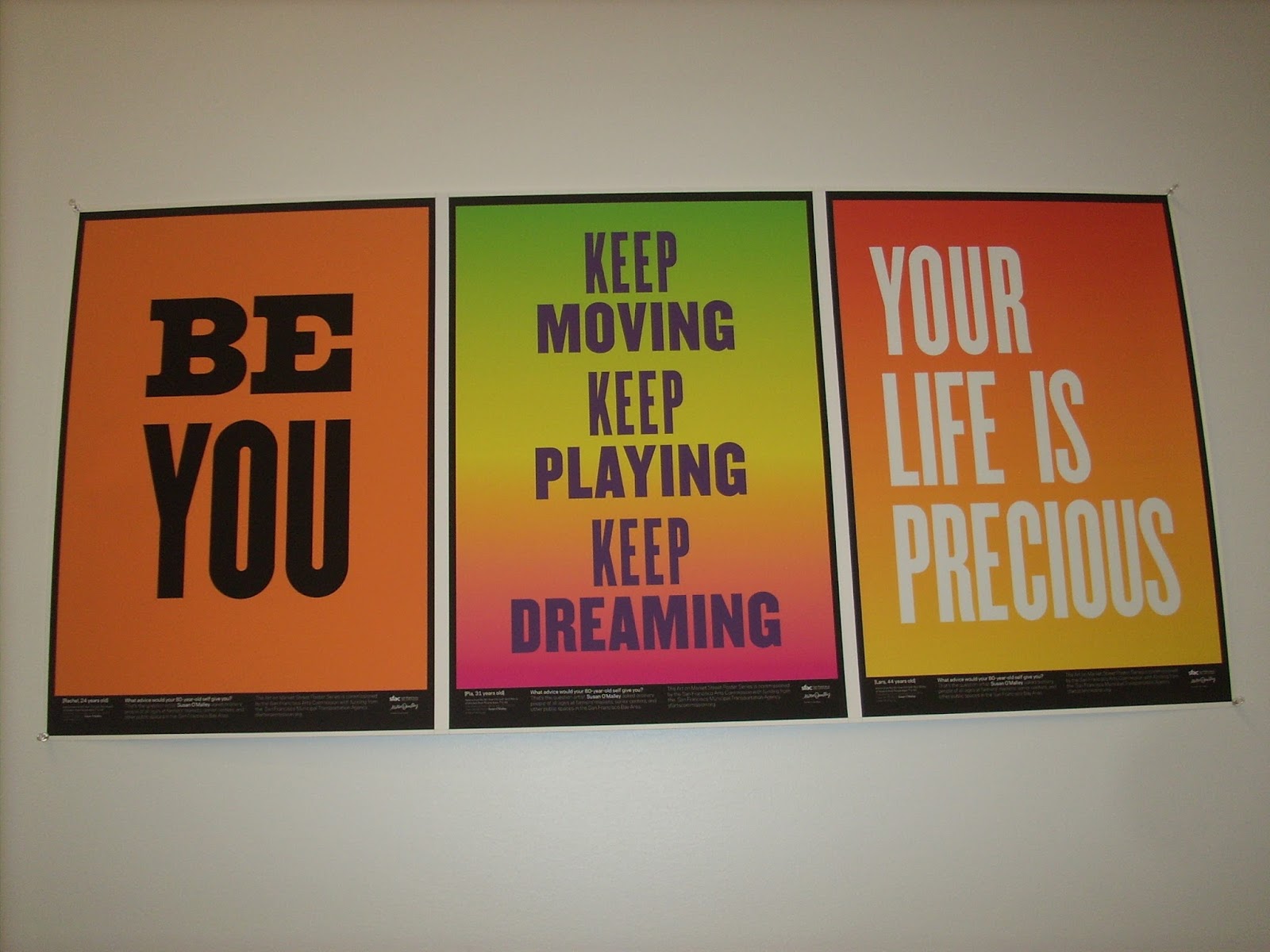
Book release party for the late Susan O’Malley’s Advice From My 80-Year-Old Self: Real Words of Wisdom from People Ages 7 to 88, at San Francisco Arts Commission Main Gallery.
 
How to give a pep talk: pay attention, ask questions, open your heart, listen actively. 
O’Malley’s poster art at Muni bus shelter on Market Street in San Francisco. O'Malley had asked passersby in Berkeley, "If you had an opportunity to meet your 80-year-old self, what do you think he/she would tell you?"  My response: "Say what you need to say before it's too late, and don't just suck it up."
Maintaining chi flow with magnolias in full bloom at The Coronet.

Sunday, January 31, 2016

Language access

Despite the cognitive benefits of lifelong bilingualism, some people remain monolingual throughout their lives.  In the United States, where 30 states have made English the official language, older adults who are monolingual in a language other than English are especially vulnerable to isolation. Older people, already rendered invisible or talked down by ageism, are ignored or silenced by their lack of access to the dominant language. Language barriers also might lead to exploitation, as in the case last year when monolingual Asian immigrant seniors were misled to support a luxury development in Oakland under pretense that it would include affordable housing units.
Senior Center Without Walls Program Director Amber Carroll announced new Gratitude program in Spanish language! She is working to add more non-English language programming.
In Going Gray in the Golden State: The Reality of Poverty Among Seniors in Oakland, California (2008), The Oakland Institute with St. Mary’s Center suggested translating documents to languages like Spanish, Chinese and Vietnamese can help monolingual immigrant seniors access opportunities like assistance programs.

Sometimes it’s not enough to translate documents because some immigrants are illiterate so interpretation services are needed. Federal and California state law make access to a medical interpreter the right of all patients who need one, just like the courts must offer an interpreter to a witness or defendant in need.

In 2001, Oakland became the first city in the nation to pass an Equal Access to Services Ordinance to remove language barriers that limited-English speakers encounter when using City services.

Communities of Oakland Respond to Emergencies (CORE) training presentation in English by Jerry Wong, and simultaneous interpretations in Cantonese, Mandarin, Vietnamese and Spanish. Big shout out to interpreters from Equal Access and Volunteer Health Interpreters Organization (VHIO) who helped impart life-saving information while strengthening this diverse senior community!


Recently I included in a job posting for an ESL (English as a Second Language) instructor: “Work experience with older adults from diverse backgrounds preferred.” One applicant responded that while she had no particular experience working with seniors, she could offer something better as she is a senior herself! I called her for an interview J.