Friday, July 31, 2015

Beautiful Acts: Americans with Disabilities & Older Americans

“I want future generations to know that we are a people who see our differences as a great gift, that we are a people who value the dignity and worth of every citizen – man and woman, young and old, black and white, Latino and Asian, immigrant and Native American, gay and straight, Americans with mental illness or physical disability.”
-- U.S. President Barack Obama, January 20, 2015 State of the Union Address
This month’s 25th anniversary of Americans with Disabilities Act (ADA), at least in San Francisco Bay Area, seemed to upstage the 50th anniversaries of Older Americans Act (OAA) and Medicare.  While OAA tends to promote age segregation by funding programs for age 60+ (with few intergenerational provisions that could be strengthened), I prefer ADA’s provisions for reasonable accommodation to promote integration into community living for all ages and abilities.  Ideally, integration creates inclusive communities where everyone can be accepted for who they are.

In Andy Imparato’s blog post, The ADA and Claiming Disability, I thought about inserting “old age” for “disabilities”:  
“Rather than buying into the larger societal narrative that disabilities are inherently limiting, we have an opportunity to recognize that personal experience with disability can lead to greater personal strength, creative problem-solving, and a stronger connection to other populations who face discrimination at work, at school and in the community.”

From ugly to beautiful law

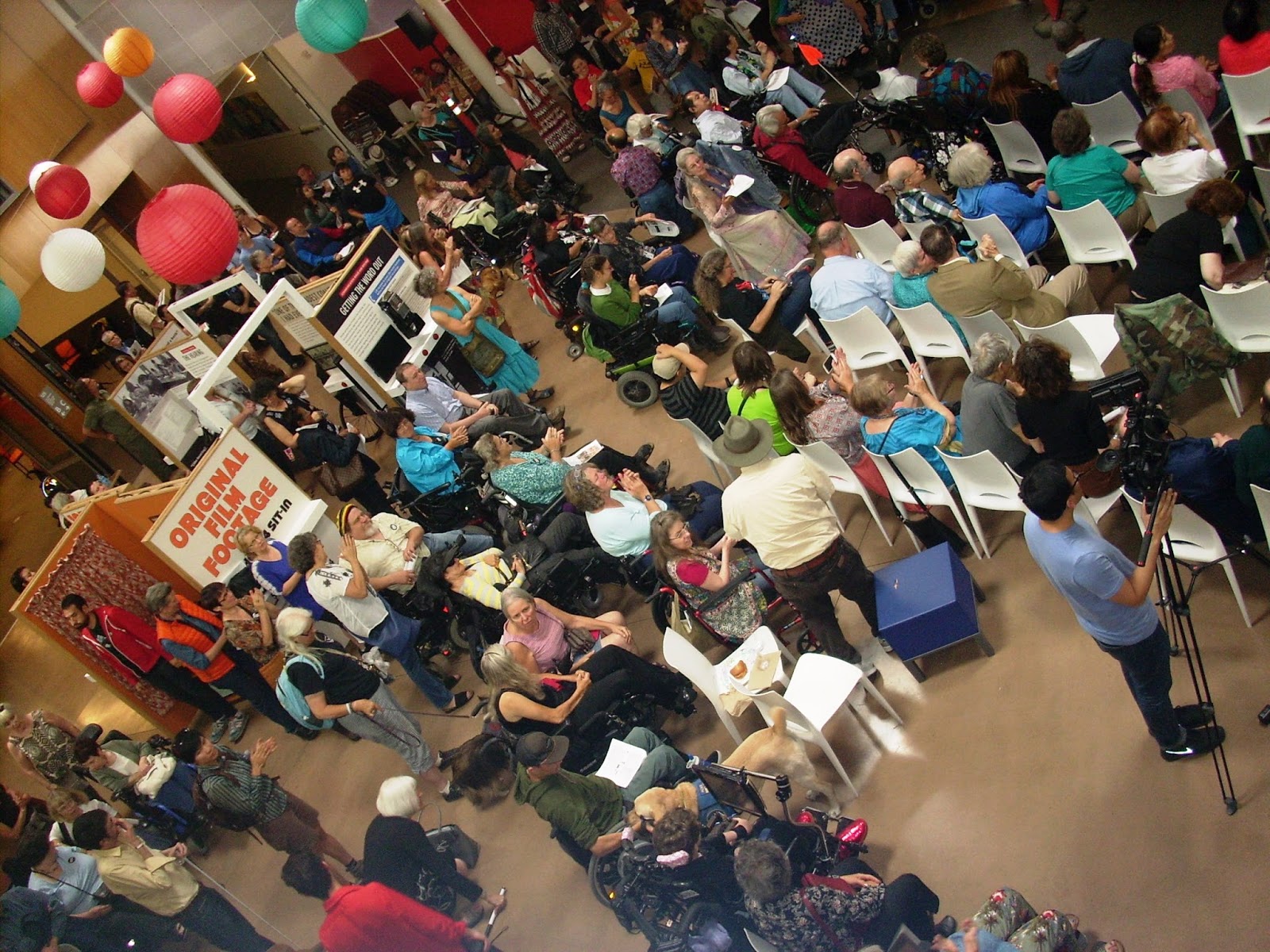
In 1867, the first “ugly law,” making it illegal for persons with disabilities to appear in public, was enacted in San Francisco.  In 1977, San Francisco helped set the stage for passage of ADA, when more than 150 people of all types of disabilities took part in the longest occupation of a federal building, in the San Francisco regional office of the Department of Health, Education and Welfare (HEW), to demand implementation of regulations to Section 504 of the Rehabilitation Act of 1973.  
Carla Johnson of San Francisco Mayor’s Office on Disability (MOD) and Community Alliance for Disability Advocates (AIDS Legal Referral Panel, Senior and Disability Action, San Francisco IHSS Public Authority, The Arc of San Francisco, LightHouse for the Blind, Independent Living Resource Center of San Francisco, Paul K. Longmore Institute on Disability, Community Living Campaign, Toolworks, Bakeworks) hosted ADA Month Kick Off Celebration on July 1st inside City Hall (which celebrated its own centennial last month).   
Mayor Ed Lee greeted the audience of “beautiful people” and praised ADA for promoting independence, inclusion and community, consistent with making San Francisco for the 100%.  During last month’s U.S. Conference of Mayors meeting in San Francisco, he introduced a resolution that was adopted nationwide to recommit cities to the goals and ideals of ADA.  He then proclaimed July as ADA Month in San Francisco. 
District 1 Supervisor Eric Mar honored grassroots organizations like ILRC and co-sponsors for organizing California #ADA25 Conference on September 25-26, in San Francisco.  He said it was Disability Empowerment Month when supervisors would introduce legislation, led by people with disabilities and supported by allies, and spoke about need for Dignity Fund. 
Kathy Martinez, a former ten-year-old actress in Lassie TV show, recalled being age 17 during 1977 sit-in that was an “invitation to fight for our civil rights.”  As former Assistant Secretary in Office of Disability Employment Policy at U.S. Department of Labor, she advocated hiring people with disabilities to achieve financial independence.  
Former Assemblymember Tom Ammiano recalled being a school teacher who brought his hungry students to the 504 rally, so when asked, “What do we want?” they replied, “French toast,” instead of “civil rights!”  On a more serious note, he reminded us that we all get old, when accommodations are welcome then, but awareness is needed beforehand to prepare.  He said to look for the 2016 ballot measure for Dignity Fund, which would allocate real estate taxes for seniors and persons with disabilities. 
Access SFUSD appeared on stage twice: to speak on disability perspectives (“because of ADA …”) and to show their dance moves to a medley of songs from 1990.
San Francisco MOD squad, established in 1998 as the City's overall ADA Coordinator, and banner reminded us that celebrating 25 years of ADA doesn't stop here:  the struggle continues to eliminate attitudinal, communication, transportation, policy and physical barriers in order to achieve full integration of people with disabilities in our society. 
Ms. Wheelchair California at Patient No More panel, a preview of larger exhibit at Ed Roberts Campus in Berkeley.
Bryan Bashin of LightHouse and Catherine Kudlick of Longmore Institute. Catherine explained double meaning of Patient No More: people with disabilities have lives beyond medicine, and they should not have to wait.   

Universal design 
Panelists discussed ADA’s impact on design with architect Michael Chambers as moderator at SmithGroupJJR in San Francisco:
·      Architect Chris Downey of Architecture for the Blind: ADA means opportunity, access to life; no handicap unless barrier is put in the way, which is done (or not done) by an architect in the built world; one has a disability, but not disabled; access is not just code, but a civil right
·      Disability Rights Advocates attorney Zoe Chernicoff: ADA is not just about physical access but covers more; for example, solitary confinement discriminates against people with mental disabilities
·      Architect and gerontologist Alexis Denton: ADA provides minimum standards, should aspire to go beyond with universal design for everyone and create great experience by designing with empathy
·      Architect Gilda Puente-Peters: ADA model has been used internationally by other countries to develop their own access standards, but ADA enforcement is weak
·      Center for Independent Living’s work and benefits counselor Alana TheriaultADA, which does not cover airplanes (but Air Carrier Access Act does), could be improved to provide more expansive definition of access.

Chris and Alana mentioned Berkeley’s Ed Roberts Campus as an example of accessible design.                   
Ed Roberts Campus housed the equally accessible exhibit, Patient No More! People with Disabilities Securing Civil Rights, which held its grand opening on ADA’s 25th anniversary on July 26. 
Spiral ramp inside Ed Roberts Campus 
Quiet area outdoors to get away from sensory overload 
Disability Mural (2000-Present) is the first community artwork about the everyday experiences of living with a disability, created by people with and without disabilities. 
Mural tile reads: "One day many people will learn to sign, and we all be seeing voices...when all the world speaks with its hands!"
Room for improvement on one size fits all

Rosemarie Garland-Thomson has noted that disability is the body's response over time to its environment.  Temporarily abled people who acquire a disability later in life experience disability differently (like learning a foreign language later in life), than people who have a congenital disability and already have adapted to “fit in” the built environment or changed the inaccessible environment to accommodate their individual differences (latter often benefits our broader society).  People with a congenital disability do not experience loss over not being able to do “normal” activities because they never did, so this self-acceptance reframes “the problem is the solution.” 
  
Celebrating disability civil rights 
Cathy Kudlick, who developed Patient No More exhibit with her team at Longmore Institute, welcomed attendees at grand opening. 
Jeff Moyer, songwriter and 504 participant, led 504 protest song, Hold On:
        “Civil Rights were knocking at our door,
        But Carter wouldn’t stand on 504…
        After four years of delay,
        We came to claim the ground we’d gained…
        Well, for 28 days unafraid
        150 people with disabilities they stayed.
        They had their eye on the prize.  They held on.
        Hold on. Hold on.
        Keep our eyes on the prize. Hold on…”  
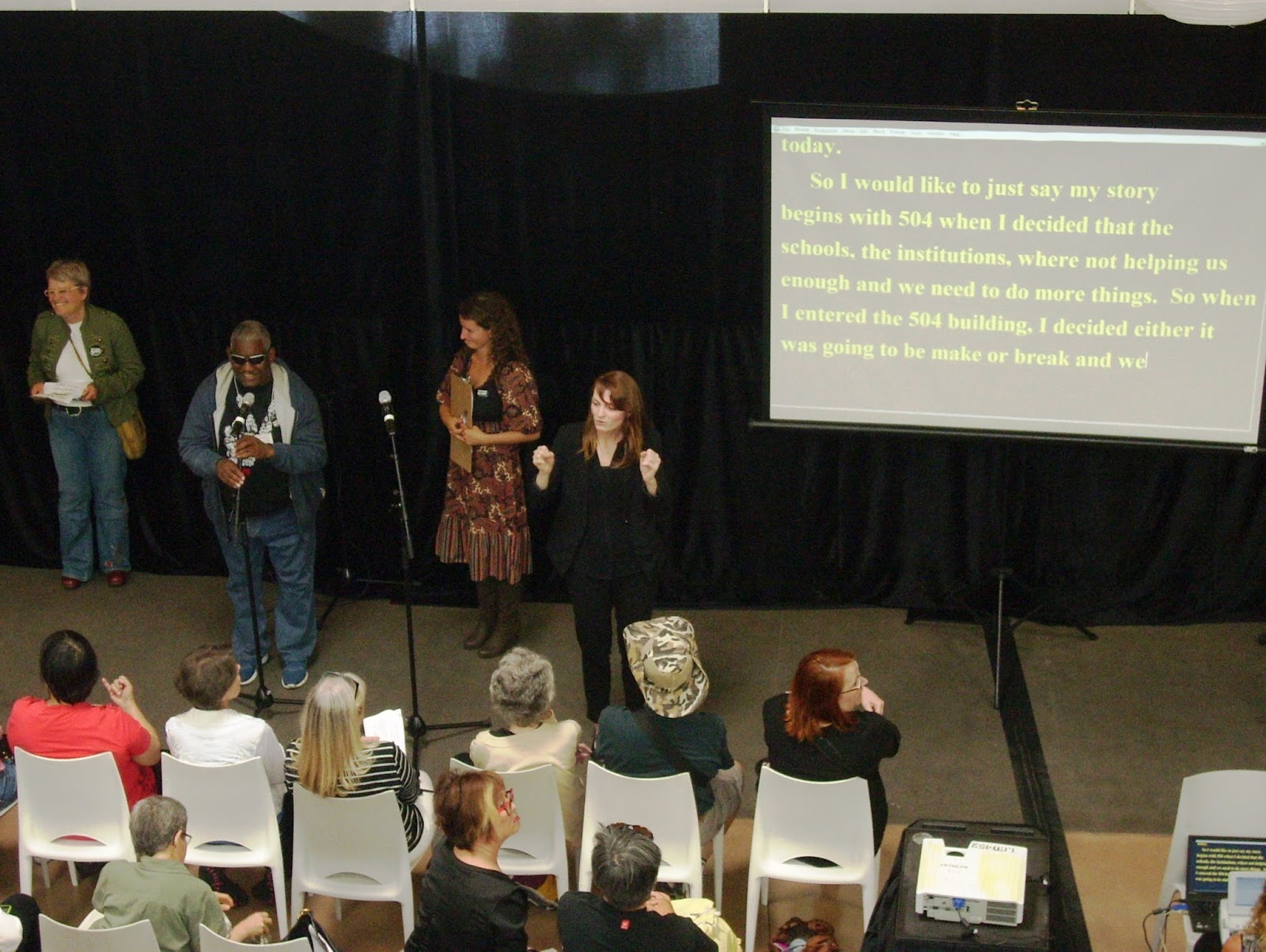
Dennis Billups, 504 Chief Morale Officer, led chant, “1-2-5-0-4. Kickin’ in the bathroom door …We’re rolling in victory now.” 
Interactive exhibit, with poster of Billups during 504 demonstration, invited visitors to respond, What makes you “patient no more”?  
Bruce Oka, 504 participant and former SFMTA Director, said he was "patient no more" because he was tired of being excluded, and talked about need to be included. 
Corbett O’Toole said she was "patient no more" because there are only two lawyers in the nation available to represent parents with disabilities losing custody of their children. 
Persons with disabilities nationwide occupied the regional offices of HEW in April 1977, but only San Francisco held out until April 28, 1977 when HEW Secretary finally signed regulations implementing Section 504. 
·      504 protests and ADA legislation grouped people with many different disabilities together, so there would be one big ADA instead of mini-ADAs for each impairment group
·      504 resulted in a national disability rights movement and national disability organizations that could promote and defend ADA
·      504 defined disability flexibly and took prejudice into account, so ADA could be about civil rights rather than medical diagnoses
Section 504 served as a template for the more comprehensive ADA passed in 1990, showing that disability rights could benefit many without adding a huge burden on society.  


disability = diversity


Invisible disabilities

At this month’s Mayor’s Disability Council meeting, attendees presented on “what ADA means to me” with several mentioning “invisible” disabilities (like learning differences and psychiatric disorders), how physical and mental disabilities influence another, and the financial impacts.  The majority of disabilities are non-apparent, and until ADA Amendments Act of 2008, the U.S. Supreme Court did not consider persons with diabetes and mental illness as disabled, and thus not entitled to protection against discrimination.  In fact, neuropsychiatric disorders represent the largest category of disability in the U.S. The landmark Olmstead case, in which the U.S. Supreme Court ruled that persons with disabilities must be enabled by states to live in the “most integrated setting appropriate” to their needs and that “unjustified isolation” is discrimination based on disability under Title II of ADA, involved persons with “invisible disabilities” (mental illness and developmental disabilities).
People With Disabilities Foundation (PWDF), a non-profit that aims to “provide total integration of people with mental disabilities into the whole of society,” hosted a delegation of disability advocates from 20 countries, at the invitation of U.S. Department of State’s International Visitor Leadership Program (IVLP), Access for All: Enhancing the Lives of People with Disabilities. Founded 15 years ago in San Francisco, PWDF won the nation’s first court case requiring a federal agency to accommodate the needs of persons with mental disabilities, who were denied equal access to Social Security disability programs, in violation of Section 504 of the Rehab Act of 1973, because they could not understand the complex eligibility rules. PWDF’s Parity in Advocacy initiative works to provide equal access to legal representation for those with mental disabilities (advocacy version of Mental Health Parity).

With the passage of ADA 25 years ago, the U.S. became the first country in the world to adopt national civil rights legislation banning discrimination against persons with disabilities.  ADA was the model for the Convention on the Rights of Persons with Disabilities (CRPD), which U.S. President Barack Obama signed in 2009, but its ratification voted down by the Senate.  

                                                                  
The 50th anniversary of Older Americans Act (OAA) on July 14 was a non-event in the Bay Area.  The decennial White House Conference on Aging (WHCoA) took place the day before with at least one watch party of the live stream in San Francisco.  Congress didn't fund WHCoA so its executive director Nora Super had to get non-government sponsors to help organize this event.  At least on July 16, the Senate passed the bill reauthorizing OAA, which expired 2011, and now goes to the House for consideration. 

I was not aware of any delegations visiting from other countries to learn about OAA as a model . . . 
Senior and Disability Action’s monthly meeting celebrated ADA rather than OAA.
Model garden at 30th Street Senior Center is a beautiful act of nature

Sunday, June 28, 2015

Age awareness

June is Alzheimer’s and Brain Awareness Month:  About 95% of people with Alzheimer’s have the late-onset form, in which symptoms become apparent in their mid-60s.
At this month’s UCSF Dementia Research Education Symposium, UCSF Memory and Aging Center Director Bruce Miller said that California has 500,000 persons with Alzheimer’s Disease, the most in U.S.  While “normal aging” involves changes in brain structure, there is great variability in cognitive aging depending on modifiable factors: adiposity and obesity, chronic inflammation, physical exercise, vascular risk.  He also reminded us of the potential strengths of aging, including “increased generosity, creativity and wisdom.”
 
UCSF nurse Robin Ketelle emphasized dementia is a loss of brain function that affects memory, thinking, language, judgment and behavior (symptoms), and that occurs with certain diseases (causes), and “dementia does not mean a person is mentally ill.”  However, Alzheimer’s Disease, which accounts for more than half of all dementia cases, has been recognized as a mental illness in the Diagnostic and Statistical Manual of Mental Disorders (DSM-IV); the term “dementia” has been replaced with neurocognitive disorder in DSM-5 
  
June 15 marked the 10th anniversary of World Elder Abuse Awareness Day (WEAAD).  In San Francisco, WEAAD was more like a month-long observation. 
This month’s Senior & Disability Action (SDA) meeting featured Avoiding Elder Abuse panel discussion:
  • Jill Nielsen of Adult Protective Services (APS) has staff of 37 MSW workers, 3 nurses and case aides to respond to reports of suspected elder abuse; state law requires APS visit within 10 days, interview client alone; self-neglect represents 50% of APS cases; emotional abuse is hardest to investigate as law enforcement is not involved (reporting is encouraged, but not required).  APS can act only with consent of the victim, unless there is Penal Code violation.
  • Hyun-Mi Kim and Ana Luz Vazquez of API Legal Outreach: Hyun-Mi said that legal remedy alone does not solve client’s life situation, so they take a holistic approach by partnering with Asian Women’s Shelter for more comprehensive services (case management) and Office of Citizen Complaints to train police (appropriately respond to immigrant victims).   In response to SDA Housing Organizer Tony Robles, who argued that Ellis Act evictions are a form of elder abuse that causes trauma, Ana mentioned she filed a restraining order against a landlord for harassing a monolingual Tagalog elder.   
  • Prescott Cole of California Advocates for Nursing Home Reform (CANHR) discussed how predators use a familiar TV celebrity like Henry “Fonz” Winkler to repeat a reward message like “let your home pay you cash” to target vulnerable seniors, who do not investigate the risks of reverse mortgages.  Prescott noted that 10% of reverse mortgages go in default, which amounts to an expensive loan because predators skip telling seniors about the obligations of paying ongoing taxes, insurance, maintenance of home, etc.  He provided copies of CANHR’s Senior Scams Alert.
  • Lisa Nerenberg of California Elder Justice Coalition (CEJC) provided an international perspective on elder abuse: World Health Organization (WHO) and International Network for the Prevention of Elder Abuse (INPEA) study, Missing Voices: Views of Older Persons on Elder Abuse (2002), identified disrespect as the most painful form of mistreatment by older adults in all countries.  Lisa provided examples of how Asian countries, influenced by Confucian filial piety, use policy to strengthen families:  Singapore has a special court for older persons to compel financial support from their adult children, and China has an elderly rights law that requires adult children to visit their elderly parents.
At our Main Library, San Francisco Department of Aging and Adult Services (DAAS) hosted WEAAD with speakers and film screening.  Administration for Community Living (ACL) Regional Administrator David Ishida said APS now has a federal home in ACL’s Office of Elder Justice for data collection. Other federal level highlights: The Elder Justice Act, which marked its 5th anniversary in March, received $4 million in funding for the first time in fiscal year 2015.  This year’s White House Conference on Aging also included elder justice as one of its four priority issues. 
DAAS Director Anne Hinton welcomed San Francisco District Attorney George Gascon, who said his staff scheduled presentations at four local senior centers in recognition of WEAAD.

These welcoming remarks were followed by a screening of Alive Inside and discussion, which I skipped since I had another appointment elsewhere and I had already seen this documentary when it was released last year with filmmaker in-person. ...and then I just wanted to listen to my own playlist like glam rocker Todd Rundgren (who turned 67 this month): Hello, It’s Me (“It's important to me that you know you are free ‘cause I never want to make you change for me”). ((^_^))

The Forum at Grace Cathedral hosted Safeguarding the Golden Generation: Understanding Financial Exploitation, which featured a screening of Last Will and Embezzlement (2012) documentary.  Seniors lose an estimated $2.9 billion annually to financial abuse and exploitation.  Perpetrators exploit the vulnerabilities of seniors who may have dementia and/or depression.  In addition, older adults from the Depression era may be more trusting and socially isolated.  Abuse is underreported due to embarrassment or fear of losing independence (like being placed under conservatorship or nursing home if they’re found to have diminished capacity). 

A lively panel discussion followed the film:
·         Filmmaker Pamela Glasner made her documentary based on her father who had Alzheimer’s Disease.  While in a Florida nursing home, her father was deceived by a stranger who added his name to her father’s bank account and will, allegedly during a “lucid moment” that was witnessed by a beneficiary.  When she reported this financial elder abuse to the Florida police, nothing could be done (police told her “nice guy said he didn’t do it”) so Pamela made this film to create awareness of this issue.
·         Evans Law Firm attorney Ingrid Evans provided tips on elder abuse fraud protection
·         Communities Against Senior Exploitation (CASE) program manager and California Senior Legislature assembly member Shirley Krohn has proposed increasing fines from $1,000 to $25,000 for financial institutions that fail to report financial abuse.

What else can be done to prevent elder abuse? 

“Unfortunately, regulations are really not preventing the abuses.  Why On Lok has never had an abuse problem, either by an employee or the organization, is because it is based in the community, and it’s open to everybody.  We have no visiting hours. ... The advantage of that is that there is an outsider that goes in or visits. ... So there is constant in and out.  People, the community is very aware of what happens. … You’re not a nursing home on the outskirts where nobody sees you and knows what happens.  So the problems of abuse are much more difficult to detect and combat.” -- Marie-Louise Ansak, Founding and Directing on On Lok Senior Health Services, 1971-1996 (pp. 127-128)

To support this transparency and reduce social isolation so we can age safely, it helps to design our environments so we can live out and about in the community with good public transportation options for all ages and abilities.  

At last month’s Aging and Tech conference, I couldn’t get enough of IDEO designer Barbara Beskind so I was hoping to see her again (but didn’t) at IDEO’s San Francisco office, which hosted At Home With Growing Older (AHWGO) forum, Embolden Bodies – Human Centered Design For Independent Living.
Susi Stadler, AHWGO cofounder and architect who specializes in the design of age-friendly and intergenerational environments, welcomed an intergenerational audience to discuss “approaches, strategies and products that assist people to gracefully age at home.”  She called aging an extreme sport—both delightful and scary, that takes focus and work. 
Ideas from interdisciplinary panel:
  • Will Carey, Industrial Designer at IDEO, showed slides of products based on user experiences that fit into everyday like a tendon machine, guide for blind to navigate using vibration and sound, walkers with tennis ball material guides
  • Jennifer Carton Wade, Senior Occupational Therapist at Laguna Honda – advocates for occupational justice (ability to do what’s needed to live fully in the community) because aging is marginalized, especially in transportation and mobility; she is less gadget-oriented, preferring to empower people to do on their own so they do not feel deficient; she also provided Handy Tips for Remaining Home as You Age  
  • Tasneem Babul Rayani, Contributing Industrial Designer at AHWGO, emphasized addressing the real (versus perceived) problem and designing to use our bodies naturally like squatty potty 
One older woman in the audience asked that they “not design for, but with us, old people because you don’t know until you get there.”
Director Sheila Malkind invited the intergenerational audience to this year’s Legacy Film Festival on Aging: September 18-20, 2015 at New People Cinema! (I suggested that Sheila screen Dancing with Maria documentary about 90-year-old ballerina Maria Fux who challenges students of all abilities so they are "made to dance.")
Dr. Margaret (Peg) Miller and Lonnie Hinckley of St. Francis Episcopal Church hosted a Transportation Fair for Seniors and Persons with Disabilities, which included all-male representatives from local public and private options:
  • BART:  FREE BART field trips for 10 to 20 seniors (age 65+) in group to get familiar with BART (includes roundtrip fare, Senior Clipper Card, travel tote, lunch, station and car tour, outing of choice); 62.5% BART fare discount for seniors and persons with disabilities
  • SFMTA:  Muni fares will increase July 1, 2015 (senior fare from 75 cents to $1), but there is still FREE Muni for low-to-moderate income (up to $71,350 Bay Area annual median income level) seniors and persons with disabilities, FREE Shop-a-Round for seniors, persons with disabilities, or eligible for ADA Paratransit; FREE Van Gogh Shuttle for groups of seniors and persons with disabilities; check out Muni Access Guide 
  • Flywheel: mobile app or phone call dispatch to request taxis with ramp van, wheelchair accessible, can specify vehicle
  • Taxis (Luxor, Yellow Cab):  will serve every neighborhood
  • Ride “sharing” platforms: did not address access for blind iphone users, riders with service dogs and wheelchair users, which is ongoing concern especially with City’s proposal to privatize paratransit and subject of discrimination lawsuits under Americans with Disabilities Act
  • Private door-to-door transport 


DeSoto Cab rebranded as Flywheel Taxi & inside paratransit van