Showing posts with label ADA. Show all posts

Wednesday, September 30, 2015

Aging + disability: equal opportunities

Americans with Disabilities Act (ADA) and Older Americans Act (OAA) are equal opportunity laws that support full participation in community living. Americans also have equal opportunities to become Americans with disabilities and older Americans.
                                             
Aging with disability

Americans, including those with disabilities, are living longer.  As Eli Gottlieb wrote in The New York Times opinion piece, “Adult, Autistic and Ignored,” parents of dependent children with disabilities fear: What will happen to them when I’m gone?  After his mother died, Eli became guardian of his older brother Joshua who has autism and lives in an institution.  Like his mother, Eli became an advocate critical of the disability cliff when children with disabilities age-out of “special education” and the need for more attention to elderly autistic people like Joshua.  
At 5th Annual Legacy Film Festival on Aging (LFFoA), LFFoA Director Sheila Malkind facilitated Caring program discussion with Dr. Toni Miles and Mimi and Dona documentary filmmaker Sophie Sartain. 

Sophie began filming her documentary in Dallas six years ago when 92-year-old Mimi (Sophie’s maternal grandmother) was no longer able to care for her 64-year-old daughter Dona (Sophie’s aunt) who was diagnosed with “mental retardation” in the 1950s (though Sophie suspects undiagnosed autism).  When Dona was asked to leave public school after 2nd grade, Mimi sheltered Dona at home instead of the prevailing practice of sending her “retarded” child to a mental institution. 

Mimi makes the difficult decision to place Dona into Denton State-Supported Assisted Living Center, a long-term care facility that serves people with intellectual and developmental disabilities.  While Mimi thrives as she continues to live at home in the community, Dona deteriorates precipitously in the institution.  Spoiler alert: Dona’s condition improves, but she is also diagnosed with early Alzheimer’s; documentary ends with death of one.  Save this date: On November 23, Mimi and Dona will have its Independent Lens premiere on PBS. 

Family caregiving theme is constant: Sophie’s mother provided care for Sophie’s father who had multiple sclerosis during the last 20 years of his life; Sophie’s brother has a son with autism (“you need to live forever or outlive your kid”); and back in Los Angeles, Sophie learns that her own son is diagnosed with autism.  The main difference between Dona’s generation and today’s children with autism are disability civil rights laws, such as Individuals with Disabilities Education Act (IDEA) ensuring that children with disabilities have an opportunity to receive free appropriate public education in the least restrictive environment.

Now there is greater public awareness of disabilities that survive into old age. In The New York Times article, "Is It Old Age, or A.D.H.D.?", Judith Berck reported on the dearth of research on older adults with A.D.H.D. and the challenge of treating them with the same drugs given to children.
At 19th Annual Golden Gate Self-Advocacy Conference: Give It to Me Straight! Current Happenings in Our Developmental Disability Community, keynote speaker Santi Rogers, Director of California Department of Developmental Services, holds up Lanterman Act, California law passed in 1977, that gives people with developmental disabilities the right to services and supports to enable independent living.  He previously announced decision to close the remaining state-run developmental centers in California and transition participants into community living. 

More ADA celebrations! Doing disability justice

Steve and Lillian Gonzalez Brown, co-founders of Institute on Disability Culture, greeted me at Disability Rights Education and Defense Fund (DREDF)’s 36th Anniversary Celebration Honoring the 25th Year of ADA & Charting the Next 25 Years of Disability Rights at Ed Roberts Campus. 
Thanks to DREDF Director of Development Ingrid Tischer, I was able to attend the Celebration fundraiser as volunteer. 
Caramelized chocolate ganache with sea salt bars welcomed guests to tables. DREDF Senior Policy Analyst Marilyn Golden urged us to sign cards (on tables) opposing HR 2646 because “it would take away legal representation for people with mental illness, reduce privacy rights, and promote institutionalization.” 
Celebration co-sponsor Google Impact Challenge: Disability hosted Bay Area Makeathon weekend to design a more accessible world. 
Google also unveiled portraits and videos of disability rights leaders like Ed Roberts. 
ACLU attorney and DREDF Board of Directors President Claudia Center called for donations, suggesting $25 in honor of 25th anniversary of ADA; she said her personal donation formula was doubling 25, for her birthday this year, times ten! 
Evening’s program capped with intergenerational discussion about ADA’s impact 25 years after its passage, and advances we want in next 25 years, particularly on issues affecting people who live with invisible disabilities and intersectional effects of race, gender and disability. Christina Mills, Deputy Director of California Foundation for Independent Living Centers, moderated the discussion among all-women panelists: Maddy Ruvolo of Marin Center for Independent Living; Yomi Wrong of Palo Alto Medical Foundation/Mills-Peninsula Health Services; Nubyaan Scott, DREDF 2015 Summer Intern; and Mary Lou Breslin, DREDF Co-Founder/Senior Policy Advisor.


Yomi discussed her concerns about aging with disability, long-term care and still being in charge of her life, who will care for her as she has no plan to "go quietly to an institution, but if I do, what will it look like?" She noted ADA's influence on the built environment, yet need to reduce health disparities, adding that “death with dignity is such crap because if people have better choices, they don’t think to kill themselves.”
Disability Organizing Network (DOnetwork) presented California#ADA25 Conference: Access, Availability, Advocacy and Civil Rights! at UC Hastings College of Law.  This multigenerational view of disability justice covered:
  • access: equal opportunity to participate in all aspects of everyday life;
  • availability: options and choices which increase independence and freedom; 
  • advocacy: our history and courageous actions of leaders that lead to today's inclusion; and
  • civil rights: our just claim to equal citizenship
The conference's lunch program featured video clips of Alice Wong’s Disability Visibility Project: “Recording disability history, one story at a time.”   
ADA: Reflections on Success panel moderated by Yomi Wrong:
·         Arlene Mayerson, DREDF Directing Attorney, was a principal architect of ADA 25 years ago.  In order to have equal opportunities for people with disabilities (PWD), they had to have accommodations which meant they have to be treated differently. After ADA, PWD no longer asked for charity or favors, but for accommodation as a matter of right.
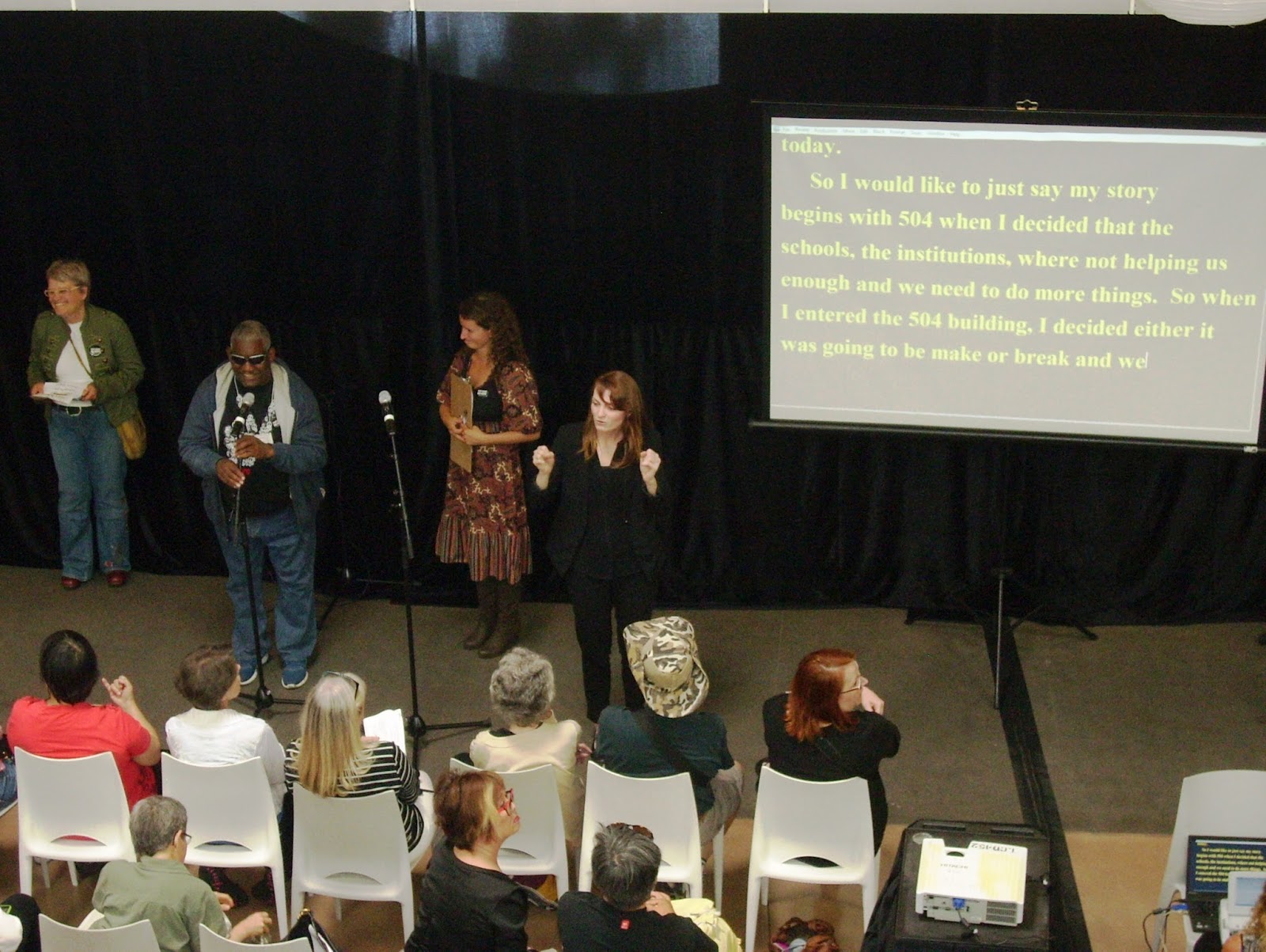
·         Paul Grossman, education civil rights attorney talked about Lau v. Nichols (1974 U.S. Supreme Court case finding that lack of language appropriate accommodation denied Chinese students equal educational opportunities because same treatment is not equal opportunity) and the 504 sit-in laying the groundwork for ADA.  He added that the second most exciting moment in disability rights has been since ADA Amendments Act of 2008 expanded the definition of disability (medication and other interventions that deal with effects of disability cannot be factors in determining whether individual is disabled), so disability-based discrimination cases can be heard on their merits.
·         Jim Patterson talked about “associational discrimination”: being pushed out of foreign service career because his employer viewed his daughter’s disability as a liability.  After The New York Times published an article, “Whose disability is it anyway?” he returned to work as a full member of the diplomatic corps and became an advocate for employment equality.
Do You Know Your Disability Civil Rights History? HolLynn D’Lil, author of Becoming Real in 24 Days: One Participant's Story of the 1977 504 Demonstrations, took over 350 black and white photos chronicling the takeover of the San Francisco Federal Building to demand that President Carter's administration implement regulations to Section 504 of the Rehabilitation Act, the first federal civil rights law for people with disabilities. At the time, Congressman Phil Burton said, "To have to demonstrate during a Democratic administration to fulfill a Republican promise is a painful irony."
Ted "can I get an accommodation?" Jackson, Community Organizing Director at California Foundation for Independent Living Centers (CFILC), moderated discussion during Breakfast with the Author Tony Coelho, who entered politics as his ministry after he was denied from pursuing Catholic priesthood based on his epilepsy. While serving in U.S. House of Representatives, he was principal author of ADA, which got bipartisan support due to supporters' personal relationships with PWD.  He noted 52 countries now have disability laws based on ADA.
Indigo Mind features artists celebrating the work of neurologist Dr. Oliver Sacks.  
Connie Barker founded Environmental Health Network (EHN), which provides support, advocacy and information to the chemically and electrically injured: “If it’s not healthy, it’s not green.” In addition to her own site http://ehnca.org/, she offered the following resources:
Access Kids perform on entertainment stage

Aging + disability-friendly communities 

Under disability laws, the person with disabilities has the burden to disclose his/her disability and ask, "can I get an accommodation?"  Sometimes, people with "invisible disabilities"--like chemical sensitivities--might resist disclosure to avoid stigma ("it's all in your head").  As a more proactive approach to move beyond individual accommodations, universal design creates inclusive environments for everyone by placing the burden for accessibility on architecture. 
ADA Conference workshop included Homesick Living with Multiple Chemical Sensitivities: Finding Accessible, Available, Affordable Housing, presented by Connie Barker of EHN.  Connie talked about 11-room Ecology House, the nation’s first HUD-funded housing for people with multiple chemical sensitivities (MCS) that was built over 20 years ago in San Rafael, and then showed documentary, Homesick (2013) about director Susan Abod’s road trip to discover how people with MCS find safe housing and cope with their disability. 
Ed Roberts Campus was ideal to host At Home With Growing Old (AHWGO) program, Dementia-Enabling Spaces: Bodies, Networks, Environments.  Panelists were:
  • Susan Stadler, architect and AHWGO co-founder, substituted for Clare Cooper Marcus and discussed gardens for people with dementia like Portland Memory Garden 
  • Dr. Mehrdad Ayati, geriatrician and author of Paths to Healthy Aging (2014), prescribed social interactions (“live like an Italian: engage brain in conversation, talk with hands”), value and respect elderly because “You cannot replace experience with knowledge (internet),” more geriatric training (completed by only 3% of U.S. medical students) and interdisciplinary teams in geriatrics 
  • Debora Tingley and Patricia Ris discussed Memory Care CafĂ©, a weekly social club for people with forgetfulness and their care partners.
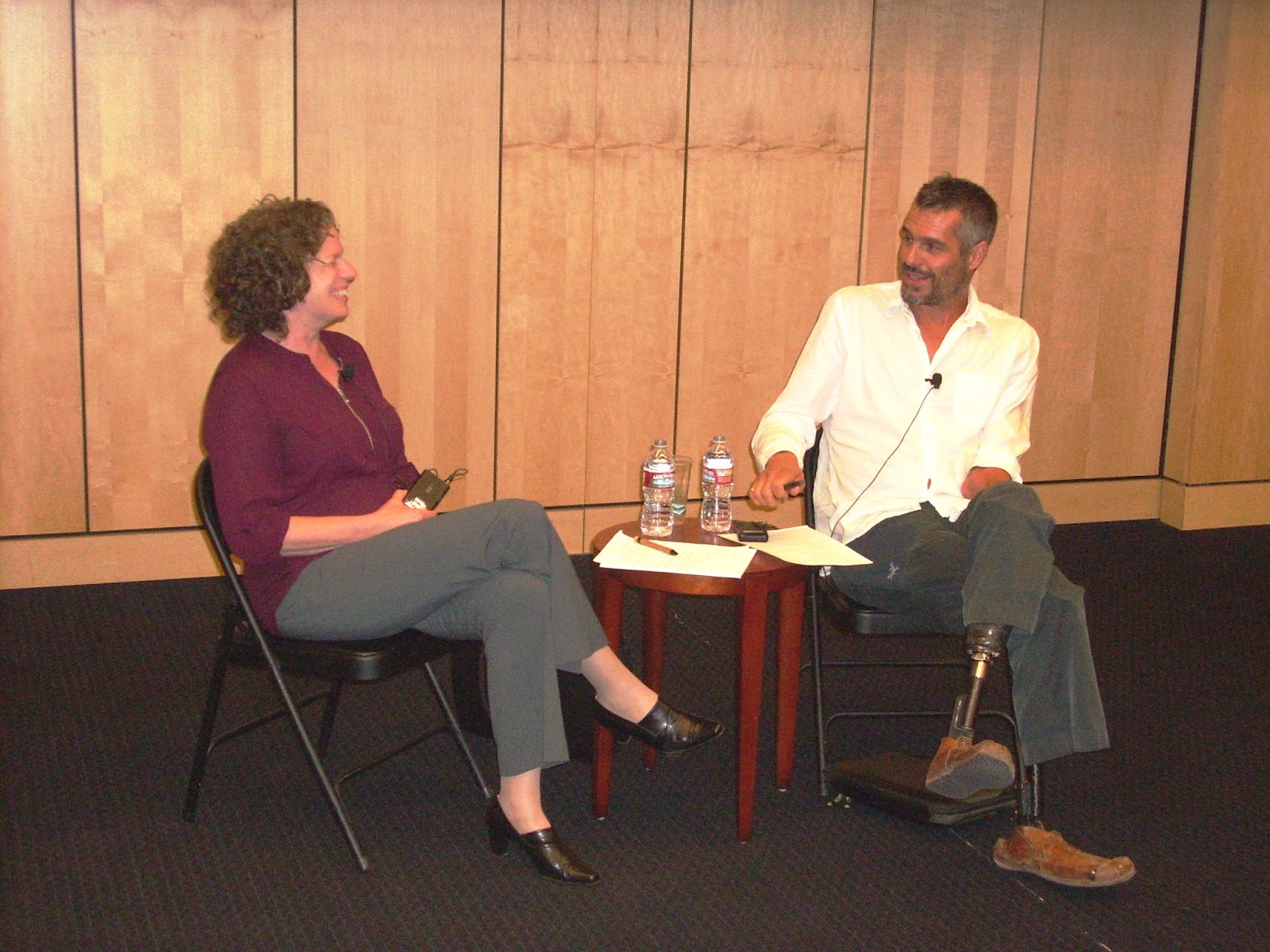
The shift from the medical model of aging and disability continues to end-of-life: life and death are natural v. medical events.  UCSF Osher Center for Integrative Medicine hosted a screening of the PBS Frontline documentary, Being Mortal, followed by a discussion on end-of-life planning with Shelly Adler, PhD, Osher Director of Education, and BJ Miller, MD, palliative care physician and Director of Zen Hospice Project.  They discussed when cure is not possible at the end of life, we can reduce suffering for a “better death.”  BJ said a doctor can tell the truth in a supportive way that does not rob hope, but informs. In BJ’s TED talk, What Really Matters At the End of Life in March, he talked about patient meaning one who suffers, so we are all patients, and how most people fear, not death but, suffering; yet suffering unites us when we share this experience.

Friday, July 31, 2015

Beautiful Acts: Americans with Disabilities & Older Americans

“I want future generations to know that we are a people who see our differences as a great gift, that we are a people who value the dignity and worth of every citizen – man and woman, young and old, black and white, Latino and Asian, immigrant and Native American, gay and straight, Americans with mental illness or physical disability.”
-- U.S. President Barack Obama, January 20, 2015 State of the Union Address
This month’s 25th anniversary of Americans with Disabilities Act (ADA), at least in San Francisco Bay Area, seemed to upstage the 50th anniversaries of Older Americans Act (OAA) and Medicare.  While OAA tends to promote age segregation by funding programs for age 60+ (with few intergenerational provisions that could be strengthened), I prefer ADA’s provisions for reasonable accommodation to promote integration into community living for all ages and abilities.  Ideally, integration creates inclusive communities where everyone can be accepted for who they are.

In Andy Imparato’s blog post, The ADA and Claiming Disability, I thought about inserting “old age” for “disabilities”:  
“Rather than buying into the larger societal narrative that disabilities are inherently limiting, we have an opportunity to recognize that personal experience with disability can lead to greater personal strength, creative problem-solving, and a stronger connection to other populations who face discrimination at work, at school and in the community.”

From ugly to beautiful law

In 1867, the first “ugly law,” making it illegal for persons with disabilities to appear in public, was enacted in San Francisco.  In 1977, San Francisco helped set the stage for passage of ADA, when more than 150 people of all types of disabilities took part in the longest occupation of a federal building, in the San Francisco regional office of the Department of Health, Education and Welfare (HEW), to demand implementation of regulations to Section 504 of the Rehabilitation Act of 1973.  
Carla Johnson of San Francisco Mayor’s Office on Disability (MOD) and Community Alliance for Disability Advocates (AIDS Legal Referral Panel, Senior and Disability Action, San Francisco IHSS Public Authority, The Arc of San Francisco, LightHouse for the Blind, Independent Living Resource Center of San Francisco, Paul K. Longmore Institute on Disability, Community Living Campaign, Toolworks, Bakeworks) hosted ADA Month Kick Off Celebration on July 1st inside City Hall (which celebrated its own centennial last month).   
Mayor Ed Lee greeted the audience of “beautiful people” and praised ADA for promoting independence, inclusion and community, consistent with making San Francisco for the 100%.  During last month’s U.S. Conference of Mayors meeting in San Francisco, he introduced a resolution that was adopted nationwide to recommit cities to the goals and ideals of ADA.  He then proclaimed July as ADA Month in San Francisco. 
District 1 Supervisor Eric Mar honored grassroots organizations like ILRC and co-sponsors for organizing California #ADA25 Conference on September 25-26, in San Francisco.  He said it was Disability Empowerment Month when supervisors would introduce legislation, led by people with disabilities and supported by allies, and spoke about need for Dignity Fund. 
Kathy Martinez, a former ten-year-old actress in Lassie TV show, recalled being age 17 during 1977 sit-in that was an “invitation to fight for our civil rights.”  As former Assistant Secretary in Office of Disability Employment Policy at U.S. Department of Labor, she advocated hiring people with disabilities to achieve financial independence.  
Former Assemblymember Tom Ammiano recalled being a school teacher who brought his hungry students to the 504 rally, so when asked, “What do we want?” they replied, “French toast,” instead of “civil rights!”  On a more serious note, he reminded us that we all get old, when accommodations are welcome then, but awareness is needed beforehand to prepare.  He said to look for the 2016 ballot measure for Dignity Fund, which would allocate real estate taxes for seniors and persons with disabilities. 
Access SFUSD appeared on stage twice: to speak on disability perspectives (“because of ADA …”) and to show their dance moves to a medley of songs from 1990.
San Francisco MOD squad, established in 1998 as the City's overall ADA Coordinator, and banner reminded us that celebrating 25 years of ADA doesn't stop here:  the struggle continues to eliminate attitudinal, communication, transportation, policy and physical barriers in order to achieve full integration of people with disabilities in our society. 
Ms. Wheelchair California at Patient No More panel, a preview of larger exhibit at Ed Roberts Campus in Berkeley.
Bryan Bashin of LightHouse and Catherine Kudlick of Longmore Institute. Catherine explained double meaning of Patient No More: people with disabilities have lives beyond medicine, and they should not have to wait.   

Universal design 
Panelists discussed ADA’s impact on design with architect Michael Chambers as moderator at SmithGroupJJR in San Francisco:
·      Architect Chris Downey of Architecture for the Blind: ADA means opportunity, access to life; no handicap unless barrier is put in the way, which is done (or not done) by an architect in the built world; one has a disability, but not disabled; access is not just code, but a civil right
·      Disability Rights Advocates attorney Zoe Chernicoff: ADA is not just about physical access but covers more; for example, solitary confinement discriminates against people with mental disabilities
·      Architect and gerontologist Alexis Denton: ADA provides minimum standards, should aspire to go beyond with universal design for everyone and create great experience by designing with empathy
·      Architect Gilda Puente-Peters: ADA model has been used internationally by other countries to develop their own access standards, but ADA enforcement is weak
·      Center for Independent Living’s work and benefits counselor Alana Theriault:  ADA, which does not cover airplanes (but Air Carrier Access Act does), could be improved to provide more expansive definition of access.

Chris and Alana mentioned Berkeley’s Ed Roberts Campus as an example of accessible design.                   
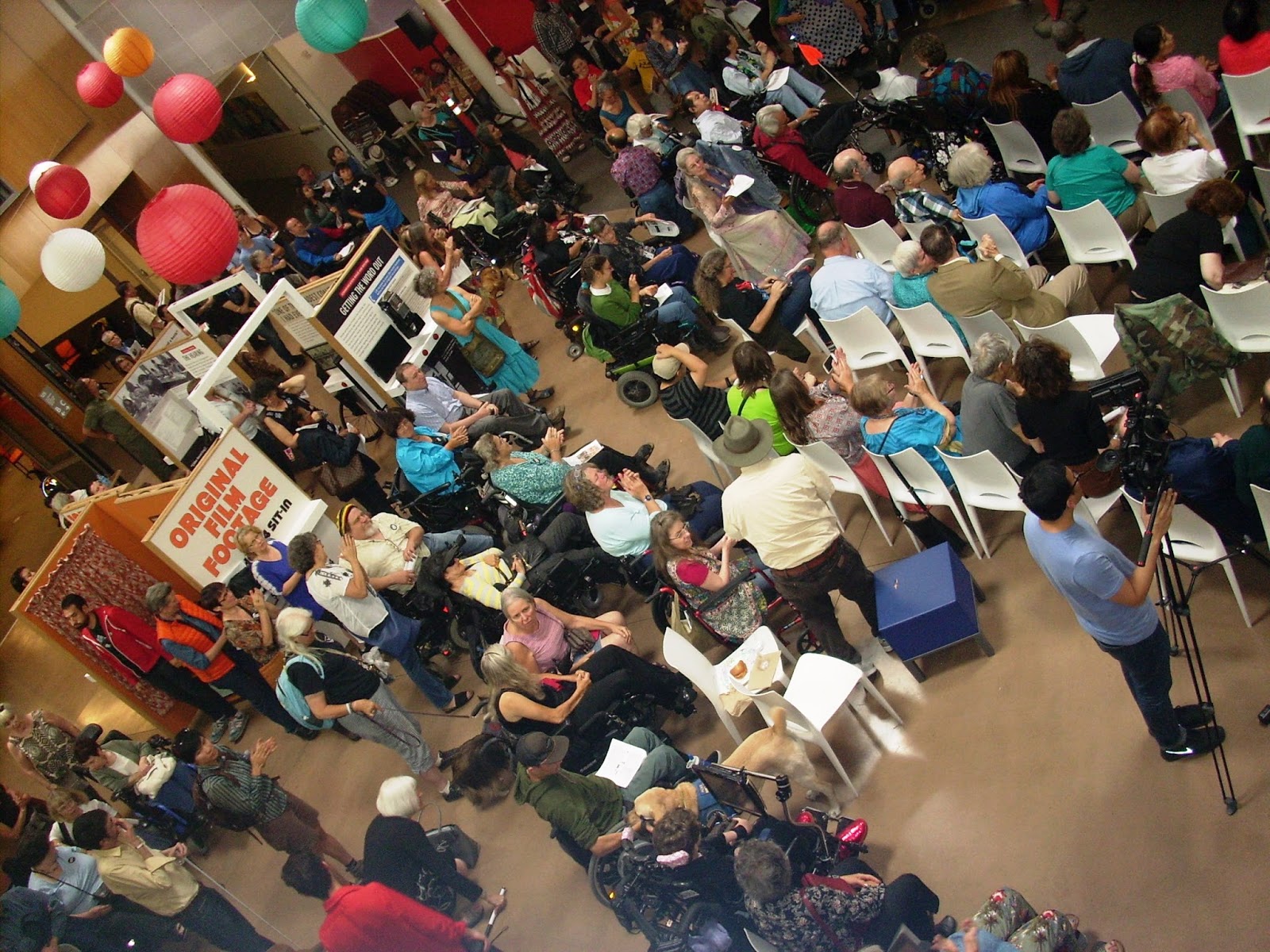
Ed Roberts Campus housed the equally accessible exhibit, Patient No More! People with Disabilities Securing Civil Rights, which held its grand opening on ADA’s 25th anniversary on July 26. 
Spiral ramp inside Ed Roberts Campus 
Quiet area outdoors to get away from sensory overload 
Disability Mural (2000-Present) is the first community artwork about the everyday experiences of living with a disability, created by people with and without disabilities. 
Mural tile reads: "One day many people will learn to sign, and we all be seeing voices...when all the world speaks with its hands!"
Room for improvement on one size fits all

Rosemarie Garland-Thomson has noted that disability is the body's response over time to its environment.  Temporarily abled people who acquire a disability later in life experience disability differently (like learning a foreign language later in life), than people who have a congenital disability and already have adapted to “fit in” the built environment or changed the inaccessible environment to accommodate their individual differences (latter often benefits our broader society).  People with a congenital disability do not experience loss over not being able to do “normal” activities because they never did, so this self-acceptance reframes “the problem is the solution.” 
  
Celebrating disability civil rights 
Cathy Kudlick, who developed Patient No More exhibit with her team at Longmore Institute, welcomed attendees at grand opening. 
Jeff Moyer, songwriter and 504 participant, led 504 protest song, Hold On:
        “Civil Rights were knocking at our door,
        But Carter wouldn’t stand on 504…
        After four years of delay,
        We came to claim the ground we’d gained…
        Well, for 28 days unafraid
        150 people with disabilities they stayed.
        They had their eye on the prize.  They held on.
        Hold on. Hold on.
        Keep our eyes on the prize. Hold on…”  
Dennis Billups, 504 Chief Morale Officer, led chant, “1-2-5-0-4. Kickin’ in the bathroom door …We’re rolling in victory now.” 
Interactive exhibit, with poster of Billups during 504 demonstration, invited visitors to respond, What makes you “patient no more”?  
Bruce Oka, 504 participant and former SFMTA Director, said he was "patient no more" because he was tired of being excluded, and talked about need to be included. 
Corbett O’Toole said she was "patient no more" because there are only two lawyers in the nation available to represent parents with disabilities losing custody of their children. 
Persons with disabilities nationwide occupied the regional offices of HEW in April 1977, but only San Francisco held out until April 28, 1977 when HEW Secretary finally signed regulations implementing Section 504. 
·      504 protests and ADA legislation grouped people with many different disabilities together, so there would be one big ADA instead of mini-ADAs for each impairment group
·      504 resulted in a national disability rights movement and national disability organizations that could promote and defend ADA
·      504 defined disability flexibly and took prejudice into account, so ADA could be about civil rights rather than medical diagnoses
Section 504 served as a template for the more comprehensive ADA passed in 1990, showing that disability rights could benefit many without adding a huge burden on society.  


disability = diversity


Invisible disabilities

At this month’s Mayor’s Disability Council meeting, attendees presented on “what ADA means to me” with several mentioning “invisible” disabilities (like learning differences and psychiatric disorders), how physical and mental disabilities influence another, and the financial impacts.  The majority of disabilities are non-apparent, and until ADA Amendments Act of 2008, the U.S. Supreme Court did not consider persons with diabetes and mental illness as disabled, and thus not entitled to protection against discrimination.  In fact, neuropsychiatric disorders represent the largest category of disability in the U.S. The landmark Olmstead case, in which the U.S. Supreme Court ruled that persons with disabilities must be enabled by states to live in the “most integrated setting appropriate” to their needs and that “unjustified isolation” is discrimination based on disability under Title II of ADA, involved persons with “invisible disabilities” (mental illness and developmental disabilities).
People With Disabilities Foundation (PWDF), a non-profit that aims to “provide total integration of people with mental disabilities into the whole of society,” hosted a delegation of disability advocates from 20 countries, at the invitation of U.S. Department of State’s International Visitor Leadership Program (IVLP), Access for All: Enhancing the Lives of People with Disabilities. Founded 15 years ago in San Francisco, PWDF won the nation’s first court case requiring a federal agency to accommodate the needs of persons with mental disabilities, who were denied equal access to Social Security disability programs, in violation of Section 504 of the Rehab Act of 1973, because they could not understand the complex eligibility rules. PWDF’s Parity in Advocacy initiative works to provide equal access to legal representation for those with mental disabilities (advocacy version of Mental Health Parity).

With the passage of ADA 25 years ago, the U.S. became the first country in the world to adopt national civil rights legislation banning discrimination against persons with disabilities.  ADA was the model for the Convention on the Rights of Persons with Disabilities (CRPD), which U.S. President Barack Obama signed in 2009, but its ratification voted down by the Senate.  

                                                                  
The 50th anniversary of Older Americans Act (OAA) on July 14 was a non-event in the Bay Area.  The decennial White House Conference on Aging (WHCoA) took place the day before with at least one watch party of the live stream in San Francisco.  Congress didn't fund WHCoA so its executive director Nora Super had to get non-government sponsors to help organize this event.  At least on July 16, the Senate passed the bill reauthorizing OAA, which expired 2011, and now goes to the House for consideration. 

I was not aware of any delegations visiting from other countries to learn about OAA as a model . . . 
Senior and Disability Action’s monthly meeting celebrated ADA rather than OAA.
Model garden at 30th Street Senior Center is a beautiful act of nature