For more than a year, I completed 470 assessments of mostly homebound older
people. Like being a bartender, my work
involved listening to people’s long life stories—except I met clients in their
homes and asked about their functional abilities, health conditions, home environment,
support systems, etc. Many clients told
me that they preferred their impaired physical mobility over “losing" their minds or developing dementia. One client
casually reported that she was taking Donezepil for dementia; but after I read
a letter (in plain view, posted on her bedroom wall) from her neurologist
stating that she scored 15/30 in MMSE and diagnosing her with moderate to severe Alzheimer’s disease, she became
visibly upset, clutching her head with both hands and repeatedly saying, “no, no,
no ...”
Anyone
with a brain is vulnerable to dementia, which remains the most expensive disease in America. Alzheimer’s is the most common form of
dementia,
affecting 1 in 10 people age 65+,
and the most feared disease in America.
Hundreds,
including yours truly, showed up at Jewish Community Center of San Francisco (JCCSF)
for its inaugural Brain Fitness Forum,
a full day scheduled with speakers and stimulating activities (coloring craze, growing herbs at home, tai chi, etc.).

In “Growing
and Managing Your Brain Health,” brain plasticity researcher Michael Merzenich,
PhD, shared this list of “vicissitudes across the life course” that add to brain
noise, making us vulnerable to dementia.
He advised that our brains need exercise to sustain high function and
boost our cognitive reserve.

Lunch
break performance by Community
Music Center 30th Street
 JCCSF
Adult Programs Manager Shiva Schulz introduced neuroscientist Robert F.
Halliwell, PhD, who provided tips on “How to Maintain a Healthy Brain without
Really Trying”:
JCCSF
Adult Programs Manager Shiva Schulz introduced neuroscientist Robert F.
Halliwell, PhD, who provided tips on “How to Maintain a Healthy Brain without
Really Trying”:

- good night’s sleep
- reading
- avoid stress
- enjoy healthy diet including
chocolate!
The Forum
ended with a screening of the documentary, My Love Affair with the Brain: The Life and Science of Dr. Marian Diamond. Better than Wonder Woman, Dr. Diamond is
known for her pioneering research on how brain development can be stimulated by
an enriched environment:
- diet
- exercise
- challenge
- newness
- love

With fellow neuroanatomist Arnold Scheibel (her
husband died in April), Dr. Diamond co-authored, The Human Brain Coloring Book (1985). The documentary showed Dr. Diamond teaching neuroanatomy
at UC Berkeley, using the old school way of handwriting on blackboard as she explained that learning is kinesthetic so we better absorb information when using pen/pencil to paper. The Forum included kinesthetic Coloring Craze session by Martha
Russell, who provided colored pencils, coloring pages (download free mini
coloring book at National Coloring Book Day) and
research on the cognitive benefits of coloring (which works like mindfulness to
calm and stimulate the brain).
Stimulated
to learn more about Dr. Diamond, I checked out Magic Trees of
the Mind: How to Nurture Your Child's Intelligence, Creativity, and Healthy
Emotions from Birth Through Adolescence (1999), which is actually intended to inspire all age groups for a lifetime of learning, as Dr.
Diamond and co-author Janet Hopson wrote in “Introduction – Experience is the Best
Sculptor”:


“Fully
two-thirds of American adults have sedentary lifestyles; and the majority have
high-fat, high-calorie diets; seldom read or create things for pleasure; and
watch television for hours every day. It would be surprising, then, if the
average child had a regimen any different. If our book has the kind of positive
effect we envision, it will inspire a new level of mental and physical activity
in all age groups.
It doesn’t take money to create a climate for enchanted minds to grow. It just takes information, imagination, motivation, and effort. Once the habit of active involvement is entrained, experience will take over and those stimulated minds will do the rest for themselves in surprising and delightful ways.”
It doesn’t take money to create a climate for enchanted minds to grow. It just takes information, imagination, motivation, and effort. Once the habit of active involvement is entrained, experience will take over and those stimulated minds will do the rest for themselves in surprising and delightful ways.”
I thought about putting Dr. Diamond’s
research on enriched environments into practice in my own life, including work
with clients.
Diet
The Mediterranean and MIND (Mediterranean-DASH Intervention
for Neurodegenerative Delay) diets were recommended “Brain Food,”
in the June/July
2017 issue of Neurology Now. Both
focus on eating plants (whole grains, nuts, legumes, fruits, vegetables), fish,
monounsaturated fats (olive oil), red wine in moderation. MIND diet focuses on 10 brain healthy food groups (green leafy vegetables, other
vegetables, nuts, berries, beans, whole grains, fish, poultry, olive oil, wine)
and restricts red meats, butter/margarine, cheese, pastries/sweets, fried/fast
food. Home-delivered meals often do not include nuts,
which should be soaked for proper digestion.

Hot lunch delivered by On Lok (funded by Medicare +
Medicaid) to homebound client, who also received home-delivered meals from
Meals on Wheels (suggested donation $5 for 2 subsidized meals) and The Salvation
Army Meals that Heal (suggested donation $20 per month for weekday hot meals).
This client also received CalFresh, or federally
known as Supplemental Nutrition Assistance Program (SNAP), which may be used to
purchase nuts (if one does not have nut allergy) that are recommended “brain food.” In early 2018, SNAP is launching a pilot
program to allow recipients to buy food online from retailers like Amazon. One wonders if this month’s Amazon-Whole Foods deal means better access to organic foods?
Some clients, who reside in Tenderloin SROs without
access to kitchens, told me they never received proper nutrition until they
became seniors eligible for elderly nutrition programs. However, a lifetime of poor nutrition (see Chin Jou’s Supersizing Urban America: How Inner Cities Got Fast Food with Government Help) contributed to chronic
conditions (osteoarthritis,
COPD,
obesity,
urinary incontinence,
shortness of breath)
that limit their mobility,
so they have difficulty getting to senior
congregate meal sites where they could also benefit from social support instead
of isolation. Some chronic conditions also make
chewing/swallowing food or feeding oneself difficult.

Even when this SRO building elevator is
operational, my frail clients cannot safely open the heavy cage door, so they
rely on home-deliveries of food. While
physical frailty is associated with cognitive impairment and dementia,
researchers at National University of Singapore found that a combination of
good nutrition, physical training and mental exercise can reverse frailty in elderly.
Exercise
Not
everyone aspires to be like Charles Eugster, who took up bodybuilding for 10 years until his death at age 97 this year. According to neuroscientist Agnieszka Burzynska, activities involving moving
and socializing might improve mental abilities in aging brains.

In
commemoration of its 10th anniversary, Hope Mohr Dance collaborated
with Shaping SF to produce Precarious: Labor History Walking Tour --awesome community engagement for all ages that provided outdoor walking
exercise, singing, learning labor history and advocacy! Starting at Edwin
Klockars Blacksmithing (built 1912, to support railroad, bridge and ship
building through the 1950s) in South of Market area, we received lyric sheets
and joined sing-along with Community
Music Center’s Aquatic Park Senior Choir, led by Beth Wilmurt and Josh
Pollock playing guitar to Bob Dylan’s “The Times They Are A-Changing.”


Rest stop to hear Shaping SF co-director Chris Carlsson
talk about Douglas Tilden’s Mechanics’ Monument,
which survived 1906 earthquake, and 1907 San Francisco

Market
Street Trolley stopped, but too full to board, so we remained at the stop and
sang “Trolley Song” to the amusement of passengers…
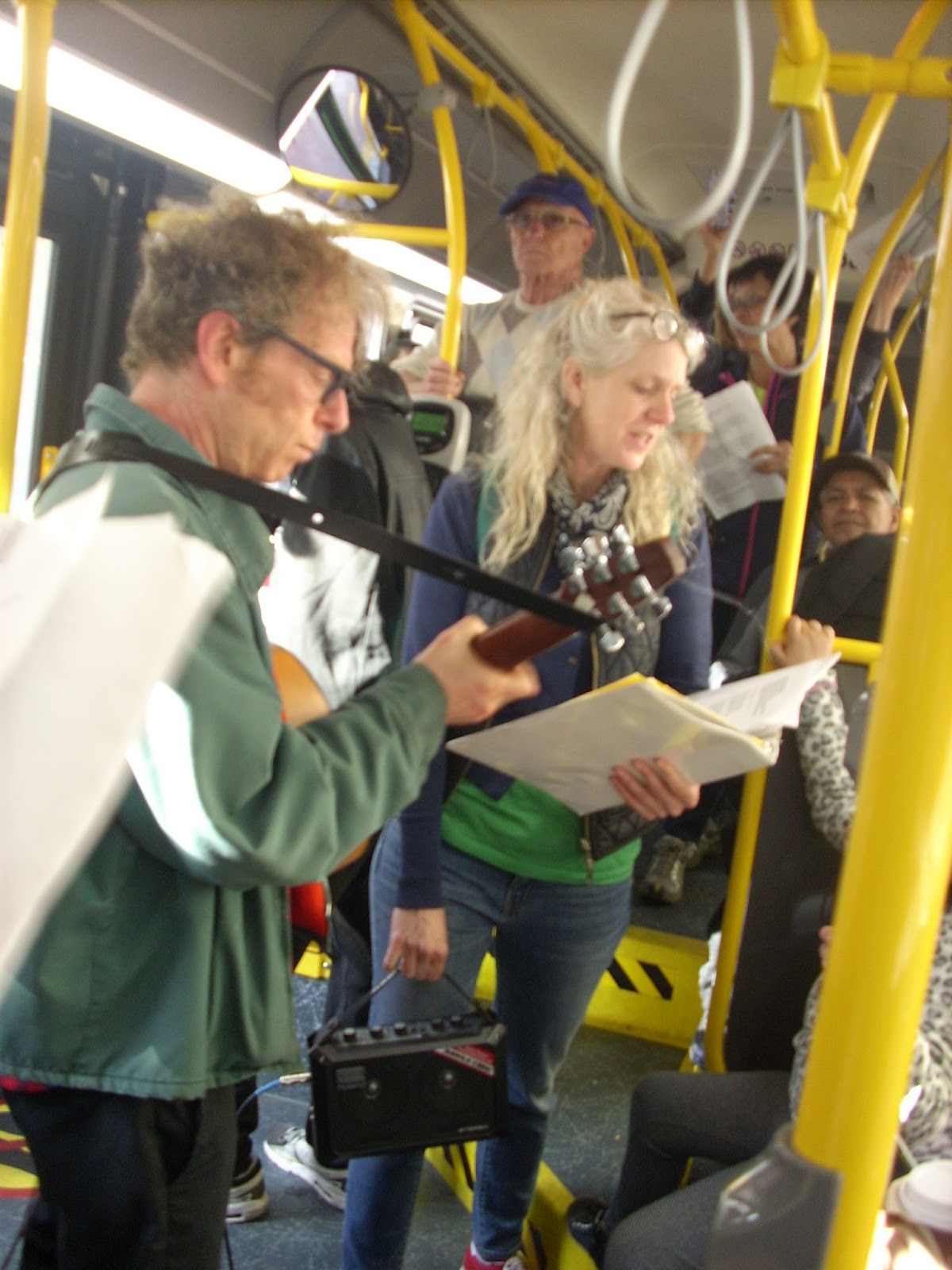
hopped on
next Muni bus and sang “Trolley Song” again.

Finale with
Pete Seeger’s “Tomorrow is a Highway.”
Challenge
Every new
challenge presents an opportunity to think and do something: adapt (“Making Solitude out of Loneliness” ),
advocate (“Challenges of Being an Advocate”),
innovate (“I Remember Better When I Paint”),
persist in hope (“Breaking Out of Locked In Syndrome”),
etc. For example, I suggest that clients,
recently diagnosed with some form of dementia, document their advance care
directive, life history,
favorite music and activities. This documentation will serve
as a foundation for person-centered care to guide future caregivers with a
better understanding of who they are and how to engage them when they lose
capacity to verbally express themselves.

At this
month’s SF Bay Area Network for End-Of-Life Care meeting, Professor Nate Hinerman (who taught Death and Dying course at SFSU) introduced Isabel
Yuriko Stenzel Byrnes, Mission Hospice bereavement social worker who leads
writing groups for those who are grieving.
Isabel and her identical twin sister Anabel published their memoir, The
Power of Two: A Twin Triumph over
Cystic Fibrosis (2007), which was made into a documentary film (2011) focused on advocacy for organ donations after learning that their double
lung transplants would have been more challenging in their mother’s native
country Japan for legal (brain death requirement) and cultural (Buddhist belief not to divide body after death)
reasons. In 2014, Isabel delivered a moving TED talk, “The Art of Saying Goodbye” on the challenge of coping with Anabel's death.

Housing in
San Francisco

Western
Addition resident and activist Wade Woods introduced excerpts from documentary,
Redevelopment: A Marxist Analysis,
showing how redevelopment in the 1960s displaced African-Americans in the once vibrant Fillmore,
and talked about need for more affordable housing. With its transition zone microclimate, flat surface
friendly to walkers and wheelchair users, proximity to retail and access to
several Muni bus lines, Western Addition remains a desirable neighborhood for
older people.

Iris
Canada’s niece, Iris Merriouns, said her late aunt’s body remains in a morgue
since her death three months ago, because Canada
1. buying a building
2. eviction threats & harassment
3. short-term rentals
4. luxury development

Tommi Avicolla Mecca, Director
of Counseling Programs at Housing Rights Committee of SF, recommended education
about tenant rights and
community organizing.
 SDA Housing Organizer Tony Robles reinforced our learning by asking us to write our takeaways on post-it notes to "Stick It to the Speculator" poster.

Newness
In direct
service work with older people, the best part of the job is listening so I am
always learning something new. As people
age, they become more different, present multiple comorbidities, and often
share their life lessons. As geriatricians say, “If you’ve seen one 80-year-old, then you’ve seen one 80-year-old.” With clients who have cognitive
impairment, interactions are often like improvisation!
Love

This is not puppy love, but senior dog love at Muttville Senior Dog Rescue, which is dedicated to improving the lives of senior dogs through rescue, foster, adoption and hospice.

Muttville’s Seniors for Seniors Program offers free senior dog companions for senior humans age 62+: perfect
match for shut-in clients!

Senior
dogs for adoption are often described as shy, sweet and mellow.

Some
shut-in clients have told me they avoid human interaction, but bond better with
animals, especially dogs who provide unconditional love to reduce anxiety, depression and social isolation. Some studies indicate that people with
dementia who received dog therapy improved cognition, as measured by MMSE.