Showing posts with label San Francisco Department of Aging and Adult Services. Show all posts

Sunday, September 30, 2018

Wellness

Due to my work with mostly homebound older adults over the past three years, I have been missing-in-action from many community events.  Last Friday afternoon, I caught up with former colleagues when I returned to campus for Department of Aging & Adult Services (DAAS) Community Training and San Francisco State University (SFSU) Gerontology Program’s inaugural Silver Lining Lecture Series: Aging, Health & Wellness in San Francisco.  When people ask where have I been “hiding”, I respond that I’ve been working with older adults in facilities.
fa·cil·i·ty (fə-sĭl′ĭ-tē)
n. pl. fa·cil·i·ties
2. often facilities
a. A building, room, array of equipment, or a number of such things, designed to serve a 
particular function: hospitals and other health care facilities.
b. Something that facilitates an action or process: The region has very poor transportation
facilities.
3. facilities Informal A restroom or public toilet.
facility. (n.d.) American Heritage® Dictionary of the English Language, Fifth Edition.(2011). Retrieved September 30 2018 from https://www.thefreedictionary.com/facility

My response was a surprise to some who knew me as a gerontology student, focused on home- and community-based services to facilitate aging in place.  But as a gerontologist three years after graduation, I decided to be intentional in gaining experience at every level in the continuum of care which includes facilities, such as Residential Care Facilities for the Elderly (RCFE, aka Assisted Living) and Skilled Nursing Facilities (SNF).  I have avoided working at for-profit facilities because resident care means more than profits (though I was fine working at for-profit accounting and financial organizations prior to launching my gerontology career).  Also, I have observed how residents with complex medical needs are underserved at RCFEs, and ought to receive more appropriate care at SNF.  In any case, I have remained focused on health promotion and wellness throughout the continuum of care. 
SFSU Gerontology Program Coordinator Darlene Yee-Melichar and San Francisco Aging & Adult Services Commission Advisory Council President Leon Schmidt welcomed attendees in Library Special Events Room filled to capacity.  (Took photos from front row, where I was seated next to fellow SFSU Gerontology alumna and solo ager Betty Burr.)
Keynote speaker Scott Wiener, State Senator, discussed his Legislative Agenda for Seniors in the SF Bay Area: his authoring of SB 219 LGBT Bill of Rights in Long-Term Care (LTC) and SB 2021 Extending Prescription Drug Co-Pay Limits; ongoing efforts to ensure all seniors have access to housing, nutrition and health care; livable wage for IHSS workers so seniors can age in home; and “if they’re in assisted living or nursing home (facilities), make it a positive experience.” He also commended 30th Street Senior Center for its meals and supportive services so seniors are not isolated. 
SFSU Gerontology Advisory Council President and alumnus Tom Berry, with Openhouse co-founder Marcy Adelman and Darlene Yee-Melichar, presented Distinguished LTC Advocate Award to Senator Wiener.
 
Close-up of LTC Advocate Award 
30th Street Senior Center Director Valorie Villela and Beth Macleod, LCSW.
SFSU Gerontology alumna and Eldercare Advocacy Bay Area Founder Cristina Flores with her mother and daughter – three generations, though they appear to be from the same generation?! 
Professor Yee presented Developing Gerontology Workforce Competency to Promote Healthy Aging & LTC.  She predicted growth in nursing home care because demand will drive supply, as baby boomers age into the oldest-old (age 85+) with higher level of care needs in the next 10 to 20 years.  Graduate gerontology students can complete 480 hour internship as SNF Administrator-In-Training (AIT); without a master’s degree, the state requires completion of 1,000 hours SNF AIT. 
DAAS Program Analyst and urban planner Valerie Coleman presented Age & Disability Friendly SF, noting San Francisco is unique in including “Disability” to Age-friendly initiative that began implementation this year.
Hey, that’s my photo of Dance Generators (with Beth Macleod) performance at 2015 Party with a Purpose celebration of Long-Term Care Coordinating Council's 10th Anniversary, from blog post at http://geronature.blogspot.com/2015/10/aging-disability-friendly-san-francisco.html! 
Gwen Harris, SFSU Gerontology alumna and Geriatric Care Manager, presented on Palliative Care & Quality of Life.  She recommended that every 18 year old should be given voter registration and Advance Care Directive. 
At this month’s SF End-of-Life Network meeting held at Cypress Golden Gate (RCFE), Art for Recovery Program Director Cindy Perlis discussed her 30 years of art therapy with cancer patients at UCSF. 
Eat a rainbow of colorful doughnuts for breakfast at Pathways to Improved Care: Rehabilitation Symposium at Laguna Honda!  
Paul Christopher Focht, Aud.D., presented The Diagnosis and Treatment of Hearing Impairment.  He conducts otoscopic inspection of the ear canal for cerumen (aka “earwax”) buildup that can cause problems with hearing and balance, which increase risks for cognitive decline and falling.  When we age, cerumen impaction is more common because the cerumen is much drier so it gets hard and creates a plug.  As many as two-thirds of residents in LTC facilities may suffer from cerumen impaction, and Medicare covered nearly 1.7 million impaction removal procedures at a cost of more than $51 million in 2016! 

Older Americans (age 65+) continue to make themselves heard during elections.  In 2016, their turnout rate was 70.9%, the highest of any age group.  The majority (51%) voted for Trump, with the strongest support from older white men (59%) and older white women (53%). 
Ian Haney Lopez, UC Berkeley Law Professor and author of Dog Whistle Politics: How Coded Racial Appeals Have Reinvented Racism & Wrecked the Middle Class (2014), talked about The Future of Whiteness at Rights and Wrongs: A Constitution Day Conference at SFSU.  He presented a crash course on how political strategists have exploited racial pandering to build resentment toward government, manipulating voters into supporting policies that favor the wealthy.  Starting with the 1964 Southern Strategy, they could appeal to rising anxiety/fear among whites to break the New Deal coalition, bringing race into politics—not in name, but “code” such as law and order, state’s rights, Silent Majority, Real American, end welfare as we know it, etc.  
Similar to Reframing Aging, Ian seeks to reframe the Race-Class Narrative for cross-racial solidarity and shared prosperity.  High levels of inequality negatively affect even the affluent, possibly because inequality reduces social cohesion so everyone suffers.
Check out video, “We Must Talk About Race to Fix Economic Inequality.”  
Cal State University (CSU):"As the CSU got darker, funding got lighter"
When I invited Marc Dollinger, SFSU Richard and Rhoda Goldman Chair of Jewish Studies and Social Responsibility, to speak at a RCFE about his new book Black Power, Jewish Politics: Reinventing the Alliance in the 1960s, he cautioned that he sometimes found that “older crowds are not as excited or engaged” with his presentation because “it could represent a revision of their own memory,” and offered a less risky topic based on his three other books.  My response was bring it on! with excitement that Marc’s new book presented a challenging perspective that would take us out of our comfort zone and stimulate brain connectivity! We learned new vocabulary, filiopietistic (ethnic self-congratulations, like aren’t Jews great?) historiographic analysis (the interpretation of the writing of history over time).

Friday, August 31, 2018

Reframing aging

During last month’s American Society on Aging (ASA) webinar, Reframing Aging: Organizational Adoption & Integration in San Francisco, San Francisco Department of Aging and Adult Services (DAAS) Executive Director Shireen McSpadden discussed the catalyst for San Francisco’s Reframing Aging Initiative coming from:
·       growing older population (1 in 5 San Francisco residents is an older adult, and this will grow to 1 in 4 by 2030),
·       population parity (Dignity Fund for seniors and adults with disabilities, similar to Children and Youth Fund),
·       interest from foundation partners (Metta Fund), and
·       needs assessment findings that highlight need to improve awareness and understanding of services, and to mitigate ageism and ableism as barriers for older adults (who desire to be seen; feel safer and connected to community; safety and access to mobility in public transit and streets; respect need for accommodation).
Shireen talked about reframing aging as a challenge to ageism: reducing avoidance of aging due to fear, stigma and lack of knowledge; ensuring systems for engagement, inclusion and support as people age—instead of leaving people to figure things out on their own until there is a crisis.  She also mentioned Vision 2025: Sustainable Aging Services, which has the tagline, “Aging is All About Living,” adopted by California Area Agencies on Aging (C4A).
Shireen said DAAS is engaging service providers (more than 60 community-based organizations, including Self-Help for the Elderly whose CEO Anni Chung briefly presented during webinar) to develop buy-in and gain insight so all voices are heard. She talked about next steps to operationalize this initiative: form small working group of stakeholders, hire project manager to lead group process, implement outreach and train 380 department staff.  She concluded with this performance measurement list: creation of handbook, consistent language across DAAS programs and materials (acknowledging her use of “older adult” instead of “older person” word choice recommended by FrameWorks Institute), launch of citywide campaigns, biennial city survey, and media coverage of aging-related issues. 
This month’s follow-up ASA webinar, A Deeper Exploration of Research-Based Messaging Strategies for the Field of Aging, by FrameWork’s Reframing Aging Master Trainers framed aging, partly through a social work lens:
·       emphasize values of social justice and collective responsibility (e.g. “ageism leads to social injustice and unequal treatment or exclusion”) to tap emotions like curiosity, concern and can-do for policy thinking;
·       explain aging in person-in-environment context that shapes decisions and outcomes; and
·       ageism as problem can be solved (interventions in systems and supports can change outcomes).
This training included viewing a short video, The Student, from USC Annenberg Norman Lear Center’s Hollywood, Health and Society Program.  It showed a day in the life of an unseen, age-unknown person behind the camera who is on campus with younger students during the day, shopping for food and then sharing mealtime with older adults.  It ended with the words “Life is Ageless" and Rethink Aging.  While one trainer liked it (because "surprising that older Asian woman was on other side of camera"), I didn't really care for the age-segregation.  Perhaps the video should have been shot at San Francisco State University, where classes are filled with students of all ages.
  
Anyway, Reframing Aging training concluded “frailty is not the whole story…” with suggestions to “avoid discussing or showing older people as ‘vulnerable’” and place greater emphasis on the “more positive story of aging, too.”  After all, framing is about choosing how information is presented, including "what to leave unsaid" based on "what will that story do?" (Assisted living marketers rarely show images of residents using walkers and wheelchairs.)
Yet for the past three years, I have worked primarily with older adults who are frail, mostly homebound in private homes and assisted living, and they sometimes cycle in and out of hospitals, with limited opportunities to be seen and heard by the public.  As a gerontologist who advocates for community living opportunities, I think it’s important to spend time with older adults who are less visible in the continuum of care to avoid the perception of us versus them (aka "the other"). 

As a former Meals on Wheels San Francisco (MOWSF) social worker, I met so many interesting clients that I often referred them to our Marketing and Communications Director to profile.  Many oldest-old (age 85+) clients who outlived savings and peers were living in poverty and isolation, which would make any human vulnerable—at any age, so no shame in "discussing or showing older people as 'vulnerable.'" (Social workers are expected in help people in need, especially vulnerable and oppressed people; also, Older Americans Act programs are intended to protect "vulnerable elders" and target older adults with the greatest economic or social need.)  MOWSF presents these compelling facts about its homebound senior clients (aka "older people" by FrameWorks), which are important to understand why we need to support its mission to provide “a network of services that allow seniors to live in their homes with dignity and independence as long as possible”: 
·       75% of MOWSF seniors live below the Federal Poverty Level ($970/month)
·       67% of MOWSF seniors live alone (many are “elder orphans”)
MOWSF’s Friendly Visitor Program has an awesome video, “Need to spice up your friend demographics?” showing a cool homebound senior Violet playing the ukulele while describing her likes and interests, and appropriately, the song “Fast Friends” by Rocketship Park plays. 

Another awesome example is Flossie Lewis, who earned her PhD at age 73 after retiring as a high school English teacher, and resides with dignity in a retirement facility in Oakland (after a young friend playfully pushed and caused Flossie to fall at age 80).
Yes! Since Flossie Lewis appeared on PBS Newshour two years ago at age 91, her Brief but Spectacular take on growing old went viral with more than seven million views! I became an instant fan because Flossie was the real deal, telling us how “getting old is a state of mind”:
·       Perceived “real” (deficits): accepting the body is going to go (“there is indigestion and your teeth fall out and suddenly you need hearing aids”)
·       Ideal (strengths): but the personality and character doesn’t have to go (“You pick yourself up and you say, ‘I’m going to get through it because I have a reason to get through it’”)
·       Opportunities to keep stimulated: taking walks outdoors with her walker or wheelchair, writing for publication, watching politics
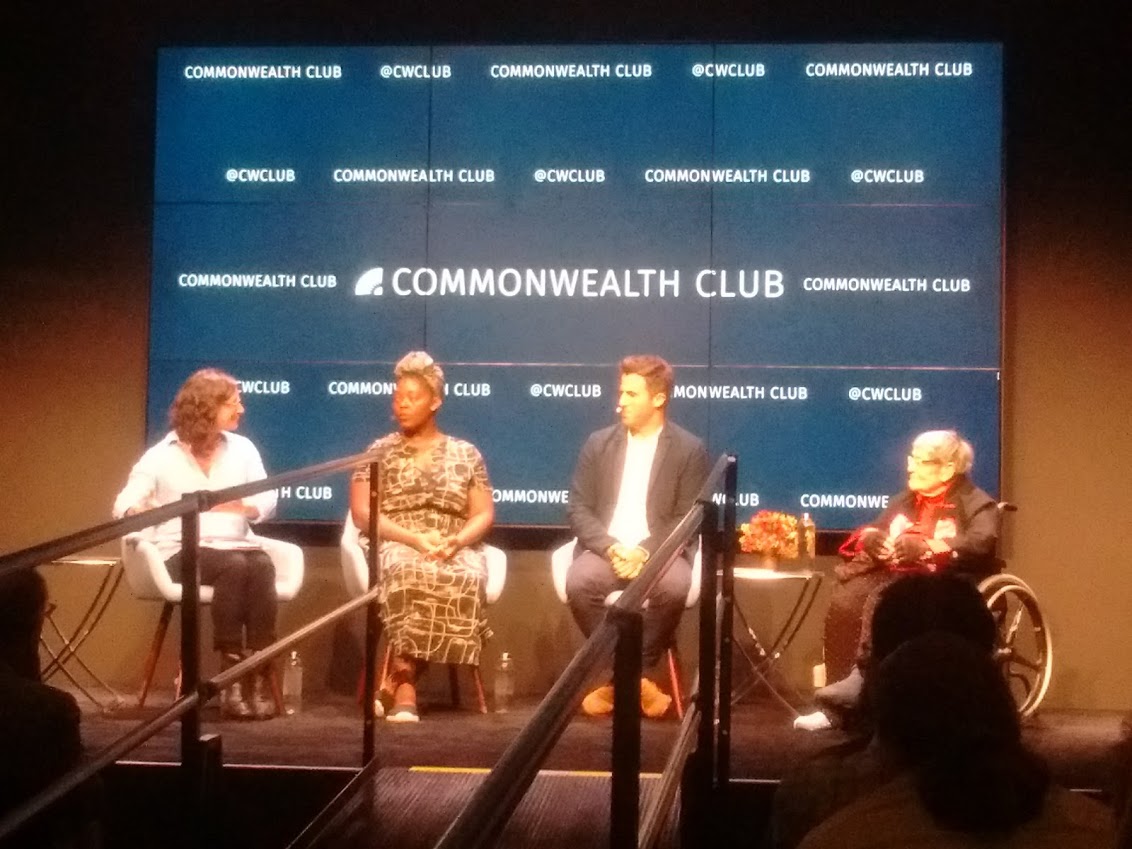
Over a hundred people, including yours truly who sat among Flossie's former Lowell High School students, turned out at the Commonwealth Club for Brief but Spectacular Stories, which kicked off with a 10-minute documentary screening of “Flossie Lewis: Back in the Classroom!” Afterwards, 94-year-old Flossie took the stage with Brief but Spectacular producer Steve Goldbloom and poet Mahogany Browne for a conversation with Inflection Point radio host Lauren Schiller. 

In this social media age of curated personalities, Steve searches for authenticity and found Flossie to be “an original force of nature.”  Flossie was critical of Twitter, not because of the President’s use of it but accepting it as a form of composition is moving toward “duckspeak” in 1984. (In contrast, much younger Mahogany has used Twitter as a writing prompt and published her collection of tweets in #Dear Twitter: Love Letters Hashed Out Online in 140 Characters or Less.) 
When Lauren asked, “How do you prioritize time, decide what to do each day with time left?” Flossie replied, “if you live in a retirement community, there are activities. You can participate, or you can sit; and if you sit, invariably you will fall asleep.” Then she talked about her participation in a poetry group.

 “We have to rethink what we value because so much of our life has reached fruition;...Now we have to find meaning in places we might not have bothered about when we were younger and half of a couple: solitude, friendship, bird and animal watching, and a closer following of music, painting, and theatre. This replacement alone can be a soul-wrenching shift that forces us to ask ourselves: What matters now?
…As with other old people, after I’ve finished the necessary examination of my life (knowing that living in the past is a trap), of death itself, and of my limited future, which will probably not be glorious, I have found myself quite inadvertently savouring the moment and focusing on it not as part of the spiritual and therapeutic practice known as “mindfulness” but as a natural development in and of the state of being old. It is through this attention to the moment that true joy in the wonders of being alive in the world, so rare otherwise in adulthood, finally comes.”
--Sharon Butala, “Against Ageism: It’s time to stop treating senior citizens as a burden,” The Walrus (April 6, 2018)